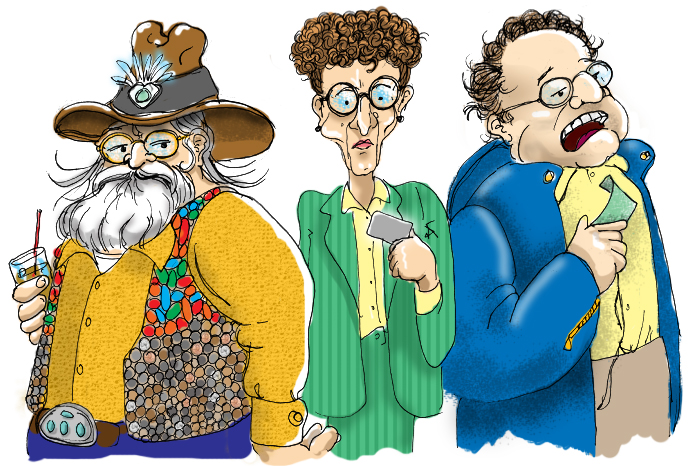
IF: stripes

This week’s Ilustration Friday‘s challenge word is “stripes”.
you may think that this is the end... well it is.
John Philip Sousa composed 136 marches in his lifetime. Sousa, the leader of the United States Marine Band, composed one of his most famous on Christmas Day 1896, as a tribute to his friend David Blakely, the manager of the Sousa Band, who had recently passed away. The rousing composition was “The Stars and Stripes Forever March”. In 1987, an Act of Congress proclaimed the piece as the National March of the United States.

Sousa wrote six verses of lyrics, heavy with heart-stirring patriotic imagery, to accompany his piece. Sousa’s words are almost never sung and are scarcely even known. Instead, most Americans know an alternate set that they are sure are the actual lyrics. You know the ones I’m talking about. The ones that open with “Be kind to your web-footed friends…” Thanks to one Mitch Miller, those words are forever linked to Sousa’s triumphant and lively tribute to his friend and his country.

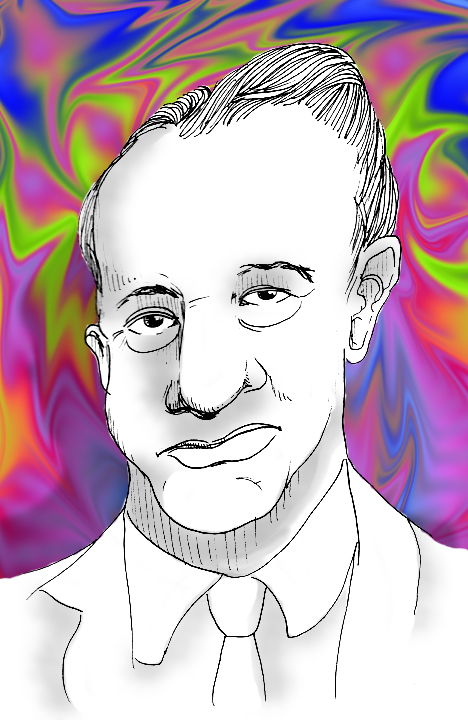
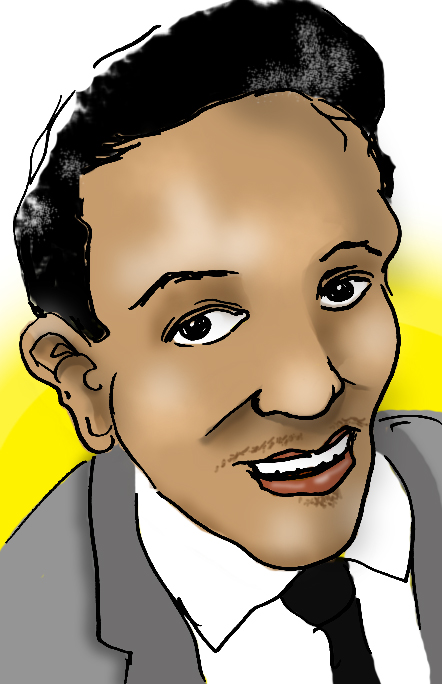
Mitch was a musician, composer, producer and conductor. He orchestrated the music for Orson Welles‘ infamous War of the Worlds  broadcast in 1938. In the 40s, he was hired as a A&R man at Mercury Records, where he was instrumental in directing the careers of Patti Page, Frankie Laine, Johnny Mathis, Doris Day, Dinah Shore and many others. Mitch pushed his affinity for novelty tunes on the likes of Frank Sinatra, Tony Bennett and Rosemary Clooney, almost ruining their careers. In the 50s, he joined Columbia Records in the same capacity. There, he signed Aretha Franklin to a contract, but she soon left to join Ahmet Ertegun at Atlantic Records. She accused Miller of hampering her creativity. Miller famously passed on two performers based purely on his blatant hatred for rock and roll. Those two singers, Elvis Presley and Buddy Holly, signed on to competing labels.

In the 60s, Mitch Miller had one of the most popular shows on television, Sing Along with Mitch.  For an hour every week, American families tuned in to watch Miller lead a male chorale and several soloists (including Leslie Uggams and future Sesame Street  staple Bob McGrath). Mom, Dad, Grandma and the kids would cheerfully sing back at their television, while “following the bouncing ball” across the song lyrics on the bottom of the screen. Miller presented favorites like “I’ve Got a Lovely Bunch of Coconuts”, “Yellow Rose of Texas” and “When You’re Smiling”. He would end every show by leading the cast (and the home viewers) in a recitation of the silly “web-footed friends” lyrics set to the tune of Sousa’s majestic march, thus permanently altering America’s perception of the patriotic song.

Thanks Mitch. Thanks for everything.

Comments

comments

from my sketchbook: suzan ball

Do what you wanna do/Hey, baby, do what you can
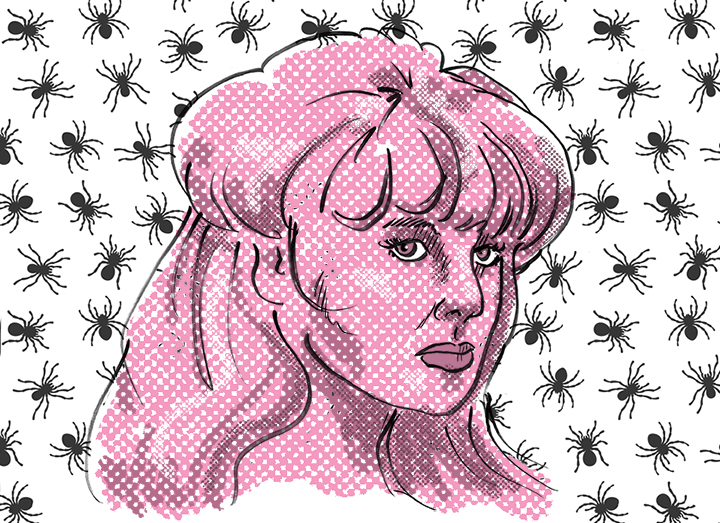
Who knows what Suzan Ball’s career could have been?

At 13, young Suzan Ball moved from Jamestown, New York to Hollywood to a home near Universal-International Pictures (a division of Universal formed from a merger to distribute lower budget films and British imports). Suzan, second cousin to comedienne Lucille Ball, landed her first acting job at 17 playing a harem girl in Aladdin and His Lamp  for Monogram Pictures. Mary Castle, a popular actress in the late 40s, took a liking to Suzan and got her an interview at Universal-International. Suzan signed a contract and was immediately cast in Untamed Frontier and began an affair with her leading man Scott Brady (the younger brother of actor Lawrence Tierney). A year later she began an affair with married actor Anthony Quinn, with whom she was starring in City Beneath the Sea.

One afternoon, at the Universal Studios commissary, she met actor Richard Long and it was love at first sight. The two were inseparable and, by the end of 1953, they were engaged. During the filming of her next picture, War Arrow,  Suzan experienced fatigue in her leg. A doctor’s examination revealed a malignant tumor. Soon, an operation was scheduled to remove the tumor.

Just prior to surgery, Suzan was in her apartment and slipped on some spilled water and broke her leg. She was rushed to the hospital. The tumor removal was unsuccessful and it was determined that Suzan’s leg needed to be amputated. She received attentive post-operative care and, now fitted with a new artificial leg, married Richard Long in April 1954. After the wedding, Suzan went right back to work. She was cast in Chief Crazy Horse.  Director George Sherman campaigned for her in the role of “Black Shawl” over the studio’s choice – Susan Cabot. While rehearsing her next project, a television drama, Suzan collapsed on the set. She was taken to the hospital and doctors discovered that the cancer had spread to her lungs.

Prognosis was not good and heavy medication altered Suzan’s personality drastically. Dealing with anxiety and pressure of the situation, Richard began an affair with Suzan’s nurse. In August 1955, just six months after her 21st birthday, Suzan passed away. Her last words – “Tony”- a reference to her relationship with Anthony Quinn, dealt a major blow to Richard Long’s already fragile emotions.

Comments

comments

from my sketchbook: great for lunch

make it blue! make it pink!

I have ranted… I mean, related  many anecdotes from my nearly thirty years as a professional artist. There’s one story that I have told numerous times, but have never put into print… until now.

I was employed for almost five years in the advertising department at the main headquarters of a major after-market auto parts retailer whose mascots are three big-headed Jewish guys, one of whom used to smoke cigars…. y’know the company of which I speak? Well, I worked with a group of other artists in a large, moldy, poorly-ventilated studio. We were a happy (and mostly) fraternal group. We were expected to be human machines, cranking out various versions of full-color weekly advertising circulars at unrealistic breakneck speed. The ads, which were essentially the same each week with the same three hundred products rearranged, were tedious, time-consuming projects. High importance was placed on accuracy and alacrity. Compensation was minimal in comparison to expected output. Our decisions were constantly undermined by the advertising executive committee who — as they say — didn’t know shit from shinola. But, we were production artists and we were used to it.

One day, one of my co-workers had his lunch resting at the top of his desk, waiting for the noon hour to roll around. His choice for his afternoon repast was a selection from the Betty Crocker “Bowl Appetit” line of microwave meals. This was a relatively new product (at the time) and several of us artists were admiring the package design. The disposable plastic bowl was slipped into a cardboard sleeve. The front of the package — the side that would entice the customer when placed on a shelf — was split across the middle. The top half bore the familiar “Betty Crocker” logo and the words “Bowl Appetit” in big, friendly, italic letters. The bottom half featured a full-color photo of the freshly-prepared product; glistening noodles, velvety sauce, flecks of vegetables and just the slightest suggestion of steam. The two halves of the design were bisected by a rippled block of color with the specific flavor of the meal written out in the same, friendly type as the product name. The back side of the package depicted other available flavors (Fettuccine Alfredo, Three-Cheese Rotini, some chicken something-or-other) and a small sample of each one’s packaging, all immediately identifiable as part of the same product line.

Turning the package over again to the front, we saw something that caught our attention almost simultaneously. At the top, near the “B” in “Bowl” was a large, gaudy, blue banner trimmed in yellow. Within the banner, the proclamation “Great For Lunch” was emblazoned in searchlight yellow, in a typeface not used anywhere else on the package. It was blatantly out of place and downright ugly.  After some discussion, we artists theorized as to how this blemish made its way on to an otherwise well-designed, cohesive package.

We surmised that the creative packaging team at Betty Crocker were given the task to come up with an innovative design for a new product line. The group — layout artists, designers, computer graphics experts — all worked diligently. After several weeks and hundreds of designs, they emerged with a series of layouts and several prototypes. Each package was brilliant in its stand alone qualities as well as working as part of a series. Proudly, they made their presentation to the executive board in charge of research, development and some such bullshit. Suddenly, some out-of-touch, pencil-pushing, number-crunching dickhead stood up and questioned, “How will the consumer know you can eat this for lunch? It doesn’t say it anywhere! They may eat it for dinner or breakfast, but how will they know this would be good for lunch?” The other board members conferred, as this asshole looked at the artists and smiled smugly. Immediately, the design team was instructed to add the aforementioned, offending banner with the additional demand to “make sure it’s big”. The design team worked long hours to incorporate the new directive into their beautiful design.

And that clueless fuck went home and told his family, “I did package design today”.

Comments

comments

from my sketchbook: viv stanshall

Roy Rogers on Trigger

Viv Stanshall hated being referred to as “eccentric”. He felt it suggested that he was putting on an act. He wasn’t. When he and band-mate Neil Innes first met, Viv was wearing checked pants, a Victorian frock coat, purple glasses, pink rubber ears and was carrying a euphonium.

The Bonzo Dog Doo-Dah Band (originally “Dada” Band, as an homage to the Dada art movement) was formed in the early 1960s by Viv Stanshall and fellow art student Rodney Slater. Viv named the band after a popular comic strip dog from the 20s. They were soon joined by Neil Innes, Vernon Dudley (to whose name Viv added “Bohay-Nowell”), Sam Spoons, Roger Ruskin Spear, “Legs” Larry Smith and Bob Kerr. They played an eclectic blend of 1920s jazz and novelty tunes. Their live “drinking music” was embraced by pub frequenters although their ventures into recorded music didn’t bring the popularity they had hoped for.

In 1966, songwriter Geoff Stephens, using the name “The New Vaudeville Band” released “Winchester Cathedral”, a novelty number that mimicked Rudy Vallee’s 1920s megaphone vocal style. The song was a worldwide hit and Stephens’ record company requested a tour. However, The New Vaudeville band was comprised of session musicians and wasn’t a real band. Stephens tried to recruit The Bonzo Dog Band to accompany him on tour, since they played a similar style of music. Only Bob Kerr accepted the offer. The remaining Bonzos were left in the unusual position of reclaiming their sound as the original and not look like “wannabes” in comparison to the copycat, yet more popular, New Vaudeville Band.

One of the Bonzos famous fans came to their rescue. Paul McCartney asked Viv and his band to appear in the Beatles film Magical Mystery Tour  and perform their song “Death Cab for Cutie”. This was followed by their signing on as the house band to a weekly BBC television show called Do Not Adjust Your Set.  The show, aimed at children, was a collection of off-the-wall comedy skits performed by Eric Idle, Terry Jones and Michael Palin in their pre-Monty Python  days. The Bonzos raucous performances fit right in.

As The Bonzo Dog Band’s popularity increased through the 60s and 70s, Viv suffered from anxiety, panic attacks and stage-fright. He battled his fears with alcohol and Valium. Between tours, Viv spent time in and out of hospitals trying to get a hold on his addictions. He managed to remain productive during these bouts, even producing several solo albums and contributing to fellow artists’ recordings, like Steve Winwood and Mike Oldfield.

Viv created Rawlinson End,  a satirical take on British aristocracy. It spawned a film and an album. He followed Rawlinson End  with Stinkfoot,  a comic opera. He continued to collaborate with other musicians, do commercial voice overs and publish a print version of Rawlinson End.  Whether it was being creative or fighting his demons, Viv always kept busy.

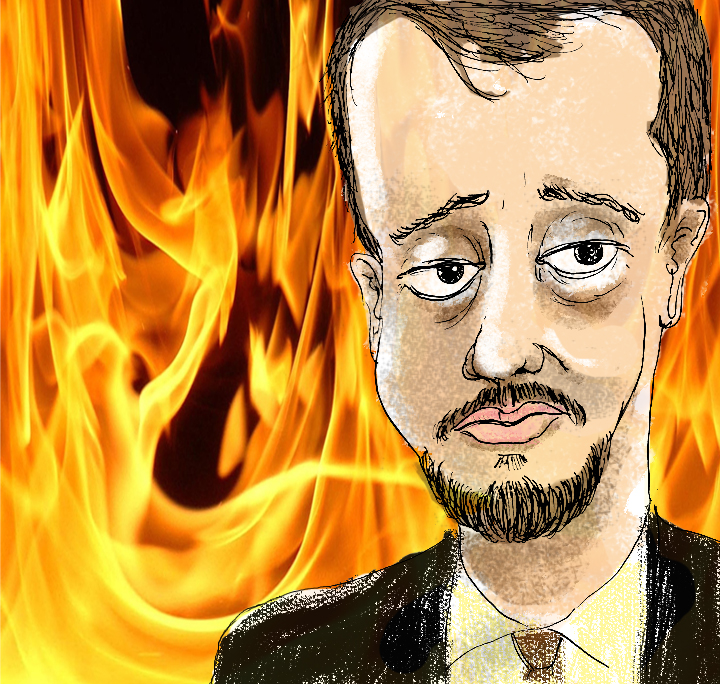
The reckless Viv often drank and smoked in bed, once even setting his beard on fire. On March 6, 1995, Viv was found dead in his North London apartment following a fire. He was 51.

In 1997, Washington singer-songwriter (and Bonzo Dog Band fan) Ben Gibbard honored Viv’s memory by naming his band “Death Cab for Cutie”.

Comments

comments

IF: scary

They're all the same. Some stupid killer stalking some big-breasted girl who can't act who is always running up the stairs when she should be running out the front door. It's insulting.
I love scary movies. I have loved scary movies since I was a kid. The problem is… they don’t really scare  me. The classic Universal Monster movies from the 30s and 40s were great, but I thought Dracula, Frankenstein and even The Wolf Man were cool, just not scary. When I was a teenager my mom introduced me to a great movie from 1944 called The Uninvited. It was one of the first Hollywood films to present a ghost story in a serious manner. Previously, ghost stories were always played for laughs. The Uninvited  was eerie, but, unfortunately, it didn’t scare me. In the 60s, Hammer Films, a British studio, remade a handful of Universal’s pictures as full-color, blood-drenched spectacles with erotic overtones. I was hardly frightened by these movies, as my budding hormones found the abundance of heaving bosoms very distracting from the horror. The Japanese imports, like Godzilla and Rodan, didn’t do it for me either and The Exorcist  actually made me laugh.

In the late 70s and early 80s, a new genre of scary movies was introduced — the slasher film. The original Halloween, A Nightmare on Elm Street  and Friday the 13th were all cleverly written and very entertaining. Sure, I jumped at each one’s climactic finale, but I was not what would be described as “scared”. (Don’t get me started on the awful sequels to these films.) Again, my mom pointed me in the direction of Alfred Hitchcock‘s Psycho  from 1960. Goddammit, if that bastard Hitchcock didn’t scare me at last!

Psycho  is the perfect scary movie. Why? Because Hitchcock manipulates the shit out the audience. Everything he does goes against the norm. SPOILER ALERT IF YOU HAVE NOT SEEN PSYCHO. First, he introduces the heroine as a thief. Then, he kills her — the film’s star — a mere 45 minutes into the story. Psycho’s  killer isn’t a terrifying monster. He’s a good-looking, well-mannered young man; the guy next door. He offers candy to an investigating detective, for Christ’s sake! At one point, Hitchcock actually has the audience worried for the killer’s well-being. Most importantly, Psycho has the twist ending that all other films wish they had. Oooh, that Hitchcock!

Alfred Hitchcock secretly purchased the rights the Robert Bloch’s novel for nine thousand dollars and then bought up all of the individual copies of the book that he could find to protect the surprise ending. Psycho  was released to theatres with explicit instructions that no one was to be admitted once the film began and he implored movie audiences not to reveal the ending to friends. It was genius marketing. The film, shot in thirty days for $800,000, earned over forty million dollars.

I have seen Psycho countless times and, although I know every scene and every line of dialogue, it still scares me. No other film comes close. Now, that’s  scary.

(I did another illustration for the word “scary” in 2008. You can see that  illustration HERE. )

Comments

comments

from my sketchbook: barbara payton

Don't let the stars get in your eyes/Don't let the moon break your heart/Love blooms at night/In the daylight it dies
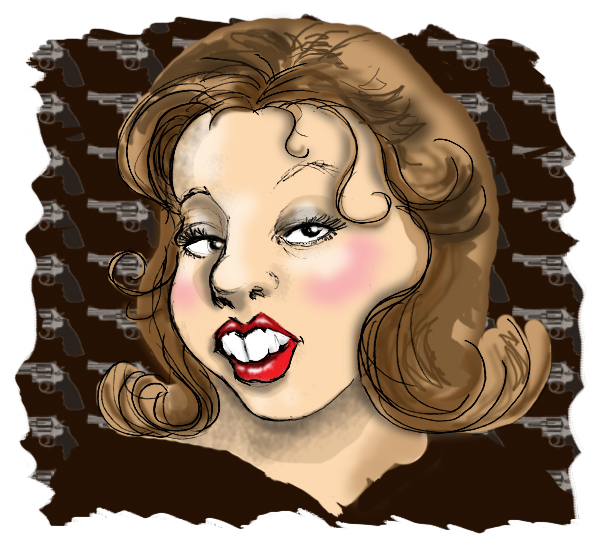
Just after separating from her second husband, twenty-one year old Barbara Payton took her young son and set off for Hollywood to take a shot at stardom. At a Hollywood nightclub, Barbara, a fun-loving “party girl” caught the attention of a Universal Studios executive. She was given the female lead opposite Lloyd Bridges in the 1949 prison drama Trapped.  She auditioned for John Huston’s The Asphalt Jungle,  but lost the role to Marilyn Monroe. She also began an affair with beloved comedian Bob Hope. Upon discovering the affair, Universal terminated her contract.

In 1950, Barbara tested for a role in Kiss Tomorrow Goodbye  starring James Cagney. The film’s producer, James’ brother William Cagney, was so taken by Barbara’s beauty that he signed her to a joint contract with William Cagney Productions and Warner Brothers. Barbara was paid a weekly salary of $5000, an unheard of amount for someone with no guaranteed box-office draw.  However, Kiss Tomorrow Goodbye  became a hit and Barbara’s performance as Cagney’s hardened girlfriend received glowing praise. She followed up by co-starring with Gary Cooper in Dallas  later the same year. Barbara was involved in many off-screen romances, including Howard Hughes, married actors John Ireland, Guy Madison and the aforementioned Cooper and mobster Mickey Cohen. Her next several pictures were not well-received and, despite her partying and excessive lifestyle, her star was beginning to fade. Barbara’s next film, the low-budget horror embarrassment Bride of Gorilla, was the beginning of the end of her short-lived stardom.

She met actor Franchot Tone, who was twenty years her senior, at a nightclub and he was immediately infatuated. The couple were engaged, but that didn’t keep Barbara from an affair with B-move actor Tom Neal. Neal, a one-time boxer, attacked Tone outside of Barbara’s apartment, breaking the elder actor’s nose and cheekbone and giving him a concussion. Tone was in a coma for eighteen hours. The incident was all over the press and Barbara eventually married Tone. The marriage lasted 53 days and she returned to Tom Neal. Capitalizing on their steamy relationship, Neal and Barbara toured the country in a stage production of The Postman Always Rings Twice.  During her rekindled relationship with Neal, she carried on affairs with night club owner Siegi Sessler and notorious playboy Serge Rubinstein (who was later murdered).

Excessive drinking and drugs took a hard toll on Barbara’s good looks and eventually acting offers became almost non-existent. She was arrested on suspicion of writing bad checks at a Hollywood supermarket in 1955. In 1962, after the breakup of her fourth marriage and the loss of custody of her son, Barbara was arrested for prostitution in a bar on Sunset Boulevard in 1962. Several months later, she was sleeping on a bus stop bench in a bathing suit and a coat and arrested for public drunkenness. She was known to spend endless hours in Sunset Boulevard bars. Turning again to prostitution, Barbara received 38 stitches after being knifed by a customer.

Battling depression and addictions to alcohol and drugs, an ill and weakened Barbara moved into her parents’ home in San Diego. On May 7, 1967, Barbara was found by her mother, dead on the bathroom floor – a victim of liver and heart failure. She looked much older than her 39 years.

Comments

comments

IF: scattered

This week’s Illustration Friday challenge word is “scattered”.
it's a scatterday!
“And Jesus saith unto them, All ye shall be offended because of me this night: for it is written, I will smite the shepherd, and the sheep shall be scattered.”
— Matthew 26:31

This quote from the New Testament has Jesus basically telling the apostles: “When I die, you guys are fucked.”

Comments

comments

from my sketchbook: stan stasiak

But it's been no bed of roses/No pleasure cruise/I consider it a challenge before the whole human race/And I ain't gonna lose

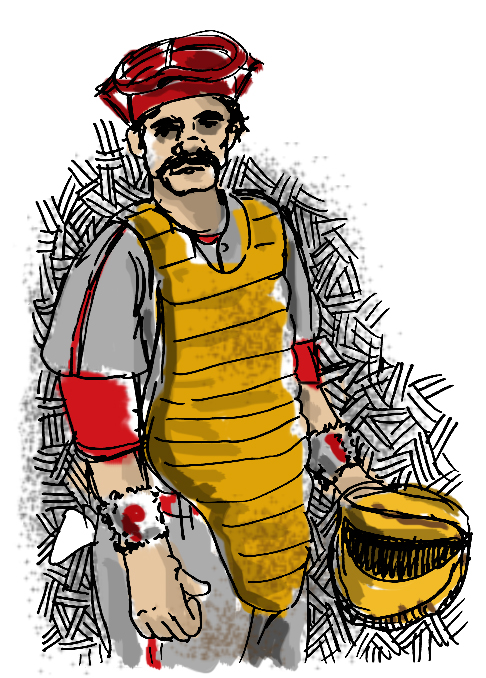
Everyone knows professional wrestling is fake. The fans know. The wrestlers know. The officials know. Everyone. But, professional wresting has remained popular ever since it was the only thing to watch in the early days of television. In fact, it has exponentially increased in popularity and made a fortune for its promoters, most notably Vince McMahon Jr. who turned the staged matches and contrived intrigue into a multimillion dollar brand.

Canadian George Stipich began wrestling in the role of “the bad guy” in the 1960s. He used the name “Stan Stasiak” and played the villainous brute character to the hilt. He bounced around different pro wrestling organizations for several years, always playing the same brooding ogre in the ring. In his third stint with Vince McMahon Sr.’s fledgling World Wide Wrestling Federation, Stan got a brief and unexpected shot at glory.

In December 1973, Stan was in a venue dressing room in Philadelphia prior to a World Championship bout in which he was to battle popular reigning champion Pedro Morales. A representative from the World Wide Wrestling Federation entered the dressing room to go over the particulars of how the match was to play out. This was a common formality and Stan hardly paid attention. He had this same conversation in the dressing rooms of a dozen venues in a dozen cities on the Eastern seaboard. The WWF agent discussed various moves and holds, describing the scene as it had been described many times before.

“Pedro makes a big comeback,” the agent said, “and the referee starts to count — right? — one, two…”

Stan, giving his full attention to lacing and tying his boots, nodded and grunted a half-hearted “Uh-huh.”

“On ‘two’, you roll your shoulder up, and Pedro’s shoulders will be down on the mat.”, the WWF official explained.

Stan looked up, knowing he was about to hear the familiar fate that ended each match.

The official continued, “The ref hits the mat at ‘three’ and Pedro is down. Okay?”

Stan froze and looked at the offical. “You mean I win?, ” he said, after a long silence.

“Yeah, Stan.”

I win?  And this is a title match? “,  a confused Stan questioned, “I  win the title? I’m  the champion?”

The WWF agent answered very matter-of-factly, “Yes, Stan.”

Stan was the World Wide Wresting Champion for nine days, until Bruno Sammartino defeated him at Madison Square Garden and took the belt.

Stan retired from the ring in 1984 and became a security guard for a shopping center. He passed away from heart failure at the age of 60. For nine days he lived what most wrestlers only dream about.

Comments

comments

from my sketchbook: janos prohaska

I don't feel safe in this world no more/I don't want to die in a nuclear war/I want to sail away to a distant shore and make like an ape man
You need a bear? Call Janos.

You need a gorilla? Call Janos.

You need a monster? Call Janos.

For fifteen years, Janos Prohaska was Hollywood’s “go-to” guy when a script called for a ursine, simian or otherworldly character to interact with a leading actor. Janos would don one of his many homemade costumes and happily perform his patented animal pantomime. He played countless gorillas in laboratories, performing circus bears and outer space monsters in television and movies. He was the popular “Cookie Bear”, a character played for comic relief, on fourteen episodes of The Andy Williams Show,  a variety showcase hosted by the easygoing singer. Janos appeared in episodes of The Munsters, Bewitched, The Lucy Show, Love American Style, I Dream of Jeannie  and even Perry Mason,  all hidden under heavy fur and latex costuming. His roles were, for the most part, uncredited. In 1969, he made an appearance on the TV game show What’s My Line?,  in a full ape get-up.

Janos was also an accomplished stuntman, doubling for Peter Falk in the physical comedy classic It’s A Mad, Mad, Mad Mad World  in 1963. In 1971, he played Heloise the gorilla in Escape from Planet of the Apes,  in which he strangled Dr. Milo, the character played by Sal Mineo.

In 1974, Janos, his son, fellow stuntman Robert Prohaska, and 34 passengers were returning by chartered plane from a mountainous location set for the ABC Television series Primal Man.  In total darkness, the plane flew into a mountain ridge, killing everyone aboard.

Comments

comments

contraption (part 2)

This week’s Illustration Friday challenge word is “contraption”.  This is the second of two illustrations for the topic. Here is the first.
oil can! oil can!
Elijah McCoy worked as a fireman and oiler on the Michigan Central Railroad in the late 1800s. He often tinkered in his home workshop trying to devise new methods for lubricating machinery. He developed an automatic lubricator for oiling the steam engines of locomotives and ships and on July 12, 1872, he obtained his first patent for the device. Elijah continued to work and refine his inventions, eventually holding over 50 patents for various lubricating systems. By the turn of the century, author Booker T. Washington recognized Elijah as having produced more patents than any other black inventor up to that time. Lacking the capital with which to manufacture his lubricators in large numbers, Elijah usually assigned his patent rights to his employers or sold them to investors.

Elijah continued to invent varied contraptions until late in life, including a folding ironing board and a lawn sprinkler. In 1922, he suffered injuries in a automobile accident. He was a long-time resident of the Eloise Hospital (later the Michigan State Asylum), where he suffered from dementia. Elijah passed away on October 10, 1929 at the age of 86.

Railroad engineers looking to avoid inferior copies of Elijah’s oil drip cup would always request it by name, and ask if a locomotive was fitted with “the real McCoy system”. The term “The Real McCoy”, meaning a genuine article, has become part of our lexicon.

Comments

comments