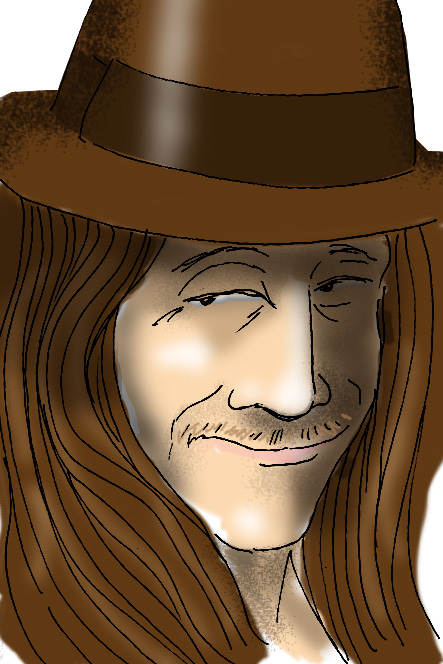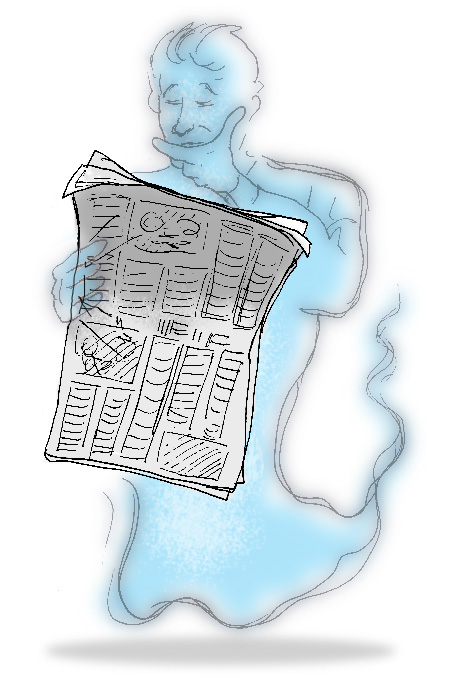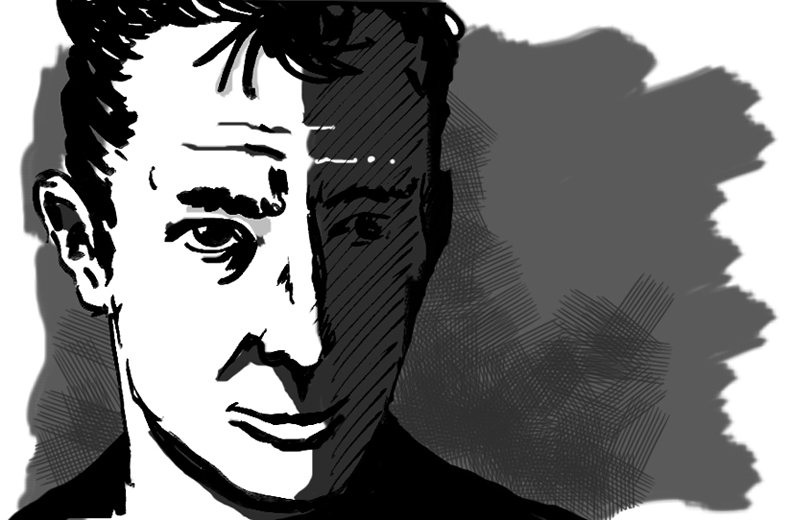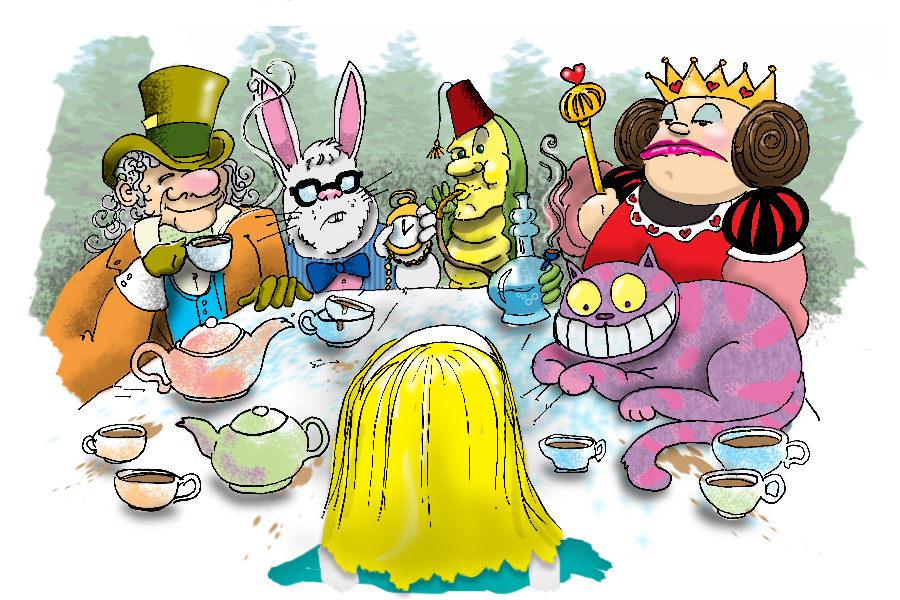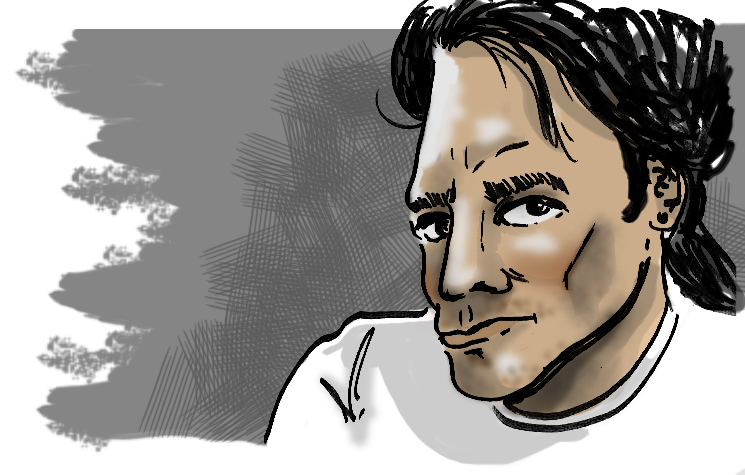
from my sketchbook: roger peterson

But February made me shiver/With every paper I'd deliver/Bad news on the doorstep/I couldn't take one more step
Roger Peterson was born and raised in Alta, Iowa, and earned his private pilot’s license in 1954, just after graduating from high school. Four years later, he got his commercial pilot’s certificate and was quickly hired by Dwyer’s Flying Service in Mason City, Iowa. Mason City was just a short drive from where Roger and his high school sweetheart, now new bride, made their home.

21 year-old Roger began making charter flights for Dwyer’s, logging flight hours needed for the next level of pilot certification. However, he was not trained for instrument flying and, therefore, not licensed to fly at night.

On February 2, 1959, the manager of the Surf Ballroom, in nearby Clear Lake, contacted Roger for a charter flight to Fargo, North Dakota. The Surf was hosting a concert and some of the performers wanted to fly ahead while the tour bus carried the majority of the tour’s personnel. At a little after 1 a.m. on February 3, Roger’s four-seater Beechcraft Bonanza sat on the runway of the Mason City airfield as a light snow fell. Soon, the single-engine craft was boarded by Buddy Holly, Ritchie Valens and J.P. Richardson, known as “The Big Bopper”. Roger checked the instruments and the plane took off. Roger maneuvered the plane northwest, cleared the airport but, just moments later crashed into a cornfield about five miles away — killing everyone aboard.

After research and investigation, the Civil Aeronautics Board ruled the crash the result of pilot error. It seemed that since Roger was not certified in flight solely by instruments, he misinterpreted the readings from the unfamiliar navigational gyroscope. He believed the plane was gaining altitude, when in reality, it was losing altitude. He became disoriented while in flight. The weather conditions were only a secondary contributing factor.

Comments

comments

IF: shiny

The new Illustration Friday challenge word is “shiny”.
Some things are classic, some things are just old

It was summer in Philadelphia in the early 1980s. I was scooping ice cream on South Street to help pay my tuition for art school. Bubblegum pop radio station WIFI had just shaken up their format, re-emerging as “I92 – Rock of the 80s”. As disco was becoming passé, I92 dove headfirst into the popularity of New Wave music, hoping it was a bankable decision. At the ice cream parlor, we cranked the New Wave full blast, utilizing it two-fold — to drown out the chugging fans and to welcome eager customers. The whole staff was animated by the music, dancing joyously as we balanced frozen treats on fragile cones and piled toppings on enormous sundaes. And, in turn,  it translated to entertained and contented patrons.

Among the top selections by The Pretenders, The B52s, Talking Heads and Eurythmics (whose big hit was ice cream-ized by the scoopers as “Whipped Cream is Made of This”), I92 mixed in the occasional novelty tune. Once an hour, we were treated to Angel and the Reruns’ ode to Anissa Jones, “Buffy Come Back” and Total Coelo’s dancey and nonsensical “I Eat Cannibals” . But the one we all waited for was Haysi Fantayzee’s “Shiny Shiny”. As soon as that angelic female voice offered the opening prayer of “Good times come to me now”, the entire place collectively smiled and braced themselves for three minutes and forty-two seconds of pure delight. When the gritty male vocalist spewed his raucous rhymes over a soundtrack punctuated by fiddles and jangling bells, we were frenzied.

Haysi Fantayzee was the brainchild of Paul Caplin, a visionary songwriter/manager/producer/musician from London. Paul was a former member of Animal Magnet, a synth-pop band that accompanied pop superstars Duran Duran on their first national tour. Paul paired his then-girlfriend, vocalist Kate Garner with 20-year-old singer/songwriter Jeremy Healy, carefully dressed them in funky, mismatched thrift-store chic, and produced an amalgam of country, reggae and tribal rhythms reminiscent of contemporaries Bow Bow Wow and Adam and the Ants. The songs, described as political and sociological nursery rhymes set to quirky music, were contained on the band’s one and only album, aptly titled Battle Hymns For Children Singing.  The band became darlings of the music video era MTV. While being interviewed on the groundbreaking music channel, Jeremy Healy even accused Culture Club’s Boy George of stealing his look.

But, fame was fleeting and the the members of Haysi Fantayzee went their separate ways in late 1983, after releasing four successful singles from their Certified Gold debut/swan song.

Now, unlike other stories of ill-fated notoriety that appear in this blog, the only thing to meet an untimely demise in this tale was the band itself.

Jeremy Healy went to become one of the most in-demand and respected DJs on the international club scene. He has produced albums for Gwen Stefani, George Michael and, ironically, Boy George. Jeremy has worked extensively with prestigious clothing designers as musical director for fashion shows, including a decade-long relationship with Victoria’s Secret. He also married and divorced actress Patsy Kensit (but then again, who hasn’t).

Kate Garner retired from the singing end of the music business, in favor of pursuing her love of photography. Kate’s photos appear on the cover of Sinead O’Connor’s 1987 debut, The Lion and the Cobra.  She has photographed everyone from Dr. Dre and Bjork to Anne Hathaway and Angelina Jolie. Her work has been featured in GQ, Harper’s Bazaar, Vogue  and Elle. More recently, Kate took a stab at wallpaper design with one of her creations securing a spot in London’s Victoria and Albert Museum.

Paul Caplin totally abandoned the music business in favor of a more lucrative venture – software. Paul is the founder and CEO of Caplin Systems, a web trading technology company. His bio page on his company’s website makes no mention of his former career.

Comments

comments

DCS: brenda benet

Like sands through the hourglass, so are the days of our lives

From her first part on the early 60s ABC soap opera The Young Marrieds,  Brenda Benet became an in-demand character actress. She played roles in both top prime-time comedies and dramas in the 1960s and 70s, appearing in Mannix, Love American Style, I Dream of Jeannie, Hogan’s Heroes  and many others. She even landed a part in the popular 1973 action film Walking Tall  with Joe Don Baker and Elizabeth Hartman. In 1967, she married actor Paul Peterson of The Donna Reed Show.  In 1969, she left Peterson for actor Bill Bixby. When her divorce from Peterson was final, she married Bixby in 1971.

Brenda was best known for her role as the devious schemer Lee Dumonde on the daytime soap Days of Our Lives.  The character caused trouble for Brenda, as rabid fans reviled the actress. A storyline had her character cause the breakup of one of the show’s popular couples, Doug and Julie. Fans were outraged and Brenda had a difficult time dealing with the negativity. This led to complaints from fellow cast members regarding her on-set behavior.

Brenda’s life began to crumble around her. She divorced Bill Bixby in 1980.  Their son Christopher died suddenly in 1981 at the age of 7. Brenda was devastated and sunk into depression. She began a romantic relationship with 19-year old Tammy Bruce, who would later become an author, political commentator and frequent contributor to Fox News.

On April 7, 1982, Tammy arrived home to find Brenda locked in a bathroom. Sensing something was wrong, Tammy went to get help. Suddenly, she heard a gunshot and soon discovered Brenda had taken her own life. She was 36.

Comments

comments

from my sketchbook: merriman smith

I had to interrupt and stop this conversation/Your voice across the line gives me a strange sensation
In 1941, Merriman Smith became the White House correspondent for United Press International (UPI), a position he held until the Nixon administration. He began the tradition of closing his presidential conferences with “Thank you, Mr. President,” a practice still used by current correspondents.

On November 22, 1963, Merriman Smith sat with several other reporters in the back of a radio car as it made its way down Elm Street in Dallas, Texas — a few hundred feet behind the presidential limousine. Merriman, a regular at a shooting range frequented by Secret Service agents, immediately recognized the sound of three distinct gunshots. He looked up to see a commotion in the open-top presidential vehicle as it sped away. Merriman immediately grabbed the radio and fired off a bulletin to the UPI news desk — a bulletin that, at this point, was pure speculation. A bulletin that could bring him notoriety as easily as it could ruin his career. A mere four minutes after shots rang out in Dealey Plaza, Merriman dictated “THREE SHOTS WERE FIRED AT PRESIDENT KENNEDY’S MOTORCADE IN DOWNTOWN DALLAS” to the operator at UPI headquarters. He waited for confirmation as the Associated Press’ Jack Bell tried to pull the phone away. Merriman’s words were the first account the world received of JFK’s assassination. The press car followed the limo to Parkland Hospital. As it pulled into the emergency room entrance, Merriman tossed the now-dead phone to Bell and ran up to a Secret Service agent who answered his query about the President’s condition with “He’s dead, Smitty.”

Thinking quickly like a true newsman, Merriman hitched a ride with a Dallas policeman to the airport in time to see Vice-President Lyndon Johnson sworn in as the 36th President of the United States.

In 1964, Merriman won the Pulitzer Prize for his coverage of the assassination of President Kennedy. He was the first to use the term “grassy knoll,” a term that would appear in virtually every future account of the incident.

In 1970, Merriman recognized one more sound of gunshot. It was the one that came from his own revolver. The one he used to put a bullet in his head.

Comments

comments

IF: faded

This week’s Illustration Friday suggestion for inspiration is the word “faded”.
it's better to burn out than to fade away

“Before the flowers of friendship faded friendship faded.” — Gertrude Stein, 1931

In 1907, Gertrude Stein met Alice B. Toklas at the apartment of Gertrude’s brother Michael. Soon after, Gertrude and Alice became companions and lovers until Gertrude’s death in 1946.

Gertrude wrote Q.E.D. (Quod Erat Demonstrandum)  in 1903, although it was first published posthumously in 1950. The book detailed Gertrude’s repressed homosexual feelings, her perception of her feelings in society and the moral dilemmas that she faced. Her use of the word “gay” as a euphemism for homosexual was the first time the word was used in print in that connotation. (Many uninformed readers totally missed the reference.)

Gertrude, a renowned art collector and close friend of Pablo Picasso and Henri Matisse, stipulated in her will that her collection be given to Alice. However, the couple’s relationship had no legal recognition. As the paintings appreciated in value, Gertrude’s relatives made claim to them. While Alice was away on vacation, Gertrude’s relatives broke into Alice’s apartment and removed a great number of paintings and placed them in a bank vault. With no legal rights in the matter, Alice made a living with her writing, eventually penning The Alice B. Toklas Cookbook  in 1954. The book, a combination of recipes and autobiography, became one of the best selling cookbooks of all time. It famously contained a recipe for Hashish Fudge, a treat which Alice boasted “can liven up any gathering and is easy to whip up on a rainy day.” The recipe called for spices, nuts, fruit and cannabis. Alice even made suggestions as to where the illegal title ingredient could be obtained. 

Comments

comments

IF: sight

This week’s Illustration Friday word is “sight”.
Suddenly I see (Suddenly I see) Why the hell it means so much to me

The assassination of President Kennedy was a traumatic event for the generation before mine. Everyone knew where they were, what they were doing and who they were with when they heard the terrible news that the president was shot In a Dallas motorcade. It was something they would never forget.

For my generation – a generation slightly too young to vividly remember the events of that November day —– there was another event. Ours was eerily similar in that a beloved cultural icon was senselessly murdered. Everyone from my generation instantly remembers where they were, what they were doing and who they were with when they heard that John Lennon was shot outside his apartment building in Upper Manhattan.

I was 19 years old. I was with my friend Sam at the Philadelphia Spectrum and we were rocking to a marathon three-hour concert by Bruce Springsteen. It was the first time that Sam and I got to see “The Boss” and he did not disappoint. Sometime around 11 p.m., as Mark David Chapman was firing four bullets into the back of the former Beatle, Bruce was wailing the Mitch Ryder classic “Devil with the Blue Dress” before a sold-out crowd of fist-pumping faithful under the harsh illumination of the house lights. After the show, Sam and I listened to an eight-track tape of Springsteen hits, prolonging the euphoria as we drove home. It wasn’t until I opened my front door that my parents informed me of the news flash, delivered by Howard Cosell during Monday Night Football,  saying John Lennon was dead.

The same night, the 20-year old future Mrs. Pincus,  a student at New York University and still four years away from becoming my wife, was on a date. Several evenings earlier, she met a guy at The Grass Roots, a regular haunt on the school’s Greenwich Village campus. Over drinks, they made plans to go out on Monday, December 8th. They met up outside The Eighth Street Playhouse for a late-night showing of Stanley Kubrick’s A Clockwork Orange.  They found seats and chatted before the film began. The guy, Richard something-or-other,  told my future bride that he was about to enter the New York City Police Academy, a lifelong goal. He also told of his family, briefly mentioning that his brother was a budding stand-up comic. Suddenly, the theater manager  jogged down the center aisle and called for the attention of the audience. He announced that he just heard on the radio that there was trouble at the Dakota, an exclusive apartment building at 72nd Street and Central Park West. The trouble involved John Lennon. The future Mrs. P., a long-time Beatles devotee, turned to her date and said, “I’m going up there to see what’s going on.”

“I wanna see the movie.,” countered Richard, “We’ll go later.”

“You stay and watch your movie,” she answered, putting on her coat, “I’m going uptown.”

Richard sighed and followed her out the door and into a cab. A short time later, they were one of several hundred forming an impromptu vigil among the news vans and emergency vehicles. Richard’s interest was waning at the same rate that Mrs. P.’s concern increased. Exasperated, he offered an excuse about needing to wake up early and he disappeared into the crowd. My future bride never saw him again.

A few years ago, Mrs. Pincus and I were plopped on the sofa, scanning the many channels our cable television provider offers. My wife stopped on The Biography Channel, as a profile of comedian-turned-sitcom star Jerry Seinfeld was just concluding. As part of a week-long series of shows highlighting comics, the next hour’s segment was devoted to the career of Ray Romano. Ray is the star of the popular Emmy-winning series Everybody Loves Raymond,  a family situation comedy based on his stand-up routines. Despite its popularity, it is a show I have never watched. Coming to the realization that nothing better was on, Mrs. Pincus dropped the remote control and we watched with indifference. The broadcast traced Ray’s roots from a novice comic to the lead in a weekly series that ran for nine seasons on CBS. During the course of the retrospect, cast members and their real-life Romano Family counterparts were interviewed. Ray’s real wife, Anna, was questioned about her similarities to the TV wife character “Debra”. Next, they spoke with Ray’s real brother about the bumbling and resentful representation of himself as portrayed by actor Brad Garrett. Suddenly, my wife let out a squeal as she caught her first sight of the interviewee.

“Oh my God!,” she exclaimed, “That’s the guy!”

“What guy?,” I asked.

“The guy I was out with the night John Lennon was shot! He said he was going to become a cop in New York. That’s him!”

As NYPD sergeant Richard Romano expounded on the quirks and eccentricities of his famous brother, my wife marveled at the flickering images on the television screen — and a puzzle piece, missing for over twenty-five years, fell into place.

Comments

comments

from my sketchbook: andy kaufman

If you believe there's nothing up his sleeve, then nothing is cool

Andy Kaufman took the whole world for a ride.

From his beginnings as a stand-up comic, Andy marched to his own beat. When he performed a short bit on the premiere episode of NBC’s Saturday Night Live,  no one knew what to make of him… and that’s just what Andy wanted. After an introduction by guest host George Carlin, Andy took the stage and set up a small phonograph. He stood quietly as a recording of the Might Mouse cartoon theme played — to the awkward chagrin of the studio audience. When the tune reached the familiar “Here I come to save the day” lyric, Andy bounced and gestured dramatically, lip-syncing the words perfectly… then resumed his position and waited for the line to roll around again. When he finished his unusual act, he thanked the crowd in an a unplaceable, but decidedly foreign accent. On a subsequent appearance, he did disastrous impressions of President Carter and Archie Bunker, each in the same uneasy, foreign-tinged voice. The confused studio audience rewarded him with nervous, awkward giggles. Then, he announced his finale — an impression of “de Elvis Presley.” After brief preparation of fixing his hair and altering his clothes to reveal previously hidden sequin accents, Andy transfixed the audience with a dead-on impersonation of The King.

And so began Andy’s life-long quest to baffle everyone.

Andy was a hot property on the stand-up circuit and was soon cast on the sitcom Taxi,  playing mechanic Latka Gravas, a variant of his “Foreign Man” character. He began playing larger venues when his popularity increased and audiences came in droves never knowing what to expect from one of his shows. He gave one performance with his grandmother seated prominently on the stage for the entire show. At the show’s conclusion, it was revealed that Andy’s “grandmother” was fellow comedian Robin Williams concealed under heavy theatrical makeup. Another show concluded with Andy taking the entire audience — twenty busloads — out for milk and cookies. Sometimes, Andy would punish his audience by reading the novel The Great Gatsby,  never yielding even as complaining patrons left the venue. Even as Andy’s fame and recognition heightened, he regularly and dutifully worked as a busboy at Jerry’s Famous Deli in Los Angeles.

Andy gave an infamous performance on the late-night ABC show Fridays  (a knock-off of Saturday Night Live ). He appeared in a sketch in which he broke character and refused to deliver his lines. Cast members grew furious and the audience was bewildered. Cast member Michael Richards (in an early pre-Seinfeld  role) dumped a stack of cue-cards on Andy’s head and producer Jack Burns took a few swings at the comedian. It was all a elaborate practical joke masterminded by Andy.

While on Taxi,  Andy introduced obnoxious lounge singer Tony Clifton and insisted he be given a role on the show. Again, it was another hoax, as Clifton turned out to be Andy in disguise.

In the early 80s, Andy switched gears and adopted a leering, abhorrent personality, becoming the self-appointed “Inter-Gender Wrestling Champion of the World.” He wrestled women, taunting and humiliating them, offering $1000 to any woman who could pin him in the ring. Among his “opponents” were his friend, singer Laurie Anderson. Andy accepted a challenge from professional wrestler Jerry Lawler. During their match, Lawler delivered a piledriver that seriously injured the much-smaller Andy. A hospitalized Andy threatened a lawsuit. Years later, it was revealed to be a hoax executed by long-time friends Andy and Lawler.

In late 1983, Andy’s family expressed concern at the persistent cough Andy exhibited during a visit for Thanksgiving dinner. Andy, a life-long, non-smoking, health conscious vegetarian, was diagnosed with a rare type of lung cancer. He took all sorts of measures to combat the disease, from special diets to chemotherapy to psychic surgery performed in Philippines. Keeping his illness a secret from the public, Andy passed away from kidney failure in May 1984 at the age of 35. Once again, Andy’s death was believed by some to be just another extravagant prank. A year later, when Tony Clifton appeared at The Comedy Store in Los Angeles, those beliefs were reinforced. (Tony was actually portrayed by Andy’s long-time collaborator Bob Zmuda.)

Although, Andy had the last laugh.

Comments

comments

IF: kernel

The current Illustration Friday challenge word is “kernel”.
Tasty and sweet/Little and neat/Bumpy and glumpy/Whirly and curly/Crunchy and munchy/Butterly and utterly delicious
“Every once in a while, someone will mail me a single popcorn kernel that didn’t pop. I’ll get out a fresh kernel, tape it to a piece of paper and mail it back to them.”
— Orville Redenbacher

In 1951, 44-year old Orville Redenbacher and his partner Charles Bowman purchased the George F. Chester and Son seed corn plant near Valparaiso, Indiana, with money earned from Orville’s lucrative fertilizer business. The pair tested thousands of hybrid strains and combinations until they were satisfied with what they considered a successful, marketable varietty of popcorn. Originally called “Redbow” (a blend of the first syllables of the two partner’s names), an advertising agency suggested they market the product under the folksy-sounding name “Orville Redenbacher”. By the mid 1970s, their upstart company had seized one third of the popcorn market. Through a series of sales and mergers, the company became the property of food conglomerate ConAgra. Orville and his partner were very generously compensated and Orville, in the manner of Colonel Harland Sanders, became the spokesman for the product. He appeared in a series of televison commercials and his friendly face graced the product’s labels.

On September 20, 1995, 88-year old Orville was found dead in the jacuzzi at his home in Coronado, California. While relaxing, he had suffered a heart attack and drowned.

Orville Redenbacher’s brand is currently the number one selling popcorn in the United States.

Comments

comments