
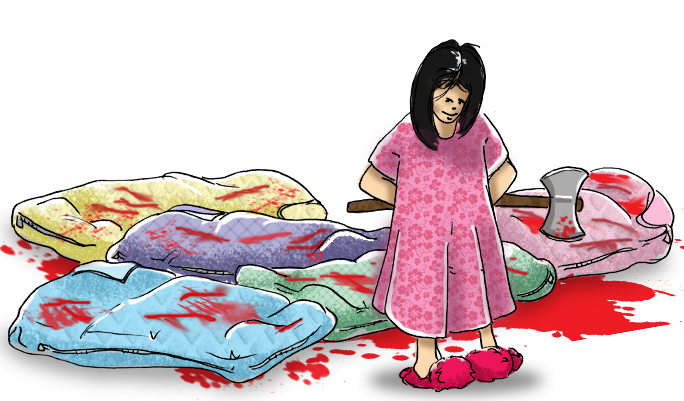
Little Lizzie Borden invited a few friends for a sleepover.
Then, things got a little out of hand.
IF: refresh
This week’s Illustration Friday challenge word is “refresh”.

There’s nothing more refreshing than lemonade.
Even if you drink it.
Comments
from my sketchbook: brian keith

Brian Keith had show business in his blood. The son of stage actor Robert Keith and actress Helena Shipman, young Brian made his motion picture debut in the 1924 silent film Pied Piper Malone at the age of 3. After his parents’ divorce, Brian’s father briefly married actress Peg Entwistle, whose claim to fame was committing suicide by jumping off the “H” in the famous Hollywood sign.
Although he did not pursue an acting career in his youth, after four years in the Marines, Brian revisited performing in 1952. He appeared in many television anthologies. He continued with guest roles throughout the 50s and 60s. He branched out in to films, both comedy and drama. He costarred with Steve McQueen in Nevada Smith and starred opposite Maureen O’Hara and Hayley Mills in Disney’s original The Parent Trap in 1961. He continued to make films through the 60s when he was offered the role for which he is best known — engineer Bill Davis in the TV series Family Affair.
When Family Affair premiered in 1966, it was an instant hit. Brian played the gruff “Uncle Bill” to his brother’s three orphaned children — twins Buffy and Jody and big sister Cissy. Bill’s “gentleman’s gentleman,” Mr. French, who became reluctant nanny to the children, rounded out the cast. Over the course of five seasons, Brian earned three Emmy nominations and grew close with his costars, especially young Anissa Jones who played Buffy.
Brian stayed busy in films through the run of Family Affair, starring with Doris Day in With Six You Get Eggroll in 1968 (her last motion picture). A year after Family Affair was canceled, Brian was cast in a self-titled sitcom in which he played a pediatrician in Hawaii. He called Anissa Jones to offer her an audition-free role on the show, which she graciously turned down, expressing no interest in furthering her acting career. Four years later, 18 year-old Anissa died from a massive overdose of barbiturates.
Brian followed his sitcom with another popular series, Hardcastle and McCormick. Brian was cast for three seasons as a cranky retired judge. He also made several television mini-series, including World War III with Rock Hudson as the President of the United States opposite Brian’s portrayal of the Soviet Premier. Brian integrated his fluency in Russian into the role. During the filming, director Boris Sagal was killed in a tragic helicopter accident.
Despite quitting smoking in the 80s, Brian was diagnosed with emphysema and lung cancer in the early 1990s. He also experienced financial difficulty later in his life. His grown daughter Daisy, unable to cope with her father’s failing health, committed suicide in April 1997. Two months later, Brian took his own life with a self-inflicted gunshot.
Comments
IF: space
The current Illustration Friday challenge word is “space”.

Blast off for adventure with Rex Afterburner, Defender of Spaaaaaaaaaaaace!
Comments
from my sketchbook: george carlin
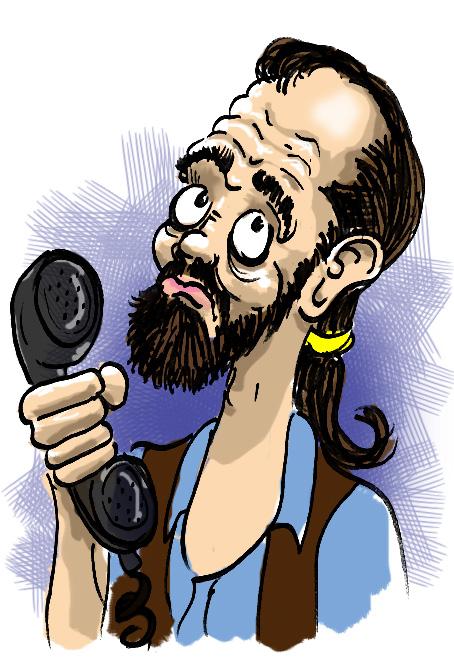
I was always a big fan of George Carlin, the original purveyor of counterculture, hippie humor. I remember watching him on The Tonight Show, always amused by the hearty laughs he coaxed out of host Johnny Carson. I remember hearing a George Carlin comedy album at a friend’s house and rolling on the floor in hysterics at his infamous “Seven Words You Can Never Say on Television” routine. I also recall being intrigued by the clean-shaven, crew-cut sporting version of George that I saw on clips from the old Ed Sullivan Show and reruns of That Girl.
After watching countless HBO specials and appearances on various variety shows, I finally got to see George perform live several years ago at the Stardust Hotel in Las Vegas. The Stardust is no longer there and, sadly, neither is George. He passed away on June 22, 2008 at the age of 71.
George Carlin gained millions of fans during the fifty years his career spanned. In addition to myself, Mark Feldstein can be counted among those fans. Mark, the son of Mad Magazine co-creator and long-time editor Al Feldstein, tells about a personal relationship with the comedian this way…
How I Was Stalked By George Carlin *
My father, Al Feldstein, was co-creator and editor of Mad Magazine for 29 years. When I was a teenager in the late 70’s, my dad took me to a George Carlin concert. He called ahead and set-up a “meet and greet” with George after the concert using his cache as editor. We waited expectedly until finally a crew member apologized to us that George couldn’t make it – he wasn’t feeling well. I survived. Three years later, I received a phone call at college from Dad, “Mark, George Carlin just called and left his number. Why don’t you call him back?”
I dialed the number and George himself answered! Before I could fully introduce myself, George blurted,”Mark! I wanted to apologize for not meeting you at my concert three years ago.”
I responded intelligently, “Uhhh.”
George went on, “I was so stoned – there was no way.”
That prodded me back to reality, “But, George, that was three years ago.” (I figured that this conversation couldn’t get any stranger, so why not call him “George?”)
“Flashbacks!” he announced, “These damn drugs!”
As you can imagine, I graciously forgave him. And thought that was the end of my George Carlin story. Little did I know.
Five years later – I had graduated and moved to Los Angeles (from New York) and Dad calls. Oh, yes,you can see it coming.
“Mark. George Carlin just called again. Here’s the number.”
I called. “Mark! I just wanted to apologize for not meeting you at my concert those years ago!”
Okay, this was just a little strange. “George, you already called five years ago to apologize.”
George: “I did? Damn these flashbacks!”
Mark: “George, tell you what. Take out a piece of paper and get a pen.”
George: “Okay.”
Mark: “Now write this down. ‘I have already apologized to Mark Feldstein.”
George: “Okay.”
Mark: “Now put the note in your wallet, George.”
George: “Okay.”
We hung up.
So, as it sometimes happens in life, strange things happen in threes.
Years later, I was working in a small special effects production house called Coast Productions. They are the ones who make the Pillsbury Doughboy giggle so adorably. Well, guess who walks in one day to discuss the special effects of his upcoming movie? Need I say it? I waited for the meeting to end and snuck into the conference room and held out my hand and said, “Hi George. My name is Mark Fel….”
He leaped to his feet and said, “Mark! I just wanted to…..”
As a footnote, Mark told me, “Every word of the story is true. Dad even told me that George sent him scribbled apologies on yellow pad paper, too, but I never saw those.”
* Permission to reprint graciously granted by Mark Feldstein.
Comments
IF: secret
This week’s Illustration Friday challenge word is “secret”.

“Bachelor number one is a successful photographer who got his start when his father found him in the darkroom at the age of 13, fully developed. Between takes you might find him skydiving or motorcycling.”
Host Jim Lange’s introduction of Rodney Alcala on The Dating Game, 1978
Rodney Alcala kept a big secret.
By the time Rodney appeared as “Bachelor Number One” on a 1978 episode of the popular ABC game show The Dating Game, he had already murdered two women in California and most likely two more in New York. But despite being a serial murderer and rapist, he managed to charm the interview staff of The Dating Game enough to allow him an appearance.
On the show, seated next to Jed Mills who described his fellow contestant as “bizarre” and “very strange,” Rodney answered the questions posed by bachelorette Cheryl Bradshaw and eventually was chosen as her date. However, Ms. Bradshaw refused to go through with the date, citing Rodney’s “creepiness” as a deciding factor. In what is believed by analysts to be a reaction to the rejection, Rodney raped and murdered 12-year old Robin Samsoe and at least two other women a short while after his episode aired.
A long investigation finally brought Rodney to trial in 2003. Charged with Samsoe’s murder and four additional killings, he acted as his own attorney, rambling nonsensically in court (in two distinct voices) for nearly five hours. He claimed he was at Knott’s Berry Farm during Samsoe’s abduction. During his closing argument, he played a recording of Arlo Guthrie’s song “Alice’s Restaurant,” pointing out the lyrics in which the protagonist tells a psychiatrist he wants to “kill”. In less than two days’ deliberation, the jury convicted Rodney on five counts of first-degree murder. He is currently on death row at San Quentin Prison, awaiting a series of appeals.
Over the years, various pieces of evidence have surfaced, possibly connecting Rodney to nearly 130 murders.
Perhaps, if Jim Lange’s introduction had been more truthful….
Comments
from my sketchbook: helen chandler
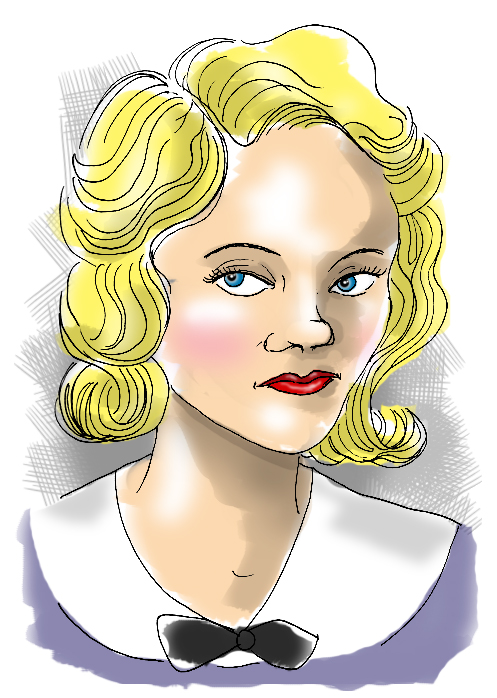
By the late 1920s, Helen Chandler was a huge star on Broadway. Her credits numbered twenty plays ranging from broad farce to Shakespeare. As the 30s approached, she hoped her popularity would continued as she headed for Hollywood. Helen had roles in a few pictures including the film version of her popular stage production Outward Bound, about passengers stranded on a strange ship only to find out they are all dead and the ship is the transportation to heaven (70 years before M.Night Shyamalan’s The Sixth Sense). Helen had hoped for the lead role in Paramount’s all-star production of Alice in Wonderland, but lost out to actress Charlotte Henry. Studio heads tried to console a disappointed Helen by casting her in the role for which she is remembered best — Mina Seward-Harker in the 1931 Universal Pictures horror classic Dracula opposite Bela Lugosi. Dracula went on to become one of the most successful films of the time.
Unable to ride the success of Dracula, Helen’s career began to falter. She returned briefly to the New York stage, but she could not reignite her earlier popularity. Battling chronic alcoholism and an addiction to sleeping pills, Helen entered a sanitarium in 1940. Her career was over.
In 1950, Helen fell asleep while smoking and her apartment went up in flames. She suffered severe burns that left her permanently disfigured. In 1965, while undergoing surgery for a bleeding stomach ulcer, Helen suffered a fatal heart attack and passed away at the age of 59. Per her wishes, she was cremated. Her ashes were never claimed by any relative and they remain at Chapel of the Pines Crematory in Los Angeles to this day.
Comments
from my sketchbook: martine carol
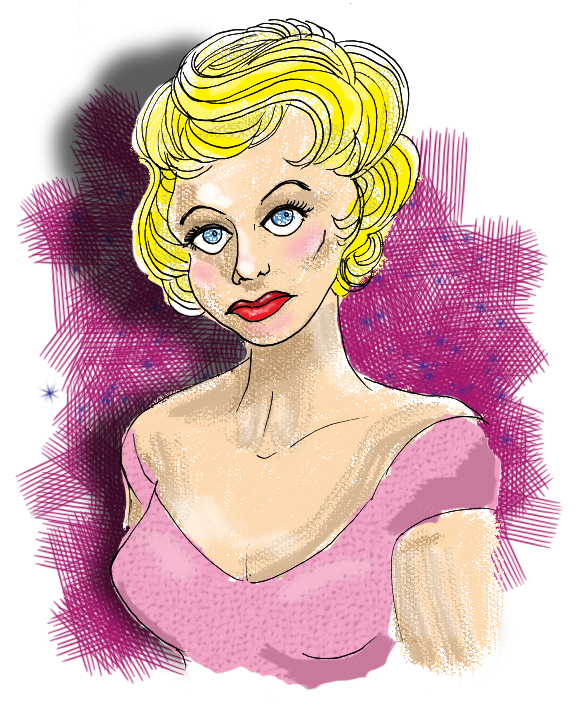
The 1950s were Martine Carol’s time to shine. The seductive blond bombshell was a top box office draw in French cinema. She starred in 15 films and was regularly compared to Marilyn Monroe. She was married to Stephen Crane, fresh from his divorce of Lana Turner (and father of Cheryl Crane, who was accused of murdering Lana’s subsequent lover, gangster Johnny Stompanato). As the 50s ended, Martine’s popularity dwindled — overshadowed by up-and-comer and compatriot Brigitte Bardot.
Despite her tremendous fame, Martine struggled with drug addiction, eventually leading to a suicide attempt. She married three more times after her parting with Crane. She was even kidnapped by notorious French gangster Pierre “Crazy Pete” Loutrel, who had earned a reputation as a cold-blooded killer. After one day, Martine was released from his custody and he sent her roses as an apology.
Martine suffered a heart attack and died suddenly in Monte Carlo at the age of 46. She was interred at Père Lachaise Cemetery in Paris, but her grave was broken into amid rumors that Martine was buried with a number of valuable pieces of jewelry. Her remains were moved to Cimetière du Grand in Cannes.
Comments
from my sketchbook: roger peterson
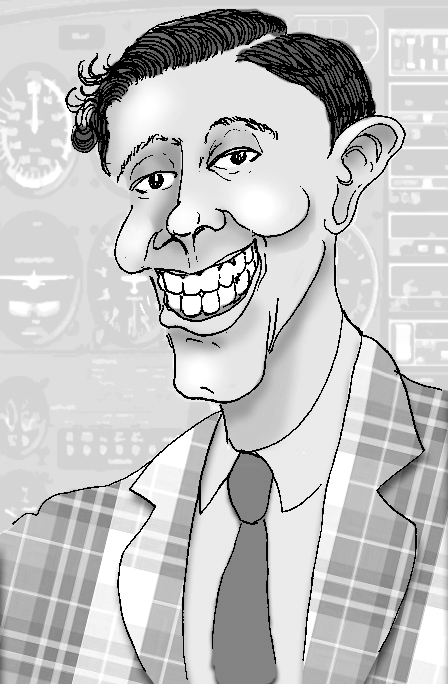
Roger Peterson was born and raised in Alta, Iowa, and earned his private pilot’s license in 1954, just after graduating from high school. Four years later, he got his commercial pilot’s certificate and was quickly hired by Dwyer’s Flying Service in Mason City, Iowa. Mason City was just a short drive from where Roger and his high school sweetheart, now new bride, made their home.
21 year-old Roger began making charter flights for Dwyer’s, logging flight hours needed for the next level of pilot certification. However, he was not trained for instrument flying and, therefore, not licensed to fly at night.
On February 2, 1959, the manager of the Surf Ballroom, in nearby Clear Lake, contacted Roger for a charter flight to Fargo, North Dakota. The Surf was hosting a concert and some of the performers wanted to fly ahead while the tour bus carried the majority of the tour’s personnel. At a little after 1 a.m. on February 3, Roger’s four-seater Beechcraft Bonanza sat on the runway of the Mason City airfield as a light snow fell. Soon, the single-engine craft was boarded by Buddy Holly, Ritchie Valens and J.P. Richardson, known as “The Big Bopper”. Roger checked the instruments and the plane took off. Roger maneuvered the plane northwest, cleared the airport but, just moments later crashed into a cornfield about five miles away killing everyone aboard.
After research and investigation, the Civil Aeronautics Board ruled the crash the result of pilot error. It seemed that since Roger was not certified in flight solely by instruments, he misinterpreted the readings from the unfamiliar navigational gyroscope. He believed the plane was gaining altitude, when in reality, it was losing altitude. He became disoriented while in flight. The weather conditions were only a secondary contributing factor.
Comments
IF: shiny
The new Illustration Friday challenge word is “shiny”.

It was summer in Philadelphia in the early 1980s. I was scooping ice cream on South Street to help pay my tuition for art school. Bubblegum pop radio station WIFI had just shaken up their format, re-emerging as “I92 – Rock of the 80s”. As disco was becoming passé, I92 dove headfirst into the popularity of New Wave music, hoping it was a bankable decision. At the ice cream parlor, we cranked the New Wave full blast, utilizing it two-fold to drown out the chugging fans and to welcome eager customers. The whole staff was animated by the music, dancing joyously as we balanced frozen treats on fragile cones and piled toppings on enormous sundaes. And, in turn, it translated to entertained and contented patrons.
Among the top selections by The Pretenders, The B52s, Talking Heads and Eurythmics (whose big hit was ice cream-ized by the scoopers as “Whipped Cream is Made of This”), I92 mixed in the occasional novelty tune. Once an hour, we were treated to Angel and the Reruns’ ode to Anissa Jones, “Buffy Come Back” and Total Coelo’s dancey and nonsensical “I Eat Cannibals” . But the one we all waited for was Haysi Fantayzee’s “Shiny Shiny”. As soon as that angelic female voice offered the opening prayer of “Good times come to me now”, the entire place collectively smiled and braced themselves for three minutes and forty-two seconds of pure delight. When the gritty male vocalist spewed his raucous rhymes over a soundtrack punctuated by fiddles and jangling bells, we were frenzied.
Haysi Fantayzee was the brainchild of Paul Caplin, a visionary songwriter/manager/producer/musician from London. Paul was a former member of Animal Magnet, a synth-pop band that accompanied pop superstars Duran Duran on their first national tour. Paul paired his then-girlfriend, vocalist Kate Garner with 20-year-old singer/songwriter Jeremy Healy, carefully dressed them in funky, mismatched thrift-store chic, and produced an amalgam of country, reggae and tribal rhythms reminiscent of contemporaries Bow Bow Wow and Adam and the Ants. The songs, described as political and sociological nursery rhymes set to quirky music, were contained on the band’s one and only album, aptly titled Battle Hymns For Children Singing. The band became darlings of the music video era MTV. While being interviewed on the groundbreaking music channel, Jeremy Healy even accused Culture Club’s Boy George of stealing his look.
But, fame was fleeting and the the members of Haysi Fantayzee went their separate ways in late 1983, after releasing four successful singles from their Certified Gold debut/swan song.
Now, unlike other stories of ill-fated notoriety that appear in this blog, the only thing to meet an untimely demise in this tale was the band itself.
Jeremy Healy went to become one of the most in-demand and respected DJs on the international club scene. He has produced albums for Gwen Stefani, George Michael and, ironically, Boy George. Jeremy has worked extensively with prestigious clothing designers as musical director for fashion shows, including a decade-long relationship with Victoria’s Secret. He also married and divorced actress Patsy Kensit (but then again, who hasn’t).
Kate Garner retired from the singing end of the music business, in favor of pursuing her love of photography. Kate’s photos appear on the cover of Sinead O’Connor’s 1987 debut, The Lion and the Cobra. She has photographed everyone from Dr. Dre and Bjork to Anne Hathaway and Angelina Jolie. Her work has been featured in GQ, Harper’s Bazaar, Vogue and Elle. More recently, Kate took a stab at wallpaper design with one of her creations securing a spot in London’s Victoria and Albert Museum.
Paul Caplin totally abandoned the music business in favor of a more lucrative venture – software. Paul is the founder and CEO of Caplin Systems, a web trading technology company. His bio page on his company’s website makes no mention of his former career.