
The Illustration Friday challenge word this week is “hibernate”.
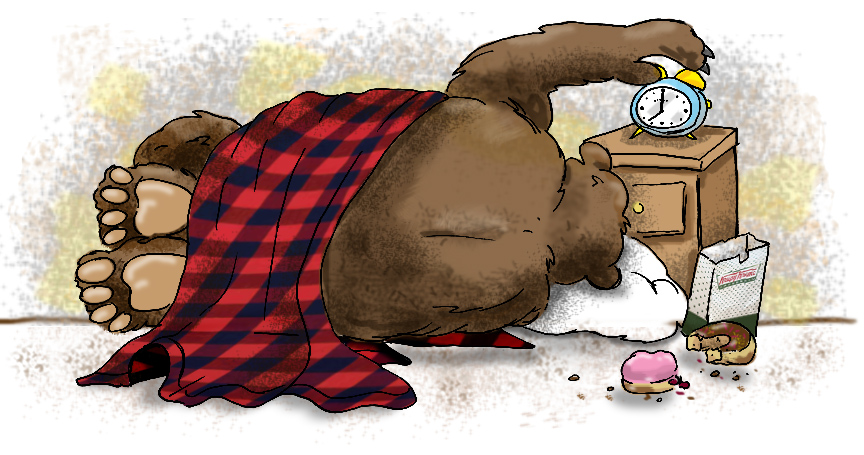
“Grrr … just five more minutes… okay?”
from my sketchbook: eric fleming

Rugged, good-looking Eric Fleming began his acting career in low-budget features like Curse of the Undead and Queen of Outer Space opposite Zsa Zsa Gabor (yes, she was actually in movies). In 1958, the 6-foot 3-inch Eric was cast in Rawhide, a TV Western that joined the ranks and popularity of Gunsmoke, Bonanza and others of the genre. Eric starred as trail boss Gil Favor, alongside a then unknown actor named Clint Eastwood. The series also featured Sheb Wooley, whose novelty song “Purple People Eater” reached number one on the charts the year Rawhide premiered.
After the cancellation of Rawhide in 1966, Eric starred with Doris Day and an ensemble cast in The Glass Bottom Boat, a typical madcap spy comedy. Soon afterward, he signed on to join the cast of High Jungle, an MGM adventure film to be shot on location in Peru.
During the final days of filming High Jungle, Eric and fellow actor Nico Minardos were shooting a climactic scene in a canoe on the rough waters of the Huallaga River. The canoe overturned. Minardos was able to swim to safety, but Eric was swept up in the churning current. His mutilated body was discovered downstream four days later. Eric was 41 years old and had planned to marry his fiancee days after production wrapped.
Comments
from my sketchbook: peaches heenan browning
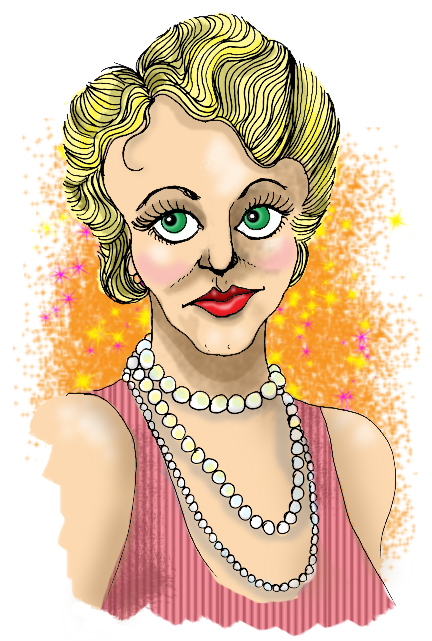
Sixty-five years before Anna Nicole Smith set her sights on oil tycoon J. Howard Marshall, there was Peaches.
Wealthy New York real estate mogul Edward Browning just couldn’t pick women. At 41, Edward married Adele Lowen, a young lady 18 years his junior. Edward showered his new bride with gifts and jewels and furs and an opulent home. When Adele wished for children, Edward placed an ad in the newspaper seeking to adopt. The couple adopted two daughters, but a bored Adele soon contracted gonorrhea from an extra-martial affair and the couple divorced in 1923.
Edward met Frances Heenan at a dance in March 1926. She was weeks away from her sixteenth birthday and 51-year old Edward was smitten, professing his love to “the girl of his dreams”. Reporters followed the new couple around New York, as Edward purchased anything and everything Frances laid eyes on. The press nicknamed them “Peaches and Daddy”. They married in late June 1926. The bride sported four diamond-encrusted platinum bracelets. The groom was all smiles.
The marriage lasted until October, when Peaches cleared $30,000 worth of clothing and jewelry from her closet and ran home to her mother. She portrayed herself as the victim of a “perverted monster”, as he called her husband. At the January divorce proceedings, Peaches told nightmarish stories of how Edward kept a honking African goose in their bedroom. Through tears, she related how he forced her to look at pornographic magazines and insisted she eat her breakfast in the nude. She delivered her horrific tale of marital grief while draped in an $11,000 Russian sable coat. “I’m a good girl,” Peaches attested. When Edward took the stand, he painted a very different picture. Edward said that his poor, little “dream girl” had never acted as a wife and had never even kissed him. Peaches and her mother, he claimed, were nothing but a pair of gold-digging schemers. Then, Edward’s attorney produced evidence of a heavily-populated roster of Peaches’ spurned former boyfriends. The judge agreed that Peaches had abandoned her husband without cause and ruled in favor of Edward.
Peaches parlayed her fleeting notoriety as her ticket to enter vaudeville. Although she never achieved the stardom she desired, she did snag three more husbands along the way. In 1956, she accidentally slipped in her bathroom — an accident that proved fatal. Peaches was 46.
Comments
from my sketchbook: chico ruiz
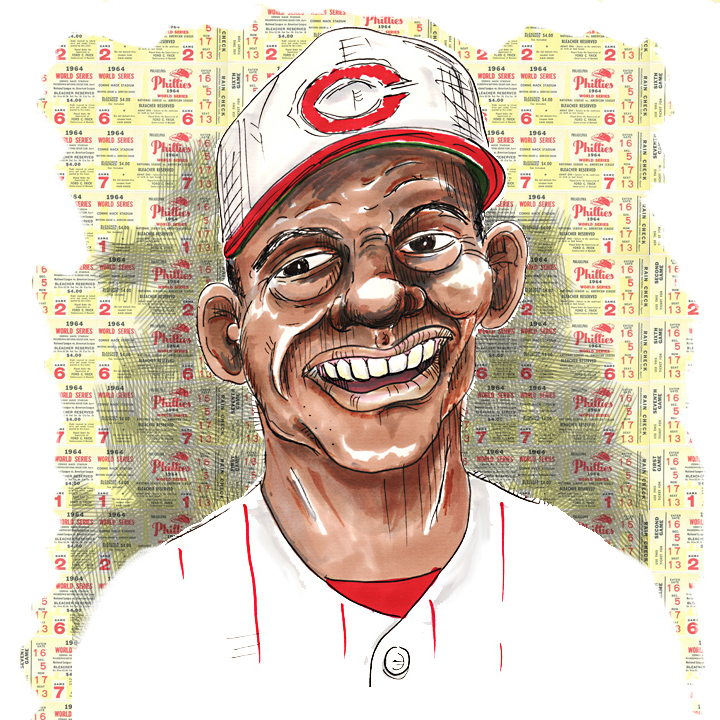
Chico Ruiz had an unremarkable career. He hit two home runs in his rookie season and never hit another. He played eight seasons in the majors with a lifetime batting average of .240. About average.
But, on September 21, 1964, Chico Ruiz became the bane of every baseball fan in Philadelphia.
In a scoreless game between the league-leading Philadelphia Phillies and the second place Cincinnati Reds, Chico Ruiz did the unthinkable, the unimaginable, the inconceivable… and got away with it. With one out and clean-up power-hitter Frank Robinson at the plate, Chico Ruiz stole home. The Phillies, who held a six and a half game lead and had the taste of the World Series on their collective lips, watched helplessly as the collapse of their team began. Shocked Phillies pitcher Art Mahaffey wildly threw the ball to catcher Clay Dalrymple as Chico slid across the dish to score the only run in that game. The Phillies lost the next ten games and saw their post-season hopes carried away on the shoulders of the rival Reds.
In 1967, Reds’ struggling rookie catcher Johnny Bench was 0 for 3, when Chico was sent in to pinch-hit for him in the 9th inning of the game. Little did Chico know he would be the only player in history to ever pinch-hit for future Hall-of-Famer Bench. In 1969, Chico was traded to the California Angels, where he allegedly brought a gun to the locker room and threatened a teammate.
In the early morning hours of February 9, 1972, Chico was driving alone just outside of San Diego, when he wrapped his car around a sign pole. He was scheduled to report to Spring Training with his new team, the Kansas City Royals, in three weeks. Chico was 33 and had just become a United States citizen one month earlier.
Comments
IF: ferocious
THe current Illustration Friday challenge word is “ferocious”.

This is Grim Ruthless, the most ferocious man to ever live. He eats termite-infested tree trunks for breakfast. He lives in a huge boulder that he hollowed out with his teeth and bare hands. His living room has wall-to-wall broken glass. He once beat up a dump truck for a parking space. He ripped a man’s lungs right out of his chest just for looking at him the wrong way. He juggles rabid porcupines for exercise.
And worst, most heinous of all…
He goes to the “12 items or less” check-out line with 14 items.
Ooooooohhhhh.
Comments
DCS: amanda blake
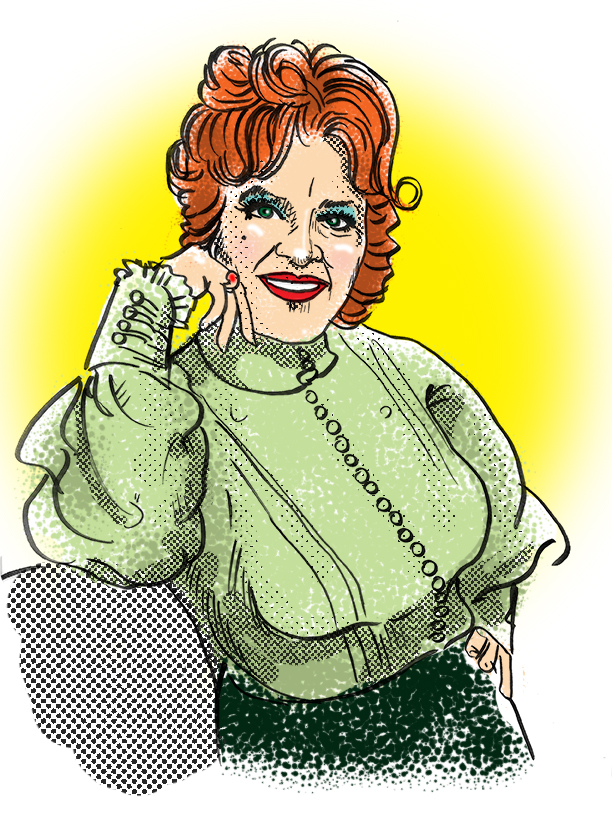
Beverly Neill was working as a telephone operator when she began to take some small roles in a few MGM productions. Using the stage name “Amanda Blake” , she appeared with Judy Garland and James Mason in the first remake of A Star is Born in 1954. The following year, she signed on for the role for which she would be most remembered. Amanda played barkeeper Miss Kitty Russell for nineteen years on Gunsmoke, the longest running Western in television history. In 1968, Amanda was inducted into the Hall of Great Western Performers at the National Cowboy & Western Heritage Museum. She was the third performer, after Tom Mix and Gary Cooper, to be given such an honor.
After 425 episodes of Gunsmoke, Amanda called it quits, commenting “‘God, if I have to put on that damn bustle and those curls one more time, I’m gonna snap!” The series lasted one season without Amanda before it was canceled. Amanda guest-starred on several television shows including The Match Game and a Gunsmoke cast reunion on The Love Boat. But soon, the demand for roles dwindled and Amanda devoted her new-found free time to animal-welfare causes. She partially financed the start-up of the Performing Animal Welfare Society (PAWS) and devoted a great deal of time and money in support of its efforts.
A life-long smoker of two to three packs a day, Amanda was diagnosed with mouth and throat cancer. She underwent oral cancer surgery and entered therapy to regain speech. She was moved to become an advocate for warning labels on cigarette packages and spoke before a United States House of Representatives subcommittee.
Amanda passed away in 1989 at the age of 60. Despite her cancer, the official cause of death was listed as cardiopulmonary arrest due to liver failure and CMV hepatitis, which is AIDS-related. It is believed that Amanda contracted the disease from her last husband who was openly bisexual and had passed away three years earlier.
Comments
from my sketchbook: vicki morgan

Vicki Morgan wanted everything – money, sex, drugs, fame – and for the most part, she got it.
Born in Colorado, the sixteen-year old willowy beauty was sent to a Catholic maternity home for girls in Los Angeles to hide her family’s shame over her unwanted pregnancy. At seventeen, she married Earle Lamm, thirty years her senior. He was interested in Vicki only as a sex object, persuading her to join in lesbian threesomes and pedophilliac role-play fantasy in which he dressed her as a schoolgirl, in exchange for a lavish lifestyle.
She began working as an usher at Graumann’s Chinese Theatre. She hoped to rub elbows with “Hollywood types” and jump-start her dreams of modeling and acting. It was at Graumann’s that young Vicki met 54-year old multimillionaire Alfred Bloomingdale, of the famed New York department store. Bloomingdale mentioned that he had a daughter Vicki’s age and the two should get together for tennis. Tennis was the last thing on Bloomingdale’s mind.
Vicki became Bloomingdale’s mistress. For twelve years, Bloomingdale showered Vicki with jewelry, clothes, vacations anything she wished for… and she wished for a lot! Bloomingdale paraded Vicki around in front of friends and colleagues like a trophy. And Vicki loved every minute of it. Betsy Bloomingdale, while fully aware of the relationship between Vicki and her husband, refused to acknowledge it. During her years with Bloomingdale, Vicki also had a whirlwind tryst with Princess al-Jauhara, daughter of King Faisal of Saudi Arabia. They partied long and hard and their affair ended with in Vicki’s words “a sex and drugs bacchanal cruise to Hawaii.” Upon returning from the cruise, Vicki checked into rehab for treatment for addiction and depression.
In 1982, Alfred was diagnosed with terminal cancer. Betsy took control of the couple’s finances and immediately cut Vicki off. Vicki hired noted attorney Marvin Mitchelson and filed a palimony suit. The pre-trial coverage caused a huge scandal in Washington political and social circles because of Bloomingdale’s connections to President and Mrs. Reagan and his membership to the United States Advisory Commission on Public Diplomacy. Vicki learned of a dinner meeting Mitchelson took at the White House. She lost trust in Mitchelson and fired him. At the trial, Betsy testified that Vicki was a very well-compensated prostitute and was entitled to nothing more than she already received. The judge agreed and the the case was dismissed.
With no income, Vicki began to sell jewelry and other possessions. She also prepared to write a “tell-all” book, detailing the sexual escapades she shared with famous businessmen and politicians. She was forced out of her plush Bloomingdale-supported LA apartment and into a small condo in the San Fernando Valley. She shared the condo with Marvin Pancoast, a man with a history of mental illness including schizophrenia, whom she met during her brief stay at a drug rehab clinic. Their time together was short, as the condo’s management threatened eviction for non-payment of rent. Vicki demanded that Marvin find alternative living quarters for the two of them, but none of his suggestions met with her satisfaction.
At 3:20 a.m. on July 7, 1983, Marvin Pancoast wandered into a North Hollywood police station and informed the desk officer on duty, “I just killed someone.” He willingly gave details to the police. He told how he was tired of hearing her complaints and being treated as “her little slave boy”. He explained that he searched the garage, found a baseball bat, returned to her bedroom and beat her to death. Vicki was a month shy of her 31st birthday. Investigators found the scene at the condo just as Marvin had described. Marvin was sentenced to twenty-six years. He died of AIDS in prison after serving eight.
A subsequent appeal to the palimony suit resulted in a settlement of $200,000. The money was awarded to Vicki’s grown son.
Comments
IF: mesmerizing
This week’s Illustration Friday challenge word is “mesmerizing”.
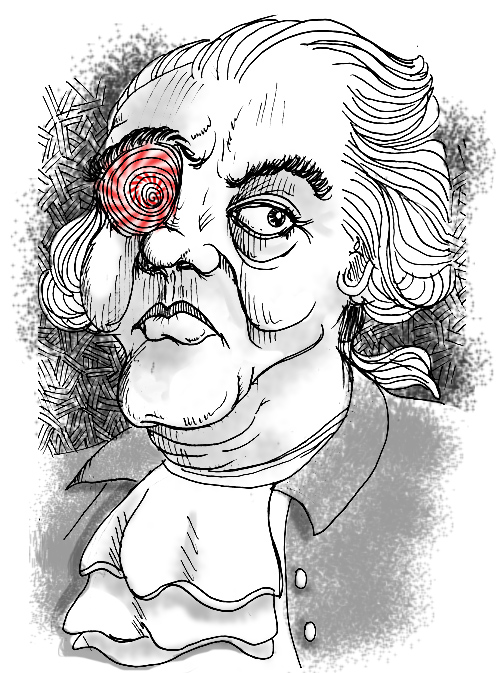
In his doctoral dissertation of 1766, De influxu planetarum in corpus humanum [“The Influence of the Planets upon the Human Body”], physician Franz Mesmer theorized that a natural energy force exists and flows continuously over the body. He publicized his belief that this energy was influenced by the positions of the stars, planets and other natural occurrences. He conducted numerous tests on this “animal magnetism” (as he called it) using techniques of touching, intense staring, waving magnetic wands and even the high-pitched tones of the glass armonica.
Mesmer left Vienna in 1777 after his claim to bring a cure for blindness failed on an 18-year old patient. He moved to Paris where he continued to proliferate his theories. In 1784, King Louis XVI organized a committee to investigate Mesmer’s practices and claims. The group of four prominent and honorable commissioners from the Royal Academy of Sciences included:
- Antoine Lavoisier, the father of modern chemistry, who assembled the first list of elements and was also instrumental in the development of the metric system
- Jean Sylvain Bailly, a noted astronomer and scientific historian
- Joseph-Ignace Guillotin, a respected physician and supporter of the smallpox vaccine pioneered by colleague Edward Jenner
- Benjamin Franklin, inventor and American ambassador to France
After careful consideration and investigation, the committee ultimately determined Mesmer to be full of shit. He was driven into exile and died in shame in obscurity in 1815.
And he outlived every member of the committee*.
* It is interesting to note that two of the four commissioners of the investigating committee, Antoine Lavoisier and Jean Sylvain Bailly, died on the guillotine during the Reign of Terror after the onset of the French Revolution. Although Dr. Joseph-Ignace Guillotin advocated the use of the mechanized decapitation device, he did not die on it. Another physician with a similar name, Dr. J.M.V. Guillotin from Lyon, France, was executed on the guillotine. Dr. Joseph-Ignace Guillotin, who despised and shunned his association with the execution apparatus, died of natural causes in 1814.
Based on stories about the many, many illegitimate children he fathered, Benjamin Franklin obviously died from exhaustion in 1790.
Comments
IF: boundaries
This week’s Illustration Friday challenge word is “boundaries”.
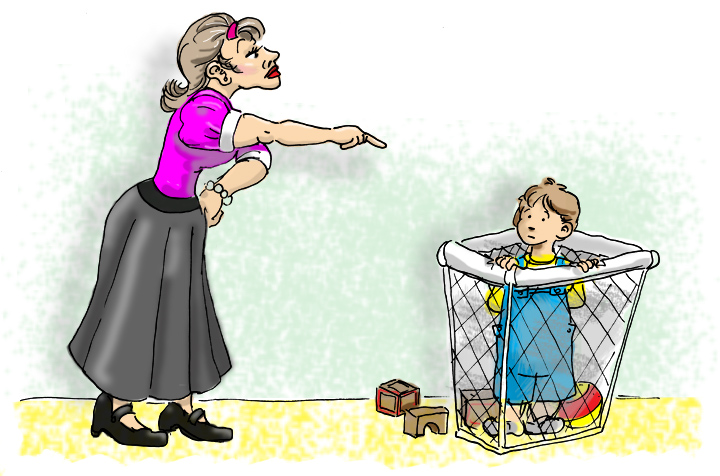
Mother lays down boundaries to keep baby …um …safe.
That’s right.
Safe.
Comments
from my sketchbook: fanny adams
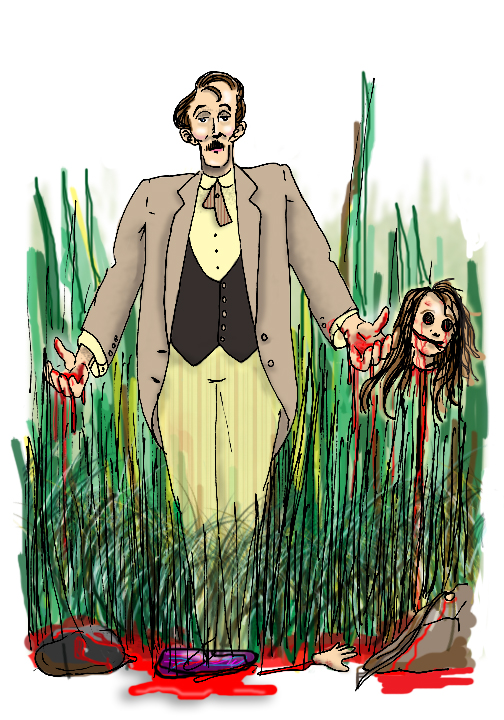
On a bright August afternoon in 1867, eight-year old Fanny Adams, along with her little sister Lizzie and her friend Minnie Warner, went to play near Flood Meadow, just up Tan House Lane from her home in southeast England.
While the girls played, they were approached by Frederick Baker, a 29-year old, well-dressed solicitor’s clerk. Baker offered Minnie and Lizzie three halfpence to run off and buy candy. He offered Fanny one halfpence to accompany him up the road to the village of Shalden. Fanny took the coin, but refused to leave. Baker picked Fanny up and carried her into a nearby field and out of the sight of her playmates. Unfazed, Lizzie and Minnie played for several more hours until they decided to head home.
Fanny’s mother questioned the girls as to Fanny’s whereabouts. The girls told her of the man and the monetary offerings. A panicked Mrs. Adams and a neighbor ran up Tan House Lane and were met by Frederick Baker, calmly strolling towards them. They asked him about Fanny. He told them he had given the girls money for sweets, as he often does, but that was all. He said the three girls left together. Impressed by his calm demeanor, his fine clothes and his air of respectability, the women let him go.
As evening fell and Fanny had still not returned home, more of the Adams’ neighbors formed a search party and scoured a wider area. Around 7 PM, they discovered Fanny’s horribly butchered remains strewn across the field at the end of Tan House Lane. Her severed head, eyes removed, was perched atop a pole. Her torso had been cut open and her internal organs were tossed in all directions. Her arms and legs had also been dismembered and lay in several locations throughout the field. Mrs. Adams ran to where her husband and some colleagues were playing cricket. Upon hearing the full report from his wife, Mr. Adams went home to get a shotgun and hunt for Frederick Baker, but neighbors talked him out of it.
Later in the evening, police arrested Frederick Baker at the office of his employer, respected solicitor William Clement. Baker’s clothes had several unexplained blood stains on them. A search of his desk yielded two blood-stained knives as well as a personal journal with the August 24 entry: “Killed a young girl. It was fine and hot”. When police questioned him as to why his pants and shoes were wet. He said he liked to walk through water and followed that with a sarcastic “I won’t hang for that, will I?”
At an inquest (sort of a grand jury), Baker maintained his innocence, despite the testimony of several witnesses and a coroner’s report identifying a rock from the field as the murder weapon and the two knives as the instruments of dismemberment. At the close of the trial, the jury took fifteen minutes to return with a guilty verdict. Frederick Baker was hanged on Christmas Eve 1867, before a crowd of 5,000.
An elaborate headstone for Fanny Adams’ grave was purchased from public donations.
(In 1869, the Royal Navy began issuing tins of mutton stew as meal rations to sailors. The tasteless meals were likened to the remains of Fanny Adams. “Sweet Fanny Adams” became slang for anything worthless and was eventually shortened to “Sweet F. A.”)