DCS: johnny stompanato

Nobody knows where my Johnny has gone
In 1958, Lana Turner was between husband number five and husband number six when she entered into a torrid and volatile relationship with Johnny Stompanato. Johnny was the bodyguard for notorious gangster Mickey Cohen. Lana didn’t care about Johnny’s connections. She was content with his dark good looks and expertise as a lover. So, he had a temper and he was possessive. Lana took the good with the bad.

Lana’s teenage daughter, Cheryl Crane, was leery of Johnny. Although she never actually saw Johnny hit her mother, Cheryl was aware of the welts and bruises Lana often displayed. Cheryl threatened to expose Johnny’s ways to her father (Lana’s second husband, international restaurateur Joseph Crane). Lana pleaded to keep the beatings a secret and Cheryl reluctantly complied.

One night in April 1958, Lana and Johnny were having a particularly heated argument behind the closed door of Lana’s Beverly Hills bedroom. Cheryl heard the yelling through the walls of her own room. She became worried for her mother’s well-being. An anxious Cheryl hurried downstairs searching for something to use to defend herself and her mother. She grabbed the first thing she saw in the kitchen — a large knife.

Cheryl returned to the second floor and stood outside her mother’s bedroom, knife poised in her hand. Suddenly, the door flew open and Johnny, still screaming, stormed out of the room. He was still facing the interior of the room as he exited and walked right into waiting knife blade. Johnny fell to the floor dead.

Lana Turner’s testimony at the subsequent trial was believed by many to have been the greatest acting performance. Cheryl took full responsibility for the stabbing, although she claimed self-defense. Public opinion was that Cheryl was taking the fall for her mother, knowing that, as a minor, she would serve a sentence that would be far less severe. Cheryl, found guilty of justifiable homicide, was ordered by the court to spend two years in a facility as a ward of the state. A facility from which she escaped after a year.

In her 1988 autobiography, in addition to coming out as a lesbian and revealing that, as a child, she had been repeatedly molested by Lana Turner’s fourth husband actor Lex Barker, Cheryl Crane again confirmed the true story of Johnny Stompanato’s death.

Comments

comments

IF: paisley

The current Illustration Friday challenge word is “paisley”.

Yes sir, Mr. Paisley!
Gerome Ragni performed in several small theatre productions until he collaborated with fellow actor James Rado on the first Broadway musical to celebrate hippie culture — Hair. Hair  was unlike anything that was previously presented on the Great White Way. Audiences were assaulted and enraptured by free-form dancing, strange and wild staging, offbeat and topical rock songs, psychedelic and paisley-patterned costumes and nudity for nudity’s sake. It opened on April 29, 1968 and ran for 1750 performances. Gerome Ragni played the lead role of counter-culture tribe leader Berger.

When I was seven years-old, I discovered the original Broadway cast recording of Hair  in a stack of records at my Aunt Claire’s house. I popped the disk onto the turntable of her hi-fi and dropped the needle. I was hooked. I played that record over and over and over again. I dragged that record out on every visit to my aunt’s house. I finally bought the record myself and repeated the ritual at my own house. I knew every word to every song. I knew the dirty song lyrics, too, even if I didn’t know their meaning. I sang along when The Fifth Dimensions’ version of “Aquarius” or The Cowsills’ take on “Hair” came on the radio, and I pointed out when they altered the lyrics slightly from the original. In 1969, the touring company of Hair  came to the Schubert Theater (now the Merriam) in Philadelphia. My mom allowed me to skip third grade for a day and took me to a matinee performance. As we walked up Broad Street toward the theater, we noticed a commotion outside. A dozen or so people — men and women — were marching in a circle on the sidewalk in front of the theater’s entrance. They held signs and chanted, trying to discourage people from seeing the show. With tickets firmly in one hand and my  little hand firmly in the other, my mom cut through the line of protesters. One stern-looking woman yelled at my mother, “How dare  you take that young child in to see this smut!”  My mother shot back, “Have you seen it?” “Oh my goodness! NO!”, the woman protester replied, outraged at my mother’s insinuation. “Well, after I see it, I’ll let you know how it is.”, my mother called back over her shoulder, as she and I walked through the theater doors. I stuck my tongue out at the lady as the door shut behind me.

The Broadway production of Hair  was a traumatic experience for Gerome Ragni. The show’s immediate popularity made him very wealthy very quickly and he had a difficult time dealing with the instant fame. His marriage broke up and he disappeared from mainstream society. He joined a religious cult and contributed money to the Black Panther Party and Yippie causes. His belabored follow-up to Hair, a show called Dude, opened on Broadway in 1972 and closed after sixteen performances. Gerome was working on a new musical when he passed away in 1991 at the age of 55.

Comments

comments

from my sketchbook: meredith hunter

Hey! Said my name is called disturbance. I'll shout and scream, I'll kill the king, I'll rail at all his servants
Eighteen-year old Meredith Hunter, known to his friends as “Murdock”, picked up his girlfriend Patty Bredahoff early on December 6, 1969. Meredith, a flashy dresser with a large Afro, was decked out in a lime green suit and matching derby hat. His destination was an all-day concert at Altamont Speedway featuring some of the top performers of the day — Santana, Jefferson Airplane, The Flying Burrito Brothers, Crosby, Stills, Nash & Young — and culminating with the legendary Rolling Stones. The concert was his destination, but his destiny was very different.

The Stones had hired infamous Southern California motorcycle club Hell’s Angels for security at the concert. As part of their payment, the Angels were provided with $500 worth of beer. The burly Angels created a human barrier between the performers on the unusually low stage and the increasingly unruly crowd. As the day progressed and as the audience and security crew became more intoxicated, the situation grew violent — so violent in fact, that The Grateful Dead refused to take the stage moments before their scheduled performance time.

The Angels were drunk. The crowd was stoned on amphetamines and LSD. Sporadic fights erupted throughout the confluence . Projectiles flew towards the stage. The Hell’s Angels retaliated by swinging pool cues and motorcycle chains and hurling full cans of beer at the crowd. In the early evening, The Rolling Stones took the stage, led by a visibly shaken Mick Jagger. Jagger pleaded with the crowd to “Just be cool down in the front there, don’t push around.” The Stones began their set. During their third song — “Under My Thumb” — Meredith Hunter made the decision to climb on stage. He met the full resistance of Hell’s Angels. One of the Angels punched Meredith in the head. He fell and disappeared in to the swelling crowd. Seconds later, Meredith resurfaced with a murderous and vengeful look in his eye. And, this time he was pointing the long barrel of a silver handgun at the stage. As Meredith pulled the trigger, Hells Angel Alan Passaro knocked the gun from his hand. Then, Passaro thrust a knife into Meredith’s back. Passaro stabbed Meredith several more times as other Angels stomped and kicked the eighteen-year old while he lay on the ground.

Passaro was arrested and charged with Meredith’s murder, but was acquitted on the grounds of self-defense after the jury viewed the footage from the concert showing Meredith drawing the revolver and pointing it toward the stage. An autopsy revealed that Meredith had been heavily intoxicated on methamphetamine.

Shortly after the incident, Meredith’s mother requested that Altamont Speedway be turned into a public park to “prevent any more wrongful deaths”. Alameda County officials allowed the Altamont to still host races, but barred any future concerts. She also sued the Rolling Stones for wrongful death and made an out-of-court settlement for $10,000.

In 1985, Alan Passaro was found dead, floating in Santa Clara County’s Anderson Reservoir with $10,000 in his pocket. No one was ever charged with his murder.

Comments

comments

IF: ripple

This week’s Illustration Friday challenge word is “ripple” and it came with a brief request. I will paraphrase from the weekly notification email: “The subject should pertain somehow to the Gulf – the oil spill – the oceans and the creatures that live in it and around it.”
Reach out your hand if your cup be empty, If your cup is full may it be again, Let it be known there is a fountain, That was not made by the hands of men
“Where did you get this bottle of Ripple, ya big dummy? Down at the BP station?”

Comments

comments

from my sketchbook: conflict on mockingbird lane

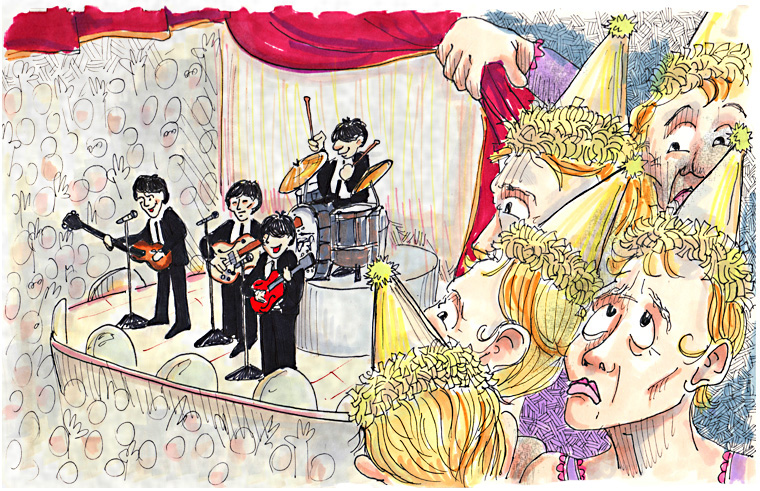
With their time winding down on the popular sitcom Leave It to Beaver, Bob Mosher and Joe Connelly began working up ideas for a new show. It would be a parody of the typical depiction of the American family à la Donna Reed. Only this family would be a family of monsters.

Mosher and Connelly knew casting would be crucial for the show’s success. They offered the role of mad scientist vampire Grandpa to veteran actor and vaudeville comic Bert Lahr, best known as the Cowardly Lion in the 1939 classic The Wizard of Oz. The role of family patriarch Herman Munster was pitched to horror film actor John Carradine. Both actors turned the respective roles down, although Carradine popped up later in the series as Herman’s funeral home boss, Mr. Gateman. Connelly offered the part of Grandpa to Al Lewis. Lewis was a former burlesque comic who laid claim to an illustrious collection of past employment including circus clown, Ebbets Field hot dog vendor and professional basketball scout. The part of Herman was given to actor and one-time editor of Harvard Lampoon Fred Gwynne. Lewis and Gwynne had previously worked together in producer Nat Hiken’s sitcom Car 54, Where Are You?  With two proven comedic talents onboard, Mosher and Connelly were faced with casting the right actress to play the pivotal role of Lily, Herman’s monstrous, yet level-headed, wife. They nabbed glamorous Hollywood starlet Yvonne DeCarlo. Gwynne and Lewis were furious and the complaining began.

Yvonne, who felt she was above playing in a sitcom (even though she agreed to the role) behaved “holier-than-thou.” “She stayed in her dressing room while we were outside, just waiting for her.,” Gwynne remembered. Yvonne regularly held up production with her constant adjustments to make-up, hair, and nails. She dictated which scenes would be shot, all from the vantage of her convenience. Gwynne and Lewis became enraged as production halted and the crew waited. Finally Al Lewis had taken enough and pulled aside the beauty queen and confronted her about her demanding attitude.” Abe Haberman, Yvonne’s personal make-up man, said, “Yvonne was a little difficult for other people. She fired five hairdressers. She hated the green make-up, insisting she should look more beautiful, but the network refused.” The two younger members of the cast – Beverley Owen (and later, Pat Priest) who played Marilyn Munster and Butch Patrick who played little Eddie Munster – did their best to avoid the on-set fireworks.

The Munsters was incredibly popular, yet it was canceled after only two seasons. Nobody understood the reason for its termination, but producer Joe Connelly explained the reason for the show’s end. “The actors were a pain in the ass. Fred and Al objected to everything. Fred hated the make-up and caused a lot of trouble about it on the set. We could not stand Fred Gwynne, Al Lewis and Yvonne DeCarlo.” Connelly dealt with what he felt was incessant and obnoxious complaining. “We had to put up with a lot of shit from them. The sponsor had enough and Bob Mosher and I had just had enough, too.”

Comments

comments

IF: trail

This week’s challenge word on Illustration Friday is “trail”.
With my knees in the saddle and seat in the sky/I'll quit punchin' cows in the sweet by and by

Ghost hunters, ghost seekers, paranormal investigators, ghost busters, ghost chasers. Whatever they wish to be called, they are always on the trail of a ghost.

They come armed with an arsenal of sophisticated hi-tech equipment like true infrared digital cameras, non-contact infrared thermometers, microlight red light flashlights and electrosensor electromagnetic field detector meters. Some like to go the spiritual route by carrying crystals and various other talismans. Still others follow the religious path wielding crosses, holy images and scripture. With their night vision goggles and ultra-sensitive recording and imaging devices, they seek a portal to the supernatural world to retrieve concrete evidence of ghosts. They face one huge obstacle, though.

There ain’t no fucking ghosts!

Comments

comments

from my sketchbook: wally cox

not plane, nor bird or even frog
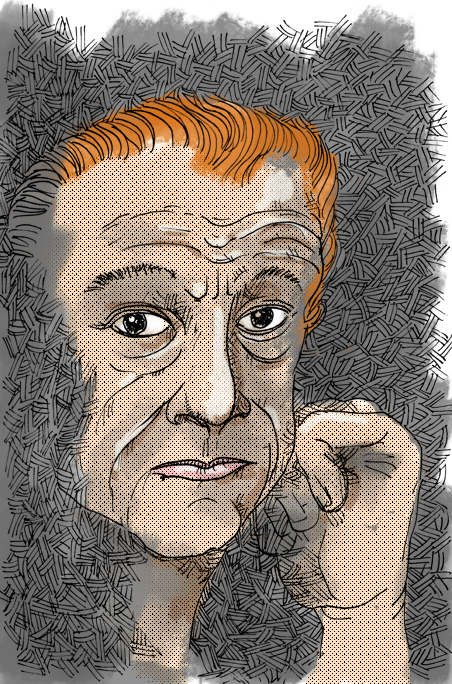
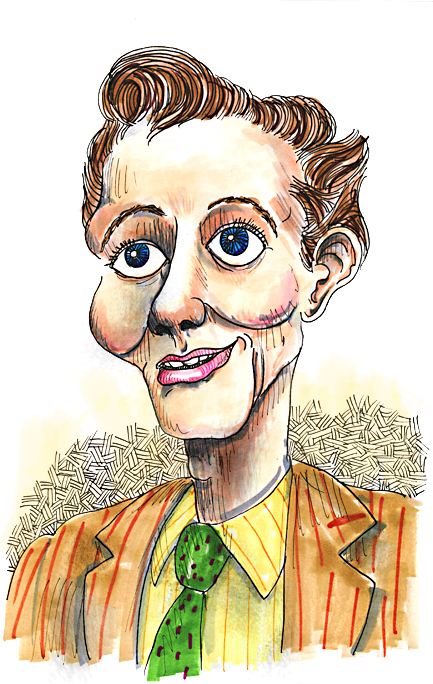
Wally Cox hated the role that made him famous. After beginning his career as a stand-up comedian, he starred for three seasons as mild-mannered science teacher Robinson Peepers in “Mr. Peepers”, an early sitcom that co-starred Tony Randall, Jack Warden and Marion Lorne. In interviews, Wally constantly argued unsuccessfully that he was nothing like the shy and timid character he portrayed. In reality, Wally was married three times. He was very athletic and he often hiked and rode a motorcycle.

In the early 1960s, he lent his voice to Underdog, a cartoon character that was a loose parody of Superman. Wally appeared in over twenty motion pictures, including several Disney productions and the unfinished final Marilyn Monroe vehicle “Something’s Got To Give”. He also appeared in guest-star roles on numerous network shows, including “The Dick Van Dyke Show”, “Bonanza” and several episodes of “The Beverly Hillbillies”. Later, he became a staple on the popular, long-running game show “Hollywood Squares”. His meek character was again exploited on “Hollywood Squares” and Wally often gave sarcastic answers to play against type.

In 1973, during his run on “Hollywood Squares”, 48-year old Wally Cox died from a heart attack. Unconfirmed rumors suggest it was brought on by an overdose of sleeping pills. An unannounced, surprise guest showed up at his wake. It was Wally’s lifelong friend Marlon Brando. Wally and Brando had been roommates in the late 1940s and remained close their entire lives. Brando was visibly upset by the loss of his friend. After cremation, Wally’s remains were given to Brando, where he kept them in a special container in a closet in his home. Sometimes, Brando later stated, conversing with Wally’s remains made him feel better when he was depressed. When Brando passed away in 2004, he, too, was cremated. Family members mixed his ashes with those of Wally Cox and scattered them in Death Valley, California.

Interestingly, in the early 1970s, character actor Bud Cort (“MASH”, “Harold and Maude”) had to adopt a stage name in order to join the Screen Actors Guild. Cort’s real name is Wally Cox.

Comments

comments

IF: slither

This week’s Illustration Friday challenge word is “slither”.
This is the lion’s den/I hope you knew that before you came in/This is where the angels and the devils fight/And they're choosing up sides tonight
The remarkable Prince Randian was one of the most successful sideshow performers of the 1930s. He was brought from his native British Guyana to the United States by showman P.T. Barnum in 1889. Despite being born with no arms and no legs, Prince Randian demonstrated his ability to shave, write, paint and roll and light a cigarette with expert proficiency. He even kept his smoking materials in a wooden box that he built himself with a hammer and saw. He often joked that one day he would build a house himself.

Barnum billed Prince Randian as “The Human Caterpillar”, who slithers on his belly like a reptile. When he performed, Randian wore a knit sack-like garment that emphasized his distinctive limbless torso.

Randian appeared in the 1932 classic Freaks directed by Tod Browning. In a memorable scene, Randian lights a cigarette with a match. He then blows out the flame as he exhales his first puff. Although he spoke four languages fluently, his only line of dialogue is delivered with an incomprehensible accent. (He actually asks another able-bodied actor “Can you do anything with your eyebrows?”) Later in the film, he is seen gripping a dagger in his teeth while crawling through the mud with his colleagues.

Prince Randian was married to “Princess Sarah,” and had five children. Shortly after a performance at the 14th Street Museum in New York City, Prince Randian passed away in 1934 at the age of 63.

Here is Prince Randian’s cigarette-lighting scene from Freaks:

Comments

comments

from my sketchbook: sanae zahani

I'm crying tears from my eyes that I can't deny and I am falling like a comet from the broken sky
Dante Gaudio, an account executive at the New York Times, wished to offer help in a time of need. In the days following September 11, 2001, Gaudio posted fliers in the area of the decimated World Trade Center offering lodging to family members of the missing. He received a call from a distraught young woman. Gaudio told her his location and invited her over.

Soon after, Gaudio opened his door to a sad young woman. Although her passport said Sanae Zehovani, she identified herself as Sanae Zahani. She was 20-years old and had come to the United States from Casablanca, Morocco in July. She had been working in a dentist’s office in Baltimore, but came to New York City to look for her sister. Aneda (or Neda, as the young woman called her) worked for Cantor Fitzgerald, a global financial services firm whose headquarters were located in World Trade Center Tower One. Almost seven hundred employees of Cantor Fitzgerald were killed when a jet crashed into Tower One. Sanae’s 26-year old sister was one of them.

The compassionate Gaudio drove Sanae to the New York Family Assistance Center, which had been set up at Pier 94. to help locate those who were missing or had perished in the World Trade Center attack. At the Center, Sanae filed a missing persons report and gave DNA swabs from inside her cheeks. She visited the Cantor Fitzgerald booth, but they could find no record of Aneda Zahani in their employ. Sanae noted that her sister was once married and could have used the last name “Apollo.” So, they researched “Aneda Apollo,” but again came up empty. Sanae explained that she may have been using an alias because of the possibility she was in the country illegally.

Sanae offered additional details about her sister. She informed Gaudio that she remembered that Neda lived near a train station and a jewelry store in Hoboken, NJ. Although she could not remember the address, she was sure she could find the apartment. While Sanae told her story to the Hoboken Police, she suddenly fainted in the police station. She was taken to a nearby hospital where she was given intravenous fluids until she was strong enough to be discharged. Sanea and Gaudio briefly cruised several Hoboken neighborhoods, but nothing seemed familiar.

A few days later, Sanae received a call from someone who had information about Neda. The caller spoke an Arabic dialect that Sanae didn’t understand. Gaudio knew a Moroccan woman he thought could help translate. The return phone number was lost in the confusion, but Gaudio’s Moroccan friend offered to have Sanea stay with her for a while. Sanae told her new host of her strict upbringing and how her mother shielded her and her sister from boys in Morocco. That is why she came to the United States.

Meanwhile, Gaudio hired a detective to track down the billing address for a cellphone that Sanae had gotten for Neda. It led to a man in Queens. He gave Sanae the number of another man who may have been Neda’s boyfriend. She called him, and he wasn’t helpful. Then another call came. Sanae began shaking and sobbing. It was the woman she was staying with in Baltimore. She told Sanae that her sister was alive and okay. Later, Sanae told Gaudio that she had spoken with her sister. She had managed to escape from her office at the World Trade Center. She received treatment for some injuries, but she was fine and was now in Baltimore. Relieved, Sanae along with Gaudio and his friend had a joyous celebration dinner. Sanae announced she would be leaving for Baltimore on September 24. Gaudio offered her $160 for her trip, but she refused all but $20 of it. She left New York, though she never officially closed her missing person case with the police.

– – –

Barbara Stout, an interfaith minister and Good Samaritan, also offered temporary housing for Ground Zero volunteers and out-of-town police officers. At 2:30 in the morning of September 26, an upset and exhausted young woman came to Reverend Stout. It was Sanae Zahani. Sanea related the same story she told Gaudio, except in this version, her sister was still missing.

Stout got Sanae accommodations at the YWCA. She volunteered to help Stout at her relief facilities, now located in a tent at the South Street Seaport. Sanae became very popular, making friends among the other volunteers. Firefighters and police officers invited her out regularly. Everyone was inspired by her story and was anxious to help find her sister in any way they could. Sanea had a photograph of her sister that she showed to everyone, including representatives from Cantor Fitzgerald. No one recognized the woman in the picture.

A fellow volunteer took Sanae to see The Rosie O’Donnell Show  and during an “audience questions” segment, Sanea spoke about her quest to find her missing sister. The touching story brought the audience to tears. She turned down offers of money from well-wishers, saying her only wish was to find her sister. In the weeks that followed, Sanae openly wept at a private tour of Ground Zero. She attended a memorial service for victims of the attacks and was presented with a container of ashes from the fateful site, along with an American flag. Soon, she said she was ready to return to Morocco and a sheriff drove her to the airport.

A few weeks later, she appeared again at Reverend Stout’s facility. She said her father had begun proceedings to collect compensation from Cantor Fitzgerald for the family’s loss. She said her sister had a car that was at the World Trade Center, and they wanted to collect for that, too. Sanae said she was off to file for a death certificate. This change in demeanor seemed odd to Stout. It was a different Sanae than she had known, but she figured that her father had made a convincing argument for practicality.

The next day, an article appeared in the New York Times about people missing from the World Trade Center who were later found to be alive. Dante Gaudio was quoted in the article, recounting Sanae’s successful search for her sister. Reverend Stout read the newspaper story and was dumbfounded. And she wept. Sanae never returned to Stout’s facility, however she did call. Stout questioned Sanae about her sister. Sanae insisted that she never implied that her sister was alive. She gave Stout the phone number for the attorney who was handling the case against Cantor Fitzgerald – a number that Stout later called. A number that rang and rang and rang. Sanae also produced a Social Security number for her sister. It was later determined that number was fictitious. Through a little investigation, Stout uncovered Sanae’s mother in Morocco. Through broken French and with the aid of a translator, Mrs. Zahani informed Stout that she only had one daughter in the New York area. Her name was Sanaa, but she had not heard from her in several months. Mrs. Zahani knew of Aneda, but confirmed that she was not family. She believed Aneda was a friend of Sanaa’s.

The last time Sanae was seen, she was headed to Brooklyn, she claimed, to meet with a lawyer. She disappeared as mysteriously as she appeared.

Comments

comments

from my sketchbook: tyler lambert

Now, the world don't move to the beat of just one drum, What might be right for you, may not be right for some.
In 1999, former child actress Dana Plato committed suicide at the age of 34. It was the culmination of a tumultuous life that went from starring in a popular weekly television series to robbing a video store and forging a prescription for Valium. The day before her suicide, an upbeat Plato appeared on The Howard Stern Radio Show  and happily subjected herself to a barrage of personal questions about her past.

On May 6, 2010, Plato’s 25-year-old son Tyler Lambert died from a self-inflicted gunshot wound to the head. A frequent drug and alcohol abuser, Lambert’s suicide came two days shy of the eleventh anniversary of his mother’s death.

Comments

comments