

“Hey McFly, you bojo! Those boards don’t work on water! Unless you got POWAH! “

After serving in the US Army during World War II, William Talman found work in Hollywood as a character actor, first in films then in various roles in anthology television series. In 1957, he went to an audition that would change his career. He read for the lead in a proposed courtroom drama series opposite another character actor Raymond Burr as the Los Angeles District Attorney. The series was based on the adventures of a lawyer named Perry Mason, a characetr created by former attorney turned author Erle Stanley Gardner. During the reading, Gardner suggested that William switch roles with Mr. Burr and television history was made. Perry Mason ran for nine years. It ranked in the top ten shows for six of those years. As the beleaguered DA Hamilton Burger, William suffered from the longest losing streak in history. Over the course of 271 episodes, William’s character lost all but three cases.
At the height of Perry Mason ‘s popularity, William was arrested on charges of “immoral conduct.” He was one of several guests at a Beverly Hills party that was raided by LA County deputies. Most of the guests (including William) were nude when authorities arrived on a tip to search for marijuana. Charges were dismissed when the judge ruled that “being naked in a private home cannot possibly be a crime.”
After Perry Mason was canceled, William appeared in guest roles on popular drama series, like Wild Wild West and The Virginian.
A life-long smoker, William was diagnosed with lung cancer. He became the first actor in Hollywood to film an anti-smoking commercial for the American Cancer Society. He requested that it not be shown until after his death. The commercial opened with William saying, “Before I die, I want to do what I can to leave a world free of cancer for my six children… ”
William filmed a second commercial at his home with his family and friend, co-star Raymond Burr. In the short film, he explained, “You know, I didn’t mind losing those courtroom battles, but I’m in a battle now I don’t want to lose at all. Because if I lose it, it means losing my wife and those kids you just met. I’ve got lung cancer…If you don’t smoke, don’t start. If you do smoke, quit! Don’t be a loser.”
Four weeks after filming, William passed away at the age of 53.
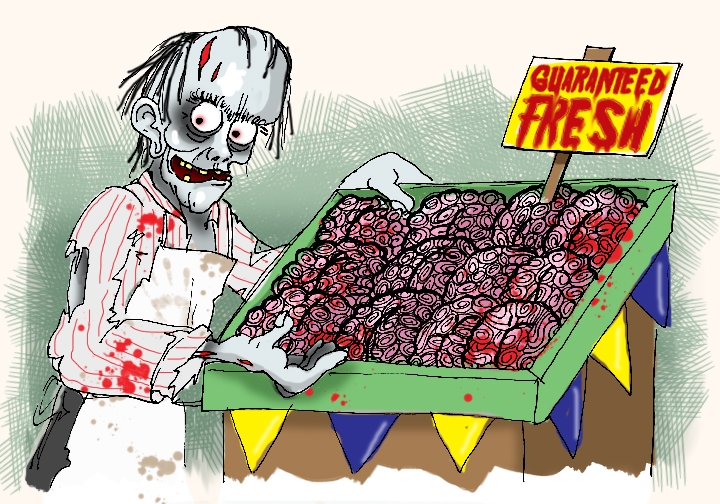
And then, over at the zombie supermarket…
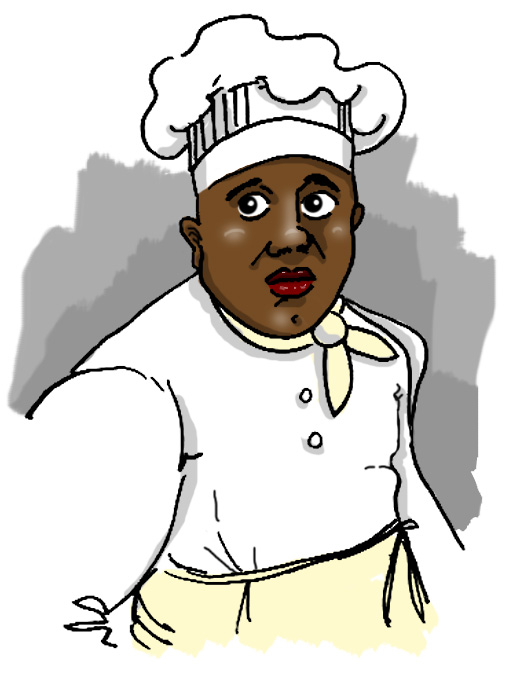
As a young boy, Dudley Dickerson was inspired by the Ringling Brothers Circus. After a stop in his hometown of Chickasha, Oklahoma, Dudley gathered some props left behind by the circus. He cobbled together an act, calling it “Pin-Penny Circus” and performed acrobatics under the name “Paddlefoot” Dickerson.
Soon, Dudley was off to California in pursuit of a career in show business. He became a regular performer at the popular Sebastian’s Cotton Club in Culver City (just outside of Los Angeles), appearing in the company of top names like Lionel Hampton and Louis Armstrong.
He made his big screen debut in 1932, playing the first of a long line of uncredited roles of janitors, porters, cooks, and various other servants. However, he was featured alongside some of Hollywood’s biggest stars like Joan Blondell, Dick Powell, Ann Southern and even Laurel and Hardy.
In 1940, he appeared with The Three Stooges in his most memorable role in “A Plumbing We Will Go.” Dudley, as an innocent cook, is besieged by the result of Moe, Larry and Curly’s incompetent plumbing solutions. As he tries to prepare a meal for a houseful of snobby guests, he slips and slides all over the flooded kitchen as water pours from the oven, clock and electric light fixtures. Bewildered, he exclaims, “This house has sho’ gone crazy!” before making a hasty exit. Dudley made appearances in nine more Stooges shorts, essentially reprising this role.
In the 1950s, Dudley was a semi-regular on the Amos ‘n’ Andy program, playing a character named Joe who had varied, but still menial, occupations. After filming the low-budget thriller The Alligator People in 1959, Dudley called it a career.
Dudley enjoyed some fleeting fame in the 1960s when a syndication package of Three Stooges short subjects was released to television stations across the country. In 1968, at the age of 61, Dudley passed away from a brain tumor.

In an effort to create a species of docile bees, the African honey bee was cross-bred with various European honey bees, like the Italian bee and the Iberian bee.
Oops.
The result was the total opposite of expectations. The new subspecies tends to swarm more frequently and travel further than other honey bees. They exhibit more defensive behavior when threatened. They pursue predators more aggressively and for a greater distance from the hive than other honey bees. They have a higher number of “guards” for their hives.
In other words, the experiment goofed. Big time.

Sheb Wooley was the real deal – born in Oklahoma on a ranch; grew up as a cowboy; became a rodeo star and formed a country & Western band. In the 1950s, Sheb moved to Hollywood and starred in dozens of Westerns, including High Noon, Giant and The Outlaw Josie Wales. On television, he appeared in The Adventures of Kit Carson, The Ranger Rider and the long-running series Rawhide with Eric Fleming and a young Clint Eastwood.
In the 1940s, Sheb took an interest in the budding career of his wife’s young cousin, Roger Miller. He taught the boy guitar chords and even bought him a fiddle and taught him how to play. Roger went on to become a renowned singer-songwriter, famous for his compositions “King of the Road” and “Dang Me,” and his Tony-winning score for the Broadway hit Big River. Roger won a record 11 Grammys, a feat eventually topped years later by Michael Jackson.
In 1958, while still maintaining an active acting career, Sheb topped the Billboard charts with his self-penned novelty hit, “Purple People Eater,” a song he wrote in an hour. The tune stayed at number 1 for six weeks. Sheb made several more appearances on the Billboard Hot Country & Western chart and was soon recruited for a new TV program highlighting rural music called Hee Haw. He appeared as a semi-regular using his alter-ego, a drunken cowboy named Ben Colder, and he also wrote the show’s theme song.
In 1951, Sheb co-starred in a film called Distant Drums with Gary Cooper. He also recorded a series of screams for the film to be used as sound effects when needed. During a scene in which a character is torn apart by an alligator, Sheb’s distinctive and plaintive yelp was dubbed in to the soundtrack. A few years later, sound man Charles Lang used Sheb’s scream in the film The Charge at Feather River, in which a Pvt. Wilhelm is shot. Since then, Sheb’s immortal holler – dubbed The Wilhelm Scream – has been used in over 200 films and has become a favorite (and sort-of inside joke) of Steven Spielberg, Quentin Tarantino, Peter Jackson, the Disney Studios and George Lucas. It has been included in every Star Wars and Indiana Jones film to date.
Just after his final film, Hoosiers with Gene Hackman, Sheb was diagnosed with leukemia and passed away in 1996 at the age of 82.
But his scream lives on.
* * * * * * * * * *
Hear Sheb Wooley’s legacy HERE.
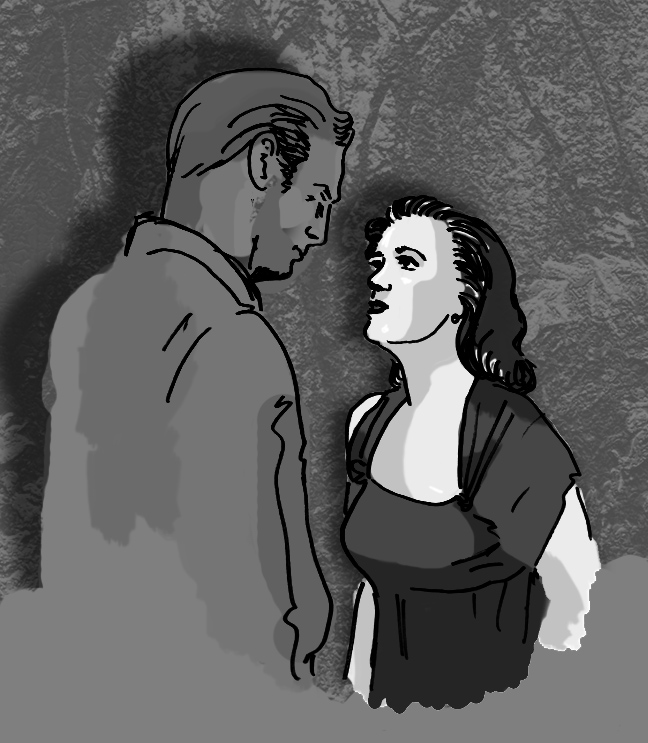
One of my favorite movies is Singin’ in the Rain. I have seen it countless times and I could watch it again and again without a second thought. Although it is primarily remembered as a showcase for the considerable dancing talents of Gene Kelly and Donald O’Connor, the film was recognized by the Academy of Motion Picture Arts and Sciences in only one acting category. Jean Hagen was nominated for Best Supporting Actress for her hilarious portrayal of the ditsy and talentless Lina Lamont, Monumental Pictures’ vain silent movie star at the dawn of the talkies. Jean, in a blond wig, spews her clueless streetwise Brooklyn-ese in a put-on squeaky voice with intentionally comical results. Aside from the stellar dancing and lavish musical productions, Jean nearly steals the show. She was honored with her one and only Oscar nomination, but lost the award to Gloria Grahame for her role as Dick Powell’s two-timing wife in The Bad and The Beautiful.
Two years before her memorable supporting role in Singin’ in the Rain, Jean starred in John Huston’s gritty crime drama The Asphalt Jungle. In hindsight, this film truly shows Jean’s versatility and underrated acting ability. In the film, Jean plays Doll Conovan, the dim but loyal girlfriend of hired muscle Dix Handley, played by Sterling Hayden. Jean’s performance is restrained, but filled with vulnerability and passion, as she shows support for her lunkheaded boyfriend, despite his involvement in a jewel heist that was doomed from the start. Jean is able to evoke desperation and sympathy for a woman who is dazzled by diamonds and blinded by love – but too dumb to know any better. The entire movie is dark, realistic and hard-hitting. All of the performances are great, but Jean’s is particularly stunning.
After Singin’ in the Rain, Jean co-starred in three seasons of the sitcom Make Room for Daddy as the wife of star Danny Thomas. Though their on-screen relationship exihibited otherwise, Jean grew bored with the role and experienced frequent on-set clashes with Thomas. She announced her plans to leave the series and Thomas became furious. He immediately instructed the show’s writers to kill her character, thus making it impossible for her to return. Jean’s “Margaret Williams” became the first TV sitcom character to be “killed off.”
In the 60s, declining health and a horribly abusive marriage took a toll on Jean’s career. She accepted smaller roles in films and episodic television. Her last role, in the made-for-television drama Alexander: The Other Side of Dawn (a sequel to the Eve Plumb TV movie Dawn: Portrait of a Teenage Runaway), was broadcast in May 1977. Jean passed away from esophageal cancer three months later at the age of 54.

Peter Watts became the road manager for Pink Floyd in 1967, a few months prior to the departure of band founder Syd Barrett. (In December 1967, guitarist David Gilmour was signed on to take Barrett’s place.) According to an interview, Peter was responsible for “getting everything together onstage, so all the guys have to do is walk onto the stage and play.”
Peter is featured on the back cover of Pink Floyd’s 1969 release Ummagumma. He and roadie Alan Styles are pictured on an airport runway surrounded by every piece of the band’s sound and stage equipment. The mixing boards, speakers, cables and instruments are arranged to mimic the “exploded-view” schematics of military aircraft.
In 1972, during the recording of the ground-breaking Dark Side of the Moon at Abbey Road Studios, Pink Floyd bassist Roger Waters compiled a series of questions. With the studio recorders going, he posed questions like “What’s your favorite color?” and “What’s your favorite food?” to the more serious “When was the last time you were violent?” and “Were you in the right?”, as a quick follow-up. He asked his questions to crew members and their families, doormen, even Paul McCartney and Wings who were also at the studio working on an album. Although, Paul’s answers were all dismissed as “trying too hard to be funny,” faithful road manager Peter Watts contributed the eerie laughter heard at the beginning of “Speak to Me” and “Brain Damage” (during the lyric “The lunatic is on the grass”). Peter’s second wife Patricia can be heard saying, “He was crusin’ for a brusin’ ” during the fade-out of the song “Money,” as a reference to Peter’s temper.
Peter was married to costume and set designer Myfanwy Roberts before they divorced in 1972. The couple had two children, future renowned fashion and advertising photographer Ben Watts and future actress Naomi Watts, who would go on to star in David Lynch’s Mullholland Dr., 21 Grams, The Ring and 2005’s big-budget remake of King Kong.
In 1976, Peter was found dead in his London apartment of a heroin overdose. He was 30.
His daughter Naomi still enjoys listening to his recorded laugh.
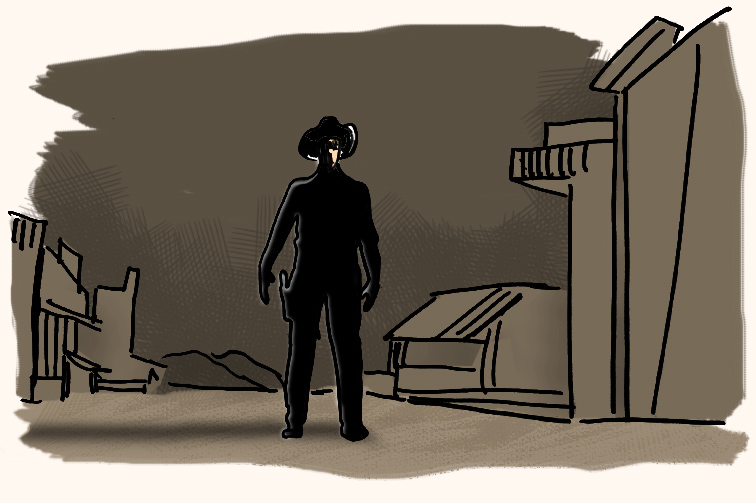
Westworld, a 1973 science-fiction movie starring Yul Brynner, Richard Benjamin and James Brolin, was the first feature film to use digital image processing.
It also featured some pretty cool robots that didn’t think twice about killing you.
* * * * * * * *
This is the second illustration for the word “robot.”
HERE is the first.

In the futuristic world of 1997, Earth’s population has hit an all-time high and the continued boom poses a major threat to the planet. Professor John Robinson, his wife Maureen, their children Judy, Penny and Will and hunky Major Don West are sent to establish an annex colony in the Alpha Centauri star system. They set out on their mission aboard their ship, the Jupiter 2. Unknown to them, Dr. Zachary Smith, a medical doctor hired by a foreign government to sabotage the crew’s environmental-control robot, has stowed away on the Jupiter 2. His extra weight throws the ship off course and they become….
Lost in Space!
When the show was originally conceived, Smith was a minor character, but character actor Jonathan Harris made the role bigger than life and stole the show. His rapport with the robot (acted by Bob May and voiced by Dick Tufeld) was the highlight of each episode. The robot — programmed to be straight-laced and by-the-book — was a constant target of ridicule by the self-centered, egotistical Smith. Harris played the part to its most irritating, most annoying hilt. He was an instant fan favorite. As the series continued and gained popularity, more episodes centered around the Smith character, much to the chagrin of other cast members, especially Mark Goddard, who played Major Don West. Goddard voiced his resentment as his role (and amount of lines) were greatly reduced in order to showcase the decidedly more comedic antics of Smith and the robot. Harris actually rewrote and ad-libbed the majority of Smith’s dialog. He interjected his signature phrases like “Oh, the pain! The pain!” and “Will, dear, dear boy!” when he felt the scene needed an extra bit of humor. Harris admitted that he sometimes stayed up nights thinking of new alliterative insults for the robot that he often used on the show (Clod-like Collection of Condensers; Jangling Junkheap; Lily-Livered Lead-Lined Lummox)
After three seasons, Lost in Space was canceled due to high production costs, displeasure from a CBS executive and waning interest from some cast members (although all of these reasons are disputed). Jonathan Harris continued to appear in numerous guest roles on television. He became an in-demand voice actor, providing characterizations for an array of animated films and television shows. The voice of Manny the Praying Mantis in Pixar’s A Bug’s Life was one of his last roles. He passed away in 2002 at age 87. He was survived by his wife of 64 years.
* * * * * * * * * *
This is the first illustration for the word “robot”. Here is the second.
Here is another illustration for the word “robot” that I did in 2008.