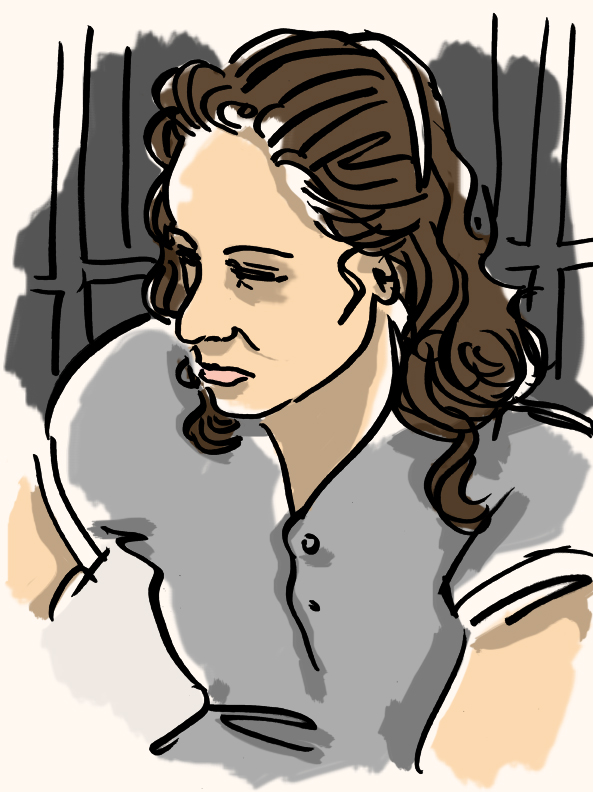
from my sketchbook: john list

our father who art in heaven, hallowed be thy name
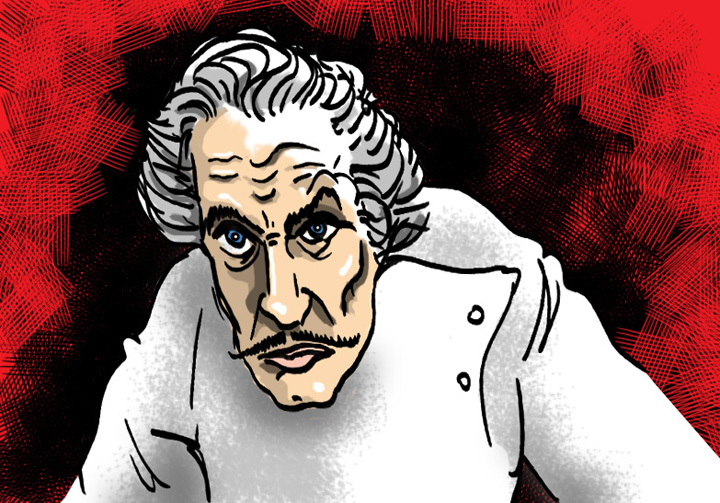
John List was faced with a dilemma. He had lost his job as an accountant. He was months behind on the mortgage payments for his nineteen-room mansion in Westfield, New Jersey. Burdened with heavy financial debt and accumulating bills, he could either force his family to accept government-sanctioned welfare or he could send them to Heaven and have God take care of them. He chose the latter.

On November 9, 1971, after his three children left for school, John List shot his wife Helen in the back of the head. He then shot his mother, who lived in an apartment in the family’s attic. When Patty and Frederick, two of the List’s three children arrived home, John shot them each in the back of the head, as well. Then, he made himself lunch. When he finished his meal, he went to watch his son, John Jr., play soccer.

After the game, John drove his son home and, upon entering the house, shot the fifteen-year-old. Later investigation showed that the teen obviously did not die immediately and was shot nine more times. John dragged all of the bodies to the home’s central ballroom and laid them on sleeping bags. He attempted to clean up the massive amounts of blood, but the task was overwhelming. He left bloodied towels and newspapers strewn about various rooms. John mailed letters to his children’s schools, informing them that the family would be traveling to North Carolina for an extended stay. He wrote a lengthy confession to his church pastor, explaining that he saw too much evil in the world and he decided to save the souls of his family. John turned all of the lights on in the house, tuned the house-wide sound system to a Christian radio station and left. His car was found in the long-term parking lot at Kennedy Airport, but there were no indications that he had boarded a flight. John List had disappeared.

Nearly a month later, neighbors alerted police that lights were burning out in the List house and, although the family was reclusive, no one had been seen entering or leaving for quite some time. Police broke into the locked residence and discovered the grisly scene.

In June 1989, almost eighteen years after the murders, John List was arrested in Richmond, Virginia, after a neighbor had seen his picture on an episode of the television program America’s Most Wanted.

John had moved to Denver, Colorado in 1972. He assumed the identity of Robert Clark and found work as an accountant. A decade later, he relocated to Midlothian, Virginia, where he met and married Delores Miller. When authorities in Virginia came for him, he fervently denied the accusations. When fingerprints, military records and crime scene evidence were presented, John List confessed.

At trial, John displayed a minimal amount of remorse. He blamed his actions on post-traumatic stress disorder, mental imbalance and obsessive-compulsive personality disorder. The jury wasn’t buying any of it. He was convicted on five counts of first-degree murder and sentenced to five consecutive life terms. He passed away, in jail, from pneumonia at the age of 82.

In a 2002 interview, news correspondent Connie Chung asked John List why he didn’t kill himself after murdering his family. He answered, “I felt suicide would keep me out of Heaven.”

Comments

comments

from my sketchbook: bea benaderet

Hi neighbor!

Bea Benaderet worked and worked and worked.

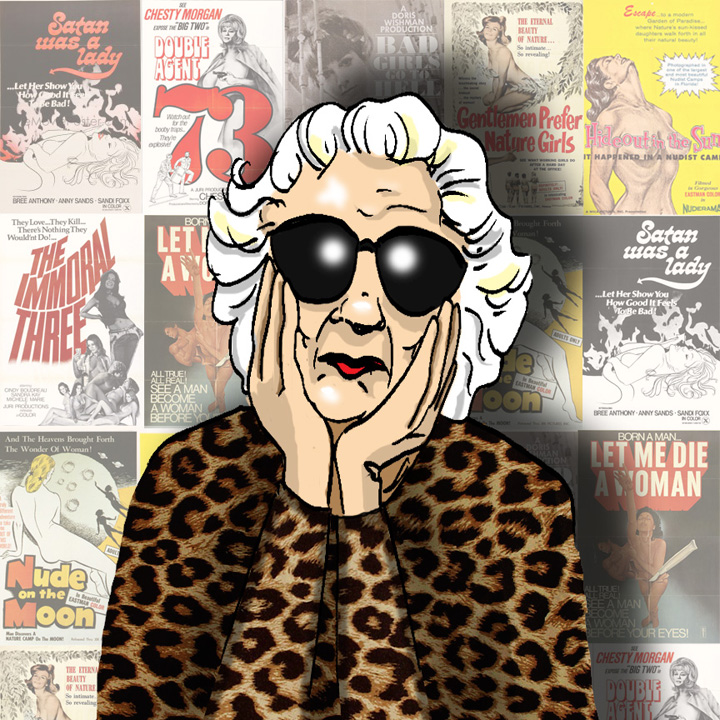
Early in her career, Bea appeared on countless popular radio shows in various character roles – telephone operators, landladies, sales clerks and most often “the neighbor.” Her keen knack for vocal inflection and dialects allowed her to portray several characters in one show, unbeknown to the radio audience. Bea also plied her voice talents in Warner Brothers cartoons alongside master voice artist Mel Blanc. She voiced female characters for decades, but, due to an exclusivity clause in Mel Blanc’s contract not permitting screen credit to any other voice artist, she was never acknowledged.

Bea co-starred with Lucille Ball in the radio comedy My Favorite Husband, the forerunner to I Love Lucy. When the decision was made to bring the show to television, Ball offer the role of neighbor Ethel Mertz to Bea. However, Bea was already recruited by George Burns to reprise her “neighbor” role on his TV sitcom, so she had to turn the part down (Gale Gordon, who played Bea’s husband had a similar commitment to the show Our Miss Brooks, allowing second choice William Frawley to step in as Fred Mertz).

After eight years on the Burns and Allen Show, Bea was cast as the voice of Betty Rubble on The Flintstones, reuniting with Mel Blanc voicing her husband Barney. In 1962, she auditioned for the role of “Granny” on a new series called The Beverly Hillbillies. She was told by creator Paul Henning that she was too buxom to portray the frail but feisty mother-in-law of series star Buddy Ebsen. Henning did cast her in the recurring part of Pearl Bodine, the mother of Ebsen’s character’s nephew Jethro, from back in the hills.  Based on the popularity of The Beverly Hillbillies, Henning created Petticoat Junction and awarded Bea the starring role of hotel proprietor Kate Bradley. With two “rural comedies” under his belt, Henning produced Green Acres, based on a radio show called Granby’s Green Acres (again starring Gale Gordon and Bea Benaderet). The lead couple was recast with Eddie Albert and Eva Gabor, although Bea appeared in several cross-over episodes as her Petticoat Junction character.

Four years into the run of Petticoat Junction, Bea was diagnosed with lung cancer. With the show finishing consistently among the top shows on television, Bea took what she had hoped would be a short leave of absence to deal with treatment for the disease. Actress Rosemary DeCamp filled in as “Aunt Helen.” Bea appeared sporadically in the show’s fifth season. Her condition worsened and after three shows in the sixth season, June Lockhart (playing the authoritative Dr. Janet Craig) was brought in as a substitute “motherly” figure. Bea’s stand-in (actress Edna Laird) was stuck into a few episodes, shot from behind with Bea’s voice dubbed into the soundtrack. Bea passed away in October 1968 at the age of 62.

On the day of her funeral, Bea’s husband, veteran sound-effects man Gene Twombly, died of a heart attack.

Comments

comments

IF: secret

listen... do you want to know a secret?

Stephani Germanotta has a secret.

In 2007, young Stephani, a budding singer, was introduced to another singer named Lina Morgana by Sony Records producer Rob Fusari. Stephani and Lina began collaborating on songs, eventually penning nearly two dozen compositions. Lina, with her dark hair and exotic good looks, was the obvious choice for performing them. Stephani was awkward, slightly overweight and not attractive in the eyes of pop music. (Although Stephani was previously signed to Def Jam Records, she was dropped by the label after three months.) Lina, however, looked like she was headed to stardom.

But, in 2008, 19-year-old Lina Morgana jumped from the tenth floor of the Staten Island Hotel to her death.

Just months after Lina’s death, her friend Stephani emerged on the music scene. She had adopted her dead friend’s persona, including outlandish costuming, exaggerated makeup, vocal style and outrageous stage antics. She was even singing their collaborative songs.

And she was calling herself “Lady Gaga.”

* * * * *

The Illustration Friday word was “secret” in June 2012. Here’s my entry from that time.

Comments

comments

from my sketchbook: ramón novarro

Descanse en paz
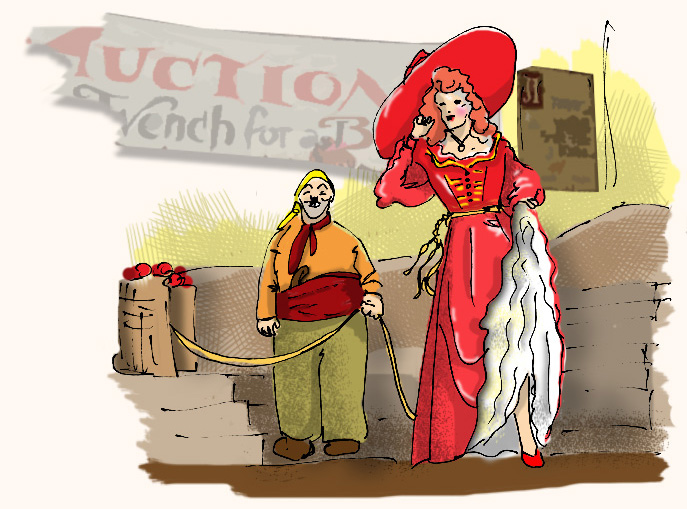
José Ramón Gil Samaniego and his family fled their native Mexico in 1913 to escape that country’s violent revolution. The family settled in Los Angeles. With a distant show business connection (actress Delores Del Rio was a second cousin), Ramón took bit parts in silent films while working as a singing waiter to supplement his income. He was befriended by actress Alice Terry and her husband, noted director Rex Ingram. The couple, respected in Hollywood circles, touted young Ramón as the successor to Rudolph Valentino. With support and a suggested name change from Ingram, Ramón Navarro was featured in more prominent roles in the early 1920s. The 1923 silent swashbuckler Scaramouche was Ramón’s breakout role.

After Valentino’s untimely and shocking death in 1926, Ramón’s popularity skyrocketed. He became the silver screen foremost Latin heartthrob. He starred opposite the top female stars of the day — Joan Crawford, Myrna Loy, Greta Garbo, as well as his friend Alice Terry — in a succession of blockbuster films. However, by the middle 30s, Ramón’s stardom began to fizzle and MGM did not renew his contract. He worked sporadically, taking on mostly minor roles. When the new medium of television offered acting work, Ramón was able to secure guest star appearances in some Westerns and anthologies.

Ramón saved enough money from the height of his career that when he found it difficult to get work, his lifestyle did not suffer. He lived in a house in the Hollywood Hills, designed by second generation architect Lloyd Wright and maintained a comfortable existence.

In 1968, the aging Ramón contacted an agency and arranged for two young men to come to his house for an evening of sex. Twenty-two-year old Paul Ferguson and his seventeen-year old brother Tom arrived at Ramón’s home on the evening before Halloween. They were invited in, but they had other plans. The Ferguson brothers believed that the one-time film star had stashed a large sum of money hidden in the house. Once inside, they tied Ramón up with an electrical cord and tortured him, eventually beating him to death. The next morning, Ramón’s secretary, Edward Weber, arrived for work and discovered the actor’s blood-soaked naked body wrapped in a sheet among the ransacked residence. He had cuts on his head and neck, as well as numerous welts and lacerations. The determined cause of death was “suffocation due to massive bleeding.” Ramón had drowned in his own blood.

A police investigation led to an arrest of the Ferguson brothers. During their trial, it was revealed that their violent efforts netted them a sum of $20, a single bill that they took from the pocket of Ramón’s bathrobe. As far as the culprit of Ramón’s murder, Paul and Tom pointed the finger at each other. They served time in San Quentin Prison. Tom was paroled in 1976, but re-arrested for another crime two years later. He died in prison in 2005. Paul Ferguson was paroled in 1978, but was also re-arrested for rape and returned to prison in Missouri. He is due to be released in 2022.

Comments

comments

IF: creature

No, you're hurting me! No!

Universal Pictures classic Frankenstein frightened audiences when it was released in 1931. One scene in particular horrified viewers so much that it was removed from early versions of the film and not restored until home video releases in 1980, nearly fifty years later. The infamous scene featured Dr. Frankenstein’s hulking, fearsome creature stumbling through the woods and finding little Maria playing by a lake. Unfazed, the young girl asks the creature to join her. She shows him how to make “a boat” by popping the flower from the top of a daisy and flicking it into the water, where it floats on the lake’s surface. When the supply of daisies is exhausted, the innocent monster with the abnormal brain, does the unthinkable. He grabs the child and hurls her into the lake, expecting her to mimic the floating flowers. She doesn’t. Instead, she flails her arms about creating wild splashes, until she stops – drowned. The confused and disappointed monster wanders off to wreak more havoc. The next scene shows Maria’s father marching through the town carrying the lifeless body of his daughter in his outstretched arms.  The outraged townspeople form a mob, complete with the requisite torches and pitchforks, and begin a search for the notorious doctor’s brute.

The girl was played by six-year old Marilyn Harris, a veteran of an uncredited role in an early John Wayne Western called The Big Trail.  When it came time to shoot the “lake” scene, Frankenstein director James Whale was concerned that little Marilyn would be frightened by actor Boris Karloff in costume as the monster. When the cast and crew assembled at the studio to drive out to the shoot location, Marilyn bounded out of her car and ran right up to Karloff, who was in full costume and makeup. She grabbed his hand and asked, “May I ride with you?”  Karloff smiled and replied, “Would you, darling?” The two got along like old friends on the set.

The scene required several takes until director Whale was satisfied. Marilyn was tossed into the water over and over again. Despite being a good swimmer, Marilyn was growing tired. Whale offered Marilyn a special treat — her favorite snack, hard-boiled eggs — if they could complete just one more take. She agreed and Whale was so pleased with the results, he presented her with two dozen eggs.

Marilyn appeared in a slew of uncredited roles for the next ten or so years, deciding to call it a career at the age of nineteen. She worked as a cashier at the famed Hollywood Palladium on Sunset Boulevard. It was there she met her husband. After marrying, Marilyn retired to the domestic life to raise a family.

With fond memories of Boris Karloff and her brief Hollywood life, Marilyn passed away from cancer at the age of 75.

Comments

comments

from my sketchbook: veronica lopez

in my midnight confession

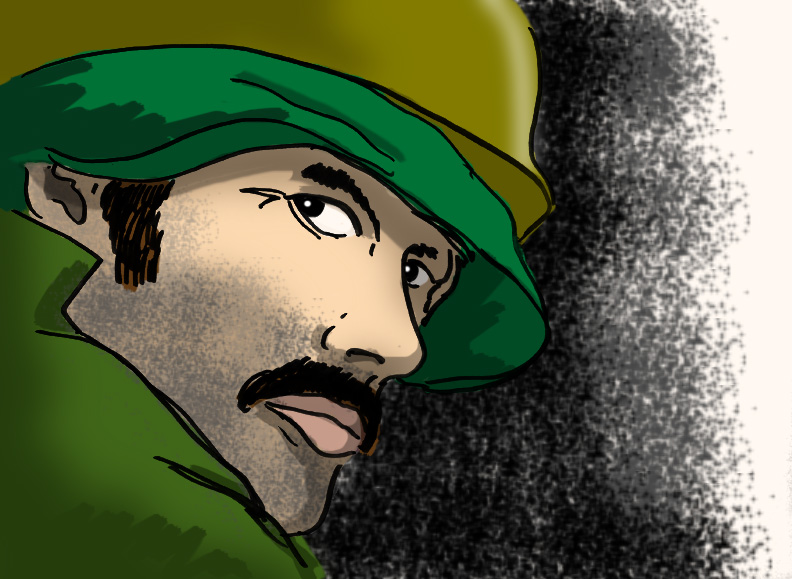
It was November 1969. Veronica Lopez, a one-time prostitute and career criminal, sat in a cell at Sybil Brand Women’s Prison. Veronica was serving a sentence for forging a prescription. One day, she got a new cellmate – a 21-year old hippie girl with a wild look in her eye. She called herself Sadie Mae Glutz, but she was booked on murder charges under her real name – Susan Atkins.

Over the next few weeks in the small cell, Susan recounted the jaw-dropping story of how she and members of her “family” attacked, tortured and murdered actress Sharon Tate and her party guests. As Veronica sat in silent awe, an emotionless Susan told how the pregnant Tate pleaded for her life and for the life of her unborn child. With no remorse, Susan stabbed Tate repeatedly (a coroner’s report put the number at sixteen) until she didn’t make a sound. She claimed she tasted Tate’s blood (a claim she later denied). Susan further detailed her participation in the subsequent murders of Los Angeles grocer Leno LaBianca and his wife Rosemary. She explained that they were following orders from Charles Manson, who Susan believed was Jesus.

Veronica repeated to police everything that Susan Atkins had confessed. Veronica received a portion of the reward money offered by Tate’s widower, director Roman Polanski. Charles Manson was arrested based, in part, on information provided by Veronica.

Returning from a Las Vegas trip in 1979, Veronica was taken from a Los Angeles bus terminal by a man she believed to be to be a hired cab driver. The driver robbed Veronica and beat her until she was unconscious. A police search found her in the street at 60th and Western Streets in South Central Los Angeles. She reported that $400 was taken from her. Over the next few days, Veronica complained of dizziness and nausea. After treatment received at a hospital, she was released, but her symptoms persisted. She was returned unresponsive to Cedars Sinai Hospital, where she soon passed away from injuries resulting from brain stem compression and blunt force trauma.

Veronica was 43. Police maintained that her murder was unrelated to her Manson Family testimony.

Comments

comments

IF: entangled

I have sinned dear Father/Father I have sinned/Try and help me Father/Won't you let me in?

“Oh, what a tangled web we weave
When first we practise to deceive!”
Marmion by Sir Walter Scott

My dad was a liar. And not a very good one.

In the long ago days before the internet, when facts were a little tougher to confirm, my dad made up shit left and right. He loved to tell of how he cut school as a child and sneaked off to a Phillies game. He claimed he witnessed a no-hitter, but couldn’t tell anyone because he’d get into hot water for skipping school. He loved telling that story. Years later, after a minimal amount of “Googling,” I discovered that the entire tale was fabricated.

By trade, my father was a butcher. He was employed by a local supermarket chain for many years, until he worked himself up to the corporate level. A suit and tie replaced his bloody apron as his regular work attire. At this new level, he was rubbing elbows with (in his eyes) the “upper crust” and was entitled to be included among the attendees of an annual corporate executive convention and banquet. My mother, at the time, established herself a little business of transporting neighborhood children to kindergarten at the nearby elementary school. For a mere three dollars per week, she’d stuff twenty toddlers into the open space of her station wagon and — seat belts be damned! — deliver them to their preschool. A little jostled and shaken-up, but relatively safe. My father, however, had told his colleagues that his wife was otherwise employed. He had told them that she was a teacher. But, he did not corroborate his deception with my mom. She was not embarrassed by how she earned her pay. (She was proud, as a matter of fact!) So, while mingling at a pre-dinner cocktail hour, my mom was confused when my dad’s boss asked what subject she taught. With a look of momentary bewilderment, she corrected the man, explaining that she was not a teacher. My dad was livid, despite not briefing my mom on the bullshit he’d been shoveling at the office for the past eleven months.

When my son was born, my wife and I continued the Jewish tradition of honoring a deceased family member by naming a newborn in their memory. My son would be carrying on the symbolic names of my wife’s beloved grandfather and my beloved maternal grandmother. The official naming was done at the brit milah (circumcision ceremony). During the proceeding, the mohel (one who performs a circumcision) announced our child’s Hebrew name to the small congregation gathered in our home. My father’s mother leaned in to my dad and asked who our baby was being named for. Then she asked who my older brother was named for. My dad replied, “Max (my brother) was named for Pop (meaning my father’s father).” This, of course, was not true. My paternal grandfather was still fourteen years from meeting the Grim Reaper when my brother was born. Jews just don’t that and my father knew it. He also knew he was lying to his elderly mother.

My father became very sick very suddenly in October 1993. Actually, he was sick for a long time, he just didn’t let anyone know — so, it was sudden for the family. My father was keeping company with a very nice woman who filled the void in his life left by my mother’s passing two years earlier. As my father drifted in and out of consciousness in a hospital bed, my immediate family — my brother Max, my wife and myself — entertained my dad’s lady friend’s future plans. With sparkly eyes, she spoke of arrangements and promises that my father made — how they would marry in the new year, how she would move in with him. She continued to explain that my father justified the enormous amount of money still owed on a thirty year-old house was due to a second and third mortgage being obtained in order to pay for my art school education.

“Whoa!,” I interrupted before another word was uttered, “I paid for art school. Me! No one else!”

We all stared at each other across the little semi-circle we had formed in the hospital hallway. “What else did he tell you?,” Max asked. She had been told by my father that he was a partner in the current supermarket in which he was employed (he wasn’t). The place had just experienced a devastating fire and he was concerned about the cost of rebuilding (it was not remotely a concern of his).

We were dumbfounded. After 36 years of lying to my mother, my dad had the opportunity to make a fresh start in a relationship. Instead, he chose to continue on the path that he was used to.

I love and miss my father. He taught me a lot, but he had no idea how he was teaching me.

* * * * * *

It looks like Illustration Friday suggested the word “entangled” in 2009. Here is my submission from that time.

Comments

comments

from my sketchbook: jon-erik hexum

green light!

Twenty-three year old Jon-Erik Hexum took his college diploma and his good looks and headed to New York City to persue an acting career. He took a job cleaning apartments until he struck gold — and it paid off. Jon-Erik met Bob LeMond, John Travolta’s manager. LeMond saw real acting potential in Jon-Erik and urging him to audition for the male lead in Summer Lovers. He lost the part to Peter Gallagher, but was soon cast as Phineas Bogg, a time-traveler in a TV series pilot called Voyager from the Unknown. The show, now called Voyagers!, was picked up by NBC and was on the 1982 Fall schedule. Jon-Erik and his young co-star Meeno Peluce (actress Soleil Moon Frye’s older half-brother) filmed twenty episodes until CBS ratings powerhouse 60 Minutes trounced Voyagers! and it was canceled.

Jon-Erik sprang back quickly, landing a role opposite Joan Collins in the TV movie Making of a Male Model and later a guest role in the anthology series Hotel. In 1984, he showed up on the big screen in a featured part in the biopic The Bear, the story of famed football coach Bear Bryant.

Another series was offered to Jon-Erik and he took it. The show was Cover Up and his co-star was model-turned actress Jennifer O’Neill (one of the most married women in Hollywood – nine times to eight husbands). Cover Up told the far-fetched story of a CIA agent posing as a male model. Jon-Erik described his character as “part-James Bond, part-Indiana Jones, part-Superman.” Cover Up debuted in September 1984 and was fairly popular.

During a lull in the filming of Cover Up‘s seventh episode, Jon-Erik and a few cast members were sitting around the set. Jon-Erik was fooling with a prop .44 Magnum handgun. He believed he had emptied its chambers of the unspent blanks from in the previous scene. As a joke, he placed the muzzle of gun to his temple and pulled the trigger. A forgotten blank — a mass of wadded paper propelled by gunpowder — was released. The force blew a quarter-sized piece of Jon-Erik’s skull into his brain. He was rushed to Beverly Hills Medical Center, when he endured five hours of delicate surgery.

Six days after the accident, Jon-Erik was declared brain dead and removed from life support. A number of his vital organs were dispersed around the country to various recipients, including a woman who had waited eight years for a kidney.

With a short three-year career as his legacy, Jon-Erik’s life ended at 26.

Comments

comments

from my sketchbook: johnny ace

A man came on the radio/And this is what he said/He said I hate to break it to his fans/But johnny ace is dead

Johnny Ace sat backstage at Houston’s City Auditorium on Christmas Day 1954, taking a short break between sets. In just two whirlwind years, Johnny had gone from stumbling into the vocalist role in B.B. King’s band to a string of eight consecutive hits on Duke Records. And now, as part of the touring company supporting headliner Big Mama Thornton, Johnny was headed to real stardom. The stardom for which he hoped would show his preacher father that his time was not wasted singing “the Devil’s music.”

Johnny was a bit on the mischievous side and Johnny liked guns. He was known to lean out the window of a moving car and fire off a few shots at billboards and street signs, laughing as the bullets ricocheted in all directions. So, while it was a bit unnerving to some, it wasn’t unusual to see Johnny playing around with a small .22 caliber handgun as he rested before his next performance.

Big Mama Thornton had had enough of Johnny’s carelessness with his firearm and confiscated it early in the tour. But, on Christmas Day 1954, she felt bad for Johnny and returned the pistol to him. Smiling, Johnny twirled the gun and pretended to fire off shots. Thornton, acting as a surrogate mother to the 25-year-old, issued a warning to “Be careful with that!” Johnny laughed and reassured her, “There’s nothing in it… see?” He playfully raised the gun to his temple and pulled the trigger in demonstration, blasting a single bullet through his head. Thornton screamed and ran out of the dressing room crying, “Johnny Ace just killed himself!”

Johnny’s biggest hit, “Pledging My Love,” was released two months after his death and it stayed at the top of the Billboard R&B Chart for ten weeks.

Comments

comments