
In doing research for this challenge, I read quite a few of the tales collected by The Brothers Grimm. I really enjoyed some of the more obscure and abstract stories, specifically “The Mouse, The Bird and The Sausage.”
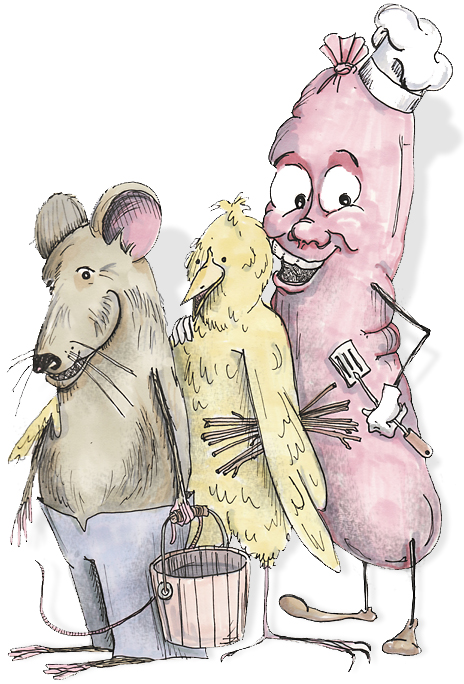
Once upon a time a Mouse, a Bird and a Sausage lived together in a single house. They were good friends and got along well. Each had a specific job. Mouse gathered water. Bird gathered wood for the fire. Sausage did the cooking. Every day, the Mouse would go to the well and come back with a bucket filled with water. Bird would fly to the forest and return with a bundle of sticks. Once at home, Bird would start a fire for cooking. Sausage would jump into the cook pot and slide around to grease the pot. He would slide around between the vegetables and meat and noodles until the pot was good and greased for cooking.
One day Bird flew out to the forest to gather wood and he met another bird. The two birds started talking about their lives. The other bird convinced Bird that his friends, Mouse and Sausage, were taking advantage of him. He said they were making Bird do all the difficult work, while all they did was get water and cook.
Bird flew home. He told his friends he felt they should all switch jobs. So, the next day, Sausage went out to the woods to gather wood. While he was gathering, a dog came up behind Sausage and gobbled him up.
Bird and Mouse were left. Just the two of them.
Mouse began to do the cooking. He remembered watching Sausage prepare meals. Mouse jumped into the cook pot to grease it up. The pot was extremely hot. Mouse’ s hair and skin were scalded off and he died. Bird panicked and began looking for Mouse. In his search, Bird threw pieces of flaming wood around the house. The house caught fire. Bird flew out to get water to extinguish the flames. He flew over the well and dropped the bucket in. But the bucket was too heavy for Bird. He was pulled down into the well and drowned.
Sweet dreams, kiddo!
Monday Artday: the brothers grimm
Through talks with peasants and visits to small villages, Jacob and Wilhelm Grimm collected some of the most gruesome, frightening and disturbing stories and published them in several volumes for children. Originally published in the early nineteenth century, these stories were watered down and homogenized over years of retelling. But in their original form, these tales of fairies and princesses and elves and animals included episodes of cannibalism, incest, murder, torture, arson, marital infidelity and racism.
The story of “The Juniper Tree” tells of a man whose wife gives gives birth to a boy, then she promptly dies of happiness. After a brief grieving period, the man remarries and wife number two gives birth to a girl. The new wife loves her daughter, but fears the family’s fortune will go to her stepson when her husband dies. She wishes her daughter will get the inheritance and she develops a hatred for the boy. Stepmom gets an idea.
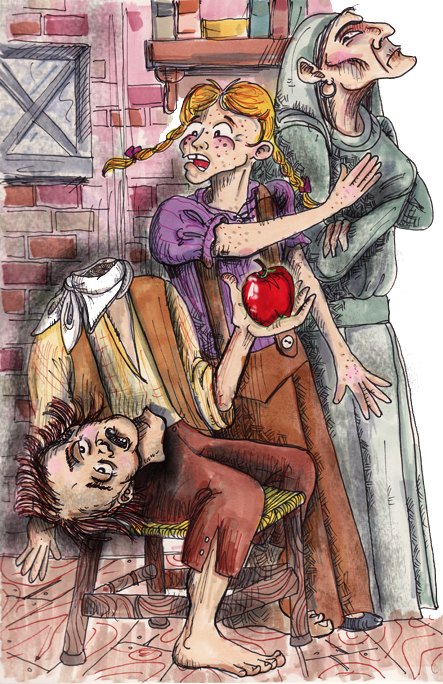
One day, the daughter comes home from school and asks Mom for an apple. Mom says “You may have one after your brother has one” and she sends the daughter out of the house. The stepson comes home and Mom offers him an apple from a large wooden chest. She opens the heavy wooden lid and, when the boy reaches in to take an apple, she drops the lid and cuts the boy’s head off. She doesn’t want to get caught, so she sits the boy’s body in a chair, sets an apple in his hand. Then, she ties a white scarf around his neck and sets the severed head on top, concealing the wound. Mom goes into another room and the daughter comes running in screaming that her brother is sitting in a chair with an apple. When she asked for the apple he said nothing. Mom suggests that she ask again and if she still gets no response, she should smack him on the head. The daughter goes back, asks her brother about the apple and smacks him — and knocks his head to the floor. She screams in horror. Mom blames the daughter for killing her brother. Mom then tells her she has a plan to cover up the murder.
I’d like to pause for a moment to remind you that this is a story intended for children.
Mom cuts the boy’s corpse up into little pieces and cooks him in a stew. The daughter cries during the entire process, even crying over the stew pot. Her tears fall into the stew, so it needs no salt. (I am NOT making this up!)
When Dad gets home from a hard day of whatever Dad does, they feed him the stew. Dad loves the stew, saying it is the best he’s ever tasted. As he’s eating, he picks out the bones and tosses them under the table. The daughter gathers the bones in a scarf and carries them outside, all the while crying tears of blood. She digs a hole and buries the bones under the juniper tree in the front yard. Suddenly, flames burst from the hole and a beautiful bird flies out. The bird flies around town, gathering specific items — a gold chain, a pair of shoes and a heavy millstone. The bird flies back and drops the gold chain around the father’s neck. Dad is pleased with his gift. The bird drops the shoes to the daughter. Then the bird drops the stone on the stepmom’s head and kills her.
The bird turns back into the boy.
Dad, Sis and boy all live happily ever after.
The end.
Pleasant dreams, kids.
Comments
from my sketchbook: butterfly mcqueen
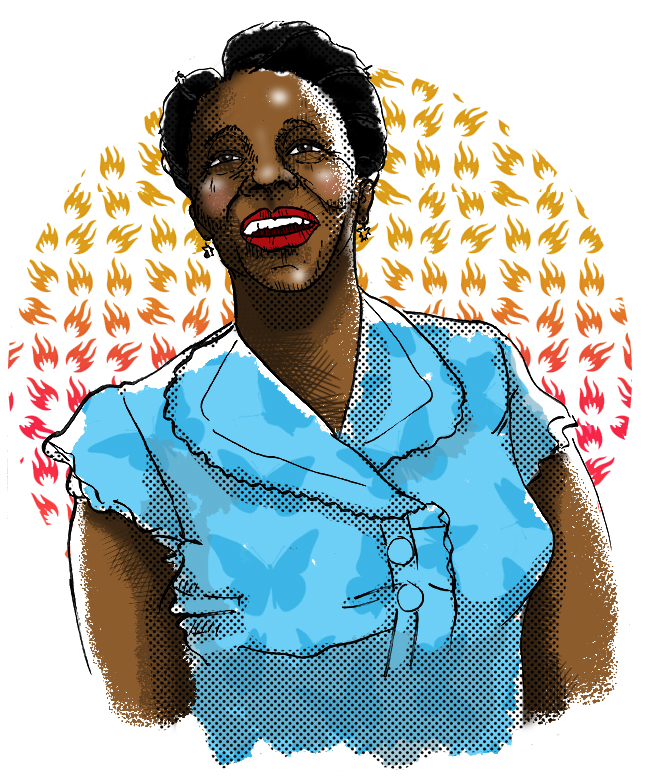
Thelma McQueen was born in Tampa, Florida in 1911. She trained as a dancer and took her stage name from the “Butterfly Dance” after performing it in a production of A Midsummer Night’s Dream. She never liked the name “Thelma” and legally changed her name to “Butterfly.”
Although she appeared in an uncredited role in 1939’s “The Women,” Butterfly made her official debut in what would become her most identifiable role — “Prissy,” Scarlett O’Hara’s house slave in the epic Gone with the Wind, uttering the famous words: “I don’t know nothin’ ’bout birthin’ babies!” She also played “Butterfly,” Mary Livingstone’s maid in the Jack Benny radio program, for a time during World War II.
By 1947 she had grown tired of the ethnic stereotypes she was required to play and ended her film career.
In 1950, anxious to work with her Gone with the Wind co-star Hattie McDaniel, she reluctantly took another racially-stereotyped role on the television series Beulah. She remained with McDaniel and the show for two years.
In a 1969, she appeared on an episode of The Dating Game.
Refusing to take any more racially-stereotyped roles, Butterfly was approached with very few acting offers. She devoted herself, instead, to other pursuits including furthering her education, and received a bachelor’s degree in political science in 1975 at the age of 64. In 1979, Butterfly won a Daytime Emmy award for her performance as “Aunt Thelma,” a fairy godmother in the ABC After School Special, Seven Wishes of a Rich Kid. She appeared in 1986’s The Mosquito Coast with Harrison Ford. Her final role was in a TV remake of Pollyanna (called Polly) with the Cosby Show’s Keshia Knight Pulliam. (Use that in your next game of Six Degrees of Kevin Bacon.)
In 1980, she sued Greyhound Bus Lines when she was assaulted in a bus station by a guard who thought she was a pickpocket. The 69 year-old Butterfly had several of her ribs damaged when the guard threw her into a bench. After several years of litigation, she was awarded $60,000.
Butterfly lived in New York in the summer months and in Augusta, Georgia in the winter. She died in Augusta as a result of burns received when a kerosene heater she was attempting to light malfunctioned and burst into flames. A lifelong atheist (and outspoken about her beliefs), she left the contents of her personal bank account to the Freedom From Religion Foundation and donated her body to medical science.
In an interview just before she died, Butterfly said, “Now I am happy I did Gone with the Wind. I wasn’t when I was 28, but now it’s part of black history.”
Comments
IF: clutter
The illustrationfriday.com challenge word this week is “clutter”.
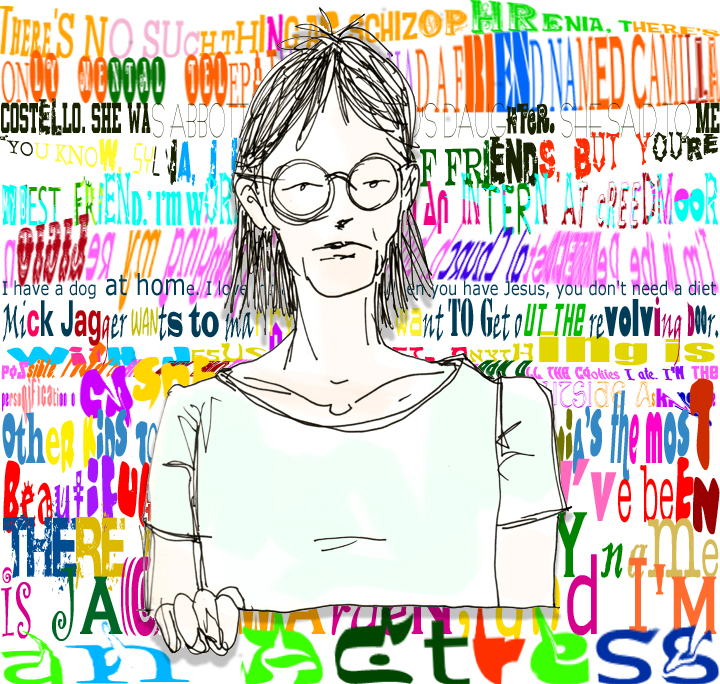
Sylvia Frumkin was the pseudonym given to Maxine Mason, the subject of the 1982 book “Is There No Place On Earth For Me?”by Susan Sheehan. Maxine was diagnosed with schizophrenia. The content of her speech revealed what was going on in her cluttered mind.
There’s no such thing as schizophrenia, there’s only mental telepathy. I once had a friend named Camilla Costello. She was Abbott and Costello’s daughter. She said to me, ‘You know, Sylvia, I have a lot of friends, but you’re my best friend.’ I’m working here. I’m an intern at Creedmoor. I’m in the Pentecostal Church, but I’m thinking of changing my religion. I have a dog at home. I love instant oatmeal. When you have Jesus, you don’t need a diet. Mick Jagger wants to marry me. I want to get out the revolving door. With Jesus Christ, anything is possible. I used to hit my mother. It was the hyperactivity from all the cookies I ate. I’m the personification of Casper the Friendly Ghost. I used to go outside asking the other kids to be my friend when I was little. California’s the most beautiful state in the Union. I’ve been there once, by television. My name is Jack Warden, and I’m an actress.
As a result of the publication of Sheehan’s book, Maxine was given more effective treatment. However, she continued to go in and out of mental hospitals and died in 1994.
Comments
Monday Artday: paris
The challenge word this week on Monday Artday is “paris”.
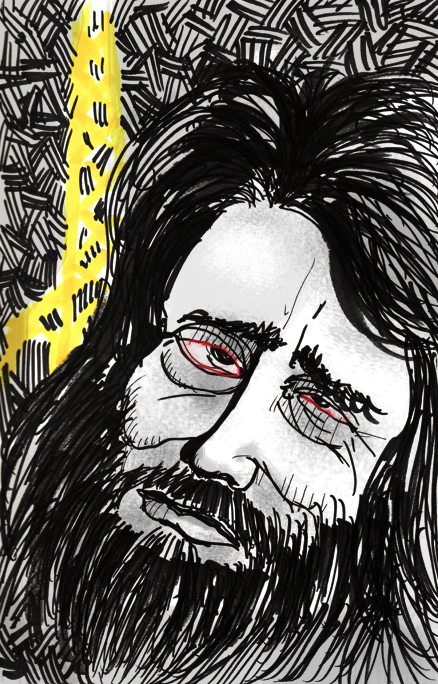
On July 3, 1971, The Doors’ Jim Morrison died of a heroin overdose in the bathtub of his Paris apartment, essentially ending Robby Krieger’s career.
I see that a band calling itself “Riders on the Storm” is on tour, with a stop near me in Atlantic City, NJ. I’d like to change my comment to John Densmore.
Comments
IF: memories
The illustrationfriday.com challenge word this week is “memories”.
This weekend is Labor Day weekend, the unofficial end of summer. I was prompted to think of all of the things I experienced this past summer. While not necessarily the best memory of the summer, the most unusual occurred on Memorial Day Weekend, the unofficial beginning of summer.
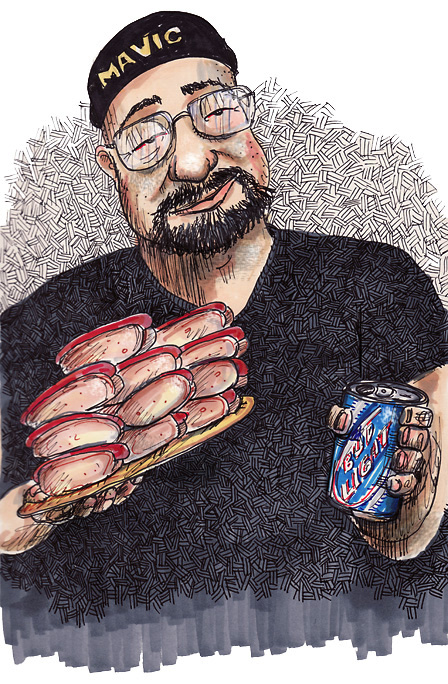
Remember The Smithereens? Y’know, that band from the 80’s… They sang that song… You remember…
Pat DiNizio is the founder of The Smithereens. In March 2007, I met Pat and the rest of The Smithereens at a “Free-At-Noon” concert hosted by local radio station WXPN. After the show, the band were slated to sign autographs. At the time, my son was an intern at WXPN and one of his duties was to escort band members to the “Meet and Greet” area. I was in line with the other fans as my son led a shuffling Pat DiNizio over the the table where the other band members had already assembled. Pat inexplicably headed right to me and hugged me, then shook my hand and personally thanked me for coming out to the show. He was very nice and gracious and he actually thought he already knew me. Although it was one o’clock in the afternoon, Pat may have been a bit sloshed. Our second meeting was at the WXPN annual summer music festival in Camden, New Jersey. The Smithereens were one of over thirty performers at the four-day festival. I saw Pat briefly and was able to get his attention and wave. He smiled broadly and waved back. Again, Pat was probably soused. Christmastime 2007 brought The Smithereens back for another WXPN Free At Noon show. After the show, Pat gave my wife and me a big “Hey Man” from the autograph table. I am not convinced he remembered me. I think he’s just a friendly guy.
For the past several years, Pat DiNizio has opened up his backyard for his annual Memorial Day Barbecue and Fan Appreciation Concert. For an admission of $50 a person, it’s all you can eat and drink plus all the music you can absorb. The event has been advertised on Pat’s website. I suggested to my family that it would be a cool idea to attend this event. We had no plans for weekend. I said it would be a great experience. If we had a great time, then great! If it sucked, then we’d have a great story.
For the sake of avoiding a long and drawn-out explanation of my family’s dietary restrictions, let’s just say we are vegetarians. I emailed Pat to inquire about the menu before I shelled out $150 for the three of us. I told him we were vegetarians and hoped there would be something available for us to eat. The Smithereens were on a West Coast tour. Pat stated in his “Greetings from San Francisco” email reply: “Its going to be mostly hamburgers and hotdogs, typical 1950s and 1960s picnic-type stuff, but I also usually always have a selection of veggie burgers, and chicken and turkey franks for the non-beef eaters. I could pick up some tofu and veggie burgers, and there will be potato salad, green salad, vegetarian beans, (as well as pork and beans), but, well, you know, how it is, most people like meat, chicken and fish, so it leans towards that area I was a vegetarian from 1974 until around 1979 and there was NOTHING commercially available to us anywhere, just health food store stuff! It was SO difficult and I was a total outcast, too! I am still primarily a vegetarian as well, too, so feel free to bring your own favorite foods. Hope you can make it over!”
I sent Pat an electronic payment of $150 and we suddenly had plans for Memorial Day.
We drove two or so hours to Scotch Plains, New Jersey. The DiNizio residence was guarded by a tattooed gentleman with a cigar and a sleeveless Harley-Davidson shirt. He was checking admission receipts. He couldn’t locate the submission date on mine, until I pointed it out to him. He smiled a gap-toothed grin and granted us access. Pat’s backyard was small and narrow. It was set up with several long picnic tables butted up to each other. The tables were sheltered by a very long and narrow commercial-variety pop-up canopy. Wedged into an awkward corner of the yard was the grill, which was laden with hot dogs. An adjacent table was stocked with cole slaw, potato salad and a well-worn, opaque, Tupperware-style container. On the lid was a length of masking tape on which was scrawled “vegan”. I was not convinced, so I steered clear. Under the table were numerous insulated coolers housing more beer than Milwaukee.
Off to one side was a makeshift stage, also covered with a canopy. There were microphones and several guitars in stands. A fellow took the stage and began setting up a laptop computer. He approached one mic and thanked Pat for having this barbecue and informed the small crowd that he was the warm-up for the main performance. He strapped on an acoustic guitar and, with the accompaniment of a karaoke computer program, treated us to an over-long set of classic rock songs. From the renditions of a few of the songs, I wondered if he had ever heard them before.
We spotted “The Thrilla” (current Smithereen’s bassist Severo Jornacion) milling around the yard. He and Pat finally began the began the featured performance. They were joined by a friend of Pat’s on guitar and a drummer that Pat claimed he found on Craig’s List. The quartet performed several Smithereens hits, several Beatles songs and a few Smithereens album tracks. The Smithereens had a hit in 1990, a duet with the Go-Go’s Belinda Carlisle, called “Blue Period”. The “backyard band” performed this song with a woman who was not Belinda Carlisle. Pat announced that there would be a brief intermission so everyone could eat. My family and I loaded up plates of cole slaw, grabbed a couple of Pepsis, took a seat under the canopy opposite the stage, and observed the interesting people in attendance.
Pat was playing the model host, carrying a huge tray that was abundant with hot dogs. He approached my family and offered from his tray. I identified us as the vegetarians. He asked if we brought food for ourselves. I said we were okay and we were able to find enough to eat.
Soon, Pat returned to the stage and sang a few acoustic numbers and a few more Beatles songs (Pat really likes The Beatles). Several additional singers were invited to perform. These included a leather-skinned guitarist with a battered wicker cowboy hat and a guy who claimed to have written a Miller Lite jingle.
The day was winding down. Pat thanked everyone for coming. We said goodbye to Pat. We reminded him that we would see him at the Appel Farm Festival in one week. Pat gave us a blank look, as if he was not aware that his band was booked for that show or what Appel Farms was. Again, I think Pat was a bit inebriated.
On our drive home, we discussed how surreal the experience was and how we probably don’t need to go to next year’s barbecue. We also agreed that we ended up with a great story.
As Pat has sung many, many times – “Only a memory…”
Comments
SFG: black
The current challenge word at sugarfrostedgoodness.com is “black”.
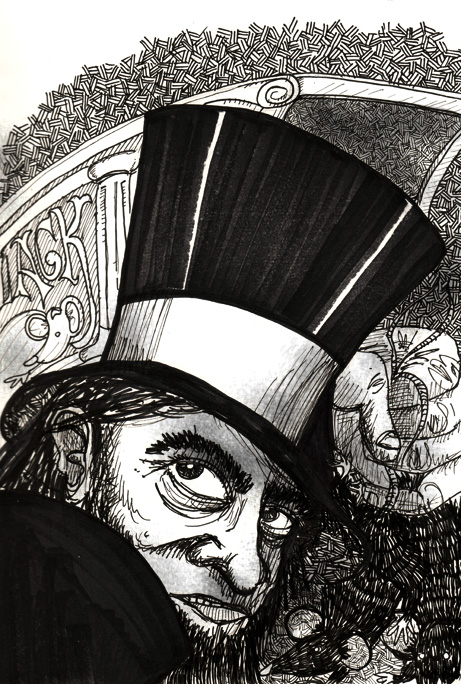
In the middle nineteenth century, Jack Black (no, not THAT Jack Black) served as rat-catcher and mole destroyer by appointment of Her Majesty Queen Victoria. That meant he was the head vermin exterminator, but he was a bit of a showman, too.
Henry Mayhew, founder of British humor magazine Punch, recalled that Jack Black (no, not THAT Jack Black) was “the most fearless handler of rats of any man living.” Proud of his profession, Black wore a wide leather belt inlaid with cast-iron rats. Black drove a cart with rats painted on the side panels. He would often stop his cart in busy areas of town for “performances”. He had a stage rigged on the cart, on which were cages filled with rats. He would exhibit the rapid effects of his rat poison, by dipping his hand into a cage of rats and taking out as many as he could hold. He would then administer his own blend of rat poison right into the animals’ mouths. However, his work experiences included a number of occasions when he nearly died from infection following rat bites.
When Jack Black (no, not THAT Jack Black) caught any unusually colored rats, he bred them, to establish new color varieties. He would sell his home-bred, domesticated colored rats as pets to well-bred young ladies to keep in squirrel cages. Beatrix Potter is believed to have been one of his customers, and she dedicated the book Samuel Whiskers to her rat of the same name.
Jack Black (no, no THAT Jack Black) had a number of sidelines beyond rats, including fishing (for food and supplying aquariums), bird catching, taxidermy and dog breeder.
The position of royal rat catcher disappeared in the early twentieth century. Unfortunately, THIS Jack Black was never caught.




Comments
from my sketchbook: diane arbus
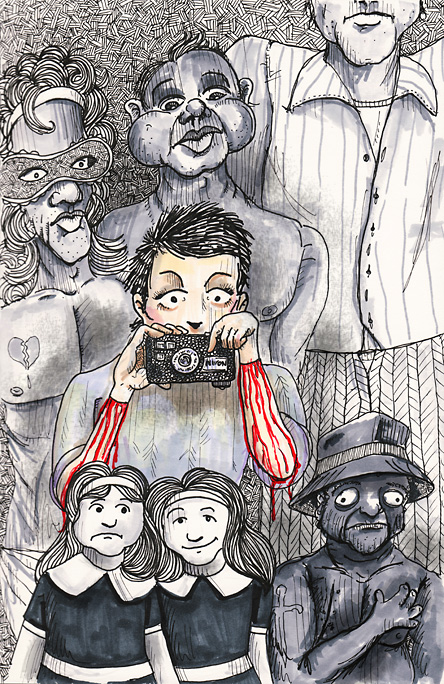
Diane Nemerov was born in New York City into a wealthy Jewish family. Her parents were fur merchants. Her older brother, Howard, served as United States Poet Laureate in 1963 and again in 1988.
When she was 14, she met and fell in love with Allan Arbus, a photographer who would later abandon photography for an acting career. (He is most famous for starring as Dr. Sidney Freedman, in the television show M*A*S*H.) Diane married Arbus when she turned 18 and the two had a fashion photography business for more than a decade. In 1959 they ended their partnership and their marriage.
Diane began studying fine art photography. In the 1960s she worked as a photojournalist, received two Guggenheim fellowships and gained critical praise for her disturbing portraits of people on the fringes of society, such as transvestites, dwarfs, giants and prostitutes. Her more famous photographs include “Child with Toy Hand Grenade in Central Park“ and “Identical Twins, Roselle, New Jersey, 1967“. (This photo is echoed in Stanley Kubrick’s film The Shining, which features twins in an identical pose.) Her voyeuristic approach has been criticized as demeaning to her subjects. In an effort to dispel this image, Diane undertook a study of “conventional” people, including Gloria Vanderbilt’s infant son, future CNN anchorman Anderson Cooper.
At 48, after a period of depression, Diane committed suicide by ingesting a large quantity of barbiturates. Not convinced that the drug overdose would be effective, she also slit her wrists.
Comments
Monday Artday: beatrix potter
The challenge at Monday Artday this week is “illustrate a Beatrix Potter story”.
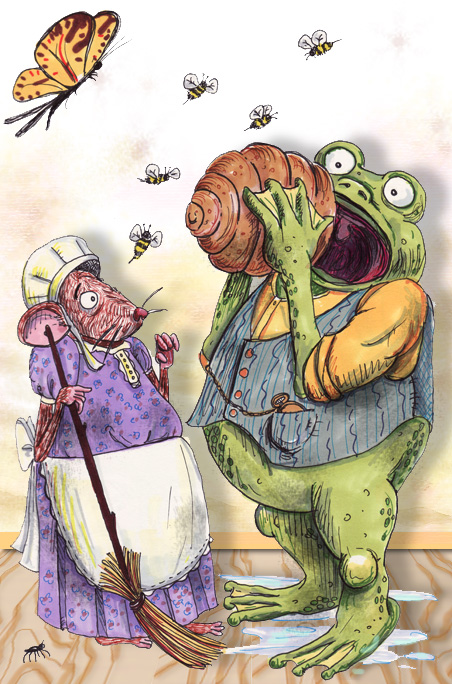
Beatrix Potter was born in London in 1866. She was educated at home by a succession of governesses, and had little opportunity to mix with other children. Even her younger brother was rarely at home. He was sent to boarding school, leaving Beatrix alone with her pet animals. She had frogs, newts, ferrets, a bat and two rabbits. Every summer, the affluent Potter family would rent a country house. Beatrix immediately fell in love with the rugged mountains and dark lakes, and learned the importance of trying to conserve the region, something that was to stay with her for the rest of her life. From the age of 15 until she was past 30, she recorded her everyday life in journals, using her own secret code which was not decoded until 20 years after her death.
Beatrix began an interest in biology, specifically fungi. She was later one of the first to suggest that lichens were a symbiotic relationship between fungi and algae. At the time, the only way to record microscopic images was by painting them, Beatrix made numerous drawings of lichens and fungi. As the result of her observations, she was widely respected throughout England as an expert mycologist. She also studied spore germination and life cycles of fungi. Potter’s set of detailed watercolors of fungi, numbering some 270 completed by 1901, is in the Armitt Library. She also lectured at the London School of Economics several times.
When Beatrix was 27, she sent a story about rabbits to the young son of her last governess. She was encouraged to publish the story so she borrowed it back and made it into the book entitled The Tale of Peter Rabbit. She struggled to find a publisher for it and eventually had 250 copies printed privately. A year later, Frederick Warne & Co agreed to publish 8,000 copies in a small format, easy for a child to hold and read. Beatrix was asked to re-illustrate it in colour. It was extremely well received and by the end of the year 28,000 copies had been printed. She followed Peter Rabbit with The Tale of Squirrel Nutkin. The popularity of these and subsequent books rewarded Beatrix with a substantial income from their sales. She also became engaged to the publisher, Norman Warne in 1905, against her parents’ wishes. Their opposition to the wedding caused a breach between Beatrix and her parents. However, the wedding never occurred. Norman fell ill and died within a few weeks. Beatrix was devastated.
Beatrix eventually wrote 23 books, all in the same small format. Her writing efforts finally ended around 1920 due to poor eyesight.
This illustration is for Beatrix’s book “The Tale of Mrs. Tittlemouse”, written in 1910. It is the story of a fastidious woodmouse named Mrs. Tittlemouse. She obsesses over keeping her home clean, constantly sweeping and chasing out unwanted visitors. She is horrified when a big, sloppy, wet frog named Mr. Jackson enters her home looking for honey.
Look! I can do cute!
Comments
IF: routine
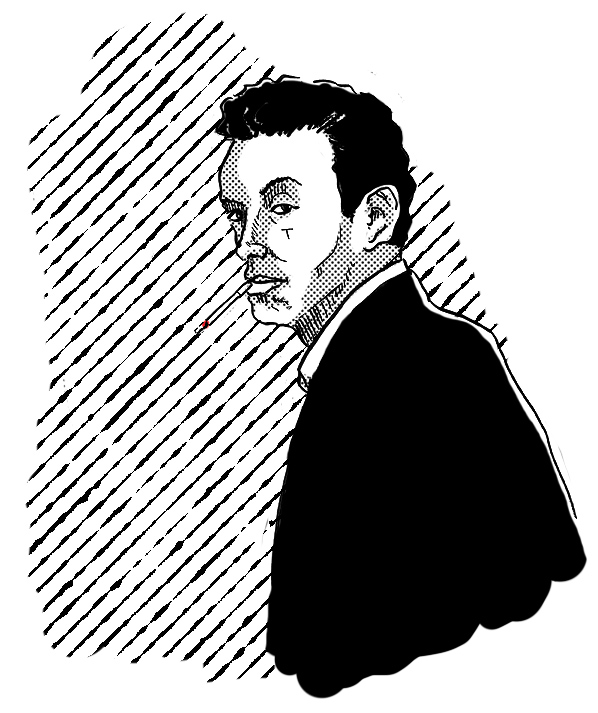
Just a few years after his discharge from the US Navy, Leonard Schneider was arrested in Miami, Florida, for impersonating a priest. He had stolen several priests’ clergy shirts and a clerical collar while posing as a laundry man. He then solicited donations for a leper colony in British Guiana after he legally chartered the “Brother Mathias Foundation”. He was found not guilty due to the legality of the New York state-chartered foundation, the actual existence of the Guiana leper colony, and the inability of the local clergy to expose him as an impostor. He made approximately $8,000, sending $2,500 to the leper colony and keeping the rest.
Soon after changing his last name to Bruce, Lenny earned $12 and a free spaghetti dinner for his first stand-up performance in Brooklyn. From that modest start, he got his first break on the Arthur Godfrey’s Talent Scouts Show, doing Bavarian impressions of American movie stars.
In the time when stand-up comics would come out on stage in a cute little suit and tell cute little mother-in-law jokes, Lenny Bruce was a trailblazer. His routines touched on previously taboo subjects, like moral philosophy, politics, patriotism, religion, law, race, abortion, drugs, the Ku Klux Klan, and Jewishness. His stand-up act featured lines like “If Jesus had been killed twenty years ago, Catholic school children would be wearing little electric chairs around their necks instead of crosses.” No comedian of that time would dare tread near that type of subject matter. He appeared on the nationally televised Steve Allen Show, where he commented on the recent marriage of Elizabeth Taylor to Eddie Fisher by making his first line an unscripted ‘will Elizabeth Taylor become bar mitzvahed?’
San Francisco columnist Herb Caen was an early and enthusiastic supporter of Lenny, writing in 1959: “They call Lenny Bruce a sick comic, and sick he is. Sick of all the pretentious phoniness of a generation that makes his vicious humor meaningful. He is a rebel, but not without a cause, for there are shirts that need un-stuffing, egos that need deflating.”
In October 1961, Lenny was arrested for obscenity at the Jazz Workshop in San Francisco. He had used the word cocksucker on stage. He was acquitted, but other law enforcement agencies began monitoring his appearances, resulting in frequent arrests under charges of obscenity. The increased scrutiny also led to an arrest in Philadelphia for drug possession in the same year, and again in Los Angeles two years later. By 1963, he had become a target of Manhattan DA, Frank Hogan, who was working closely with Francis Cardinal Spellman, the Archbishop of New York. In April 1964, Lenny appeared twice at the Cafe Au Go Go in Greenwich Village, with undercover police detectives in the audience. On both occasions, he was arrested on obscentiy charges upon leaving the stage. Despite despite positive testimony and support from the likes of Woody Allen, Bob Dylan, Jules Feiffer, Allen Ginsberg, Norman Mailer, William Styron and Dorothy Kilgallen, Lenny was sentenced to four months in the workhouse.
Lenny was arrested 15 times in two years. His performances were banned in Great Britian. At his first show in Sydney, Australia, he got up on stage, declared “What a fucking wonderful audience” and was promptly arrested.
By 1966 he had been blacklisted by nearly every nightclub in the United States, as club owners feared prosecution for obscenity. The less work Lenny got, the more he turned to drugs. His last performance was June 25, 1966, at San Francisco’s Fillmore Auditorium, on a bill with Frank Zappa and The Mothers of Invention. The performance was not remembered fondly by promoter Bill Graham, who described Lenny as “whacked out on amphetamines”.
On August 3, 1966, Lenny was found dead in the bathroom of his Hollywood Hills home. Lenny was lying naked on the floor, a syringe and burned bottle cap nearby, along with various other narcotics paraphernalia. Sportswriter Dick Schaap famously eulogized Lenny in Playboy, with the line: “One last four-letter word for Lenny: Dead. At forty. That’s obscene.”
Lenny Bruce paved the comedic way for George Carlin, Robin Williams, Chris Rock and many others. Thirty-seven years after his death, Lenny was granted a posthumous pardon for his obscenity conviction by New York Governor George Pataki.