
The challenge this week on illustrationfriday.com is “packed”.
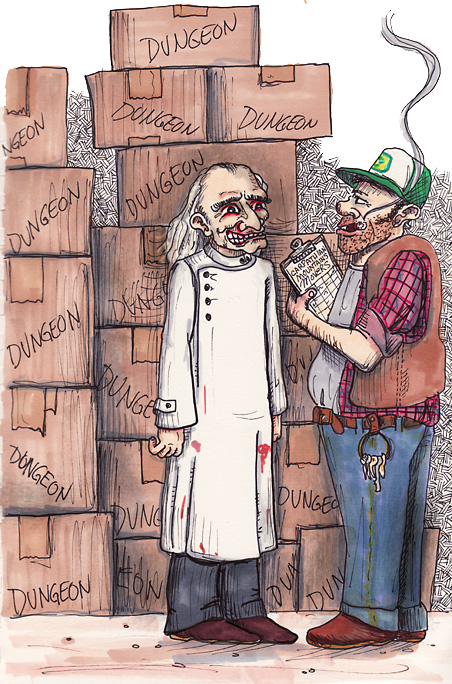
Moving day at Castle Frankenstein.
Monday Artday: prehistoric humans
The challenge on Monday Artday this week is “prehistoric humans”.
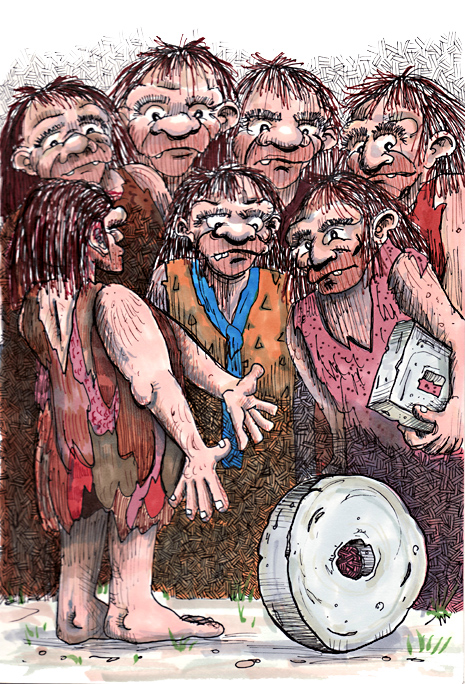
The first automotive trade show, circa 10,000,000 years BC.
Comments
SFG: yummy
The sugarfrostedgoodness.com current challenge is “yummy”.
For this uncharacteristically cheerful illustration, I took my inspiration from Dr. Seuss.
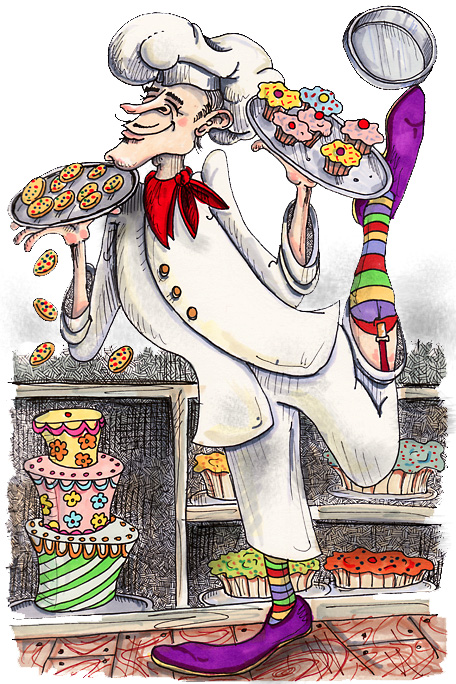
Here’s my original story of “Mister McBaker O’Frosting Moran”
Mister McBaker O’Frosting Moran
Baked one thousand cakes and used only one pan
He concocted pink cupcakes
And yellow and blue
But he used just one pan
Not seven or two
Giant red cream cakes with sprinkles on top
A big plate of chocolatey brownies and glop
Crunch cookies and fudgy yum yummies with fudge
Six batches of rum raisin spice cinnamon sludge
A great big enormous sweet stick-ity bun
And the pans that he used only numbered to one
He mixed in the eggs and the butter and flour
And the baking was done in just under an hour
Petit fours were presented by O’Frosting Moran
And ten dozen tea cakes — all using one pan
Cakes for a birthday
Cakes for a bris
Cakes for a Christening
with a cinnamon twist
How, you may ask, could he just use one pan?
’cause there’s magic in the kitchen
Of McBaker Moran
Comments
IF: clique
The illustrationfriday.com challenge word this week is “clique”.
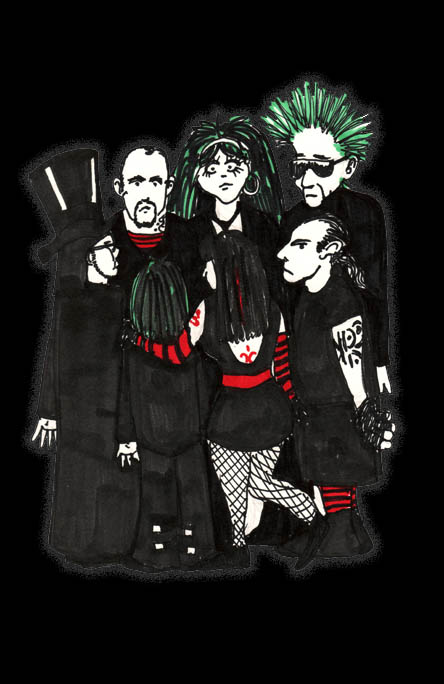
no clique would have them, so they made their own.
Comments
Monday Artday: music group part 2
The challenge this week on Monday Artday is music group. This is the second of two illustrations for this topic.
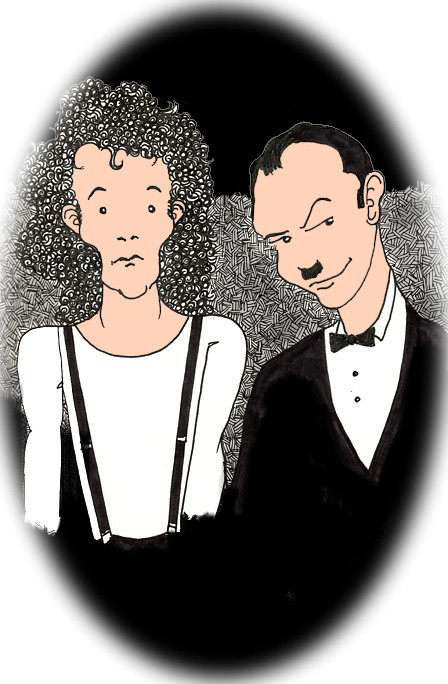
Sparks are the greatest band that you have never heard of. Their career has spanned five decades. They have released twenty-one albums. They have played sold-out shows all over the world. And you’ve never heard of them.
Keyboard wiz Ron Mael and his younger brother, vocalist Russell formed Sparks (originally named “Halfnelson”) in Los Angeles in late 1969. Self-proclaimed Anglophiles, the brothers moved to England, assembled a backing band of local musicians and released “A Woofer In Tweeter’s Clothing”.They toured the United Kingdom and released their breakthrough follow-up album “Kimono My House”in 1974. That album gave Sparks a Number 2 single in the UK with “This Town Ain’t Big Enough for Both of Us” (covered by British “Flavor-of-the-Month” The Darkness’ singer Justin Hawkins in August 2005). Sparks’ cult-status success continued with one genre-defying album after another. Sparks appeared in the 1977 Sensurround film “Rollercoaster“, after Kiss turned the role down. (The Mael brothers later said that their appearance in that film was the biggest regret of their career.)
Their style jumped from rock to glam to pop to euro-pop to electronic to new wave. In 1983, they broke onto the US singles chart with “Cool Places,”a collaboration with the Go-Go’s Jane Wiedlin. Jane had run her own Sparks Fan Club as a teenager.
Known for their “off-the-wall” ventures, Sparks released “Plagiarism”, an album of covers of their own songs with guest vocalists.
2002 saw the release of their opus “Lil Beethoven”, featuring classical arrangements of strings and choirs. Record Collector Magazine named the album as one of its “Best New Albums of 2002”, describing it as “possibly the most exciting and interesting release ever from such a long established act”. Sparks appeared in the season 6 finale of the show Gilmore Girls, performing “Perfume” from the follow-up to “Lil Beethoven”, “Hello Young Lovers”.
In May and June 2008, the always-ambitious Maels brought the 21-night “Sparks Spectacular” in London, where the band performed each of their albums in chronological order during the first twenty nights, and premiered their new album, “Exotic Creatures of the Deep”, on the twenty-first concert on June 13th. Each night, they performed an album in its entirety followed by a rare track. Many of the songs had never been performed live before.
Sparks’ musical philosophy has always been to observe current trends in music and then head in the opposite direction. They’ve been doing it for almost forty years.
And you haven’t heard of them? You have a lot of catching up to do.
Comments
Monday Artday: music group
The challenge this week on Monday Artday is “music group”.
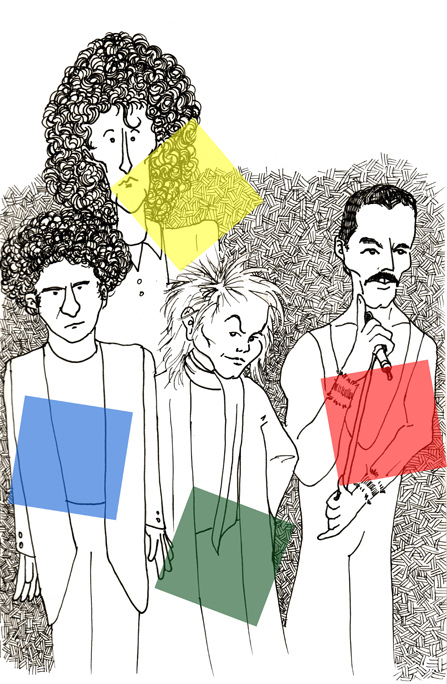
I remember it well. It was late one night in 1974. I was in the bedroom I shared with my brother. As usual, his clock radio was tuned to WFIL-AM. Typical for a top 40 AM radio station in 1974, the air was filled with the likes of Helen Reddy, Barry White, The Carpenters and Barry Manilow. There were the one-hit wonders of the day, like “Life is a Rock (But The Radio Rolled Me)” and “Kung Fu Fighting”. But this particular night stands out in my mind. It was on this night I heard a song cut through all of the other songs. It sounded like nothing else I had ever heard. There were musical sounds and vocal arrangements unlike anything else being played on the radio. I dropped the Mad Magazine I was reading and was mesmerized. At the song’s conclusion, the DJ announced (most likely while the fade-out was still playing, as was the custom of AM disc jockeys) the song title and performer. It was “Killer Queen” by a band called Queen. The next day in eighth grade, I asked some classmates if anyone had heard this song. No one did. For a few days, I thought maybe I had dreamed up this song. Finally, in my math class, Ellen Weinraub said she heard the song. I never liked Ellen very much, but at least now I knew I wasn’t crazy.
Then, I heard it again. It was incredible. There were words I heard that I had no idea what they meant. What was “Moet et Chandon”? What was “gelatine”? And where on earth was “Geisha Minah”?
This was just the beginning. Queen’s “Sheer Heart Attack” joined my collection of vinyl LPs. It stood out like a sore thumb among Carole King’s “Tapestry” and “Rufusized” by Rufus. After owning “Sheer Heart Attack” for a week, I knew every word to every song. I could sing along in perfect sync with my new hero, Freddie Mercury.
In December 1975, I was browsing the selection at Sam Goody in Neshaminy Mall. I spotted what would become my purchase for the day. It was a new recording by that band Queen called “A Night at the Opera”. I purchased my copy on eight-track tape. When I got home, I popped it into my Panasonic Dynamite 8. Again, this sounded like no other album in my collection. And when my player clicked to “Bohemian Rhapsody”, I thought my head would explode.
On New Year’s Day 1977, I begged my father to take me to buy the newest Queen album, “A Day at the Races”. I had to get it before Hal Feldbaum did. Hal was my friend, but rival for all things Queen. Through a heavy snowfall, my dad drove me to Korvette’s and the album was mine.
My Queen experience was about to move to the next plateau. I had been to several concerts by 1977. I saw Alice Cooper in ’74 and America right after that (The old “one-two” musical punch). I read in the paper and heard on the radio that the Philadelphia Civic Center was a stop on Queen’s US Tour. (Unknown to me, they had played at Philadelphia’s Erlanger Theatre several years earlier.) I bought tickets and secured a ride. I was as good as in. The big night came. My mom drove Hal and me to the venue. We filed in and figured the balcony would offer the best view. We found two seats in the front row of the balcony and watched Thin Lizzy open the show. Soon, Queen took the stage. There were lights and costume changes and soaring guitars and the theatrics of Freddie Mercury. The crowd was in the palms of their hands. After the show, I bought a Queen t-shirt from a guy in the parking lot. When I got home, I noticed that the imprint was halfway between the front of the shirt and just under the right sleeve. But, it was only five bucks.
When “News of the World’ was released, Queen once again hit their mark. The double-A side single of “We Will Rock You” and “We are the Champions” was an instant international hit. When the tour dates were announced, my brother slept out all night for concert tickets. He got tickets for his friends, himself and me for Queen’s Philadelphia Spectrum show in November 1978. I was a bit upset when my brother gave me the fourth row seats and kept the front row seats for himself, until we arrived at the show and saw that his seats were facing a bank of twelve-foot speakers. Sure, Brian May talked to him during the show, but damned if he could hear what Brain was saying. Plus, from my fourth row vantage point, I was able to catch one of the three dozen carnations that Freddie threw into the crowd during the encore.
As the years went on, I loyally purchased every one of Queen’s albums on their release day. I even bought “Jazz” at midnight at Peaches Records. Nothing would stand in my way of seeing a Queen concert. I had missed a week of school with pneumonia, but I still when I went to see Queen on their Jazz Tour. Still sick.
But, something happened as the years went on. I don’t know if it happened to Queen or to me. Queen’s albums were still good, but not great. Sure, I bought them, but I found myself playing the earlier ones more and listening to the newer ones less. In 1982, I met the girl who would become my wife. She was a tie-dyed-in-the-wool Dead Head. In ’82, I took my mom (a Queen fan) and my girlfriend (um, not a Queen fan) to see the local stop on Queen’s “Hot Space” Tour. This was my mom’s first concert and she cried when Queen took the stage. I believed my girlfriend was going to cry too, but for a different reason. She asked why they keep changing costumes. “Is it to hide their lack of talent?”, she inquired. I thought about Jerry Garcia’s usual stage garb. I didn’t answer her question.
Queen stopped touring in the United States after 1982. They continued to release albums, but they included sub-par compositions that sounded tired and bland. Freddie Mercury passed away in November 1991 at the age of 45. He died twelve hours after announcing to the press that he had AIDS. Queen and I parted ways.
Two years ago, guitarist Brian May and drummer Roger Taylor teamed with Bad Company’s Paul Rodgers to form a band called Queen. I saw them on MTV. They sound like a bad Queen cover band. They are not, nor will they ever be, Queen.
Freddie Mercury must be pirouetting in his grave.
Comments
IF: island
The illustrationfriday.com challange word this week is “island”.
The song “Zombie Jamboree” began life as “Jumbie Jamberee”, a calypso song written by Winston O’Conner. Winston performed under the name Lord Intruder in the early 1950s. In 1953, Lord Intruder released the song as the B-side to his recording of “Disaster With Police”. The Kingston Trio recorded it for their 1959 album “Hungry i”. Since then, it has been recorded and performed by Harry Belafonte (on four different albums), Bob Marley and The Wailers , Harry Nilsson and many others. In the early 1980s, a new, a capella version of the song was arranged by Rockapella’s Sean Altman an arrangement that has since been used by virtually every a capella group on the planet.
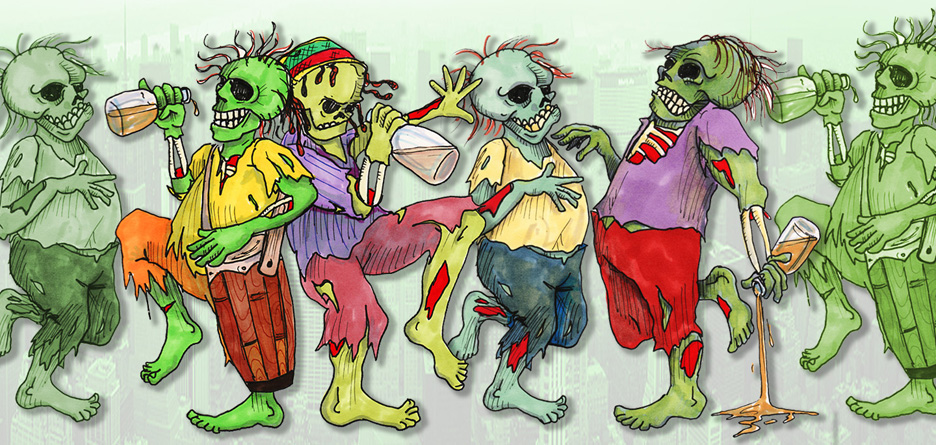
In Rockapella’s live performances, bass singer Barry Carl would introduce the song this way…
“This next song is about an island yesssssss…
Not one of those little islands where you take your winter vacation or spring break no, no no…
This song is about a big
cold
smelly
broke
island
This island called…
MANHATTAN!
Comments
SFG: comfortable
If you are too young to remember when “The Tonight Show“ was hosted by Johnny Carson, then you probably don’t remember Myron Cohen. Myron Cohen was a textile salesman working in New York City’s “Garment District“. Early in his career, he developed client relationships by telling jokes. Pretty soon, his jokes became more popular than his merchandise. Customers urged Cohen to become a comedian. In the early 1950s, Cohen left his job in the fabric industry and began performing in nightclubs. In his act, Cohen told long stories, enunciating each word in beautifully cultured English. He contrasted that by sprinkling masterfully mimicked New York Yiddish accents throughout his narrative. His nightclub performances proved very popular and led to numerous appearances on “The Ed Sullivan Show“ and “The Tonight Show” during the 1960s. He also recorded several popular comedy albums.
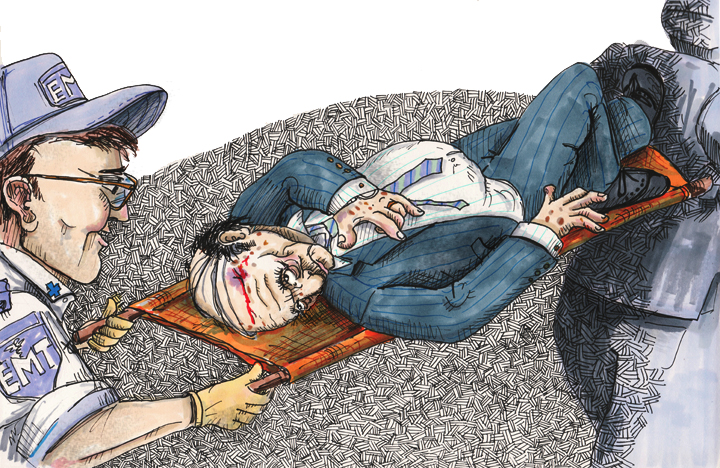
Here is one of my favorite Myron Cohen jokes:
An old man is crossing the street in the Garment District and gets hit by a car. An ambulance arrives and two emergency workers carefully lift the old man onto a stretcher. As they are carry him to the ambulance, one of the EMTs asks the the old man, “Are you comfortable?” In obvious pain, the old man looks up and says, “I make a nice living.”
Myron Cohen passed away in 1986.
Comments
Monday Artday: the brothers grimm part 2
In doing research for this challenge, I read quite a few of the tales collected by The Brothers Grimm. I really enjoyed some of the more obscure and abstract stories, specifically “The Mouse, The Bird and The Sausage.”
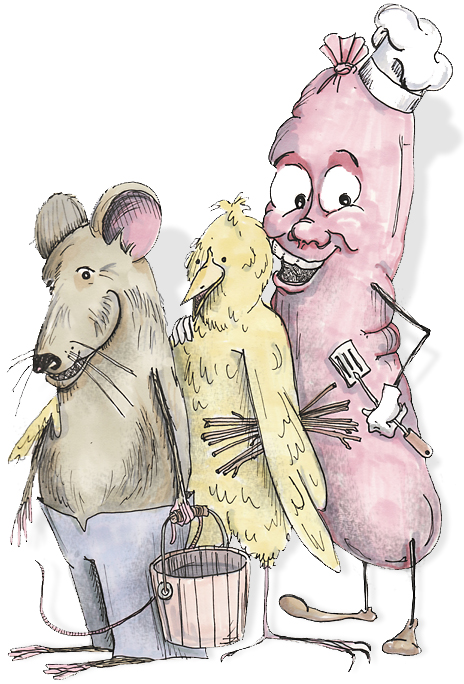
Once upon a time a Mouse, a Bird and a Sausage lived together in a single house. They were good friends and got along well. Each had a specific job. Mouse gathered water. Bird gathered wood for the fire. Sausage did the cooking. Every day, the Mouse would go to the well and come back with a bucket filled with water. Bird would fly to the forest and return with a bundle of sticks. Once at home, Bird would start a fire for cooking. Sausage would jump into the cook pot and slide around to grease the pot. He would slide around between the vegetables and meat and noodles until the pot was good and greased for cooking.
One day Bird flew out to the forest to gather wood and he met another bird. The two birds started talking about their lives. The other bird convinced Bird that his friends, Mouse and Sausage, were taking advantage of him. He said they were making Bird do all the difficult work, while all they did was get water and cook.
Bird flew home. He told his friends he felt they should all switch jobs. So, the next day, Sausage went out to the woods to gather wood. While he was gathering, a dog came up behind Sausage and gobbled him up.
Bird and Mouse were left. Just the two of them.
Mouse began to do the cooking. He remembered watching Sausage prepare meals. Mouse jumped into the cook pot to grease it up. The pot was extremely hot. Mouse’ s hair and skin were scalded off and he died. Bird panicked and began looking for Mouse. In his search, Bird threw pieces of flaming wood around the house. The house caught fire. Bird flew out to get water to extinguish the flames. He flew over the well and dropped the bucket in. But the bucket was too heavy for Bird. He was pulled down into the well and drowned.
Sweet dreams, kiddo!
Comments
Monday Artday: the brothers grimm
Through talks with peasants and visits to small villages, Jacob and Wilhelm Grimm collected some of the most gruesome, frightening and disturbing stories and published them in several volumes for children. Originally published in the early nineteenth century, these stories were watered down and homogenized over years of retelling. But in their original form, these tales of fairies and princesses and elves and animals included episodes of cannibalism, incest, murder, torture, arson, marital infidelity and racism.
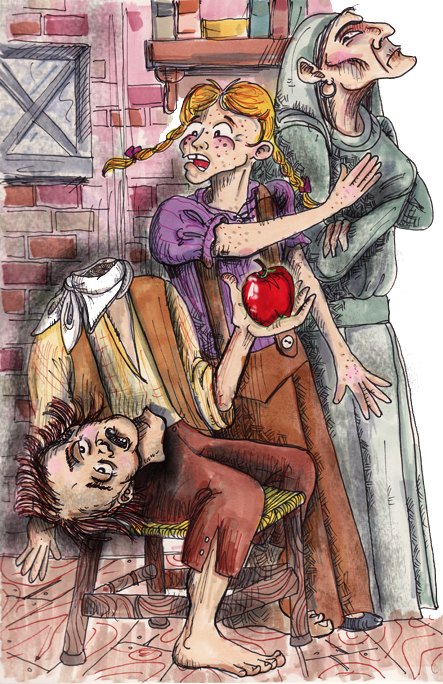
The story of “The Juniper Tree” tells of a man whose wife gives gives birth to a boy, then she promptly dies of happiness. After a brief grieving period, the man remarries and wife number two gives birth to a girl. The new wife loves her daughter, but fears the family’s fortune will go to her stepson when her husband dies. She wishes her daughter will get the inheritance and she develops a hatred for the boy. Stepmom gets an idea.
One day, the daughter comes home from school and asks Mom for an apple. Mom says “You may have one after your brother has one” and she sends the daughter out of the house. The stepson comes home and Mom offers him an apple from a large wooden chest. She opens the heavy wooden lid and, when the boy reaches in to take an apple, she drops the lid and cuts the boy’s head off. She doesn’t want to get caught, so she sits the boy’s body in a chair, sets an apple in his hand. Then, she ties a white scarf around his neck and sets the severed head on top, concealing the wound. Mom goes into another room and the daughter comes running in screaming that her brother is sitting in a chair with an apple. When she asked for the apple he said nothing. Mom suggests that she ask again and if she still gets no response, she should smack him on the head. The daughter goes back, asks her brother about the apple and smacks him — and knocks his head to the floor. She screams in horror. Mom blames the daughter for killing her brother. Mom then tells her she has a plan to cover up the murder.
I’d like to pause for a moment to remind you that this is a story intended for children.
Mom cuts the boy’s corpse up into little pieces and cooks him in a stew. The daughter cries during the entire process, even crying over the stew pot. Her tears fall into the stew, so it needs no salt. (I am NOT making this up!)
When Dad gets home from a hard day of whatever Dad does, they feed him the stew. Dad loves the stew, saying it is the best he’s ever tasted. As he’s eating, he picks out the bones and tosses them under the table. The daughter gathers the bones in a scarf and carries them outside, all the while crying tears of blood. She digs a hole and buries the bones under the juniper tree in the front yard. Suddenly, flames burst from the hole and a beautiful bird flies out. The bird flies around town, gathering specific items — a gold chain, a pair of shoes and a heavy millstone. The bird flies back and drops the gold chain around the father’s neck. Dad is pleased with his gift. The bird drops the shoes to the daughter. Then the bird drops the stone on the stepmom’s head and kills her.
The bird turns back into the boy.
Dad, Sis and boy all live happily ever after.
The end.
Pleasant dreams, kids.