Monday Artday: portrait of the artist as an eight-year old

take this brother, may it serve you well
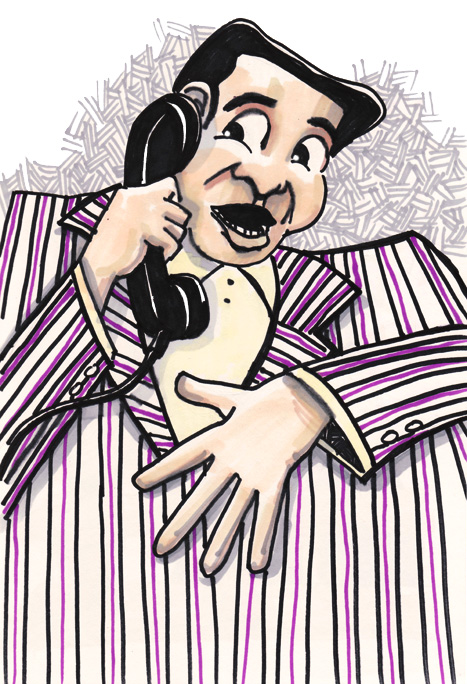
I was eight years old in 1969. I wore cool green and blue plaid bell-bottom pants. I watched The Brady Bunch on Friday nights. I watched The Banana Splits on Saturday mornings. I went to third grade at Watson T. Comly Elementary School. I remember being worried that my older brother might have to go to fight in the war in Viet Nam. (When the US involvement in Viet Nam essentially ended, my brother was 15.)

In 1969, when I was eight years old, something else happened.

Sure, I had the 45rpm singles of “Sugar Sugar” by cartoon idols The Archies and “Aquarius” by smooth soul song stylists The Fifth Dimension. I even had the original Broadway recording of the musical “Hair“. I knew every lyric, even if I didn’t know what they were singing about. (I’m sure my parents were proud to have their eight-year old running around the house singing “Sodomy“.)

But, one day, on a shopping trip with my mom to Northeast Philadelphia’s Roosevelt Mall, I browsed the “Rock” section of Sam Goody. I spotted an album that stood out from all of the psychedelic themed covers. It screamed for my attention. It practically glowed. It was plain and square and white. Under the tautly-stretched cellophane, its cover was embossed with two words — “The”, followed by “Beatles”.

I was mesmerized. Was this the same “The Beatles” that cheerfully wailed about wanting to hold my hand on those old, scratched swirly-labeled Capitol 45s that my Uncle Sidney gleaned from an old jukebox when I was five? Those four fresh-faced moptops weren’t pictured anywhere on the album cover. For Christ’s sake, nothing was pictured on the album cover. I dug deep into my pants pocket and extracted a wad of birthday money. I snatched the double record from the rack and excitedly tucked it under my arm. I marched to the cashier and made the coolest purchase of my eight years on earth.
Comments

comments

Monday Artday: movie quote part 3

One more in a series of illustrations based on movie quotes, the current challenge on Monday Artday.
black gold/texas tea
“Drainage! Drainage, you boy. Drained dry. I’m so sorry. Here, if you have a milkshake, and I have a milkshake, and I have a straw. There it is, that’s a straw, you see? You watching?. And my straw reaches across the room, and starts to drink your milkshake. I… drink… your… milkshake! ”
— Daniel Planiview (Daniel Day-Lewis) in There Will Be Blood

Comments

comments

IMT: silver

The inspirational word on Inspire Me Thursday is “silver”.
doctor say you're gonna die.
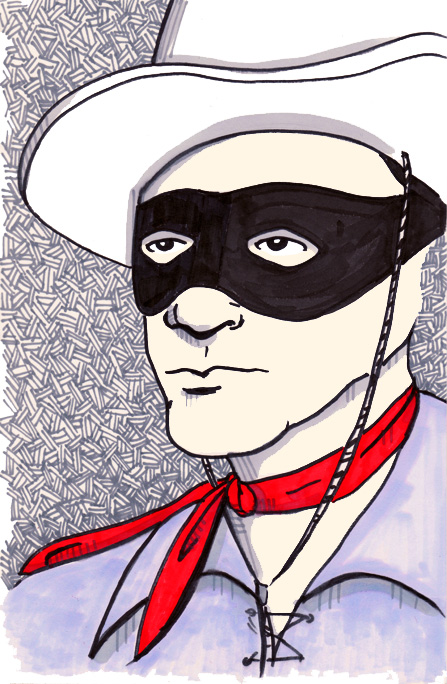
Long before Bob Denver, Fred Gwynne and Barry Williams were typecast in an acting role, there was Clayton Moore.
Moore’s big break came in 1949, when George Trendle spotted him in “Ghost of Zorro”. As producer of the radio show and creator of “The Lone Ranger” character, Trendle was about to launch the masked man in the new medium of television. Moore was cast on sight.
Moore trained his voice to sound like the radio version of The Lone Ranger, which had been on the air since 1933. Accompanied by the strains of Rossini’s “William Tell Overture”, announcer Fred Foy gave the Lone Ranger his famous introduction: “A fiery horse with the speed of light, a cloud of dust and a hearty “Hi Ho Silver!” The Lone Ranger. “Hi Ho Silver, away!” With his faithful Indian companion Tonto, the daring and resourceful masked rider of the plains, led the fight for law and order in the early west. Return with us now to those thrilling days of yesteryear. The Lone Ranger rides again!”
Moore and his co-star Jay Silverheels, in the role of Tonto, made history in the first Western written specifically for television. The Lone Ranger soon became the highest-rated program on the fledgling ABC network and its first true “hit,” earning an Emmy nomination in 1950. After completion of two Lone Ranger feature films, Moore embarked on what became 40 years of personal appearances, TV guest spots, and classic commercials as the legendary masked man. Silverheels even joined him for occasional appearances during the early 1960s.
In 1979, the owner of the Lone Ranger character, producer Jack Wrather, obtained a court order prohibiting Moore from making appearances as The Lone Ranger. Wrather anticipated making a new film version of the story, and did not want the value of the character being undercut by Moore’s appearances This move proved to be a public relations disaster. Moore continued to make appearances by changing his costume slightly and replacing the mask with wraparound sunglasses. Moore then counter-sued Wrather. Moore eventually won the suit, and was able to resume his appearances in costume, which he continued to do until shortly before his death in 1999.
In keeping with the nature of the character, Moore chose to protect the Lone Ranger’s identity at all times and is perhaps the only actor whose face is largely unknown to the public.

Comments

comments

Monday Artday: movie quote

The challenge on Monday Artday is “movie quote”. If you are a regular reader of my blog, then you know that a lot of my illustrations are based on movie quotes. I love movies, so I had a difficult time deciding which one to illustrate.
I know what you're doin'/I know where you've been/I know where, but I don't care/'cause there's no such thing as an original sin.
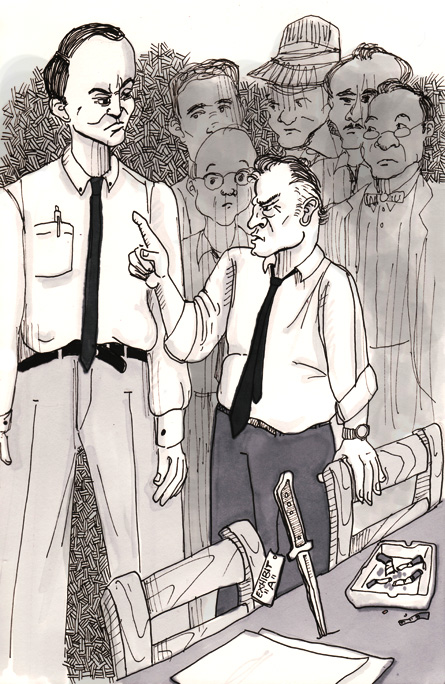
“Everything… every single thing that took place in that courtroom, but I mean everything… says he’s guilty. What d’ya think? I’m an idiot or somethin’? Why don’t cha take that stuff about the old man; the old man who lived there and heard every thing? Or this business about the knife! What, ’cause we found one exactly like it? The old man saw  him. Right there on the stairs. What’s the difference how many seconds it was? Every single thing. The knife falling through a hole in his pocket… you can’t prove  he didn’t get to the door! Sure, you can take all the time hobblin’ around the room, but you can’t prove  it! And what about this business with the El? And the movies! There’s a phony deal if I ever heard one. I betcha five thousand dollars I’d remember the movies I saw! I’m tellin’ ya: every thing that’s gone on has been twisted… and turned. This business with the glasses. How do you know she didn’t have ’em on? This woman testified in open court! And what about hearin’ the kid yell… huh? I’m tellin’ ya, I’ve got all the facts here… ”
— Juror #3 (Lee J. Cobb) in 12 Angry Men

Maybe this out-of-context quote will inspire you to seek out this riveting, beautifully acted, Hollywood classic.

Comments

comments

IF: celebrate

This week’s challenge word on Illustration Friday is “celebrate”.
The things that you're li'ble/To read in the Bible/It ain't necessarily so!
Wake Nicodemus! by Henry Clay Work
Nicodemus, the slave, was of African birth,
And was bought for a bagful of gold,
He was reckon’d as part of the salt of the earth,
But he died years ago very old.
‘Twas his last sad request, so we laid him away
In the trunk of an old hollow tree.
“Wake me up!” was his charge, “at the first break of day,
Wake me up for the great Jubilee!”

The “Good Time coming’ is almost here!
It was long, long, long on the way!
Now, run and tell Elijah to hurry up Pomp,
And meet us at the gum-tree down in the swamp,
To wake Nicodemus today.

He was known as a prophet – at least was as wise –
For he told of the battles to come;
And he trembled with dread when he roll’d up his eyes,
And we heeded the shake of his thumb,
Though he clothed us with fear, yet the garments he wore
Were in patches at elbow and knee,
And he still wears the suit that he used to of yore,
As he sleeps in the old hollow tree.

Nicodemus was never the sport of the lash,
Though the bullet has oft crossed his path.
There were none of his masters so brave or so rash,
As to face such a man in his wrath,
Yet his great heart with kindness was filled to the brim,
He obeyed who was born to command,
But he long’d for the morning which then was so dim –
The morning which now is at hand.

‘Twas a long weary night – we were almost in fear,
That the future was more than he knew,
‘Twas a long weary night – but the morning is near,
And the words of our prophet are true.
There are signs in the sky that the darkness is gone –
There are tokens in endless array,
When the storm which had seemingly banished the dawn,
Only hastens the advent of day.

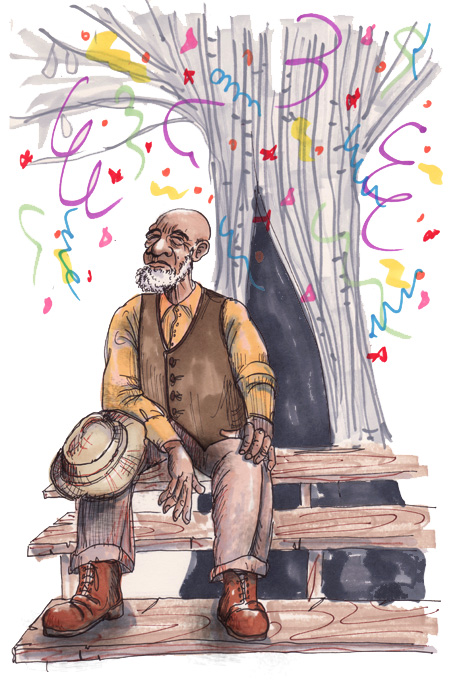
“Wake Nicodemus” was written in 1864 as an abolitionist anthem and a call for freedom. The character of Nicodemus asks those around him to “Wake me up for the great Jubiliee” – the time of celebration when all slaves are free. By allowing the listener to enter into Nicodemus’ life – to know him and sympathize with him – the case for abolition is made more compelling. Nicodemus is characterized as a prophet: wise and impressive, almost supernatural. As he looks forward to the time to celebrate, the listener longs for that day, too.

Click HERE to hear the Tim Curry’s unusual version of “Wake Nicodemus” from his album “Read My Lips”.

Comments

comments

IMT: lace

This week’s word of inspiration on the Inspire Me Thursday illustration blog is “lace”.
The three men I admire most/ The Father, Son, and Holy Ghost
“Hell-OOOOOOOOOOOOOOOOOOOOOOOOOO Bay-BEE!”
Long before speaking those famous words, Jiles Perry Richardson, Jr. was a disk jockey on Texas radio’s KTRM, where he hosted the “Dishwashers’ Serenade” show from 11 AM to 12:30 PM, Monday through Friday. Richardson changed to late afternoons and along with the time change, he also introduced a new on-air persona. He had seen the college students doing a dance called The Bop, and he decided to call himself “The Big Bopper”. In May 1957, he set the record for continuous on-the-air broadcasting. He performed for total of five days, two hours and eight minutes, playing 1,821 records and taking showers during five-minute newscasts. He lost 35 pounds during his marathon and he slept for the next 20 hours after it was all over.
Richardson embarked on his musical career as a songwriter. He wrote “White Lightning”, the first number one hit for George Jones. His ballad “Running Bear” (inspired in the bathtub by a bar of “White Dove” soap) was a number one hit for his Texas pal Johnny Preston.
Richardson, who played guitar, recorded his first single, “Beggar To A King”, but it failed to chart. Determined to succeed, he followed it with “Chantilly Lace”, recorded under the name The Big Bopper. “Chantilly Lace” was a huge hit, climbing to number six on the Billboard charts. Richardson performed the song in a short film for nationwide distribution to local television stations. He called the film a “music video”, thus coining the phrase. He followed that song with a second hit, a raucous novelty tune entitled “The Big Bopper’s Wedding”. Two back-to-back smashes led to Richardson joining Buddy Holly, Ritchie Valens and Waylon Jennings on the “Winter Dance Party” tour. On February 2, 1959, Buddy Holly chartered a Beechcraft Bonanza airplane to take him, guitarist Tommy Allsup, and Waylon Jennings to Fargo, North Dakota. Richardson was suffering from the flu and didn’t feel comfortable on the group’s bus. Jennings agreed to give up his plane seat to Richardson. Valens, who had never flown in a small plane, anxiously requested Allsup’s seat. They flipped a coin, and Valens won the toss. At about 1 AM on February 3, the plane crashed into Albert Juhl’s corn field killing everyone aboard.
Richardson was survived by his wife and four year-old daughter. His son, Jay Perry Richardson, was born two months later in April 1959.
Jay Richardson, took up a musical career and is known professionally as “The Big Bopper, Jr.” In January 2007, Jay requested that his father’s body be exhumed and an autopsy be performed to settle the rumors that The Big Bopper initially survived the crash. Jay observed as the casket was opened. The autopsy was performed with Jay present. The autopsy findings indicated there are fractures from head to toe and The Big Bopper died immediately. He didn’t crawl away and he certainly didn’t walk away from the plane. After the autopsy, Richardson’s body was placed in a new casket and was reburied next to his wife in Beaumont, Texas. In December 2008, Jay Richardson announced that he would be placing the old casket up for auction on eBay with  The Texas Musician’s Museum receiving a share of the profits.

Comments

comments

Monday Artday: greek myth

The challenge on Monday Artday is “greek myth”.
it's greek to me
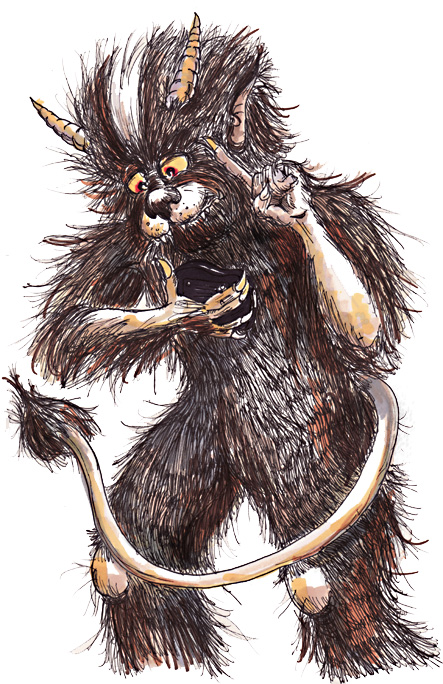
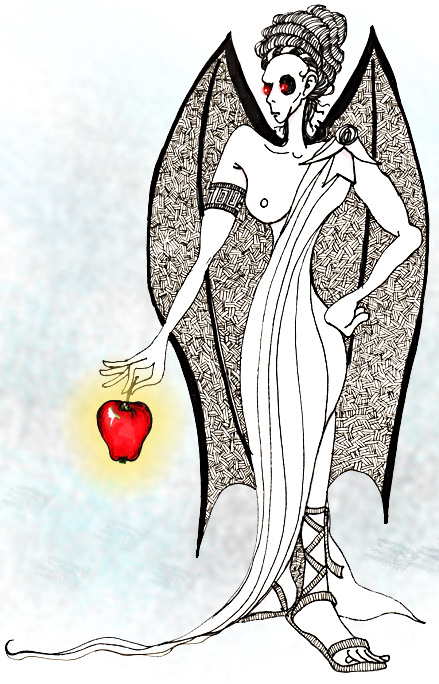
Eris is the Greek goddess of strife and discord. The goddesses Hera, Athena and Aphrodite had been invited along with the rest of Olympus to the forced wedding of Peleus and Thetis, who would become the parents of Achilles, but Eris had been snubbed because of her troublemaking inclinations. Eris crashed the wedding reception. She threw a golden apple into the center of the festivities. The apple was inscribed “To the Fairest One”– provoking the goddesses to begin quarreling about the appropriate recipient. The arguing escalated – into the Trojan War. 

Comments

comments

Monday Artday: cliffhanger

The new challenge on Monday Artday is “cliffhanger”.
You Americans, you're all the same. Always overdressing for the wrong occasions.
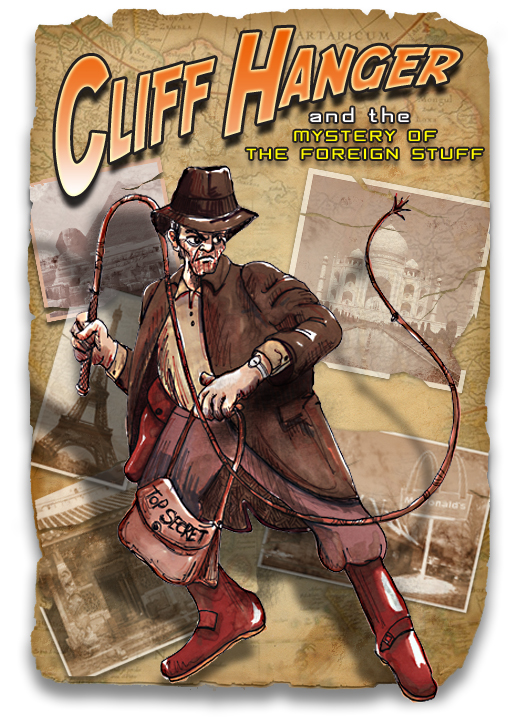
Action! Adventure! Intrigue! More Action! This is what you’ll encounter along side Cliff Hanger as he embarks on “The Mystery of the Foreign Stuff”. Join Cliff Hanger as he covertly transverses recondite continents searching for mysterious mystery. Marvel as Cliff Hanger battles savage and bloodthirsty inhabitants of uncivilized civilizations. Thrill as Cliff Hanger peculates ancient relics from lost and puerile cultures with ways different from our own. Laugh when Cliff Hanger humiliates those more substantial than himself. Cheer when Cliff Hanger kills someone — unprovoked and for no apparent reason. It’s all here! America’s last and only hope — Cliff Hanger! Don’t miss Cliff Hanger in his latest, greatest and most implausible adventure yet — “The Mystery of the Foreign Stuff”.

Comments

comments