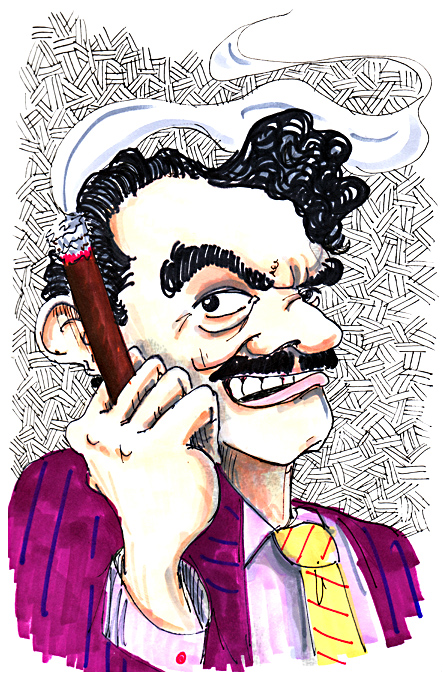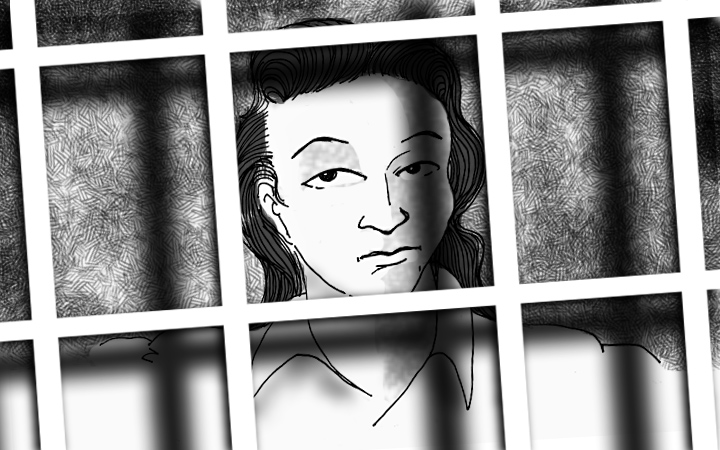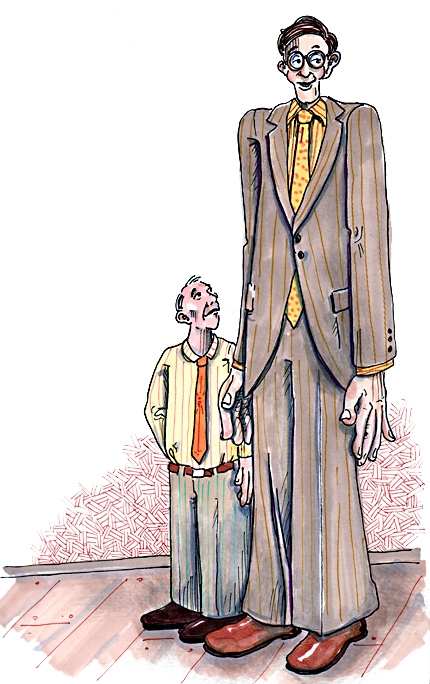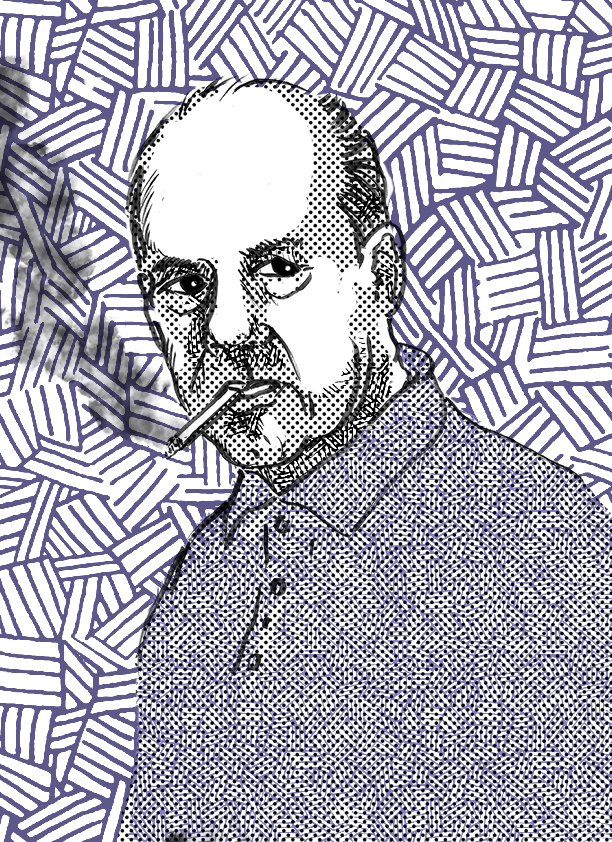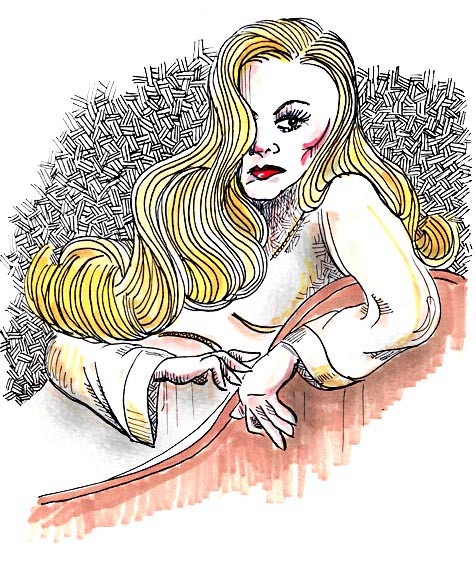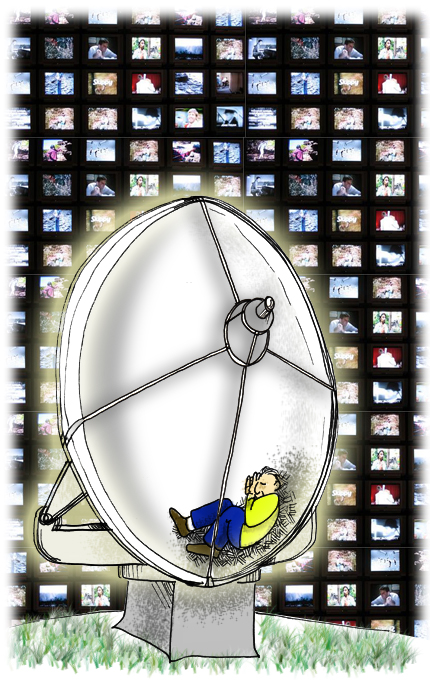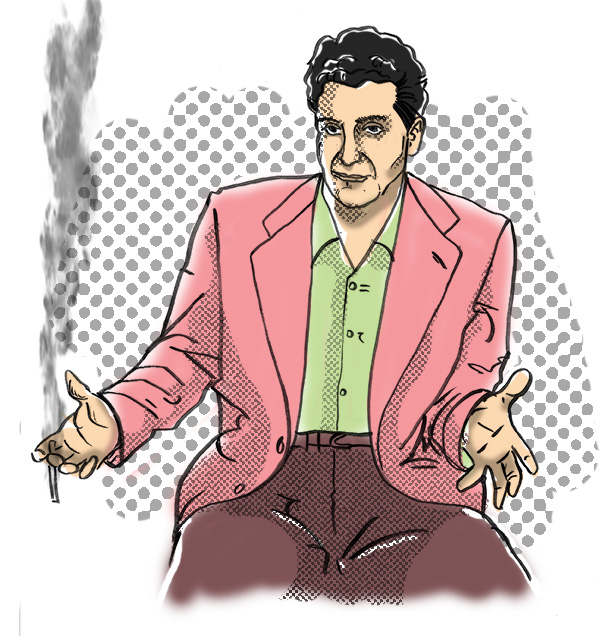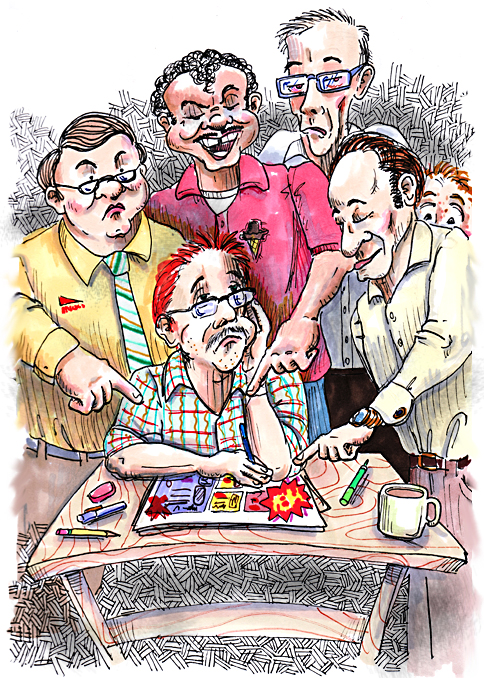
from my sketchbook: wally cox

not plane, nor bird or even frog
Wally Cox hated the role that made him famous. After beginning his career as a stand-up comedian, he starred for three seasons as mild-mannered science teacher Robinson Peepers in “Mr. Peepers”, an early sitcom that co-starred Tony Randall, Jack Warden and Marion Lorne. In interviews, Wally constantly argued unsuccessfully that he was nothing like the shy and timid character he portrayed. In reality, Wally was married three times. He was very athletic and he often hiked and rode a motorcycle.

In the early 1960s, he lent his voice to Underdog, a cartoon character that was a loose parody of Superman. Wally appeared in over twenty motion pictures, including several Disney productions and the unfinished final Marilyn Monroe vehicle “Something’s Got To Give”. He also appeared in guest-star roles on numerous network shows, including “The Dick Van Dyke Show”, “Bonanza” and several episodes of “The Beverly Hillbillies”. Later, he became a staple on the popular, long-running game show “Hollywood Squares”. His meek character was again exploited on “Hollywood Squares” and Wally often gave sarcastic answers to play against type.

In 1973, during his run on “Hollywood Squares”, 48-year old Wally Cox died from a heart attack. Unconfirmed rumors suggest it was brought on by an overdose of sleeping pills. An unannounced, surprise guest showed up at his wake. It was Wally’s lifelong friend Marlon Brando. Wally and Brando had been roommates in the late 1940s and remained close their entire lives. Brando was visibly upset by the loss of his friend. After cremation, Wally’s remains were given to Brando, where he kept them in a special container in a closet in his home. Sometimes, Brando later stated, conversing with Wally’s remains made him feel better when he was depressed. When Brando passed away in 2004, he, too, was cremated. Family members mixed his ashes with those of Wally Cox and scattered them in Death Valley, California.

Interestingly, in the early 1970s, character actor Bud Cort (“MASH”, “Harold and Maude”) had to adopt a stage name in order to join the Screen Actors Guild. Cort’s real name is Wally Cox.

Comments

comments

IF: slither

This week’s Illustration Friday challenge word is “slither”.
This is the lion’s den/I hope you knew that before you came in/This is where the angels and the devils fight/And they're choosing up sides tonight
The remarkable Prince Randian was one of the most successful sideshow performers of the 1930s. He was brought from his native British Guyana to the United States by showman P.T. Barnum in 1889. Despite being born with no arms and no legs, Prince Randian demonstrated his ability to shave, write, paint and roll and light a cigarette with expert proficiency. He even kept his smoking materials in a wooden box that he built himself with a hammer and saw. He often joked that one day he would build a house himself.

Barnum billed Prince Randian as “The Human Caterpillar”, who slithers on his belly like a reptile. When he performed, Randian wore a knit sack-like garment that emphasized his distinctive limbless torso.

Randian appeared in the 1932 classic Freaks directed by Tod Browning. In a memorable scene, Randian lights a cigarette with a match. He then blows out the flame as he exhales his first puff. Although he spoke four languages fluently, his only line of dialogue is delivered with an incomprehensible accent. (He actually asks another able-bodied actor “Can you do anything with your eyebrows?”) Later in the film, he is seen gripping a dagger in his teeth while crawling through the mud with his colleagues.

Prince Randian was married to “Princess Sarah,” and had five children. Shortly after a performance at the 14th Street Museum in New York City, Prince Randian passed away in 1934 at the age of 63.

Here is Prince Randian’s cigarette-lighting scene from Freaks:

Comments

comments

from my sketchbook: sanae zahani

I'm crying tears from my eyes that I can't deny and I am falling like a comet from the broken sky
Dante Gaudio, an account executive at the New York Times, wished to offer help in a time of need. In the days following September 11, 2001, Gaudio posted fliers in the area of the decimated World Trade Center offering lodging to family members of the missing. He received a call from a distraught young woman. Gaudio told her his location and invited her over.

Soon after, Gaudio opened his door to a sad young woman. Although her passport said Sanae Zehovani, she identified herself as Sanae Zahani. She was 20-years old and had come to the United States from Casablanca, Morocco in July. She had been working in a dentist’s office in Baltimore, but came to New York City to look for her sister. Aneda (or Neda, as the young woman called her) worked for Cantor Fitzgerald, a global financial services firm whose headquarters were located in World Trade Center Tower One. Almost seven hundred employees of Cantor Fitzgerald were killed when a jet crashed into Tower One. Sanae’s 26-year old sister was one of them.

The compassionate Gaudio drove Sanae to the New York Family Assistance Center, which had been set up at Pier 94. to help locate those who were missing or had perished in the World Trade Center attack. At the Center, Sanae filed a missing persons report and gave DNA swabs from inside her cheeks. She visited the Cantor Fitzgerald booth, but they could find no record of Aneda Zahani in their employ. Sanae noted that her sister was once married and could have used the last name “Apollo.” So, they researched “Aneda Apollo,” but again came up empty. Sanae explained that she may have been using an alias because of the possibility she was in the country illegally.

Sanae offered additional details about her sister. She informed Gaudio that she remembered that Neda lived near a train station and a jewelry store in Hoboken, NJ. Although she could not remember the address, she was sure she could find the apartment. While Sanae told her story to the Hoboken Police, she suddenly fainted in the police station. She was taken to a nearby hospital where she was given intravenous fluids until she was strong enough to be discharged. Sanea and Gaudio briefly cruised several Hoboken neighborhoods, but nothing seemed familiar.

A few days later, Sanae received a call from someone who had information about Neda. The caller spoke an Arabic dialect that Sanae didn’t understand. Gaudio knew a Moroccan woman he thought could help translate. The return phone number was lost in the confusion, but Gaudio’s Moroccan friend offered to have Sanea stay with her for a while. Sanae told her new host of her strict upbringing and how her mother shielded her and her sister from boys in Morocco. That is why she came to the United States.

Meanwhile, Gaudio hired a detective to track down the billing address for a cellphone that Sanae had gotten for Neda. It led to a man in Queens. He gave Sanae the number of another man who may have been Neda’s boyfriend. She called him, and he wasn’t helpful. Then another call came. Sanae began shaking and sobbing. It was the woman she was staying with in Baltimore. She told Sanae that her sister was alive and okay. Later, Sanae told Gaudio that she had spoken with her sister. She had managed to escape from her office at the World Trade Center. She received treatment for some injuries, but she was fine and was now in Baltimore. Relieved, Sanae along with Gaudio and his friend had a joyous celebration dinner. Sanae announced she would be leaving for Baltimore on September 24. Gaudio offered her $160 for her trip, but she refused all but $20 of it. She left New York, though she never officially closed her missing person case with the police.

– – –

Barbara Stout, an interfaith minister and Good Samaritan, also offered temporary housing for Ground Zero volunteers and out-of-town police officers. At 2:30 in the morning of September 26, an upset and exhausted young woman came to Reverend Stout. It was Sanae Zahani. Sanea related the same story she told Gaudio, except in this version, her sister was still missing.

Stout got Sanae accommodations at the YWCA. She volunteered to help Stout at her relief facilities, now located in a tent at the South Street Seaport. Sanae became very popular, making friends among the other volunteers. Firefighters and police officers invited her out regularly. Everyone was inspired by her story and was anxious to help find her sister in any way they could. Sanea had a photograph of her sister that she showed to everyone, including representatives from Cantor Fitzgerald. No one recognized the woman in the picture.

A fellow volunteer took Sanae to see The Rosie O’Donnell Show  and during an “audience questions” segment, Sanea spoke about her quest to find her missing sister. The touching story brought the audience to tears. She turned down offers of money from well-wishers, saying her only wish was to find her sister. In the weeks that followed, Sanae openly wept at a private tour of Ground Zero. She attended a memorial service for victims of the attacks and was presented with a container of ashes from the fateful site, along with an American flag. Soon, she said she was ready to return to Morocco and a sheriff drove her to the airport.

A few weeks later, she appeared again at Reverend Stout’s facility. She said her father had begun proceedings to collect compensation from Cantor Fitzgerald for the family’s loss. She said her sister had a car that was at the World Trade Center, and they wanted to collect for that, too. Sanae said she was off to file for a death certificate. This change in demeanor seemed odd to Stout. It was a different Sanae than she had known, but she figured that her father had made a convincing argument for practicality.

The next day, an article appeared in the New York Times about people missing from the World Trade Center who were later found to be alive. Dante Gaudio was quoted in the article, recounting Sanae’s successful search for her sister. Reverend Stout read the newspaper story and was dumbfounded. And she wept. Sanae never returned to Stout’s facility, however she did call. Stout questioned Sanae about her sister. Sanae insisted that she never implied that her sister was alive. She gave Stout the phone number for the attorney who was handling the case against Cantor Fitzgerald – a number that Stout later called. A number that rang and rang and rang. Sanae also produced a Social Security number for her sister. It was later determined that number was fictitious. Through a little investigation, Stout uncovered Sanae’s mother in Morocco. Through broken French and with the aid of a translator, Mrs. Zahani informed Stout that she only had one daughter in the New York area. Her name was Sanaa, but she had not heard from her in several months. Mrs. Zahani knew of Aneda, but confirmed that she was not family. She believed Aneda was a friend of Sanaa’s.

The last time Sanae was seen, she was headed to Brooklyn, she claimed, to meet with a lawyer. She disappeared as mysteriously as she appeared.

Comments

comments

from my sketchbook: tyler lambert

Now, the world don't move to the beat of just one drum, What might be right for you, may not be right for some.
In 1999, former child actress Dana Plato committed suicide at the age of 34. It was the culmination of a tumultuous life that went from starring in a popular weekly television series to robbing a video store and forging a prescription for Valium. The day before her suicide, an upbeat Plato appeared on The Howard Stern Radio Show  and happily subjected herself to a barrage of personal questions about her past.

On May 6, 2010, Plato’s 25-year-old son Tyler Lambert died from a self-inflicted gunshot wound to the head. A frequent drug and alcohol abuser, Lambert’s suicide came two days shy of the eleventh anniversary of his mother’s death.

Comments

comments

from my sketchbook: kam fong chun and gilbert kauhi

 I want to go back to my little grass shack in Kealakekua Hawaii
Kam Tong Chun’s teacher misunderstood his name and taught him to write Kam Fong  Chun. Later in his life, he had his name legally changed to Kam Fong Chun.

In the early 1930s, his family was broken apart when it was discovered that his father had an affair. His parents divorced and his mother raised Kam Fong and his four siblings. Facing poverty, his mother raised ducks and brewed whiskey. Their home was raided by the police many times and the family scrambled to hide hundreds of bottles of illegal liquor. In his early 20s, Kam Fong earned $13.50 a week as a welder at Pearl Harbor. Kam Fong reported to work just after the Dec. 7, 1941, Japanese attack. He remained at the harbor for three days without food and water and cried as he watched the burning USS Arizona sink. 

On June 8, 1944, two American B-52 bomber planes collided in mid-air and crashed into Kam Fong’s house, killing his wife and two young children. Shortly after, despondent and intoxicated, Kam Fong placed a revolver to his head in the back room of his mother’s house. His mother unexpectedly burst in an begged him not to kill himself. Instead, he sought a life-threatening job and joined the Honolulu Police Department.

Kam Fong remarried five years later and had four children. He also became involved in community theater. He left the police force and became a disc jockey. A friend got him an audition for a new show to be filmed in Hawaii. It involved the adventures of an elite branch of the Hawaii State Police. When the producers found out Kam Fong was a former police officer, they cast him in the role of Detective Chin Ho Kelly. The show was Hawaii Five-O.  The producers also asked him to shorten his name to Kam Fong. He was happy to oblige. Kam Fong stayed with the series for ten seasons and became close friends with cast members Jack Lord (Steve McGarrett) and James MacArthur (Danny Williams).

Kam Fong Chun died of lung cancer in 2002, at age of 84.

——–

Gilbert Kauhi was nicknamed Zulu while at school in Honolulu because classmates thought his hair looked African.

Gilbert, a singer, guitarist and ukulele player, formed Zulu and the Polynesians and performed on cruise ships. He appeared in films made in Hawaii, including Hawaiian Eye in 1959, Gidget Goes Hawaiian in 1961 and Diamond Head in 1962. Gilbert also worked a radio disc jockey.

Leaning toward an acting career, Gilbert adopted his school nickname “Zulu” when he was cast as Detective Kono Kalakua in Hawaii Five-O.  Zulu’s character provided some brief comic relief with his signature headbutts and his voracious appetite. Jack Lord’s character often referred to him as “Big Kanaka”. Zulu was fired from the show in 1972, after making racist remarks to a production crew member. The show, however, had helped Zulu launch a successful night-club career as a singer and comedian in Hawaii, which included a five-year, $2.5m contract with C’est Si Bon Showroom in the Pagoda Hotel & Restaurant in Waikiki. He became a much in-demand performer and wildly popular throughout the Hawaiian islands.

In 1986, Zulu was convicted of second-degree negligent homicide after hit and killed a bicyclist with his car. He was fined $500 and placed on one year’s probation. He also began to suffer from failing health, falling victim to two heart attacks and several strokes. He had a kidney transplant and was on a waiting list to receive another when he passed away in 2004 at the age of 67.

Comments

comments

from my sketchbook: william darby

Having been some days in preparation/A splendid time is guaranteed for all
William Darby, the son of a freed slave, was born in 1796 and orphaned as a child. As a youngster, he joined up with William Batty, the owner of a small travelling circus. The young Darby quickly picked up numerous acrobatic skills. Soon after, he trained with another circus owner, Andrew Ducrow, under whose guidance he became a first-rate equestrian, acrobat, tightrope walker and trainer of show horses. By the 1830s, Darby was billed in the press as ‘the loftiest jumper in England.’ It was about this time that Darby began calling himself  “Pablo Fanque” and started a circus of his own. With just two horses, he performed mostly in the north of England until his show gradually developed into a full-fledged circus including clowns and acrobatic acts. He became the first black owner of a circus in England’s history.

Fanque’s circus featured such illustrious and renowned performers as aerialist and all around-performer William Kite and high wire-walker, equestrian, trampolinist and clown John Henderson and his equally-talented wife Agnes. The Hendersons had traveled all over Europe and Russia during the 1840s. John Henderson’s specialty was executing somersaults (or “somersets”, as they were then called) over banners, known as “garters”, held between two people. He became airborne with the aid of a trampoline, which in those days, was a wooden springboard rather than a stretched canvas. By the late 1840s, Fanque’s circus was one of the best known in the country. During one performance, part of a wooden seating structure collapsed and Fanque’s wife, Susannah, was struck on the head by several heavy planks and killed.

Fanque continued to run his circus after his wife’s death and eventually included his children in the performances. He encountered relatively little racism in the course of his career. A prominent member of the British Showman’s Guild said “In the great brotherhood of the equestrian world there is no color line. Although Pablo Fanque was of African extraction, he speedily made his way to the top of his profession. The camaraderie of the Ring has but one test and that is ability!”

Pablo Fanque passed away in Stockport, in Greater Manchester, England, at the age of 75. Nearly a century later, John Lennon discovered an old playbill from 1843 advertising a benefit performance for one of his circus’s stars. Lennon adapted some of the wording on the poster to write the song “Being for the Benefit of Mr Kite”.

Comments

comments

IF: equipment

Hey, you've got to hide your love away!
My dad was a simple man and he loved simple things. He loved the Philadelphia Phillies. He loved breakfast at the Heritage Diner. And he loved pornography.

I’m not talking about the occasional Playboy magazine that, as a nine-year old, I stumbled across hidden under some shirts in a bottom drawer or the lurid novel stashed behind the clothes hamper in the bathroom. Sure, my dad owned several copies of Playboy and Penthouse, but his tastes leaned towards the more — shall I say — exotic.  These weren’t artful shots of lithe beauties, softly-lit and airbrushed to flawless perfection. I’m talking full-color, foreign-published, plain-brown-envelope, hard-core stuff. These tomes were filled with grainy photos of skanky women in various stages of undress, bent into impossible positions and inserting any one of a number of varied objects into any one of a number of body orifices. This was harsh and shocking stuff in the pre-Internet days of the 1960s. A thousand times more shocking than the sanitized material distributed by Hugh Hefner’s fledgling publishing empire.

My dad thought he was clever and wily and that only he had knowledge of his pornography collection. I can’t understand how he could believe this while sharing a house with his wife and two young (and curious) sons. My father was terrible at hiding birthday gifts and his beloved Tastykake snacks  from his family and he was just as terrible at hiding his pornography collection. My mom used to joke that nothing could get past her, but my brother and I were not so sure she was joking. She knew about things that she couldn’t possibly have known — from the whereabouts of a mysteriously missing cupcake to a failing grade brought home on a hidden school test. My father’s porn accumulation was no exception. My mom was fully aware of my dad’s explicit cache. On a semi-regular basis, while my dad was at work, my mom would gather up his X-rated stockpile. She’d load it into several heavy paper grocery-store bags until they were at the point of bursting. Then she’d cap each one with another inverted bag for extra security and privacy. She’d carry each bag, sometimes numbering four and five, to the curb and place them alongside our metal trash cans, where they would wait until the municipal sanitation department truck came for its weekly pick-up. After a few days, my father was obviously frantic. He would search for his pornography in the most casual and unassuming manner. My mom would smile silently and relish in his frustration. He couldn’t very well come out and say to his wife, “Hey, where’s all my pornography?” It was an unspoken ritual. They were both aware of what had transpired, but neither one would dare give verbal acknowledgement.

One day, my mom decided the time was right to “clean house” of my dad’s smut reserve. While my father was at work, she went from hiding place to hiding place and gathered the material up into the grocery bags. With the second bag securely capped on top of each bundle, she placed five or six of the obscenity-stuffed packages at the curb in front of our house. Soon, the trash collection truck appeared, slowly making its way up the block as the workers methodically emptied the neighbors’ refuse into the truck’s rear receptacle. When enough trash had filled the open cavity at the truck’s posterior, one of the workers would pull a lever and the garbage would be compacted back into the large storage area that made up the bulk of the vehicle’s size. Eventually, the truck rolled up to the Pincus curb. One of the workers ambled over to our trash cans, while the other hefted two of the paper sacks holding the lewd contents. He tossed them into the truck. They mingled with the coffee grinds and empty cans and the usual household discards as he returned to the curb for the remainder of the bags. After adding the last few bags to the repugnant mix, he decided the mass needed compacting to make room for the rest of our blocks’ rubbish. He pulled the lever and the machinery roared to life, as a huge steel plate forced the garbage back into the depths of the truck’s auxiliary stowage. Suddenly, under the pressure of the equipment and the sheer volume of trash, several of the bags burst, spewing their lascivious filling into the air. A cloud of vulgarity rained down. One worker realized what had happened and yelled “Stop! Stop!” as the other quickly disengaged the compacting switch. The two workers dropped to their knees and grabbed at the printed material that was now scattered in all directions, shoving it in their pockets and arranging it into neat little stacks. The driver climbed out of the cab to investigate and soon joined his colleagues in their pursuit of free porn. My mother watched, unnoticed from our kitchen window, as the trash collection was halted for a good twenty-five minutes, while the three sanitation workers reaped the spoils of hitting the erotica jackpot. When every last piece of my dad’s collection had been retrieved, the truck continued on its way up the street.

In the house, my mom chuckled to herself. She knew she had a great story that she wouldn’t tell to me until years later. A story she never told my father.


Comments

comments

Monday Artday: flying machine

The current Monday Artday challenge is “flying machine”.
they go up tiddly up up, they go down tiddly down down.
Wilbur and Orville were two brothers, named Wright
The nicest pair of kids you’ve ever seen
They worked twelve years on a secret project
They thought it was a washing machine

I said, “Fellas, what are all those wings for?”
They said, “For hanging clothes out to dry”
I said, “You fools, take that washing machine out to Kitty Hawk
And see if the darn thing’ll fly

— “Good Advice” by Allan Sherman

CLICK HERE to hear Allan Sherman’s “Good Advice” in its entirety (all glorious eight minutes and twenty-six seconds).

Comments

comments