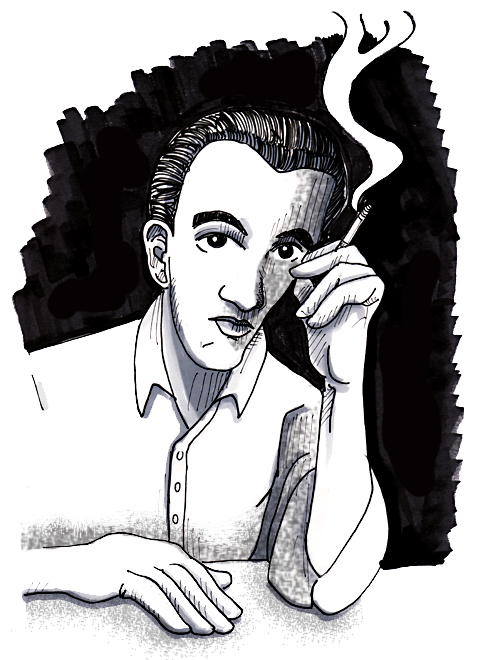
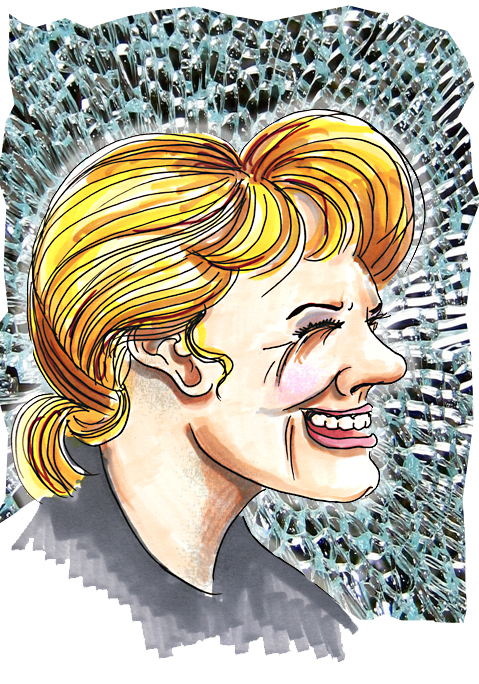
from my sketchbook: brad delp

I understand about indecision/But I don't care if I get behind/People living in competition/All I want is to have my peace of mind
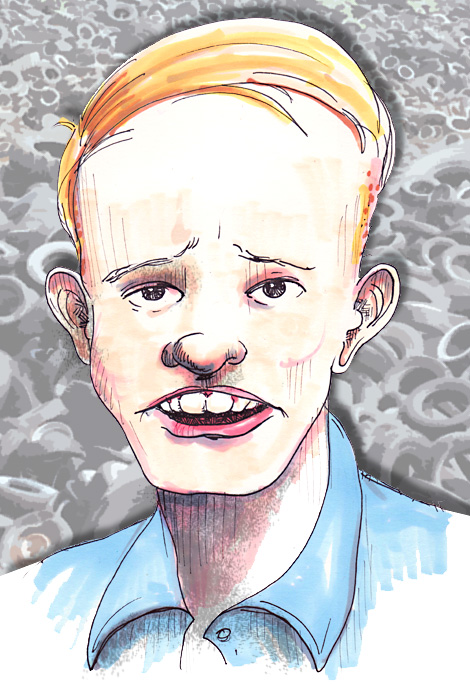
Brad Delp was “the nicest, most considerate guy you could ever hope to meet,” according to colleagues and those close to him. Brad was the primary singer and rhythm guitarist for the popular 70s band Boston. Boston’s 1976 eponymous debut sold seventeen million copies and featured Brad’s soaring vocals and multi-octave range on many of the band’s most famous hits like “More Than A Feeling” and “Long Time”.

Boston co-founder, micro-managing perfectionist Tom Scholz, delayed the release of their next two albums. When Third Stage, Boston’s appropriately-named third effort, was released, only Scholz and Brad remained from the band’s original lineup. Between infrequent tours and infrequent albums, Brad formed a Beatles tribute band called Beatlejuice and performed in the Boston area.

On March 9, 2007, Brad’s fiancée, Pamela, arrived at his New Hampshire home. Something was not right. She found a note taped to the windshield of Brad’s car. It read: “To whoever finds this I have hopefully committed suicide. Plan B was to asphyxiate myself in my car.” She found a dryer vent hose attached to the car’s exhaust pipe. Pamela called the police.

When police arrived, they found another note on an upstairs door directing them to the master bathroom. A third note warned of the presence of carbon monoxide. The police officers knocked on the closed bathroom door. “Mr Delp?”, they asked. Receiving no reply, they forced the door open. Immediately, they were overcome by the smell of burning charcoal. Inside the bathroom, they found two smoldering charcoal grills producing huge billows of gray smoke. The bottom of the door and the windows had been sealed with tape. Brad Delp lay dead on the floor, his head resting on a pillow, another note paper-clipped to his collar. This note read: “Mr. Brad Delp. Je suis une âme solitaire. (I am a lonely soul.)”

Brad was 55. He was thoughtful and considerate to the end.

Comments

comments

DCS: jean seberg

Jean, Jean, you're young and alive/Come out of your half-dreamed dream/And run, if you will, to the top of the hill/Open your arms, bonnie Jean
Jean Seberg made her motion picture debut at age 19 in Otto Preminger’s unusual interpretation of George Bernard Shaw’s play Saint Joan,  about Joan of Arc. Preminger’s daring casting of the unknown Jean received a huge build-up in the press, but Jean’s performance was panned by critics. Jean noted “I have two memories of St. Joan. The first was being burned at the stake in the picture. The second was being burned at the stake by the critics. The latter hurt more.”

Preminger immediately gave her another chance in his 1958 film Bonjour Tristesse.  Again, Jean’s performance was lambasted by critics, almost ending her acting career. However, Jean moved to France and was cast in Jean-Luc Godard’s French New Wave classic Breathless. French film reviewers called her “the best actress in Europe” and Jean became an international success. Jean did not identify with her characters or the film plots, saying that she was “making films in France about people she’s not really interested in.” The critics did not agree with Jean’s absence of enthusiasm, and raved about her performances, causing Hollywood to reconsider and welcome her back. New film offers from the United States began to roll in. Jean’s acclaimed role opposite Warren Beatty, in 1964’s Lilith,  prompted critics to view her as a serious actress. She followed that with several more favorable roles including her only musical, Paint Your Wagon  in 1969. Curiously, Jean’s singing was dubbed while co-stars (and non-singers) Lee Marvin and Clint Eastwood sang their songs themselves. She also was part of the all-star ensemble cast of the early disaster film Airport  in 1970.

Her brief and violent marriage to French director Francois Moreuil ended in divorce. In 1962, she married director Romain Gary, who was 24 years her senior. During the filming of Paint Your Wagon,  Jean had an affair with Clint Eastwood. In 1970, she had an affair with a college student, a union which produced a daughter. Due to her outspoken support of the Black Panthers Party and the political climate in the United States at the time, the FBI created a false story that the baby was not fathered by her husband Romain Gary, but by a member of the Black Panthers Party. The story was reported by a Los Angeles Times gossip columnist. During her pregnancy, Jean claimed that her husband Gary was the father. She gave birth to a girl named Nina on August 23, 1970, but the infant died two days later. Jean soon confessed that her daughter was the result of an affair she had with a college student during a separation in her marriage. She and Gary divorced by the year’s end.

Jean married director Dennis Berry in 1972. She also began an increased dependency on alcohol and prescription drugs. She regularly suffered bouts of clinical depression and separated from Berry, though they did not divorce.

In August 1979, after being missing for eleven days, Jean was found dead in the back seat of her car parked near her Paris apartment. She had taken a massive overdose of barbiturates and alcohol. A note — reading “Forgive me. I can no longer live with my nerves.” — was found in her hand. She was 40.

One year later, Jean’s second husband Romain Gary committed suicide.

Comments

comments

from my sketchbook: bridgette andersen

smile a little smile for me
Seven year-old Bridgette Andersen stole moviegoer’s hearts in her starring role as the title character in 1982’s Savannah Smiles. She followed that with the horror anthology film Nightmares  in 1983, guest roles on television series like Family Ties, Remington Steel, Fantasy Island,  and a TV movie playing a young Mae West.

Despite a part in the Disney Channel-produced sequel The Parent Trap II, Bridgette found her demand as an actress waning and her roles reduced to background characters and extra work in commercials.

Bridgette was not close with her family and turned to drugs in her teen years, eventually acquiring an addiction to heroin. In 1997, she was working in a Los Angeles health food store and trying desperately to kick her drug habit. One evening in May 1997, Bridgette overdosed on a combination of heroin and alcohol. She was taken to Queen of Angels hospital in Hollywood and placed on life support. Bridgette remained in a coma until she was declared brain dead on May 18, 1997. She was 21.

Comments

comments

IF: chicken (part 2)

This week’s challenge word on the Illustration Friday website is “chicken”.  This is the second of three illustrations I’ve done for this word. Here  is the first and here   is the third, which I did over a year ago, but fits the theme.
What's wrong, McFly. Chicken?
“The difference between ‘involvement’ and ‘commitment’ is like an eggs-and-ham breakfast: the chicken was ‘involved’. The pig was ‘committed’.”

Comments

comments

IF: chicken (part 1)

This week’s challenge word on the Illustration Friday website is “chicken”.  This is the first of three illustrations I’ve done for this word. Here  is the second and here  is the third, which I did over a year ago, but fits the theme. 
There ain't nobody here at all/So calm yourself,/And stop your fuss/There ain't nobody here but us
In 1920, a railroad worker named Arthur Perdue noticed that the farmers bringing eggs for shipping were taking in more money that their vegetable-growing counterparts. Arthur, along with his wife Pearl, purchased a small flock of chickens and built a coop in their Salisbury, Maryland backyard. Soon the Perdues were taking in an extra ten to twenty dollars a week from their new venture. That was a lot of money in the days of the Great Depression.

Although reluctant, son Frank put aside his dreams of becoming a professional baseball player and dropped out of college to become the third full-time employee in his parents’ egg business. They soon switched the direction of the business to raising chickens for meat rather than eggs. When meat prices began to rise during World War II, the Perdues earned a fortune and the business grew steadily. Frank became president of the company in 1952. He devised an idea to make the chicken more appealing to the consumer. He added marigold petals to the chicken feed, thus giving the chickens a more yellow appearance. Then he shipped his product on ice, rather than frozen like his competitors. This gave the chickens a fresher taste.

In the early 1970s, Frank approached an ad agency and produced a commercial in which he starred as spokesperson for his product. Prior to this, selling chicken under a ‘brand name” was unheard of in the industry. Frank was considered a branding visionary. Frank’s advertisements were wildly popular and, despite his shyness, he was featured in over 200 commercials over the next 23 years. The ad’s tag line — “It takes a tough man to make a tender chicken” — became known nationwide. Frank also made it clear to his customers that he welcomed criticism of his product and would happily give a refund to anyone unsatisfied with his chicken.

Frank had built his family business to a multi-billion dollar corporation.  Suffering from the beginnings of Parkinson’s disease, Frank turned the company’s reigns over to his son Jim in 1991. After a brief illness, Frank passed away in 2005.

In the 70s, my father’s humble beginnings as a butcher led to an executive position in the fresh meat and poultry division of a chain of local Philadelphia supermarkets. He had the opportunity to meet Frank Perdue. He described Mr. Perdue as a quiet, well-mannered man who, in person, looked like a chicken.

Comments

comments

from my sketchbook: zero mostel

Now you're here to stay/And nobody really knows/How wonderful you are./Why we could never reach a star,/Without you, Zero, my hero,/How wonderful you are.
Brooklyn-born Samuel Mostel came from very humble beginnings, hoping to one day become an artist. After his graduation from City College of New York, when he took the same Beginner Art class over and over, he joined the Public Works of Art Project and began teaching art. He mixed his natural humor into his classes and was soon performing his brand of comedy for private parties, including gatherings at Labor Union Social Clubs. These performances would play a major role in his eventual blacklisting in the next decade.

In the early 1940s, Samuel landed a regular gig doing stand-up comedy at a small Manhattan nightclub. The club’s press agent dubbed him “Zero” saying he’s “a man who made something out of nothing.” The name stuck and Zero’s blend of comedy and social commentary was a hit with audiences. He appeared in some off-Broadway plays and eventually had several programs on local New York television.

In the early 1950s, Zero was blacklisted for his alleged association with the Communist Party and his refusal to report on the activities of his colleagues. Unable to get work for years, theatrical agent Toby Cole, who strongly opposed blacklisting, offered Zero a role in his off-off-Broadway production of Ulysses. Zero received rave reviews and overwhelming praise and was awarded an Obie in 1958. That award led to the role of Pseudolus in the Broadway musical A Funny Thing Happened on the Way to The Forum.  Although Zero was a joy for audiences, directors and fellow actors had great difficulty working with him. He had a tendency to ad-lib at length thus throwing off the timing of live performances and confusing other cast members waiting for specific cues. Producers preferred to sign Zero to short contracts, as the longer he played a part, the more he would put his own spin on it. In 1964, Zero opened on Broadway in his memorable role as Tevye in Fiddler on the Roof,  for which he won a Tony Award. However, mostly likely due to his reputation, Zero was passed over in favor of Israeli actor Topol, by director Norman Jewison for the movie version of Fiddler. (Years later, when Zero’s son Josh was cast in the Jewison-directed Jesus Christ Superstar,  Zero joked “Watch it! He’s libel to cast Topol’s son instead.”)

In 1968, director Mel Brooks had to convince Zero to play Max Bialystock in his film The Producers.  The film, which garnered lukewarm reviews in its initial release, has since become a cult classic and possibly Zero’s most memorable role. 

Zero appeared in several movies through the 60s and 70s, including the film version of A Funny Thing Happened…  and The Front,  a story of a blacklisted actor that eerily mirrored Zero’s own struggles. He also filmed short segments for Sesame Street  and The Electric Company  for public television. During rehearsals in Philadelphia for a reworking of The Merchant of Venice,  Zero collapsed in his dressing room and was taken to the hospital with a respiratory ailment. Over the next day or so, Zero complained of dizziness and lost consciousness. Doctors were unable to revive him. He was pronounced dead at the age of 62, the result of an aortic aneurysm. Zero had recently completed a guest role on The Muppet Show  and became the only guest in the show’s history to die before his appearance was broadcast. He enjoyed working with Jim Henson, noting “[Henson] has the best possible actors. If you have a disagreement with them, you can always use them to wash your car.”

Comments

comments

from my sketchbook: will the circle be unbroken

it's a world of laughter, a world of tears, it's a world of hopes and a world of fears
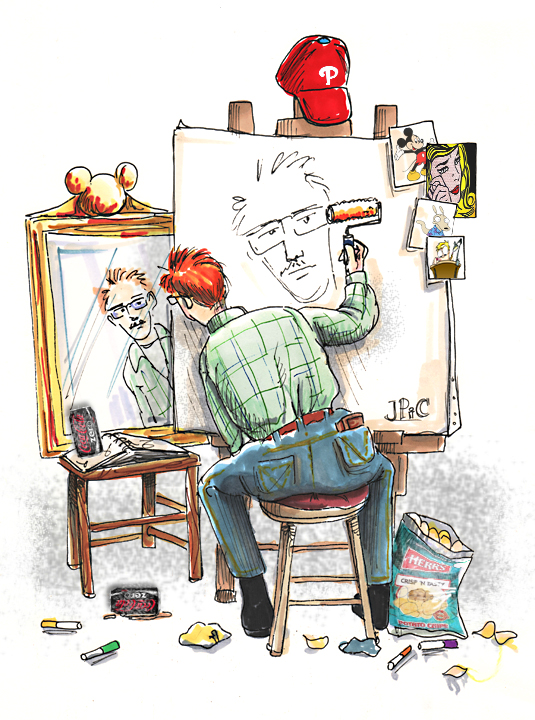
2010 came to a close last week, but it began almost 35 years ago, when I was in high school. After getting tossed out of the majority of my academic classes, I gravitated towards the art department. There, among those paint-splattered desks and rolls of brown kraft paper, I felt comfortable and had as much a sense of purpose as a 16 year-old could. It was in one of those art classrooms I met Eric Dorfman. My relationship with Eric could best be described as a cordial, but distrustful, rivalry. We weren’t so much friends as we “got along” – always aware of the underlying atmosphere of competition between us. Eric was a grade behind me, but freshmen through seniors were lumped together in art classes to make up for the lack of full enrollment. Of course, the first thing anyone noticed about Eric Dorfman was his huge shocking red “Jew-fro.” He was short of stature with broad shoulders and a perpetual look of “don’t fuck with me” on his freckled face. He had a fast and determined gait and maneuvered through the hallways with his head down, like a bull on a mission. We passionately discussed movies and music with teenage fervor, sometimes even sharing a few favorites, but more often we disagreed. We did, however, have a similar drawing style, although I remember his being more advanced and refined and not nearly as crude and sketchy as mine. (I like to think I got better.)

Eric and I were also rivals for Lisa Holtsberg. I dated a lot of girls in high school and, although she was sweet and I liked her, my main reason for dating Lisa was that Eric Dorfman pursued her, too. Over an undetermined period of time (read:  I can’t remember), Lisa seemed attracted to each of us equally, unless she was just secretly enjoying being a witness to our animosity and the battle for her affection. Soon, I graduated from high school and I moved on, leaving Eric and Lisa (and many others) behind. Or so I thought.

While attending art school, I met the future Mrs. Pincus. When I first met her, as I related in a story told elsewhere on this blog, Mrs. P. was accompanied by her friend Ricci (pronounced “Ricky”, not like actress Christina’s last name). I became friends with Ricci and she would often be invited (or just join in) when Mrs. P. and I went out – and, honestly, I had no problem with that. I soon found out that Ricci had a long time, on-again off-again, somewhat tumultuous, relationship with none other than Eric Dorfman. Ricci talked about Eric constantly, although they seldom went out on dates. She hung out at his place a lot and she went out with us a lot, but rarely would those two activities merge. (In the nearly thirty years I have known my wife, I believe I saw Eric show his face in public with Ricci twice.) When Mrs. P. and I married, Ricci was Maid of Honor. When our son was born, we named Ricci his godmother. Eric eventually married someone who was not Ricci. Despite that, there remained a constant, though illicit, connection between the two of them.

During one of the “off-again” phases of the Ricci-Eric relationship, Ricci developed an unrequited crush on a local radio personality named Mark the Shark. Mark was the amiable half of the wacky 80s era Morning Zoo franchise in Philadelphia. The celebrated show was hosted by perennial pompous asshole John DeBella, a man whose talent and popularity I have yet to understand. In addition to the hourly news updates, the soft-spoken, easy-going Mark the Shark provided a modicum of civility in contrast to DeBella’s annoying antics and forced laughter. Ricci was enamored with Mark. During a live broadcast of the Zoo before an audience of which we were a part, Ricci gazed longingly at Mark for a marathon four hours. Ultimately, John DeBella was humiliated on the air by rival Howard Stern in his early days of syndication and the Morning Zoo fell out of fashion. Mark the Shark, now using his real name Mark Drucker, quietly became the unassuming entertainment reporter for an all-news radio station in Philadelphia. He also married Lisa Holtsberg.

One morning in 1997 at the ungodly hour of 3 AM, a ring from my bedside telephone shattered an otherwise deep sleep. A phone call at 3 AM is rarely a good thing and this one was no different. It was Ricci and she was hysterically crying. Through shrieking and gasps for breath, I was able to decipher her words – Eric Dorfman had committed suicide. He had been depressed over his separation from his wife and young daughter. His excessive self-medication was no longer effective and he shot himself. My wife and I were shocked. Ricci was devastated. A funeral followed shortly. I believe this marked the beginning of the end of my wife’s friendship with Ricci. As I had witnessed and correctly predicted, my wife’s lengthy and strong friendship with Ricci came to a bitter end. Ricci had evolved into a different person – a person far removed from the fun-loving, spontaneous and occasionally happy Ricci we once knew. All in all, Ricci and Mrs. Pincus just grew apart and into different lives.

Early last year, my friend Sam passed away. I encountered several friends from my life a thousand years ago at his memorial service. Now older and somewhat wiser, we seemed to approach each other with warm familiarity and, under the circumstances, sad sentimentality. The cross conversations were peppered with promises of get-togethers and lunch dates and the obligatory exchange of email addresses and cell phone numbers. And as long as the cell phones were out, the display of digitally-captured photographs of absent children soon followed.

Over the course of the next several months, I had rekindled paused friendships from my younger days, culminating in an informal gathering at my friend (and Florida traveling companion) Alan’s home. On that July evening, we were joined by Scott Sadel (now an anesthesiologist) and Jon Wassermann (now a very huggy chiropractor) and our wives for a session of reminiscing among old friends and introduction, as our wives had not previously met. As the sky outside grew darker and several pizzas were reduced to gnawed crusts, the conversation bounced from recounting embarrassing episodes of youth to commiserating about our current employment to updates on our children and extended families. Of course, the inevitable round of “Jewish Geography” reared its yenta  head and soon previously unknown connections through summer camp and Jewish youth groups were revealed. Alan even broke out his slide projector for a pale and scratchy trip down Memory Lane. During the “who have you seen/who have you talked to” portion of the night, various forgotten names were bandied about – names that had not crossed our collective minds in decades. We briefly discussed the untimely 2005 death of Mark Drucker when Lisa Holtsberg’s name surfaced, and just as quickly moved on to the next old girlfriend or English teacher.

When autumn rolled around, a varied group of guests gathered at my house for a pre-Thanksgiving soiree. My new old friends Scott and Alan were unavailable to attend, but Jon and his missus excitedly joined us. With a houseful of people from various categories of my acquaintance, extended conversations are difficult. My wife is much more adept at mingling and spending time with all her guests, no matter how brief. I pick who I want to talk to and I pick who I want to avoid. While Jon was simultaneously devouring a cookie and admiring the unusual décor in our dining room, he offhandedly mentioned that Lisa Holtsberg had passed away in September. My eyes widened and I cocked my head in disbelief as I asked Jon to repeat what he just said, in case an errant chocolate chip had ricocheted off a vocal cord and impacted his words. Jon’s wife Marjie confirmed that I had not heard wrong. Mrs. Pincus was carrying a stack of paper plates laden with crumbs and I grabbed her arm as she walked by. I told her what Jon had told me, and although she had never met Lisa, I could tell she was saddened. Not just at the loss of someone so young, but because of the unusual reoccurring role Lisa played in our lives.

For most of our relationship, my wife has been intrigued by the fact that I avoid my past like the plague. Often, we would go to a mall or to a restaurant and I would single out a man noting that I had attended high school with him. “Are you going to say ‘Hello’ and ask how he’s been?,” she’d innocently inquire. I would always answer in the negative, adding that if I gave a shit about “how he’s been,” I would have kept in touch. My dear, dear wife – sweet, warm and friend to all – still finds this perplexing. Year after year, I have expressed no interest in the festivities of a high school reunion. The thought of reliving the dreadful memories (the ones I can remember) of my teen years turns my stomach. Catching up with ancient acquaintances I expect would be lying about post-high school accomplishments turns my stomach even more. Sure, I had friends in school – close ones – but it seemed as though that portion of my life happened to another person. However, 2010 seemed to have brought that person back.

Comments

comments

from my sketchbook: peter boyle

Puttin' on the Ritz
Young Peter Boyle joined a monastery, in his hometown of Philadelphia, just after high school. After losing his religious calling, he became a cameraman at a local TV station and later look acting lessons from Tony Award-winning actress Uta Hagen in New York City.

He was cast in the title role of the violent and controversial 1969 film Joe,  playing a murderous bigot. Liberal-minded Peter was appalled by the audience’s supportive reaction to the character and vowed never again to appear in a movie in which violence is glorified. A man of his word, he turned down the role of Popeye Doyle in The French Connection,  a role for which Gene Hackman earned the Academy Award.

Peter appeared in mainly dramas playing gruff types, usually cops or gangsters. In 1974, he took an unexpected, yet hysterical, turn as The Monster in Mel Brooks’ gothic horror parody Young Frankenstein.  On the set of Young Frankenstein,  Peter met Rolling Stone  reporter Loraine Alterman. He was in full monster make-up when he asked her for a date. Through Loraine’s friend Yoko Ono, Peter developed a lifelong friendship with John Lennon. John served as best man at Peter’s and Loraine’s wedding. Peter’s career was all over the map through the 80s and 90s, starring in dramas, comedies and even science fiction. In 1990, Peter suffered a stoke that left him immobile and unable to speak. After a long and difficult recovery period, Peter returned to acting and won an Emmy for a guest appearance in the popular X-Files  series in 1996. This led to his signature role as perennial crank Frank Barone on the sitcom Everybody Loves Raymond.  Peter was nominated for an Emmy seven consecutive times during the run of the series, but never won. He lost three consecutive times to co-star Brad Garrett. In 1999, Peter suffered a heart attack on the set of the show. Again, he regained his health and returned to acting. He starred opposite Billy Bob Thornton in the gritty Monster’s Ball,  as well as continuing to play Ray Romano’s father on television.

Peter appeared in all three Santa Clause  films with Tim Allen, the last bearing a dedication to his memory. Peter passed away from heart disease in 2006. His friend, Bruce Springsteen dedicated a performance of the song “Meeting Across the River” to Peter, on what would have been the actor’s 72nd birthday.

Comments

comments

IF: resolution

The first Illustration Friday challenge word of 2011 is, fittingly, “resolutions”.
but if you go carrying pictures of Chairman Mao, you ain't gonna make it with anyone anyhow
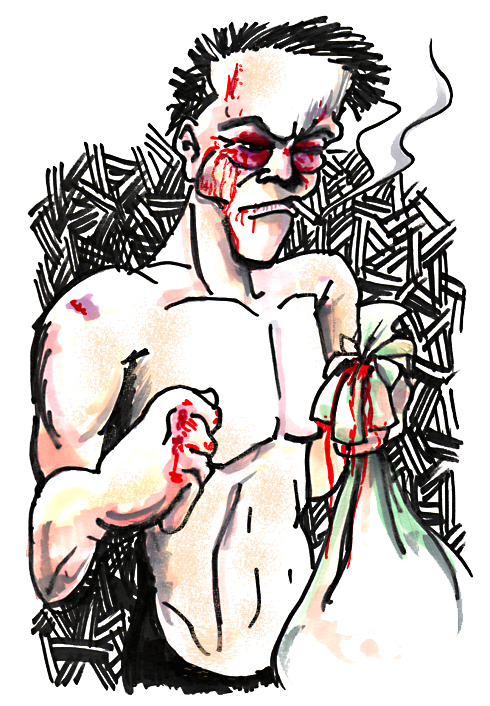
I usually don’t make New Year’s Resolutions, but this year I thought I would attempt to do one million drawings. That sounded pretty cool. So, I did the math (with a calculator — I’m an artist, after all). In order for me to fulfill my goal of one million drawings in 2011, I would have to create two thousand seven hundred forty every day. This would allow me to skip a few here and there over the course of a year, in case there are some days that I am not feeling particularly creative. At that rate, I will be on course to create one million one hundred drawings. Today, however, is January third and, so far, I have done three illustrations in 2011. I am currently eight thousand two hundred seventeen drawings behind schedule.

My other resolution was to try to be nicer to people, but fuck that.

Comments

comments