from my sketchbook: karyn kupcinet

We get it on most every night/When that old moon gets so big and bright
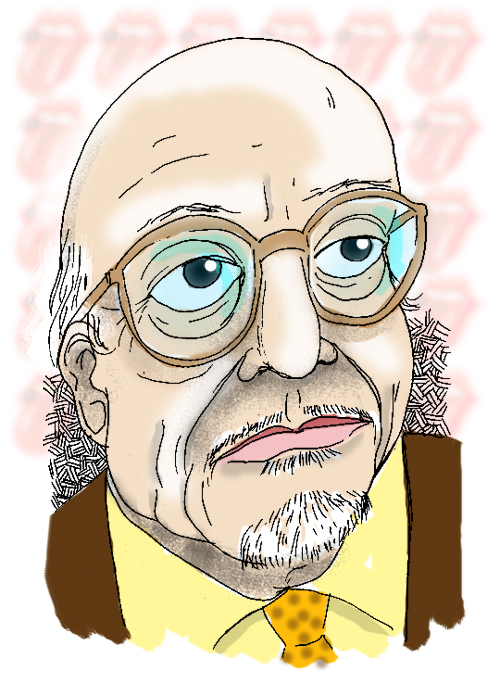
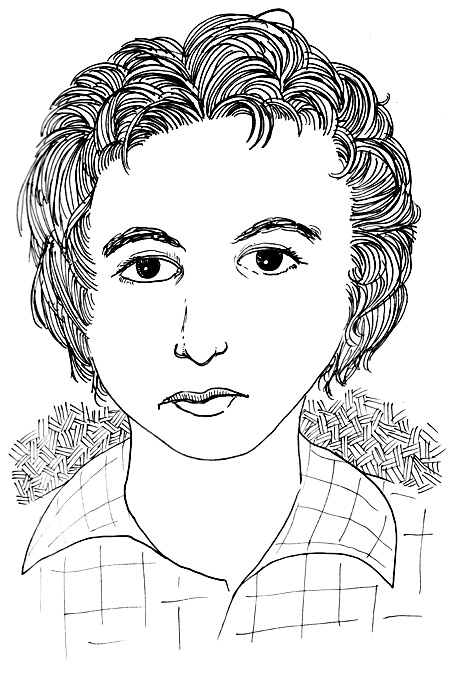
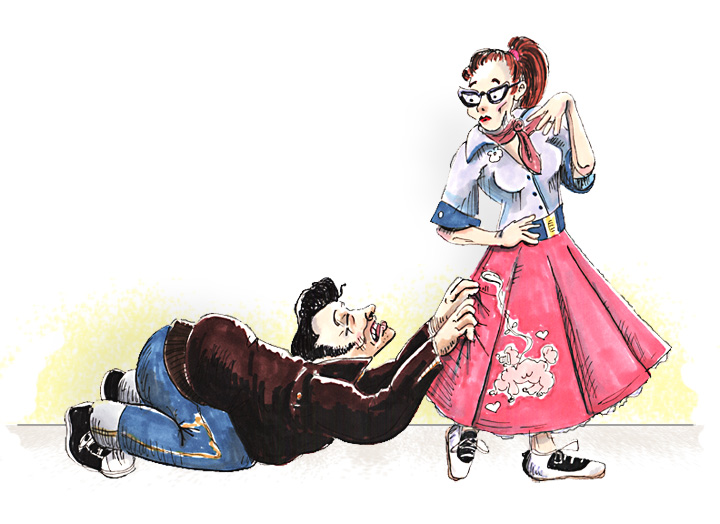
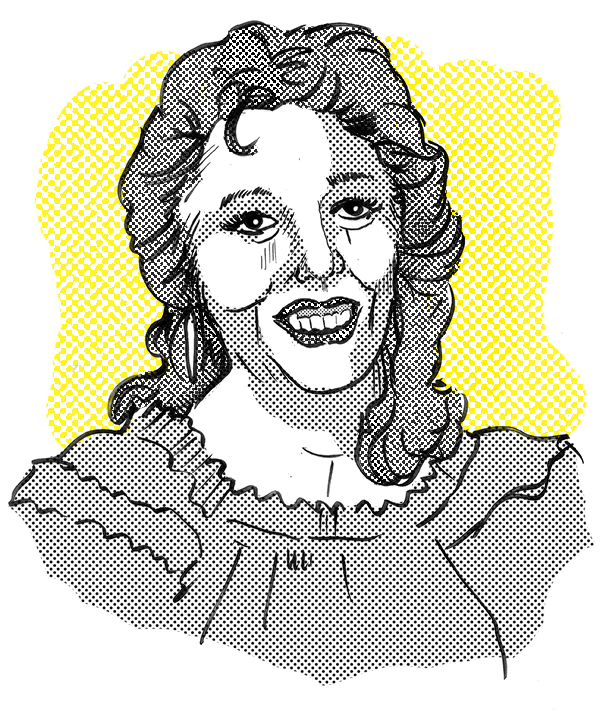
Karyn Kupcinet, the daughter of popular Chicago columnist Irv Kupcinet, was a young and aspiring actress. She was given access to producers thorough her father’s connections. Using the name “Tammy Windsor”, she landed a small role in the campy Roger Corman original Little Shop of Horrors.  In 1961, she was offered a small role in The Ladies Man by its director-star, Jerry Lewis. This was her last motion picture before turning to a modest career on episodic television. Karyn made numerous, one-shot appearances in both comedies and dramas, including a regular role on the short-lived Gertrude Berg Show,  alongside a young Marion Ross.

Karyn was getting positive feedback for her acting. However, she began an unfounded concern for her physical appearance and started taking an excessive amount of diet pills. Around this time, she began a relationship with fellow actor Andrew Prine, but her overuse of prescription drugs was a cause of conflict for the couple. In addition, Karyn was arrested for shoplifting in 1962.

Prine dismissed Karyn’s pleas for an exclusive relationship. He distanced himself from the actress and pursued other women. Karyn took to spying on Prine and his dates. She even sent threatening messages to Prine, using printed words and letters she had cut out of magazines.

On November 28, 1963, Karyn arrived late for a Thanksgiving dinner invitation from actor Mark Goddard (several years before he would gain fame as Major Don West on Lost in Space) and his wife Marcia. Goddard and his wife noticed Karyn behaving in an unusual manner. He noted that her voice seemed strange, she played with her food – eating very little and seemed to be moving her head at odd angles. When confronted by the Goddards, Karyn began to cry and told an unsubstantiated story of a baby being left on her doorstep earlier in the day. Once calmed down and comforted, Karyn left for home in a taxi, promising to call upon her arrival.

Two friends came by Karyn’s house later that evening. The three watched television and drank coffee until Karyn dozed off on the sofa. She awoke, excused herself and headed for her bedroom. The two men lowered the volume on the TV and locked the front door behind them.

On November 30, the Goddards went to Karyn’s home after not hearing from her since Thanksgiving. They found her lying on the sofa. She was nude and she was dead. The front door was unlocked and the television was still on. A subsequent police search yielded bottles of Desoxyn, Miltown, and other medications. A coronoer’s examination concluded that, due to a broken hyoid bone in her throat, Karyn had been strangled. Her death was officially ruled a homicide.

Years later, while doing independent research for a book, author James Ellroy claimed that a sheriff’s report found a book that recommended naked dancing to free one’s inhibitions lying on a table near Karyn’s body. It had been placed on the table and bookmarked at the page that explained the dancing. Ellroy has theorized that she followed the advice in the book, started dancing, fell and broke her hyoid bone on a chair. He went on to say that the coroner who performed Karyn’s autopsy was an alcoholic and botched the autopsy.

Another scenario from conspiracy theorist Penn Jones claims that a woman who dialed her local operator approximately 20 minutes before President Kennedy’s assassination with information of the shooting, was Karyn. Jones’ claim points to Irv Kupcinet as the source of the information saying he passed the knowledge on to his daughter. Jones goes on to say that Karyn was murdered because of this knowledge.

Karyn’s family have disputed Ellroy’s claim and, although they believed Karyn was murdered, dismissed Jones’ theory as well.

Comments

comments

IF: journey

Strangers waiting, up and down the boulevard/Their shadows searching in the night/Streetlights people, living just to find emotion/Hiding, somewhere in the night.
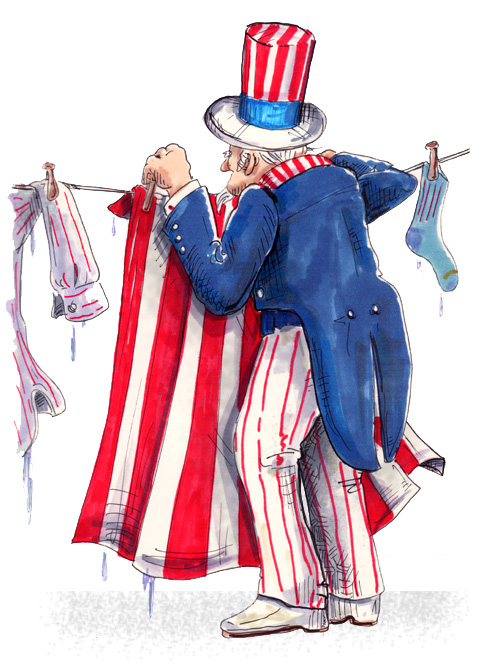
Passover — the holiest day on the Jewish calendar after Rosh Hashanah, Yom Kippur, Sukkot, Shavuot, Shemini Atzeret and Simchat Torah …..um, where was I ?

Oh, yeah. Passover.  Passover recounts the story of the ancient Israelites’ long journey out of slavery and oppression by Egypt and the Pharaoh. The Jews were enslaved and ordered to build the pyramids. This, of course, was the last time any Jew attempted a large home construction project with his own hands. The poor children of Israel were miserable and looked to their leader Moses for comfort and a remedy to their problems.

Moses demanded that the uninterested Pharaoh “let his people go.” With some assistance from God, Moses warned of ten plagues that would be brought upon Egypt until the Jews were freed. After an unrelenting wave of locusts and boils and flaming hail and anthrax (the disease, not the band — although that would have definitely qualified as a plague), Pharaoh said “Alright already! Beat it!” and granted the people their freedom. Wasting no time, the Israelites rapidly gathered their belongings and split. In their haste, they quickly grabbed the dough that had been baking on the hot rocks, not allowing it to properly rise. Because of this very act, this simple exercise in impatience, every year on Passover, Jews are condemned commanded to eat matzo in celebration of their freedom.

My observance of Passover has changed throughout the various stages of my life. As a child, there was little to no observance of Passover in my house. Of course, we had the obligatory single box of matzo and the occasional can of chocolate macaroons, but they held an equal place at the table alongside the plastic-wrapped loaves of bread. My father wasn’t going to stand for this “matzo shit” when he craved a bologna sandwich. Thirty years ago, when I met my wife and her traditionally observant family, I was introduced their elaborate seder. My in-law’s seder, the steadfast Passover meal, was a relative-stuffed, marathon event in which my father-in-law, reading from a generations-old tome, chronicled the tale of the Exodus in what seemed like real time. The entire ritual was meticulously orchestrated — from the reciting of the ma nishtana,  to the off-key, communal singing of prayers — until we reached page 62 in the Haggadah and dinner was served. As the years rolled on and the massive preparation began to take its toll on my beleaguered in-laws, the seder has evolved into a much more intimate affair. The guest list has been whittled down to the families of their three grown children. Since my in-law’s grandchildren range in age from preschool to thirty years old, participation seems to excite only the smaller ones. Seated at the table, the older grandchildren can be caught observing their younger counterparts with glazed expressions, betraying conflicting feelings of fond memories and detachment. Others at the table are frantically calculating the arrival of page 62. My father-in-law’s one-time epic dissertations on the adventures of Moses and his freedom-seeking crew has been reduced to, what we fondly refer to as, the “Reader’s Digest” seder.

Matzo is the most familiar symbol of Passover. Both Jews, who suffer rejoice in its annual arrival, and non-Jews, who have sampled it in curiosity, are accustomed to its presence on supermarket shelves. Even among the assembly of unfamiliar products, like gefilte fish, farfel and kichel,  matzo has become the Passover equivalent of chocolate bunnies… sort of. Not renowned for its versatility, inventive chefs (such as my mother-in-law) have sprung unlikely offerings like matzo lasagna (using strips of matzo in place of noodles) and matzo pizza (using matzo instead of anything that remotely resembles pizza) on their invited Passover visitors. These preparations have their hearts in the right place , but their taste buds have taken the eight day celebration off. An age-old dish, created to tolerate the eating of matzo and to mask its bland taste and cardboard-like texture, is matzo brie or fried matzo. Matzo brie, depending on whose family tradition you are following, can be likened to anything from French toast to an omelet to a doorstop. Years ago, my wife and I had a heated debate over the proper way to prepare matzo brie. Of course, we were each used to the way it was concocted by our respective mothers. I came to really love the way my wife made matzo brie , despite its noticeable difference from how my mom made it. The reason, I figured, was: number one — I can’t cook to save my life and number two — I damn well better prefer my wife’s cooking over my mother’s. Oh, my wife’s matzo brie  is really good, too.

While our methods of honoring the redemption of the children of Israel were virtually non-existent, my mother did  like making matzo brie and my brother and I loved eating it. We would sit at the kitchen table and carefully watch as my mother eyeballed the perfect amount of oil into her heated electric skillet. Then, in one fluid motion, she’d remove every insipid slice of plain matzo from a box and run the stack under a rushing stream of water from the kitchen faucet, deeply soaking every piece. The next step would be breaking the saturated mass into bite-sized pieces and combining the result together in a bowl of an egg, milk, salt and pepper mixture — coating each shard in preparation for frying. Once she was satisfied with the coverage, she’d dump the whole shebang into the crackling oil and shuffle it around for several minutes until it was golden brown and some pieces fused together. My brother and I hungrily gaped at the pan as my mother dished out equal portions and warned us to eat slowly, lest we get indigestion (this was a yearly practice associated with the consuming of my mother’s matzo brie). My brother and I would take turns with the cinnamon sugar and maple syrup, adjusting the fare to our individual liking.

One day during a particular Passover in my youth, my mother was not around when my brother got a hankering for matzo brie. He decided after years of careful observation and making mental notes, he could flawlessly duplicate my mother’s recipe with a result that would pass a blind taste-test with no problem. I stood back as my brother assaulted the kitchen. He spun the dial on the skillet to the setting he had seen mother select countless time before. He gathered the eggs, the milk, the salt, the pepper and the familiar mixing bowl and set them on the counter like little food-staple soldiers. Then, he turned to the table to choose the main ingredient — the missing element that puts the “matzo” in “matzo brie.” Unfortunately, this was my dear brother’s downfall. He mistakenly appropriated a box of egg matzo instead of its stiff, innocuous comrade. Egg matzo, as its label so cautiously warns, is for exclusive consumption by children and the infirm. Its inclusion of fruit juice instead of water makes for a softer, almost palatable, alternative to the regular “bread of affliction” that is the preferred celebratory punishment choice. When commingled with the wet ingredients and the baptismal-like drenching of water, egg matzo becomes a disastrous mess once it hits a pan of hot cooking oil. My brother found this out the hard way. My mother came home and witnessed the after-effects of what came to be known around my house as “The Fried Matzo Incident.” One new electric skillet later, my brother never attempted fried matzo again.

So, the tradition of Passover in my life has gone from unfamiliarity to extremely traditional to my current feeling of skeptical indifference. Only two things have remained constant — confirmation of the start time for the annual network telecast of The Ten Commandments  and, of course,  matzo.

Comments

comments

from my sketchbook: klaus nomi

Za Bakdaz

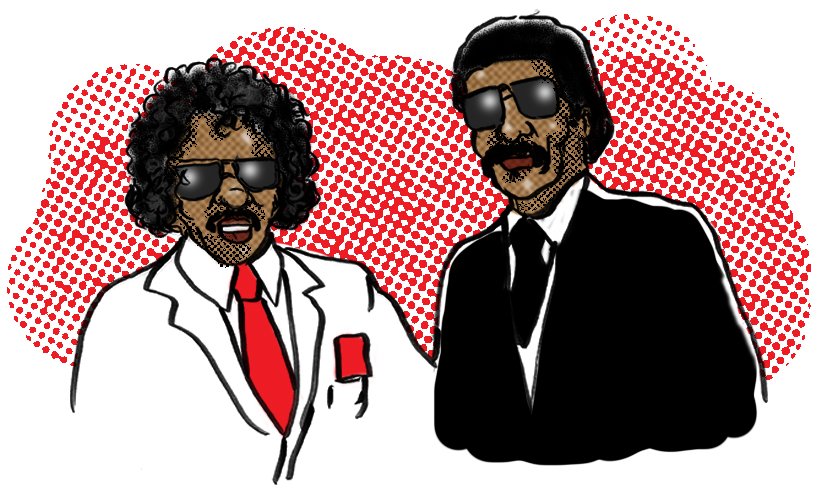
He would have you believe that he landed on this planet from some far off galaxy, but in reality, Klaus Nomi was born in Germany (on planet Earth) in 1944.

In his youth, he worked as an usher at the Deutsche Oper in West Berlin where he’d entertain the other ushers and the maintenance staff by singing opera after the shows. He also sang in small clubs in Germany until he moved to New York City in 1972. He began performing in the arty East Village clubs showcasing an eclectic blend of operatic arias and pop classics from the 1960s. His shows featured strobe lights and smoke bombs and unusual costumes and was a word-of-mouth sensation. Klaus soon teamed with Joey Arias, a Fiorucci  live model and drag queen turned singer/performance artist. Klaus appeared with Arias and his band Strange Party at various night clubs in New York City. Their otherworldly shows caught the attention of David Bowie and he asked the pair to accompany him on his upcoming guest appearance on Saturday Night Live.  Klaus sang back-up with Bowie on “TVC15”, “Boys Keep Swinging” and “The Man Who Sold the World” on the show in 1979. Bowie wore an over-sized plastic tuxedo for his set and Klaus was taken by it. He commissioned one to be made for himself and it soon became his iconic trademark. Klaus released four albums and a slew of singles ranging from opera to show tunes to covers of early rock and roll classics. As his career progressed, he concentrated primarily on opera and displayed an incredibly wide vocal range.

In the late 1970s, Klaus’ health began to deteriorate and he eventually succumbed to the then-relatively unknown disease AIDS in 1983. He was 39.

In the nearly 30 years since his death, Klaus’ cult following has increased. A documentary of his life, The Nomi Song, was released in 2004. Several designers have used his unusual fashion as an inspiration for their lines. Many artists have recorded cover versions of his songs. A cartoon version of Klaus even popped up on The Venture Brothers in 2006.

Yet, Klaus Nomi remains largely unknown.

Comments

comments

IF: duet

He who fucks nuns will later join the church
Jeanne Deckers was a nun in the Dominican Fichermont Convent in Waterloo, Belgium. She wrote, sang and performed her own songs, which were so well received that the monastery decided to let her record an album, which visitors to the monastery would be able to purchase. In 1963, Jeanne (who chose the name Sister Luc Gabriel) released the song “Dominique,” which became an international hit. Radio stations embraced the song and in the United States it became wildly popular and brought a sort of distracting comfort in the days following the assassination of President Kennedy. Almost overnight, Sister Luc Gabriel, the Dominican nun, was an international celebrity with the stage name of “Sœur Sourire” (Sister Smile). She gave concerts and appeared on The Ed Sullivan Show in early 1964.

Sister Luc Gabriel’s unlikely rise to fame was chronicled in the 1966 film The Singing Nun  starring Debbie Reynolds. Sister Luc Gabriel dismissed the film as pure fiction. In 1967, she released a second album that was poorly received. Meanwhile, her label, Phillips Records, kept a majority of the revenue from her debut release and maintained right to the name “Sœur Sourire, forcing Sister Luc Gabriel to take the altered stage name “Luc Dominique”. Still determined to maintain a singing career, she released a third album, this time geared toward religious songs for children. Again, it went nearly unrecognized. Between her failing music career and her increasing criticism of Catholic doctrines, she left the Church. Still using the name “Luc Dominique,” she recorded an ode to her strong advocacy of birth control called “Glory Be to God for the Golden Pill.” It, too, was a commercial failure. Sister Luc reverted back to being plain old Jeanne Deckers and faded into show business obscurity.

With her music career in her past, Jeanne opened a school for autistic children with her friend Anna Pécher, also a former nun. In the late 1970s, the Belgian government claimed that she owed approximately $63,000 in back taxes. Jeanne countered that the royalties from her recording were given to the convent and therefore she was not liable for payment of any personal income taxes. Lacking any receipts to prove her donations to the convent, Jeanne ran into heavy financial problems. Despite being a solo act in her early days, Jeanne performed a suicide duet with Anna. The pair – friends for ten years – composed a note reading “We hope God will welcome us. He saw us suffer. He should show clemency.” Then, they each downed a fatal dose of barbiturates and alcohol.

Jeanne was 51.

Comments

comments

from my sketchbook: joseph kearns

Martha! Bring me my nerve medicine!
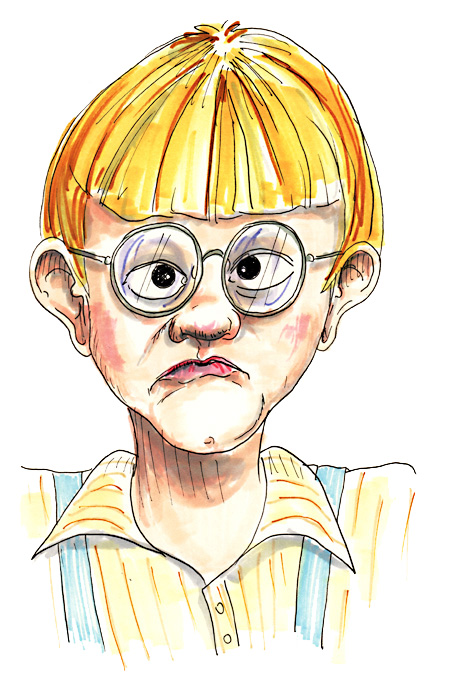
Character actor Joseph Kearns began his career in the heyday of radio in the unlikely role of a pipe organ player. He soon was performing regularly on radio programs like I Married Joan, December Bride, Burns and Allen, Sam Spade and many others. He was the mysterious announcer “The Man in Black” on the radio drama Suspense. His best known radio role was that of Ed, the security guard for Jack Benny’s underground money vault, on The Jack Benny Program. The “running gag” was that Benny had kept Ed on duty at the vault’s door so long that the guard was not aware of current events. When Benny informed him that “The War had ended,” Ed asked whether the “North” or the “South” had won.

In 1951,  Joseph made his motion picture debut in the Ida Lupino-directed Hard, Fast and Beautiful  with Claire Trevor. The same year, he lent his voice to The Doorknob in Walt Disney’s animated Alice in Wonderland. He appeared on both comedy and dramatic series in the early days of television. He was a regular cast member on Our Miss Brooks, Professional Father  and How to Marry a Millionaire. He even reprised his role (appearing exclusively in shadow) as Ed the guard on the TV version of Jack Benny’s show. In 1959, Joseph landed the role for which he is most remembered. He was cast as the irascible Mr. Wilson, the long-suffering neighbor of Dennis Mitchell on the CBS sitcom Dennis the Menace. For three seasons, Joseph’s Mr. Wilson was tortured by Dennis, the eternal pain-in-the ass. On February 11, 1962, CBS aired the Dennis the Menace  episode entitled “Where There’s a Will”, in which Mr. Wilson made out his will and explained to Dennis that he would inherit his gold watch when he dies. Joseph Kearns died from a cerebral hemorrhage on February 17, 1962.

A week or so ago, I called my brother to wish him a “Happy Birthday”. He was lamenting over turning 54. Later, I called him to tell him a bit of information that I hoped would make him feel better about passing another year over the half century mark. I told him that I was watching Dennis the Menace, a show we both agreed we hated watching in our youth. Feeding my obsession for the trivial, I went on to say that I was researching the fate of the show’s various cast members. I knew that Joseph Kearns had passed away during the program’s third season. (He was replaced by the equally annoying Gale Gordon.) What surprised me was Joseph Kearn’s age at the time of his death. He was 55. My brother’s reaction was the same as mine. Fifty-five!?  Jeez! I thought he was at least seventy!  I informed my brother that he looks a hell of a lot better than Mr. Wilson did at practically the same age.

I think I cheered him up. At least a little.

Comments

comments

from my sketchbook: dorothy dell

Hey Nineteen/No we got nothin' in common/No we can't talk at all
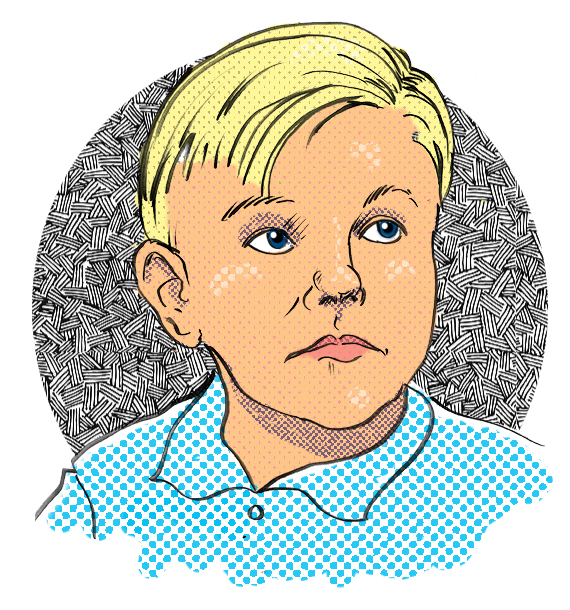
Dorothy Dell aspired to fame from the time she was a child. She won a “Beautiful Baby” contest in her native Hattiesburg, Mississippi at one year old and continued to enter and win others throughout her childhood. In high school in Louisiana, she made friends with Mary Leta Dorothy Slaton, another aspiring actress. The pair became known as “The Two Dorothys” and decided the first one to make the big break into show business would help the other. The two Dorothys entered the Miss New Orleans Pageant in 1930. Dorothy Dell won the contest. Later the same year, Dorothy was named winner of the International Pageant of Pulchritude, the forerunner to the Miss Universe Pageant.

Dorothy turned down initial offers from master showman Florenz Ziegfeld. She insisted on a part for her friend, the other Dorothy, but Ziegfeld said she was too short for the chorus line. Dorothy instead opted for the vaudeville circuit and was accompanied on tour by her family and friend. She finally accepted a stint in what would be the final Ziegfeld Follies in 1931. She stood in for an ailing Ruth Etting and was soon drawing comparisons to Mae West. Hollywood took notice and came calling.

In 1933, Dorothy moved to Hollywood and signed a contract with Paramount Pictures. She was cast as a saloon girl in 1934’s Wharf Angel, beating out established stars like Mae Clarke and Isabel Jewell. She is proclaimed as “the find of the season” in the press. Her next part was in the Shirley Temple vehicle Little Miss Marker  later the same year. She made the musical Shoot the Works  which garnered Dorothy more comparisons to Mae West. Just after the premiere of Shoot the Works, co-star Lew Cody and actress Lilyan Tashman passed away. At Cody’s wake, Dorothy wondered to a friend, “The old theater superstition says death strikes in threes. “I wonder who’ll be next?”

Paramount scheduled her to re-team with Shirley Temple in Now and Forever, co-starring Gary Cooper. Before filming began, Dorothy attended a party in Altadena, California with Dr. Carl Wagner, an oral surgeon who operated on her mother a few months earlier. Wagner, a prominent society figure in Pasadena, figured in the police probe into the mysterious murder of Dr. Leonard Siever, a leading Pasadena dentist, who was killed in December 1933. Wagner drove Dorothy back to Pasadena, but the trip was cut short when the car struck a telephone pole, caromed off a palm tree and finally smashed into a boulder. Wagner died in the hospital six hours later. Dorothy was killed instantly. She was 19. Newcomer Carole Lombard took over Dorothy’s part in Now and Forever.

Dorothy’s childhood friend, Dorothy Slaton moved to Chicago and took a job as an elevator operator at the Marshall Fields department store. A chance meeting with popular singer Rudy Vallee led to a singing gig in Manhattan, where she met Louis B. Mayer, head of the MGM Studios. Mayer arranged for a screen test and Dorothy’s career took off. On Vallee’s suggestion, she changed her last name to the French word for “love” — Lamour. Dorothy Lamour always credited her childhood friend Dorothy Dell as the person responsible for the beginning of her own film career.

 This post marks the fourth anniversary of the josh pincus is crying blog.

Comments

comments