from my sketchbook: stan stasiak

But it's been no bed of roses/No pleasure cruise/I consider it a challenge before the whole human race/And I ain't gonna lose

Everyone knows professional wrestling is fake. The fans know. The wrestlers know. The officials know. Everyone. But, professional wresting has remained popular ever since it was the only thing to watch in the early days of television. In fact, it has exponentially increased in popularity and made a fortune for its promoters, most notably Vince McMahon Jr. who turned the staged matches and contrived intrigue into a multimillion dollar brand.

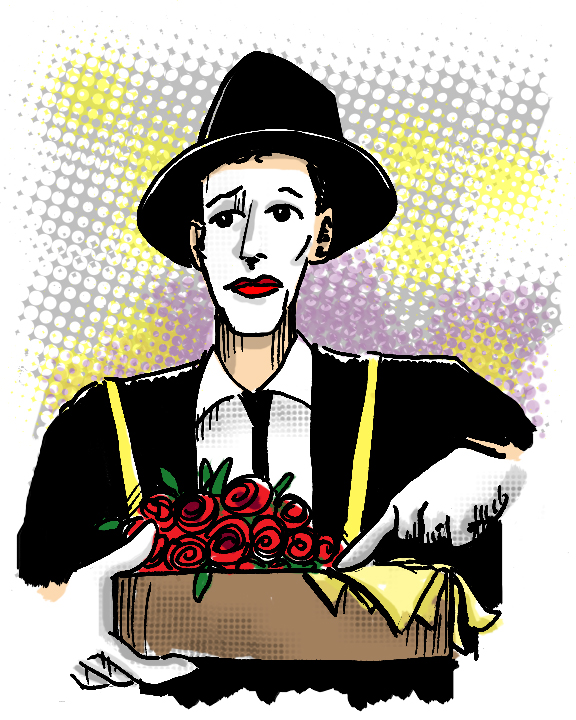
Canadian George Stipich began wrestling in the role of “the bad guy” in the 1960s. He used the name “Stan Stasiak” and played the villainous brute character to the hilt. He bounced around different pro wrestling organizations for several years, always playing the same brooding ogre in the ring. In his third stint with Vince McMahon Sr.’s fledgling World Wide Wrestling Federation, Stan got a brief and unexpected shot at glory.

In December 1973, Stan was in a venue dressing room in Philadelphia prior to a World Championship bout in which he was to battle popular reigning champion Pedro Morales. A representative from the World Wide Wrestling Federation entered the dressing room to go over the particulars of how the match was to play out. This was a common formality and Stan hardly paid attention. He had this same conversation in the dressing rooms of a dozen venues in a dozen cities on the Eastern seaboard. The WWF agent discussed various moves and holds, describing the scene as it had been described many times before.

“Pedro makes a big comeback,” the agent said, “and the referee starts to count — right? — one, two…”

Stan, giving his full attention to lacing and tying his boots, nodded and grunted a half-hearted “Uh-huh.”

“On ‘two’, you roll your shoulder up, and Pedro’s shoulders will be down on the mat.”, the WWF official explained.

Stan looked up, knowing he was about to hear the familiar fate that ended each match.

The official continued, “The ref hits the mat at ‘three’ and Pedro is down. Okay?”

Stan froze and looked at the offical. “You mean I win?, ” he said, after a long silence.

“Yeah, Stan.”

I win?  And this is a title match? “,  a confused Stan questioned, “I  win the title? I’m  the champion?”

The WWF agent answered very matter-of-factly, “Yes, Stan.”

Stan was the World Wide Wresting Champion for nine days, until Bruno Sammartino defeated him at Madison Square Garden and took the belt.

Stan retired from the ring in 1984 and became a security guard for a shopping center. He passed away from heart failure at the age of 60. For nine days he lived what most wrestlers only dream about.

Comments

comments

from my sketchbook: janos prohaska

I don't feel safe in this world no more/I don't want to die in a nuclear war/I want to sail away to a distant shore and make like an ape man
You need a bear? Call Janos.

You need a gorilla? Call Janos.

You need a monster? Call Janos.

For fifteen years, Janos Prohaska was Hollywood’s “go-to” guy when a script called for a ursine, simian or otherworldly character to interact with a leading actor. Janos would don one of his many homemade costumes and happily perform his patented animal pantomime. He played countless gorillas in laboratories, performing circus bears and outer space monsters in television and movies. He was the popular “Cookie Bear”, a character played for comic relief, on fourteen episodes of The Andy Williams Show,  a variety showcase hosted by the easygoing singer. Janos appeared in episodes of The Munsters, Bewitched, The Lucy Show, Love American Style, I Dream of Jeannie  and even Perry Mason,  all hidden under heavy fur and latex costuming. His roles were, for the most part, uncredited. In 1969, he made an appearance on the TV game show What’s My Line?,  in a full ape get-up.

Janos was also an accomplished stuntman, doubling for Peter Falk in the physical comedy classic It’s A Mad, Mad, Mad Mad World  in 1963. In 1971, he played Heloise the gorilla in Escape from Planet of the Apes,  in which he strangled Dr. Milo, the character played by Sal Mineo.

In 1974, Janos, his son, fellow stuntman Robert Prohaska, and 34 passengers were returning by chartered plane from a mountainous location set for the ABC Television series Primal Man.  In total darkness, the plane flew into a mountain ridge, killing everyone aboard.

Comments

comments

contraption (part 2)

This week’s Illustration Friday challenge word is “contraption”.  This is the second of two illustrations for the topic. Here is the first.
oil can! oil can!
Elijah McCoy worked as a fireman and oiler on the Michigan Central Railroad in the late 1800s. He often tinkered in his home workshop trying to devise new methods for lubricating machinery. He developed an automatic lubricator for oiling the steam engines of locomotives and ships and on July 12, 1872, he obtained his first patent for the device. Elijah continued to work and refine his inventions, eventually holding over 50 patents for various lubricating systems. By the turn of the century, author Booker T. Washington recognized Elijah as having produced more patents than any other black inventor up to that time. Lacking the capital with which to manufacture his lubricators in large numbers, Elijah usually assigned his patent rights to his employers or sold them to investors.

Elijah continued to invent varied contraptions until late in life, including a folding ironing board and a lawn sprinkler. In 1922, he suffered injuries in a automobile accident. He was a long-time resident of the Eloise Hospital (later the Michigan State Asylum), where he suffered from dementia. Elijah passed away on October 10, 1929 at the age of 86.

Railroad engineers looking to avoid inferior copies of Elijah’s oil drip cup would always request it by name, and ask if a locomotive was fitted with “the real McCoy system”. The term “The Real McCoy”, meaning a genuine article, has become part of our lexicon.

Comments

comments

IF: contraption (part 1)

This week’s Illustration Friday challenge word is “contraption”.  This is the first of two illustrations for the topic. Here is the second.
Oh. I don't care what they say I don't care what you've heard
In 1970, 25-year old Steve Wozniak was working at a California company on their mainframe computer. He met a summer employee, 20-year old Steve Jobs and the two became friends. Jobs got an idea to sell computers as kits with fully assembled circuit boards. Wozniak was skeptical, but Jobs explained that even if the idea failed, they could tell their grand kids that they ran their own company. They joined up with Ronald Wayne, whom they called their “adult supervisor” and, with Wayne’s help and small financial backing, formed Apple Computers out of Jobs’ bedroom at his parent’s home. Wozniak worked diligently, assembling the computers of his own invention and design — individually by hand. The first ones were unusual-looking contraptions – housed in a wooden case with visible bolts and wood-burned lettering. When the computer was presented and demonstrated to the Homebrew Computer Club, a group of hobbyists in Silicon Valley, interest was piqued and soon Jobs was selling Apple Computer kits to local electronic retailers. Wayne wrote the owner’s manual for the first computer and designed Apple’s logo, but grew worried about his investment and, after considering past failed investments, asked to be bought out of his 10% share. Wozniak and Jobs initially paid Wayne $800 and followed that with a full buyout of $1500. Wayne was out of the picture.

Until September 2011, Ronald Wayne had never owned an Apple product. Had he kept his 10% share in the company, it would have been worth over 35 billion dollars.

Comments

comments

DCS: diana dors

I love you with all my heart/And I hope we will never part
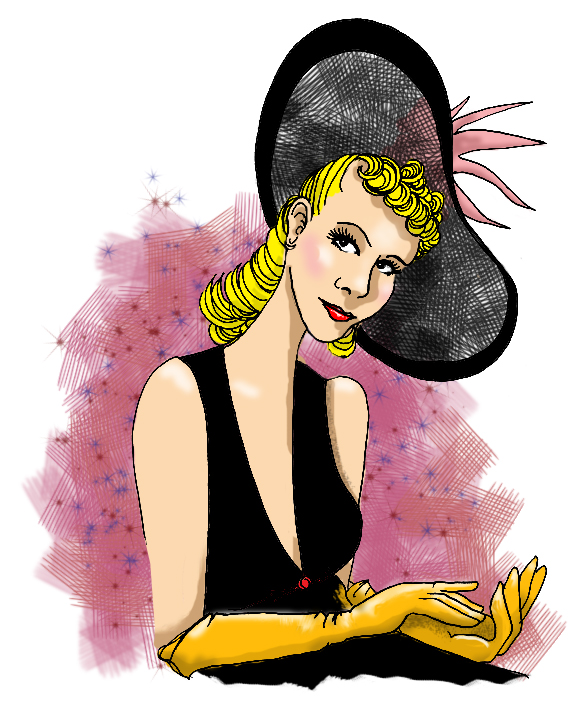
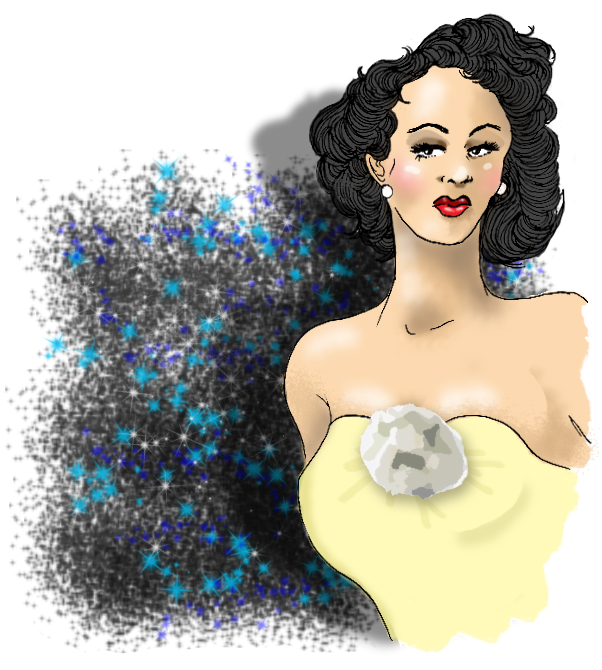
Diana (pronounced “DEE-ana”) Dors was under contract to The Rank Organization, a large British entertainment conglomerate, and appeared in many of their films beginning in the mid-1940s. Her portrayals of femme fatales  and objects of unrequited love, coupled with her striking, yet familiar, good looks led to her comparison to a certain American sex symbol. By the 1950s, Diana was known as “the English Marilyn Monroe.” (That’s the American sex symbol I was referring to.) Despite her obvious acting ability, she was relegated to mostly one-dimension roles for her entire career. She filmed a particularly grisly episode of the anthology series Alfred Hitchcock Presents, one that was banned from broadcast for several decades. She also enjoyed a modest singing career, releasing several popular singles but only one full-length album. Later, her likeness was featured in the crowd of celebrities on the cover of the Beatles’ Sgt. Pepper’s Lonely Hearts Club Band album.

Diana was born in the southwest English town of Swindon. Her birth name was Diana Fluck. She often joked that she was forced to change her name upon entering show business, fearing the consequences of a blown light bulb were her real  name to appear on a theater marquee. As her popularity grew, Diana was invited to a festival in her hometown. Prior to her introduction by a local vicar, she informed the clergyman that her real name was “Diana Fluck.” According to her autobiography, the flustered reverend, distressed over a possible slip-up of her name, took the stage and welcomed the actress to the festivities as “the lovely Miss Diana Clunt”.

Diana was married three times, including eight years to actor/future game show host Richard Dawson. In 1982, Diana was diagnosed with the ovarian cancer that would take her life two years later at the age of 52. Just after her fateful diagnosis, she told her son Mark Dawson that she had hidden over two million pounds in bank accounts across Europe. She gave Mark a sheet of paper containing a code that would guide him to the money’s exact whereabouts. Her widow, actor Alan Lake, claimed he had the key to the code, but he committed suicide within months of Diana’s death. Mark hired forensics specialists and encryption experts, but each possible lead resulted in a dead-end. The location of Diana’s alleged fortune still remains a mystery.

Comments

comments

from my sketchbook: eric fleming

Move 'em out, head 'em up, head 'em up, move 'em on, move 'em out, head 'em up
Rugged, good-looking Eric Fleming began his acting career in low-budget features like Curse of the Undead  and Queen of Outer Space  opposite Zsa Zsa Gabor (yes,  she was actually in  movies). In 1958, the 6-foot 3-inch Eric was cast in Rawhide,  a TV Western that joined the ranks and popularity of Gunsmoke, Bonanza  and others of the genre. Eric starred as trail boss Gil Favor, alongside a then unknown actor named Clint Eastwood. The series also featured Sheb Wooley, whose novelty song “Purple People Eater” reached number one on the charts the year Rawhide  premiered.

After the cancellation of Rawhide  in 1966, Eric starred with Doris Day and an ensemble cast in The Glass Bottom Boat,  a typical madcap spy comedy. Soon afterward, he signed on to join the cast of High Jungle,  an MGM adventure film to be shot on location in Peru.

During the final days of filming High Jungle,  Eric and fellow actor Nico Minardos were shooting a climactic scene in a canoe on the rough waters of the Huallaga River. The canoe overturned. Minardos was able to swim to safety, but Eric was swept up in the churning current. His mutilated body was discovered downstream four days later. Eric was 41 years old and had planned to marry his fiancee days after production wrapped.

Comments

comments

from my sketchbook: peaches heenan browning

Our quarrel was such a way of learning so much/I know now that I love you 'cuz I need your touch

Sixty-five years before Anna Nicole Smith set her sights on oil tycoon J. Howard Marshall, there was Peaches.

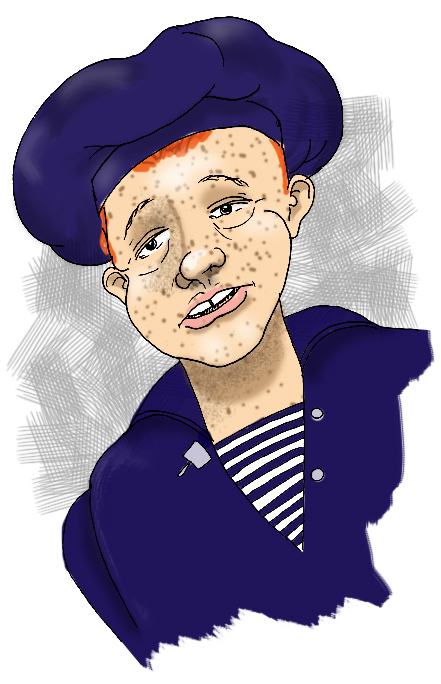
Wealthy New York real estate mogul Edward Browning just couldn’t pick women. At 41, Edward married Adele Lowen, a young lady 18 years his junior. Edward showered his new bride with gifts and jewels and furs and an opulent home. When Adele wished for children, Edward placed an ad in the newspaper seeking to adopt. The couple adopted two daughters, but a bored Adele soon contracted gonorrhea from an extra-martial affair and the couple divorced in 1923.

Edward met Frances Heenan at a dance in March 1926. She was weeks away from her sixteenth birthday and 51-year old Edward was smitten, professing his love to “the girl of his dreams”. Reporters followed the new couple around New York, as Edward purchased anything and everything Frances laid eyes on. The press nicknamed them “Peaches and Daddy”. They married in late June 1926. The bride sported four diamond-encrusted platinum bracelets. The groom was all smiles.

The marriage lasted until October, when Peaches cleared $30,000 worth of clothing and jewelry from her closet and ran home to her mother. She portrayed herself as the victim of a “perverted monster”, as he called her husband. At the January divorce proceedings, Peaches told nightmarish stories of how Edward kept a honking African goose in their bedroom. Through tears, she related how he forced her to look at pornographic magazines and insisted she eat her breakfast in the nude. She delivered her horrific tale of marital grief while draped in an $11,000 Russian sable coat. “I’m a good girl,” Peaches attested. When Edward took the stand, he painted a very different picture. Edward said that his poor, little “dream girl” had never acted as a wife and had never even kissed him. Peaches and her mother, he claimed, were nothing but a pair of gold-digging schemers. Then, Edward’s attorney produced evidence of a heavily-populated roster of Peaches’ spurned former boyfriends. The judge agreed that Peaches had abandoned her husband without cause and ruled in favor of Edward.

Peaches parlayed her fleeting notoriety as her ticket to enter vaudeville. Although she never achieved the stardom she desired,  she did snag three more husbands along the way. In 1956, she accidentally slipped in her bathroom — an accident that proved fatal. Peaches was 46.

Comments

comments

from my sketchbook: chico ruiz

It's better to burn out than to fade away

Chico Ruiz had an unremarkable career. He hit two home runs in his rookie season and never hit another. He played eight seasons in the majors with a lifetime batting average of .240. About average.

But, on September 21, 1964, Chico Ruiz became the bane of every baseball fan in Philadelphia.

In a scoreless game between the league-leading Philadelphia Phillies and the second place Cincinnati Reds, Chico Ruiz did the unthinkable, the unimaginable, the inconceivable… and got away with it. With one out and clean-up power-hitter Frank Robinson at the plate, Chico Ruiz stole home. The Phillies, who held a six and a half game lead and had the taste of the World Series on their collective lips, watched helplessly as the collapse of their team began. Shocked Phillies pitcher Art Mahaffey wildly threw the ball to catcher Clay Dalrymple as Chico slid across the dish to score the only run in that game. The Phillies lost the next ten games and saw their post-season hopes carried away on the shoulders of the rival Reds.

In 1967, Reds’ struggling rookie catcher Johnny Bench was 0 for 3, when Chico was sent in to pinch-hit for him in the 9th inning of the game. Little did Chico know he would be the only player in history to ever pinch-hit for future Hall-of-Famer Bench. In 1969, Chico was traded to the California Angels, where he allegedly brought a gun to the locker room and threatened a teammate.

In the early morning hours of February 9, 1972, Chico was driving alone just outside of San Diego, when he wrapped his car around a sign pole. He was scheduled to report to Spring Training with his new team, the Kansas City Royals, in three weeks. Chico was 33 and had just become a United States citizen one month earlier.

Comments

comments

IF: ferocious

THe current Illustration Friday challenge word is “ferocious”.
grrrrrrrrrrrrrrrrrrrrrrrrrrrrrrrrrrrrrrrrrrrrrrrrr

This is Grim Ruthless, the most ferocious man to ever live. He eats termite-infested tree trunks for breakfast. He lives in a huge boulder that he hollowed out with his teeth and bare hands. His living room has wall-to-wall broken glass. He once beat up a dump truck for a parking space. He ripped a man’s lungs right out of his chest just for looking at him the wrong way. He juggles rabid porcupines for exercise.

And worst, most heinous of all…

He goes to the “12 items or less” check-out line with 14 items.

Ooooooohhhhh.

Comments

comments