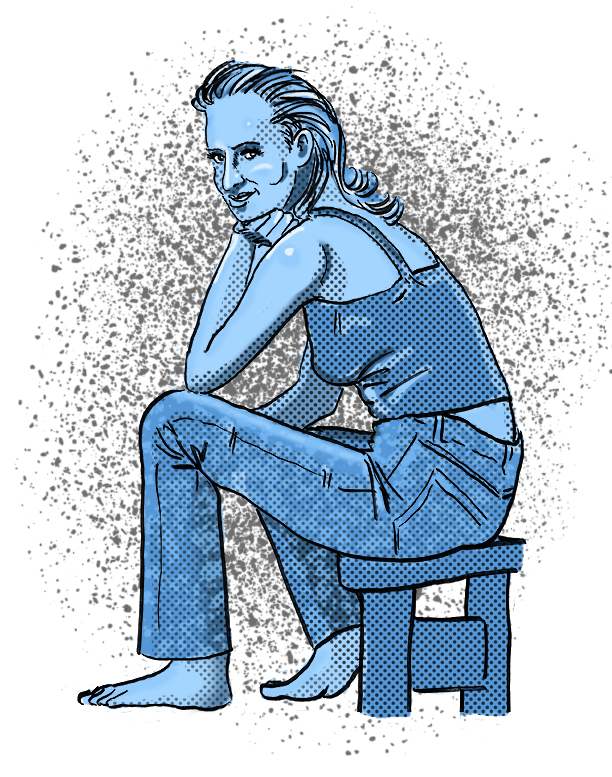
inktober52: praying mantis

like a prayer

When I was a kid, it was common knowledge among my peers that killing a praying mantis was against the law. The neighborhood kids would go on to say there was a fine if you were caught. At various times, that fine would range from ten dollars to thousands of dollars… and jail time! Of course, I have come to learn that this one of those urban legends with no basis in any law on the books in any municipality or jurisdiction anywhere in the country. Praying mantises are not on the endangered species list. There are over 2000 different species of mantises in the world. If they were an endangered species, the fine for killing one would be a lot more than fifty bucks.

In reality, praying mantises are pretty beneficial insects for farmers and gardeners. They are often used in lieu of pesticides to maintain control over insects that could harm crops and flowers.

Illegal to kill them? No, but don’t do it anyway. What’s the point?

And go ahead and drive barefoot. That’s not illegal either.

Comments

comments

DCS: millie small

the blue beat girl

Twelve-year old Millie Small won the Vere Johns (the Jamaican Ted Mack) talent contest in her native Jamaica. She recorded a few songs that became hits on Jamaican radio. These songs made their way to Chris Blackwell, noted hitmaker and founder of Island Records, one of England’s biggest independent labels. Blackwell brought Millie to London where she began an extensive regimen of dance and diction training. Blackwell hand-picked the song “My Boy Lollipop,” a cover of a tune by The Cadillacs, to become Millie’s next single. Released in 1964, it shot to the top a many international charts, becoming the first ska influenced hit. It also became the first international hit for Island Record. Millie was tagged “The Blue Beat Girl,” for introducing a hybrid sound of rhythm & blues and reggae.

Millie appeared on a 1964 Beatles TV special. This led to bookings on numerous other music programs. She began a brief affair with Peter Asher of Peter & Gordon, a relationship she later denied. A surge of popularity of reggae insured more opportunities for Millie, but, sadly she found herself broke and destitute in the late 1980s. She disappeared from the public eye, even failing to appear at an awards ceremony in Jamaica where she was honored with a lifetime achievement presentation.

In 2012, Millie granted a rare interview with Goldmine Magazine, where she revealed that Rod Stewart played harmonica on “My Boy Lollipop” and that she received no royalties for the recording.

Millie passed away on May 5, 2020 at her home in England. She was 72.

Comments

comments

inktober52: train

Come round the bend you know it's the end

Casey Jones, a respected engineer with the Memphis-based Illinois Central Railroad, was a risk taker. His trains were often on-schedule, though his methods to keep that schedule were questionable. A number of citations for various rules infractions were issued to Casey and he totaled suspensions for well over one hundred days, but none of those occurred on his final run.

On April 30, 1900, he was due to drive the southbound passenger service from Memphis to Canton. Working an overtime shift from the previous night, Casey was likely sleep deprived. He departed for his shift over an hour late, but was sure he could make up the time

Approaching Vaughan, Mississippi at high speed, he was unaware that three trains were occupying the station,, including one that had broken down and was stalled directly on his line. He ignored a flagman signalling to him, although Casey may not have seen him, due to the dense morning fog.

Through the fog, Casey spotted the red rear lights of the caboose in front of him. Quickly, he blew his whistle to clear the tracks. Then, he reversed the throttle and slammed the air brakes into emergency stop. Casey’s train plowed into the train stopped on the tracks. Because he stayed aboard to manually reduce the speed of the train, Casey saved the lives of every passenger on the train. Despite the severity of the wreckage, there was just one fatality — Casey Jones.

Comments

comments

DCS: joseph melville see jr.

for some California grass

Melville See Jr. graduated from Princeton University and headed to University of Arizona to take graduate courses in anthropology. In June 1962, he married photographer and fellow student Linda Eastman, an art major whose mother was killed in a plane crash just a few months earlier. By the end of the year, the couple became parents of Heather Louise See. Unfortunately, the young couple soon discovered their dissimilar lifestyles and they divorced in 1965.

In 1967, while on a photography assignment in London, newly-single Linda met Paul McCartney at a club. She met him again at a party at Brian Epstein’s house for the release of the Beatles album Sgt. Pepper’s Lonely Hearts Club Band. Linda and her daughter began spending a lot of time with Paul. They eventually left their New York home and moved to London. Paul and Heather, who was six, bonded immediately. Paul told Linda that he had always dreamed of having children.

Friends noticed that Linda had a calming effect on Paul, putting him at ease during the hectic business of “being a Beatle.” They married in March of 1969. Paul had grown depressed after the Beatles break-up. He credits Linda with bringing him out of it. Paul wrote “Maybe I’m Amazed” for his wife. Paul and Linda had three children together and Paul legally adopted Heather. Melville had been out of his daughter’s life for years.

However, Paul wrote another song that referenced Linda’s past. The character “Jo Jo” mentioned in the Beatles song “Get Back” is Melville See Jr., whose actual first name was Joseph.

In March 2000, an on-again-off-again girlfriend discovered the body of Melville See Jr. in his home in the desert of Tuscon, Arizona. He had a single gunshot wound in his head and a gun lay nearby. He was 62 years old. He left no note.

Comments

comments

inktober52: yellow

jag är nyfiken gul

22-year old Lena Nyman played 22-year old “Lena Nyman” in the controversial 1966 film I Am Curious (Yellow), as well as its companion piece I Am Curious (Blue). The film was held up by US Customs while an investigation was conducted to determine if it was to be classified as “pornography” under the current strict guidelines in the United States. The film was eventually granted release as an “art film” a year later, gaining credibility from patrons like Johnny Carson and Jacqueline Kennedy. Measured against today’s standards, I Am Curious (Yellow) is a far cry from pornography. It is more of a pseudo-documentary and social commentary, although it is acknowledged as the first mainstream film to show full frontal male nudity.

The film received mixed reviews in its initial run. Vincent Canby of the New York Times referred to it as a “Good, serious movie about a society in transition.” However, critics Rex Reed described the film as “about as good for you as drinking furniture polish” and Roger Ebert noted it as “a dog… a real dog” and “stupid and slow and uninteresting.” An arsonist burned down a theater in Houston during an engagement.

Lena, however, continued her career without concern. She even took a cameo role in a documentary introduction to Scandinavian cinema. She continued to appear in films and television in her native Sweden until her death in 2011 at the age of 66.

Comments

comments

DCS: carol hughes

flash! flash!

Catherine Hukill expressed an interest in acting as a teenager in her native Chicago. She performed a song-and-dance act with her cousin in several local productions. In the middle 1920s, she teamed up with Frank Faylen and toured the vaudeville circuit as “Faylen and Hughes,” where she played the role of the “dumb girl” to the delight of audiences. In 1928, she married Faylen. Soon, the couple headed to Hollywood to persue careers in movies.

After signing on as a contract player with Warner Brothers, her name was changed to “Carol Hughes” by studio executives. She was given bit parts in a number of “B” pictures. She worked her way up to speaking roles, eventually landing lead roles in Meet the Boy Friend, Marry the Girl, Renfrew of the Royal Mounted, and The Westland Case, all in 1937.

The late 1930s saw Carol transition to Westerns, appearing opposite Roy Rogers and Gene Autry, the two biggest cowboy stars on the silver screen. In 1940, she was cast in her most notable role — “Dale Arden,” femme fatale to Buster Crabbe’s heroic “Flash Gordon” in the 12-part serial Flash Gordon Conquers the Universe, the last of the “Flash Gordon” serials for Universal Pictures.

The 40s saw Carol’s roles dwindle to small parts in Mighty Joe Young and The Bachelor and the Bobby-Soxer. She returned to the stage, although she took a few more small roles in the early 1950s before calling it a career. Her husband, Frank Faylen, enjoyed a successful career as a character actor with more than 200 credits over five decades. Despite appearances in It’s A Wonderful Life, Gone With The Wind, Yankee Doodle Dandy, Gunfight at the O.K. Corral and even Funny Girl, Faylen is best remembered as irascible grocer “Herbert T. Gillis,” father of the title character on the sitcom The Many Loves of Dobie Gillis. Carol remained married to Faylen for 57 years until his death in 1985.

Carol passed away in 1995 at the age of 85, after being retired from show business for nearly 40 years.

Comments

comments

inktober52: blue

am I blue

I’ve done several illustrations over the years for the word “blue” and they’ve taken varied forms. There’s this one of Pablo Picasso that I did back in 2007. In 2018, I did this abstract composition. For this week’s Inktober 52, I went the abstract route again, but more of a minimalist take.

Comments

comments

DCS: duncan hines

let them eat cake

Duncan Hines worked tirelessly, criss-crossing the country selling letter openers and paper clips, as well as printing services for a Chicago based company. His sales routes took him all over, forcing stays in hotels and meals in one restaurant after another. In 1920s America, there were very few (if any) chain restaurants, so Duncan frequented single location eateries — each with varying degrees of quality. Duncan made notes of the good places — the ones that offered a substantial meal at a reasonable price. (A “reasonable price” in Duncan’s opinion was $1.35for a full-course meal.) He began making notes and compiling lists of the best places and the greatest values. He insisted on inspecting the kitchens of each dining establishment he visited. Duncan distributed his list to friends who were traveling. Soon, he self-published his findings in a book called Adventures in Good Eating. The book was so popular, it led to Duncan’s three-day-a-week syndicated column, also called Adventures in Good Eating. The column appeared in newspapers across the country and became the authority for travelers.

Through a deal with the Durkee’s Bakery Company of Homer, New York, Duncan introduced his own line of bread. After a year of success with his first foray into the baked goods business, he teamed up with entrepreneur Roy H. Park to form Hines-Park Foods. The new company licensed the “Duncan Hines” name to various companies, including Nebraska Consolidated Mills, who produced cake mixes. In 1957, Nebraska Consolidated Mills sold the cake mix business to the consumer products company Procter & Gamble. The company expanded the business to the national market and added a series of related products.

Duncan Hines passed away in 1959, eleven days before his 79th birthday. “Duncan Hines” is one of the most widely recognized and respected brands of consumer food products. Not bad for a guy who couldn’t cook.

Comments

comments

inktober52: red

I dood it!
I first became familiar with Red Skelton when I was a kid. My family, like most families across the country, watched Red Skelton’s variety show every Tuesday night. I didn’t know who Red Skelton was or why he had such an unusual first name, but my parents watched, therefore I watched it too. Red had guest stars perform with him on his show, usually some actor or actress that was popular at the time or one of Red’s “show biz” contemporaries, like John Wayne or Jack Benny. He played goofy characters for cheap laughs. He also featured a silent pantomime segment, for which he was apparently famous. His show finally was cancelled after nearly twenty years, in a network-wide “sweep” of variety shows that saw heavy-hitters like Jackie Gleason and Ed Sullivan get the ax. Red was bitter, since his show rated in the top ten for most of its run.

When I got older, I discovered that Red Skelton had a huge career before his foray into television. It seemed in the 1930s and 40s, Red Skelton was a pretty big star in films. Red often was the featured “comic relief,” most notably in a few of the Dr. Kildare film series. Then he appeared in a succession of films as the inept radio detective “The Fox.” He moved on to lavish musicals opposite Eleanor Powell, Ann Miller and Lucille Ball, playing the unlikely leading man. He was one of the first “movie stars” to make the leap to the new medium of television, doing so in 1951.

Red Skelton, along with fellow redhead Lucille Ball and song-and-dance-man Buddy Ebsen, was one of those rare performers who had success in two separate careers, appealing to two separate generations.

Comments

comments

DCS: herk harvey

cut!

Upon his discharge from the US Navy after World War II, Herk Harvey took a teaching position in the drama department at the University of Kansas. He decided against a career in chemical engineering, the trade he mastered in the service, opting to use the directorial experience he gained before the war.

Herk did some acting on the side at Centron Corporation, an independent industrial and educational film production company in Lawrence, Kansas. He eventually joined the staff at Centron as a director and writer. He made numerous films for corporations and governmental use. He worked with a variety of name stars over the years, including Walter Pidgeon, Rowan and Martin, Dennis Day, Louis Nye, Billy Barty, Anita Bryant, Eddie Albert, Ed Ames, Jesse White, and Ricardo Montalban. He won many awards for his work, including the highest honors from the American Film Festival. Herk was praised for the special effects innovations that he developed while working at Centron.

In 1961, Herk was returning from a work-related film shoot in California. He passed an abandoned resort called Saltair on the southern shore of the Great Salt Lake in Utah. He was taken by the ornate building and recruited John Clifford, a co-worker at Centron, to write the screenplay for a film idea based on the resort. Herk took three weeks off from work to film around Lawrence, Kansas and Salt Lake City, Utah. He raised $17,000 for his initial budget, getting an additional $13,000 on deferment. He hired an assistant director. Reza Badiyi, a young immigrant who was just beginning his film work in the United States. (Badiyi would go on to create some of the most well-known, iconic television series openings and montages, including: Hawaii Five-O, Get Smart, and The Mary Tyler Moore Show.) Through arrangements with local government, Herk was permitted free access to film on a bridge, providing he repair any damage his crew created. He ended up paying $38 to fix a guard rail through which a car crashed on the bridge. Herk bribed a salesgirl to allow him to film for thirty minutes in a Lawrence department store. The only cast member that received compensation was Candace Hilligoss, a budding professional actress who played the lead role of “Mary.” Candace received $2000. The result of Herk’s efforts was the supernatural horror film Carnival of Souls.

Released in late 1962, Carnival of Souls was panned by critics. Disappointed by its poor showing, Herk returned to Centron and never directed another commercial film again. However, in later years, Carnival of Souls gained a cult following and has since been praised for its foreboding atmosphere and homage to German expressionist cinema. George Romero and David Lynch have both cited Carnival of Souls as inspiration for their own work.

After retiring from Centron, Herk became a regular on the horror convention circuit where he signed autographs and posed for pictures with fans. When asked why he only directed one film, Herk would quickly reply, “I directed over 400 films!”

Herk passed away in 1996 at his home in Lawrence. He was 71. The Academy Film Archive selected Carnival of Souls for preservation in 2012.

Comments

comments