
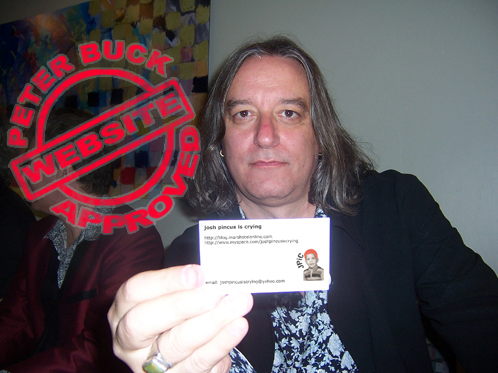
The josh pincus is crying blog carries the Peter Buck Seal of Approval.
IMT: in good company
The suggestion for inspiration on the Inspire Me Thursday website is “in good company”.
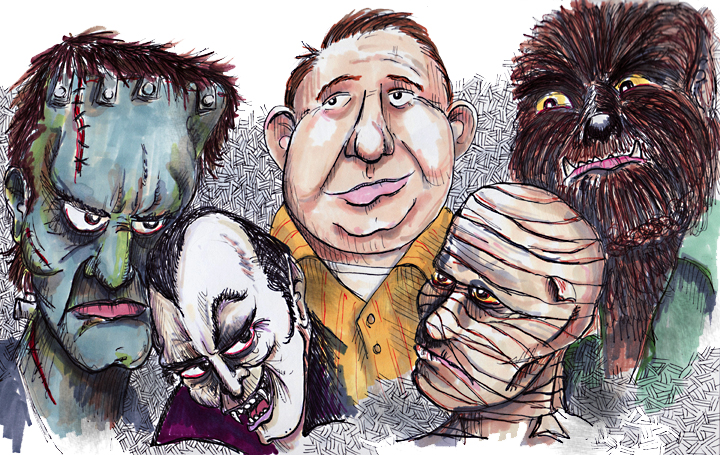
Lon Chaney Jr. was in good company with Bela Lugosi, Boris Karloff and his father, Lon Chaney Sr. However, Lon Chaney Jr. is the only actor to have played all four major Universal Monsters.
Comments
Monday Artday: nerd
The Monday Artday current challenge is “nerd”.
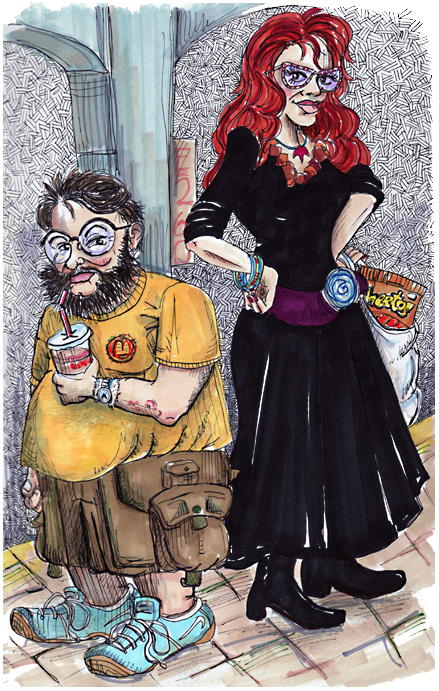
I know both of them.
They don’t know each other.
One is a nerd.
Comments
IF: welcome
The illustrationfriday.com challenge word this week is “welcome”.
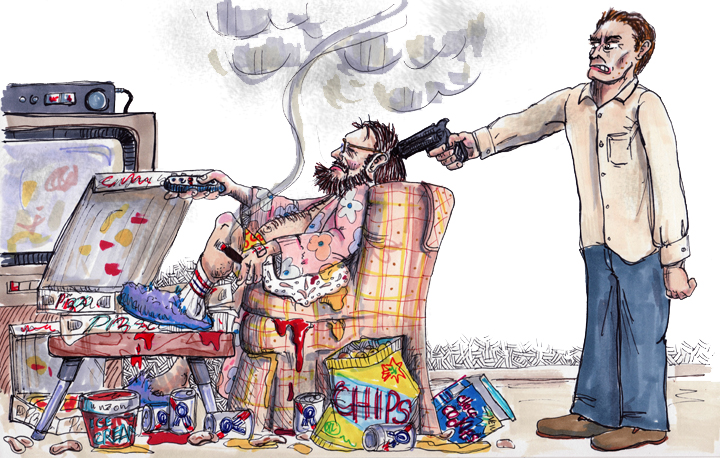
After fourteen weeks, Wilbur had worn out his welcome.
Comments
from my sketchbook: jeffrey dampier
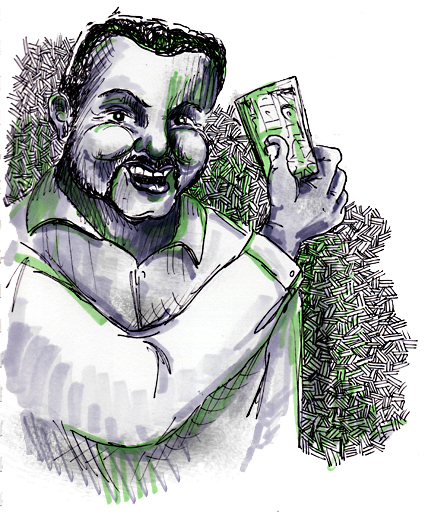
Jeffrey Dampier Jr. won a $20-million Illinois Lotto jackpot in 1996. He bought houses and cars for his siblings and parents. In 2001, he bought a half-million dollar home near Tampa, Florida. He also purchased a townhouse for his parents close by. Several family members followed Jeffrey to the Florida Gulf Coast because he liked to be surrounded by family. He arranged for monthly family dinners at area restaurants. He opened a gourmet popcorn store and named it for his grand-daughter and his mother and brother helped run it. For Christmas, Jeffrey treated 38 members of his family to a seven-day Caribbean cruise. He was the family member everyone could count on for business advice, auto repair, even babysitting.
In July 2005, Victoria Jackson called her brother-in-law Jeffrey from her apartment and told him she was having car trouble. Jeffrey told her he’d be right over. When he arrived he was greeted by Victoria and her boyfriend Nathaniel Jackson (no relation to Victoria). And they greeted him with a gun. Victoria and Nathaniel forced Jeffrey into his van and bound his hands and feet. Even though Jeffrey had been extremely generous with his lottery winnings, Victoria and Nathaniel wanted more. Nathaniel handed the gun to his girlfriend and said, “Shoot him or I’ll shoot you.” Victoria squeezed the trigger, firing once in the back of Jeffrey’s head. After robbing him of several thousand dollars, they abandoned the van with Jeffrey’s body at an intersection and fled on foot. They were apprehended by police two days later. Although he had spent a large portion of the stolen money, Nathaniel was picked up with an amount of blood-stained bills.
At the trial, it was revealed that Jeffrey had made sexual advances towards Victoria years earlier. It was also alleged that Jeffrey had controlling grasp on Victoria’s life. Nathaniel was doubly jealous of Jeffrey’s good fortune and his relationship with his girlfriend. After two hours of deliberation, Victoria was sentenced to three consecutive life sentences for the charges of carjacking, kidnapping and first-degree murder. In a separate trial, Nathaniel received the same sentence.
Comments
IF: strong
This week’s challenge word on the Illustration Friday website is “strong”.
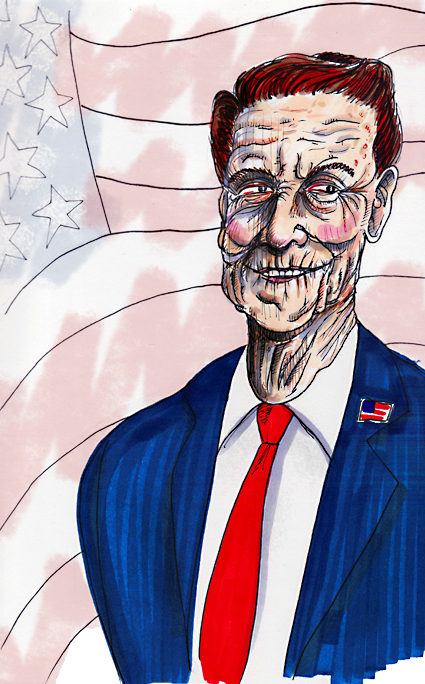
“Of the four wars in my lifetime, none came about because the U.S. was too strong.”
— Ronald Reagan
On a recent trip to Walt Disney World, my wife and I witnessed something we found very unsettling. To alleviate the effects of the central Florida humidity, we ducked into The Hall of Presidents. Walt Disney World’s Hall of Presidents is an impressive expansion of Disneyland’s Great Moments with Mr. Lincoln attraction. The Disneyland version features a single, multi-articulated, Audio-Animatronic figure of the sixteenth president, similar to the original attraction that appeared at the 1964 World’s Fair in New York.
For those not familiar with the attraction, after a stirring and patriotic film offering a very brief history of our country, the heavy curtain is raised to reveal a darkened stage and the full-size figures of the Commanders-in-Chief. As each one is spotlighted and introduced by a disembodied voice, the other presidents shift and fidget eerily in the background. Mr. Lincoln then rises from his seat and delivers a sort of “medley” of his speeches. (Since 1993, Lincoln’s speech has been trimmed down to allow for a few words from the current president.) Although my wife and I have seen this presentation countless times over the years, we still marvel at the overwhelming and pride-producing (if not campy) spectacle.
On this particular day, we watched as the film played as usual and the curtain rose as always. However, this time, as the presidents were identified, each was greeted by a small smattering of applause. (May I remind you that, as remarkable as these figures are, they are just a few steps above a department store mannequin.) When Lincoln was introduced, the cheers increased slightly and reduced again at the mention of Andrew Johnson and the twenty-one presidents that followed him. When they reached Ronald Reagan, the fortieth president, the crowd erupted in a wild and frenzied ovation. Hoots and whistles filled the darkened theater. The applause carried into George Bush’s introduction and then audibly escalated again at the mention of George W. Bush’s name. My wife and I turned to each other. In the darkness, we could see that we each had the same dumbfounded look on our faces.
Ronald Reagan was one of the most beloved presidents in this country’s history — and I can’t figure out why. As president of the Screen Actors Guild, Reagan provided the FBI with names of suspects whom he believed to be communist sympathizers within the motion picture industry, stating, “I never, as a citizen, want to see our country become urged, by either fear or resentment of this group, that we ever compromise with any of our democratic principles through that fear or resentment.”
As governor of California, Reagan was involved in high-profile conflicts with the protest movements. On May 15, 1969, during protests at UC Berkeley, Reagan sent the California Highway Patrol and other officers to quell the protests, in an incident that became known as “Bloody Thursday.” Reagan then called out the National Guard to occupy the city of Berkeley for two weeks in order to crack down on the protesters.
As President, he proliferated the frightened paranoia that began with Richard Nixon. He sold arms to Iran to fund the Contras in Nicaragua, then lied (or conveniently forgot) about his involvement. He spent his first term ordering a massive military buildup in an arms race with the USSR. In the early 1980s, he supplied weapons to groups of “freedom fighters” in Afghanistan — led by a young Osama Bin-Laden — citing their common cause against Communist Russia. Those weapons would later be used against the US in their efforts in Afghanistan in 2001. He stood for the arrogance and elitism that has ruled the Republican Party — a mindset that has carried through every Republican administration since.
Bill Clinton was impeached for lying in court about his extramarital affair, an infraction that, while I do not condone it, essentially only affected President Clinton and his wife. Ronald Reagan sold arms to an enemy of the United States (the definition of treason) and his effigy receives wild praise at a theme park attraction.
Can someone offer a reasonable explanation? But don’t bother me calling from Walmart.
Comments
IMT: chair
This week’s inspirational word on Inspire Me Thursday is “chair”.
My brother was born in 1957. The Pincus family was a nice, sweet, calm family for four and a half years. Then little Josh was born and all hell broke loose.
It began when I was brought home from the hospital. My parents thought it would be nice if the baby brought a present for his big brother. They stopped at a toy store on the way home from the hospital. My father ran in and, being 1961, had no problem purchasing a wood and metal rifle for his older son as a gift from his infant. My mother and father arrived home with brand new baby Josh. At first, my brother expressed disappointment at the sight of a baby. When my mom had explained that a “new playmate” would be coming, he expected one of his own age immediately ready to play. He never imagined it would come in the form of a whining and crying poop machine. The gift of the rifle softened his initial reaction until years later, after mastering walking and hand-eye coordination, I broke that rifle.
The family home, in a budding Northeast Philadelphia neighborhood, was a great place. My brother had a huge backyard in which to romp and play and develop his eventual athletic ability. Access to the large front lawn was unobstructed and it offered a comparable open space. When I gained confidence in my walking skills, my parents were forced to construct a chain-link fence around the perimeter of their property, complete with a hinged gate with a large steel padlock. My mother often told of the endless hours I would spend trying to pick that lock and plotting my escape.
I started kindergarten at Stephen Decatur Elementary School in 1966. My mom began a small business of transporting my classmates from the neighborhood to kindergarten. She drove a station wagon that featured a large flat area behind the front seats when the rear seats were folded down. Approximately fifteen tykes were sloshed around the back of that car unencumbered by seatbelts or any sort of safety restraints. After all, this was the freewheeling 60s and child safety was not a concern. My classmates’ parents were happy not to be burdened with driving their kids to school themselves, so, for this service, my mom received a small weekly fee. My mom kept that service up for thirteen years, with the fee escalating only slightly.
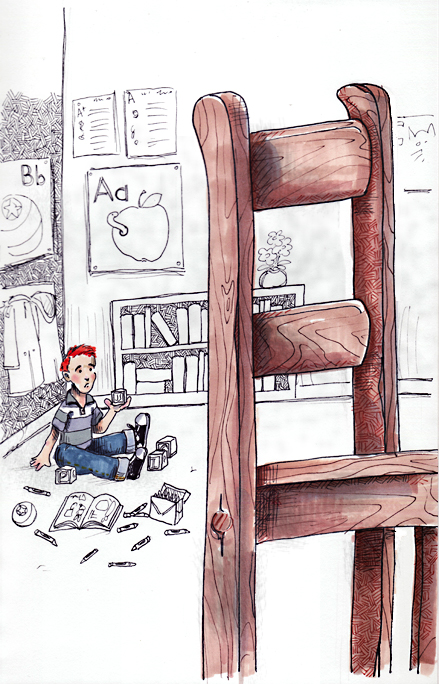
My parents were a bit apprehensive about the start of my school career. They were very familiar with my out-of-control behavior, but few people outside of the family were. Once I entered the classroom and was introduced to my classmates, things were pretty uneventful. I listened to my teacher and did as I was instructed. I happily and complacently participated in playtime, storytime and whatever-else “time” that was part of the curriculum. One day, I witnessed a fellow kindergartner push another student. In full view of the entire class of wide-eyed, innocent pupils, the offending five-year old was led to a large wooden chair situated in a corner of the room. He was reprimanded by the teacher and made to sit in “The Big Chair” and think about what he had done. He sat as if in the pillory in a colonial townsquare, on public display, open to the class to bestow their silent mockery upon him. After a period of time, his sentence was served and he was free to rejoin the class activities. I, however, was intrigued by the Chair. It was so big and ominous, sitting at the far end of the classroom in a veritable “no man’s land”. During regular classtime, no one played near it. The teacher read stories far away from it. When we rested on our mats for naptime, the Chair stood silent and menacing in that dimly-lit room. As the days and weeks went on, several more of my classmates committed offenses worthy of a stretch in The Big Chair. As I observed them in their dire, sometimes tearful state, suddenly, it occured to me I needed to sit in that chair. I thought about what horrible act, what heinous deed I could perform to get to sit in that Chair. I was determined.
Honestly, I don’t remember what I did. After all, it was 43 years ago. But, it was something. Something so awful that my teacher had no choice but to make me sit in that Chair. I was elated. I was led to the Chair as a death row inmate is led to his final destination. I climbed up the wooden rungs of its thick legs and planted my butt on its huge flat seat. The view from up there was not as rewarding as I had imagined. The feeling that those staring tiny and forlorn faces gave me was not what I had hoped for.
It sucked being in The Big Chair.
Comments
from my sketchbook: oliver sipple
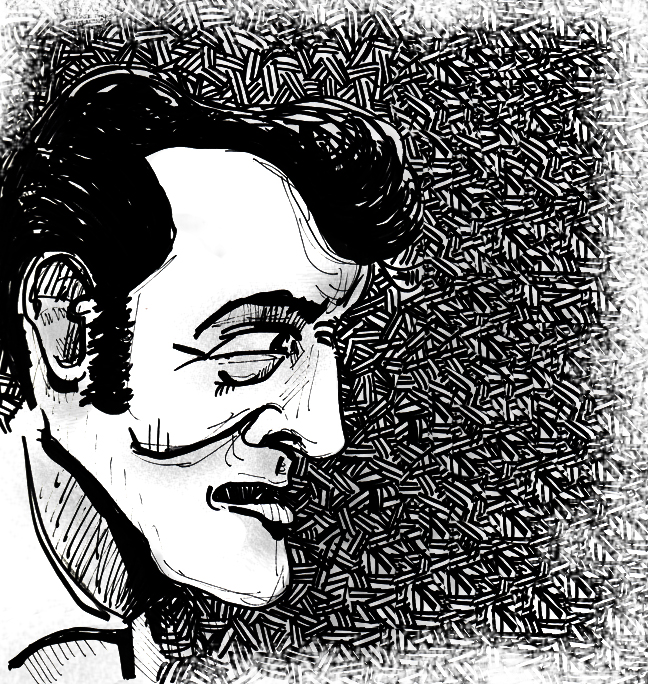
Oliver Sipple stood in the crowd. He was no different from the other 3,000 people gathered outside San Francisco’s St. Francis Hotel hoping to catch a glimpse of President Ford. As the President emerged from the building, Oliver looked and saw the woman next to him pull out a .38-caliber pistol and aim it at Ford as he headed to his limousine. Oliver lunged at the woman, Sara Jane Moore, just as her finger squeezed the trigger. The deflected bullet hit cab driver John Ludwig (who would survive). The police and the Secret Service immediately commended Oliver for his action and bravery. President Ford thanked him with a letter. The news media praised him as a hero. Oliver felt the praise and attention was unwarranted and shyed away. He was a former US Marine and Viet Nam veteran and instinctively did what anyone with his training would have done. The press hounded him. He pleaded to be left alone.
Oliver was gay and, although he participated in Gay Pride events, this was 1975 and his sexual orientation was a secret from his family. He begged the press to keep his sexuality off the record, making it clear that neither his mother nor his employer had knowledge of his orientation. The media ignored his request. San Francisco City Councilman Harvey Milk contacted the newspapers and proudly proclaimed Oliver’s status as a hero and role model for the gay community all against Oliver’s wishes. Oliver was besieged by more reporters, as was his family. His mother, a staunch Baptist in Detroit, refused to speak to him. Milk publicly suggested that Oliver’s sexual orientation was the reason he received only a note from the President, rather than an invitation to the White House.
Oliver filed a $15 million invasion of privacy suit against seven newspapers, and a number of unnamed publishers. The Superior Court in San Francisco dismissed the suit, and Oliver continued his legal battle until May 1984, when a state court of appeals held that Oliver had indeed become news, and that his sexual orientation was part of the story.
Oliver’s mental and physical health sharply declined over the years. He drank heavily and his weight ballooned to 300 pounds. He was fitted with a pacemaker. He became paranoid and suicidal. On February 2, 1989, he was found dead in his bed at his $334 per month apartment, at the age of forty-seven. Earlier, Oliver had visited a friend and said he had been turned away by the Veterans Administration hospital where he went concerning his difficulty in breathing due to pneumonia. Friends going through his affects in his apartment came across his most prized possession the framed letter from the White House.
Shortly before he died, Oliver expressed, to friends, his regrets toward grabbing Sara Jane Moore’s gun.
Comments
from my sketchbook: donnie moore
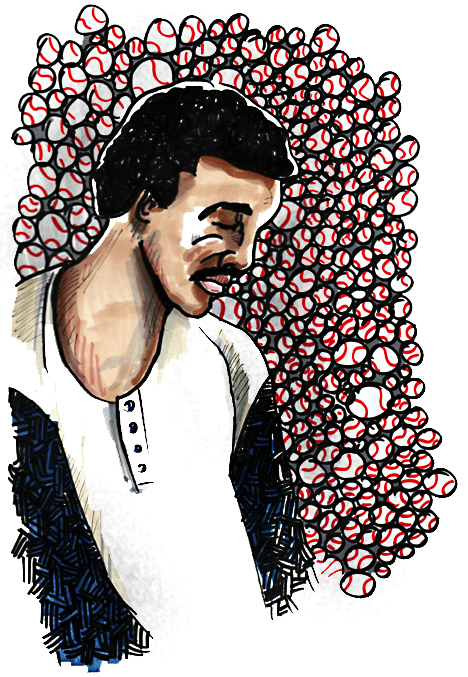
In his thirteen season career, Donnie Moore posted a 43-40 record and a 3.67 ERA. He was even selected to the All-Star team in 1985.
Donnie’s downfall came on October 12, 1986. He was pitching for the Angels in Game 5 of the 1986 American League Championship Series in Anaheim. The Angels held a 3-1 lead in the best-of-seven series against the Boston Red Sox. The Angels held a 5-2 lead in Game 5 going into the ninth inning. Boston rallied and put two more on the scoreboard on a home run by Don Baylor, closing the gap to 5-4.
Donnie came in to shut down the Red Sox and win the series and the first-ever pennant for the Angels. There were two outs and a runner on first. Boston’s Dave Henderson ran a count of 2-2. The Angels were one strike away from advancing to the World Series. Henderson stood in and took Donnie’s next pitch out of the park, giving the Red Sox a 6-5 lead. The Angels scored in the bottom of the ninth, forcing the game into extra innings.
Donnie remained in the game for the tenth and, after a double play, Donnie got the Angels out of the inning. Unable to score in the bottom of the tenth, the Angels sent Donnie back to the mound in the top of the eleventh inning. Donnie put Don Baylor on base and, again, he faced Dave Henderson. Henderson belted a sacrifice fly to the outfield, scoring Baylor. The Angels could not score in the bottom of the 11th, and lost the game 7-6. The Angels lost the remaining games at Boston’s Fenway Park and lost the series. Donnie became indelibly associated with the Angels’ loss of the pennant and it haunted him for the rest of his days. Donnie was released by the Angels at the end of the season. He signed a minor league contract with the Kansas City Royals. He appeared in a few games in the Kansas City farm system and was released from his contract.
On July 18, 1989, during an argument with his wife Tonya, Donnie shot her three times, in full view of their three children. Tonya and their 17-year old daughter Demetria fled from the house. Demetria drove her mother to the hospital. Both survived the shooting.
Back inside the house, still in the presence of one of his sons, Donnie fatally shot himself.
Comments
IF: magnify
This week’s challenge on Illustration Friday is “magnify”.
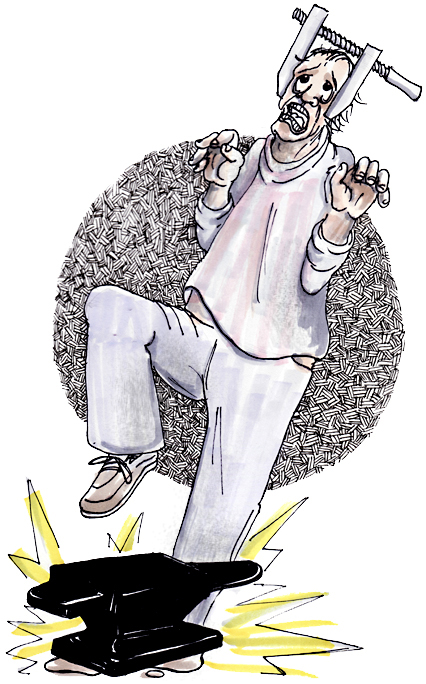
Sure, he dropped an anvil on his foot, but Gerald’s pain was magnified by the vice clamped on his head.