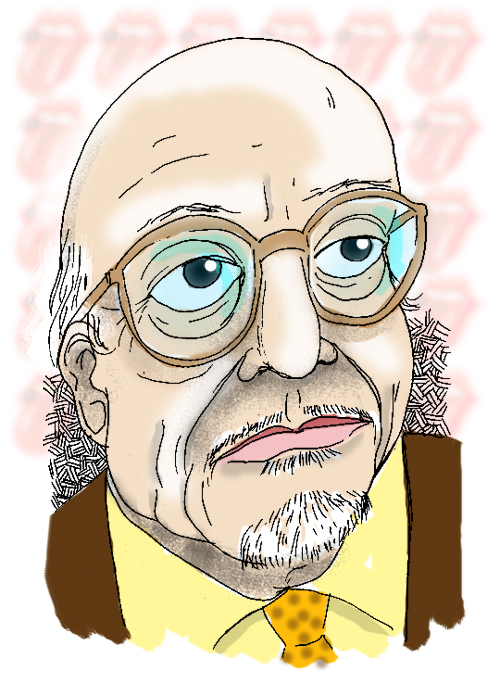
from my sketchbook: ernie roth

we're off to see the wizard
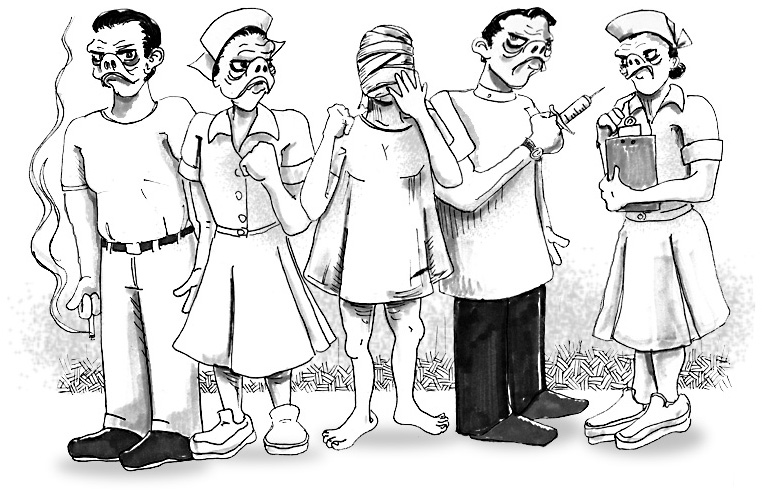
Ernie Roth entered show business as a disc jockey in the early 1960s. Soon, he became involved with professional wrestling and began managing in the Detroit are using several different stage names, including “Mr. Clean” and “J. Wellington Radcliffe”. He represented Michigan native Edward Farhat, who wrestled under the guise of a rich but crazed Syrian royal named “The Sheik”. Ernie portrayed his mentor/overseer and called himself “Abdullah Farouk”. He wore outrageously wild clothing, sequined turbans and wrap-around sunglasses. He created the character of the interfering manager by insulting fans and illegally aiding his proteges during matches, well out of the referee’s line of vision. He became one of the the most hated managers in wrestling, to the delight of fans.

Ernie joined up with the World Wide Wrestling Federation (now the mighty WWE) and changed his character name to “The Grand Wizard of Wrestling”. He continued to ham it up during ringside interviews and taunt fans with his put-on arrogance. He managed Superstar Billy Graham, a flamboyant wrestler who was the prototype for future stars like Hulk Hogan and Jesse Ventura. Ernie was in Graham’s corner in 1977 on the night he dethroned Bruno Sammartino as WWF Champion. Along with fellow “bad guy” managers Lou Albano and “Classy” Freddie Blassie, Ernie was in the spotlight acting the jerk, getting jeers and adding to the show in the infancy of the huge business of professional wrestling.

In complete contrast to his overbearing public persona, the private Ernie was a Jewish closeted homosexual who liked to cook chicken from his grandmother’s recipe for his long-time roommate, wrestler “Beautiful” Bobby Harman.

Ernie passed away from a heart attack in 1983 at the age of 54. Prior to a match just after Ernie’s death, Sgt. Slaughter silently saluted an empty corner of the ring in tribute to his late manager.

Comments

comments

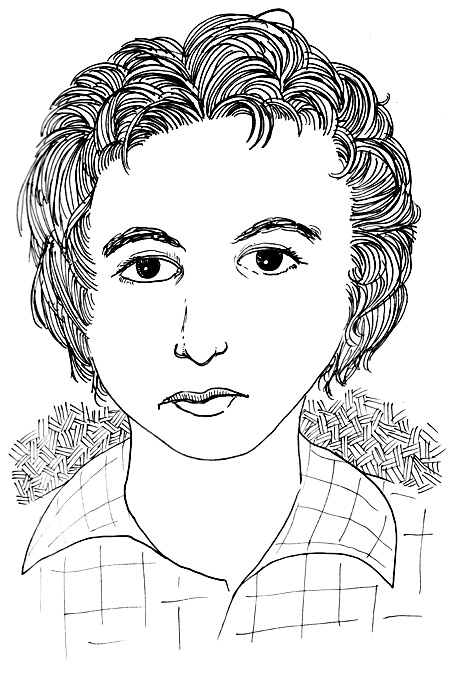
from my sketchbook: jack slivinski

Sometimes it's like someone took a knife baby/Edgy and dull and cut a six-inch valley/Through the middle of my skull
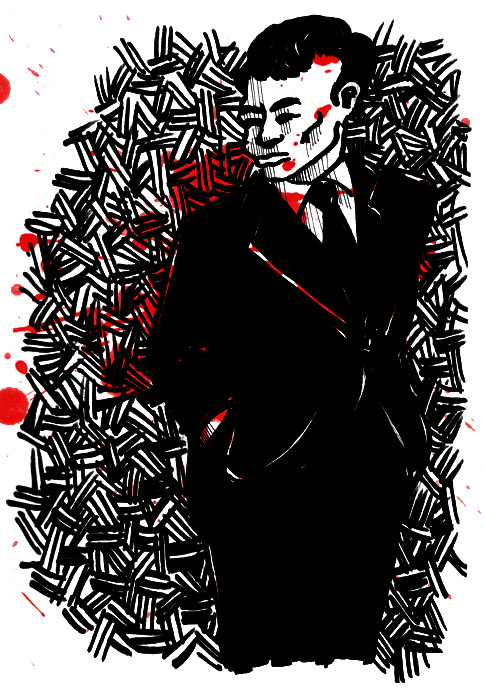
Jack Slivinski thought he was doing the right thing. The 32 year-old Philadelphia firefighter always wanted to help those in need any way he could. So, when photographer Katherine Kostreva asked him to pose for a charity calendar called “Nation’s Bravest” — a pictorial of firefighters from across the country with proceeds from sales going to families of fellow firefighters lost in the line of duty — Jack jumped at the opportunity. In April 2011, Jack posed — smiling and shirtless — in front of the Swann Fountain on Philadelphia’s Logan Circle. By the look on his face in the resulting photos, Jack was proud.

When Philadelphia Fire Commissioner Lloyd Ayers got wind of the photo shoot and proposed calendar, he was furious. He cited Jack for insubordination, saying he was “selling sex”. The Commissioner also stated that Jack did not have permission to do the shoot. Jack was relieved of his position as a part of the elite Heavy Rescue 1 unit. A week later, he was reinstated to the unit but received a harsh verbal reprimand. Jack was pleased to return to duty, but the fact that he was disciplined for something he perceived as righteous and generous weighed heavy on his conscience.

This past Saturday morning, Jack’s father, firefighter John Slivinski Sr., found his son’s body a little before 4:20 a.m. Jack was dead from a self-inflicted gunshot, the discharge point just under his chin.

Comments

comments

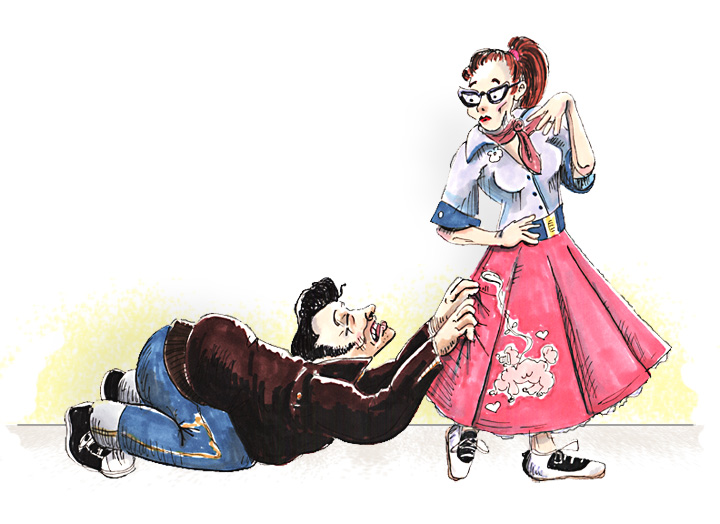
IF: midsummer night

The Illustration Friday website suggests “midsummer night”  as this week’s inspiration.
A lion among ladies, is a most dreadful thing.
My son and I experienced Niagara Falls for the first time at the same  time. My wife, whose parents took their three children on numerous family vacations, saw the renowned natural spectacle in her youth. I went on my last furlough with my parents at the age of seven, and Atlantic City, New Jersey is severely lacking in the waterfall department. When I became a father, I was determined to travel with my own family as much as time and money would allow. They would need not be extravagant, cultural excursions — just good, old-fashioned family fun time. So, in the summer of 1993, the three-member Pincus family loaded our typically-domestic minivan with suitcases and snack foods and headed in the direction of our neighbors to the North.

Niagara Falls, in all its majestic aqueous glory, is truly breathtaking. However, after staring at an enormous wall of furiously rushing water, one’s sensibilities tend to shift from awestruck to bored to “I really have to go to the bathroom”. The Niagara Falls Chamber of Commerce is obviously aware of this emotional phenomenon. That has to be the reason that one of the most glorious displays of natural wonder and beauty is surrounded by kitschy souvenir shops, wax museums, arcades, miniature golf courses, spook houses, fast-food joints and budget motels. The average traveler might be turned-off by such vulgarity but this was right up the Pincus family’s alley.

Once past the brief, yet friendly, interrogation by the international border patrol, we crossed the Rainbow Bridge at Niagara Falls, New York and entered its bright and sparkly Canadian namesake on the other side of the Niagara River. As our son E. peered out of the backseat windows at the flashing lights and colorful building facades of frantic Clifton Hill, Mrs. Pincus navigated the Plymouth Voyager to the Quality Inn that would be our accommodations for several midsummer nights. We  pulled into the Victoria Avenue driveway of the Quality Inn and my wife let me out by the front office entrance to check in. The motel was standard, no-frills lodging consisting of a two-story, horseshoe-shaped structure encircling a small in-ground swimming pool surrounded by unassuming chaise lounges and enclosed by a chain-link fence. The rooms were nondescript and served their purpose in cleanliness, convenience and affordability.

Our first evening included a search for restaurant food that didn’t contain meat — evidently, a fairly difficult task in Canada. Afterwards, we strolled Clifton Hill, its surreal promenade alight with exuberance that spilled out of every open door and into the streets. E. was amazed and excited and we capped the night with a stop for ice cream before turning in. As we made our way back to our motel, we noticed a large group of Amish* teens — the boys in straw hats and dark vests with dark colored shirts; the girls in solid color dresses and starched white bonnets — heading in the same direction. As we walked, the population of the Amish youths steadily increased. When we reached the Quality Inn, the Pincus family proceeded to our first-floor room and the faction of Jakob Ammann‘s young disciples climbed the open-air staircase to the second story and retired to three adjoining rooms.

Our next day was spent doing all the activities that tourists at Niagara Falls do. We donned disposable rain gear for the the famous , yet drenching, Maid of the Mist boat ride. We retained our slickers for the equally waterlogged tour of the tunnels behind the Horseshoe Falls. We snapped photos along the guardrails protecting us from the hundred foot drop to the churning river below. Our whirlwind expedition sapped our collective energy, so we retreated to our motel for a rejuvenating dip in the pool. We hurriedly changed into swimming attire and started toward the small oasis in the middle of the parking lot. I laid claim to several recliners and accompanied my wife and son in the humble, water-filled cement tank. A few laps and splashes later, we were toweling off and relaxing.

Soon, two boys emerged from the second floor rooms where the Amish assembly had disappeared the night before. They joined the small congregation of hotel patrons at the pool and commenced to splashing and cavorting and doing the playful things boys do in a pool. While the usually sheltered youngsters amused themselves, two attractive, bikini-clad young ladies sauntered across the far end of the hotel property with their sights on the same midday refreshment the swimming pool offered their fellow guests. The girls idly chatted to each other as they dropped their towels on some chaise lounges on the opposite side of the pool and absentmindedly kicked off their sandals. The two Amish boys froze in mid-movement, their bodies rigid, their eyes transfixed. The young ladies, unaware that their every move was being observed and tracked by two innocent and bewildered 12 year-olds, continued their conversation. It was obvious that these two young men had never, ever, in their short lives, witnessed anything that remotely resembled the figures now on display before them. The female members of their traveling contingency sure as hell didn’t look like these… these…. females.  Suddenly, one of the girls rose from her seat and strode to the edge of the pool. The boys’ eyes widened. The young lady pointed her leg and slowly and precariously dipped her toe into the water. At the exact same pace, the two boys slowly and precariously backed out of the water, never once taking their gaze away from the girl. It was as though Satan himself had chosen this small, man-made body of water to cool off his cloven hoof. The girl lazily stirred the water around with her extended leg, then withdrew it and patted it with a towel  — never once glancing in the boys’ direction. By the time the young girl returned to the seat by her friend, the two boys were, no doubt, on their knees in their room praying and repenting for whatever they had done to have been subjected to the Devil’s temptations.

Sometimes, vacations yield more sights that just the ones for the average tourist. And that works on several levels.

* For over fifty years, my wife’s family owned and operated a general merchandise store in a farmer’s market located in the heart of Pennsylvania’s Amish population, so we are well-acquainted with their practices, observances and attire.

Comments

comments

from my sketchbook: wild man fischer

My name is Larry! My name is Larry!
At 16 years old, Larry Fischer was institutionalized for attacking his mother with a knife. He was diagnosed with severe paranoid schizophrenia and manic depression (now known as bipolar disorder). After his release from a mental hospital in his late teens, Larry lived on the streets of Los Angeles. He became a street performer serenading passersby on the Sunset Strip for handouts. His earnest, though offbeat, songs brought him a cult following. He caught the attention of musician Frank Zappa and was signed to Zappa’s fledgling Bizarre Records. Larry, now tagged with the fitting moniker “Wild Man Fischer”, opened concerts for diverse headliners like Alice Cooper, Solomon Burke and The Byrds. His song “My Name is Larry” became a staple on the popular Dr. Demento show in the 70s.

Larry had a falling out with his one-time close friend Frank Zappa. According to Zappa’s widow Gail, Larry threw a glass jar at Zappa’s daughter Moon Unit for no apparent reason. This incident prompted Zappa to stop releasing Larry’s albums. Larry was back on the streets until his song “Go to Rhino Records” created interest in the small Hollywood store and record label. Larry released three albums for Rhino and is credited for putting the eclectic company on the map. Larry collaborated with an odd assortment of singers, including Devo’s Mark Mothersbaugh, comedy duo Barnes & Barnes (of “Fish Heads” fame) and even Rosemary Clooney.

Since 2004, Larry had been living in an assisted-living facility for mentally-ill patients and was on medication for his paranoia. He passed away on June 16, 2011 from a heart ailment at the age of 66.

Comments

comments

from my sketchbook: johnny marks

but, do you recall the most famous reindeer of all?
In 1939, retailer Montgomery Ward was looking for a gimmick to drum up business for the upcoming Christmas holiday. In the past, they had distributed free coloring books to children and decided to produce a book of their own to save money. They assigned in-house copywriter Robert May to come up with an appealing holiday story for children. May penned a little poem of a spunky outcast reindeer determined to help guide Santa’s sleigh through a particularly foggy Christmas Eve. He dismissed “Rollo” and “Reginald” before settling on “Rudolph” as the name for the main character. May’s brother-in-law, songwriter and radio producer Johnny Marks set the poem to music and in 1948 singer Harry Brannon introduced it on New York City radio. In 1949, singing cowboy Gene Autry reluctantly recorded “Rudolph the Red-Nosed Reindeer”. It sold 2.5 million copies in its initial release and went on to sell 25 million copies making it the second biggest selling song of all time, a status it held until the 1980s. Over the years, the song was recorded by many artists as diverse as Dean Martin and Alan Jackson to the Chipmunks and The Jackson 5.

Johnny Marks formed a music publishing company, St Nicholas Music, in 1949 and established a career perfectly suited for a nice Jewish boy from New York — writing Christmas songs. In the course of thirty years, Johnny wrote 94 songs, including over a dozen of the most famous and beloved Christmas songs of all time. Johnny authored “Holly Jolly Christmas”, “I Heard the Bells on Christmas Day”, “Run Rudolph Run”, “Rockin’ Around the Christmas Tree” and many others. In 1964, he wrote eight more songs for the Rankin-Bass animated holiday special based on his most famous composition about that crimson-snouted caribou.

In addition, Johnny served as director of American Society of Composers, Authors and Publishers (ASCAP) from 1957 to 1961. He was inducted into the Songwriters Hall of Fame in 1981.

Johnny passed away in 1985 at the age of 76. His son still maintains the publishing business as the popularity of Johnny’s holiday catalog shows no signs of dying.

Comments

comments

from my sketchbook: harry r. truman

The world is turnin' round and losin' lots of ground/Oh Harry is there something we can do to save the land we love
After his 1917 discharge from military service, West Virginia-born Harry R. Truman moved to Riffe, Washington. In 1926, he became the caretaker of a lodge on the shore of Spirit Lake. The lodge was a popular spot for hunters and fishing enthusiasts looking for rustic accommodations in a remote wooded area. Harry was a cantankerous character who took in feral cats and had an affinity for alcohol. He operated the lodge for 52 years.

In the late months of 1979, authorities issued warnings based on possible volcanic activity. Harry’s lodge was at the base of Mt. Saint Helens and he was told of the possibility of evacuation in early 1980. Stubborn Harry said that the findings and predictions were over-exaggerated and that he had no intention of leaving his dwelling. The authorities continued to issue words of caution and Harry and his cats continued to stay put. Harry maintained that, after years of side-by-side existence, he and the mountain had a mutual respect, saying “Spirit Lake is in between me and the mountain, and the mountain is a mile away, the mountain ain’t gonna hurt me”. Harry ignored the warnings and stood his ground.

Just as predicted, on May 18, 1980, Mt. Saint Helens erupted, spewing a mixture of superheated gas and rock sixteen miles into the air and into a surrounding area of 230 square miles. Buildings and vegetation were destroyed. Volcanic ash and debris — one hundred and fifty feet deep — engulfed Spirit Lake.

Harry, his cats and his lodge were, no doubt, buried, too.

Comments

comments

from my sketchbook: gus dudgeon

it's just a job/five days a week
Gus Dudgeon worked his way from tea boy to sound engineer at Decca Records in the middle 1960s, where he worked on The Zombies hit “She’s Not There” and John Mayall’s Blues Breakers with Eric Clapton. By the end of the 60s, he produced albums by Ten Years After, The Bonzo Dog Band and a single called “Space Oddity” by a then-unknown David Bowie.

Gus left Decca and formed his own company. It was around this time he began his long collaboration with Elton John that started with “Your Song” in 1970. As Elton John’s populatrity increased, Gus was given free reign over the production of his albums. After recording sessions had ended, John and his band would exit the studio and leave Gus to “work his magic” alone at the controls. Gus was very critical of John’s work, calling his popular 1974 album Caribou  “a piece of crap”. After a long run of successes, Gus parted ways with John, although they reunited in the 80s for three more albums. Branching out, Gus worked with a variety of other performers like The Moody Blues, Joan Armatrading, Fairport Convention, The Beach Boys, XTC and Elton John protege Kiki Dee..

Gus is credited in The Guinness Book of World Records  for the first recorded use of “sampling”, for his inclusion of African tribal drumming in his 1971 recording of John Kongos’ “He’s Gonna Step On You Again”.

In July 2002, while driving home from a party with his wife Sheila, Gus fell asleep at the wheel and drove off an embankment at high speed. The car crashed in a ditch where he and his wife drowned. Gus was 59.

Comments

comments

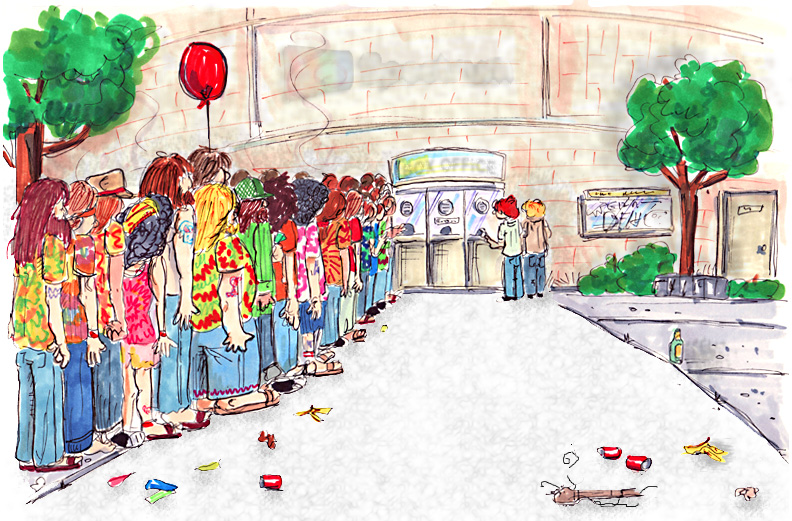
IF: swept

Who am I? No, no, no, no, no! Who are YOU?
My father’s low tolerance for other humans kept my parent’s accumulation of friends to a minimum. There was one couple with which my parents maintained a close relationship and that was Jack and Myrna. They’d go out to dinner regularly. They’d visit each others homes, sometimes including a few other couples so the men could play low stakes poker while the wives played Mah Jongg and gossipped. But mostly, my parents stuck with Myrna and Jack, until Jack’s untimely death.

Every March, my parents would take a lengthy weekend vacation to the Nevele Resort in the Catskill Mountains, affectionately known as “the Jewish Alps.” Nevele was a real-life version of the type of resort depicted in the film Dirty Dancing.  A sprawling conglomeration of buildings that housed guest rooms, ballrooms, dining rooms, banquet rooms and showrooms — all surrounding a grassy common area with pools, playgrounds, tennis and basketballs courts, running tracks and a wide variety of benches just for “a little sit down, farshtaist?” The main activity for guests at Nevele (or any of the many Catskill resorts) was eating, followed a close second, by eating. In addition to a room and nightly shows, your stay included three meals a day – meals that would put the Roman bacchanalia to shame. If there’s one thing Jews love (besides getting their way and talking on top of other people’s conversations), it’s eating. The food for breakfast was abundant with a huge array of offerings. The wait staff would happily bring as many different dishes and as much of them as any guest desired. And after the early morning gorging ended, the dining room would refill within ninety minutes to start the process again for lunchtime. Dinners, too, were a repeat performance as guests eagerly sampled separate platters overflowing with roast beef and roast chicken – side-by-side at their place setting. After dinner, the overstuffed patrons would slowly waddle over to the showroom and fart their way through a schticky comedian and a female singer doing her best Barbra Streisand impersonation. My parents and their friends looked forward to four days of this each Spring. God bless ’em.

When my brother and I were past the age where the services of a babysitter was required, we looked forward to that weekend in March as well. One particular March, as my parents made their annual getaway plans, my brother and I had plans of our own. Early on Thursday morning, Jack and Myrna pulled their car up in front of our house. Jack, a jovial and kind-hearted but simple-minded guy, bounded out of the passenger seat to show my father the surplus of X-rated novelties he had stocked up on for the trip. Jack was so excited to pass out cigarette lighters in the shape of penises and fake dollar bills with a scene of fellatio in place of George Washington’s picture to a group of strangers at Nevele. (In the middle 1970s, this was, evidently, funny.) Myrna and Jack loaded their luggage alongside my parents’ bags in my Dad’s trunk. With goodbye waves and a couple of honks from the horn, the couples were off. That was the cue for my brother and I to set our plans into motion. I headed to school and announced a weekend party at my house to everyone who looked in my direction. My brother, now in college, did the same among his friends. On Saturday night, our house was overflowing with teens and beer and potato chips and pizza and music. Surprisingly, my high school friends and my brother’s older college pals got along swimmingly. I suppose enough alcohol will bridge any age gap. The party raged on until the small hours of the morning.

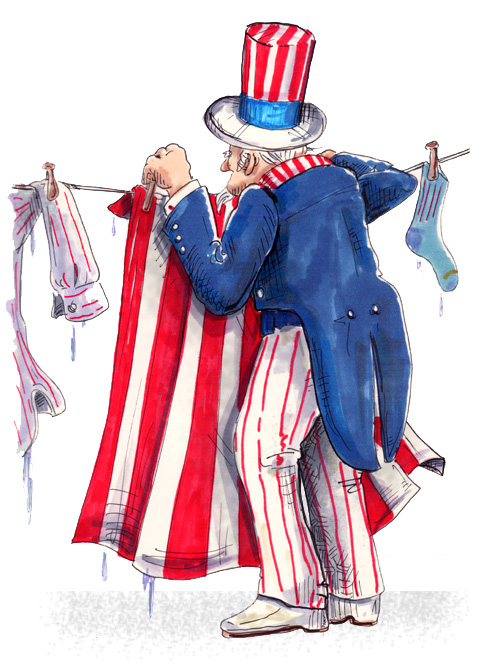
After just a few brief moments of sleep, my brother and I slowly woke and were greeted by the aftermath of the previous evening’s revelry. Our house was littered with beer cans, spills, pizza crusts, empty cups, the crumbs of various foodstuffs and several items that, to this day, remain unidentified. My brother silently went for the vacuum cleaner and I went to the kitchen cabinet for trash bags. Fighting through hangovers, we swept and vacuumed and scrubbed — slowly, but efficiently. I tossed mounds of cans and cups into the trash. My brother picked each and every food particle out of the living room carpet. We straightened the furniture, realigned pictures on the walls and shook out area rugs. We even plucked a few stray bottles out of the azalea bush on our front lawn. Finally, we stood back and admired our work. Then, we collapsed on the sofa and tried to act innocent until our parents arrived home.

Eventually, my dad’s car pulled into the driveway. Jack and Myrna grabbed their bags and said their goodbyes. My mom came into the house first as my dad lagged behind with their luggage. Three steps into the living room, my mother surveyed the surroundings, squinted her eyes and said, “You had a party, didn’t you?”

My brother and I answered, “What are you talking about?,” putting on our best “what-are-you-talking-about” faces.

“This place is too spotless. I know damn well you didn’t spend the weekend cleaning.” my mother keenly surmised.,

Word of advice: You can’t get anything past your mother. So, don’t even try.

Comments

comments

DCS: dick shawn

I would like to sing this song, it's about love, and hate. Psychedelically speaking I am talking about the power.

Dick Shawn was a difficult performer to peg. He was an film actor, a stand-up comic, a singer, a voice actor and a stage actor. And he did them all well. But he never achieved the fame for his performances that he really deserved. He actually became more famous for the circumstances surrounding his death.

Born Richard Schulefand in Buffalo, New York, Dick worked primarily as a stand-up comic in a one-man show that he performed internationally for over 35 years. Over the years, he appeared in films and television, including his most famous roles — Sylvester Marcus, Ethel Merman’s hippie son, in 1963’s It’s A Mad, Mad, Mad, Mad World  and Lorenzo St. DuBois, the man would would be Hitler, in Mel Brooks’ original version of The Producers  in 1968. He also lent his voice to the Snow Miser in the Rankin-Bass animated Christmas special The Year Without a Santa Claus  in 1974. In one of his last filmed roles, he was cast as Commander Bog to Michael Jackson’s title character in the 3D space adventure Captain EO that played exclusively in Disney theme parks in the mid-1980s.

As a comedian, he was a frequent guest at celebrity roasts at the Friars Club. One particular night, after a parade of comics delivered some of the evening’s raunchiest, off-color remarks, Dick approached the podium, paused to slowly look around, opened his mouth and let flow a gush of pea soup over the microphone, his clothes and the surrounding area. He then returned to his seat on the dais — never uttering a word.

In April 1987, Dick was scheduled to perform his award-winning one-man stage show, The Second Greatest Entertainer in the Whole Wide World  at UC San Diego’s Mandeville Hall. As the audience entered the theater, the curtain was opened and the entire stage was strewn with crumpled sheets of newspaper. The seats filled after a while and the play began. Suddenly, Dick emerged from beneath the piles of newspaper, having been lying still the entire time. The show — a mix of song, political satire and fantasy character play — included a bit featuring Dick as a promise-making politician. He uttered the line, “If elected, I will not lay down on the job” and immediately collapsed face down on the stage. The audience exploded in laughter. Dick lay motionless. The hearty laughter turned to nervous giggles then to uncomfortable awkwardness. Low muttering filled the theater as a stagehand ran over to check on Dick, calling out “Is the a doctor in the house?” The audience, believing it was part of the act, began laughing again, until another man came from backstage to administer CPR. Finally, paramedics arrived and confirmed that Dick had suffered a fatal heart attack.

He was 63 and he went out doing what he loved best.


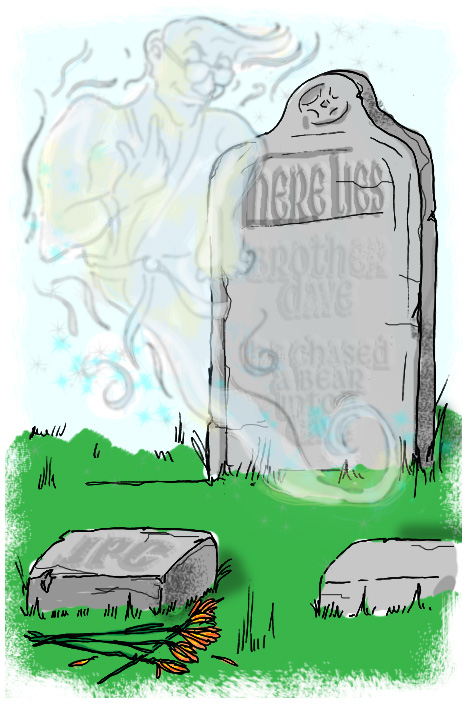
Here’s where Dick Shawn is todayat Hillside Cemetery in Culver City, California

Comments

comments