
The illustrationfriday.com challenge word this week is “superstition“.
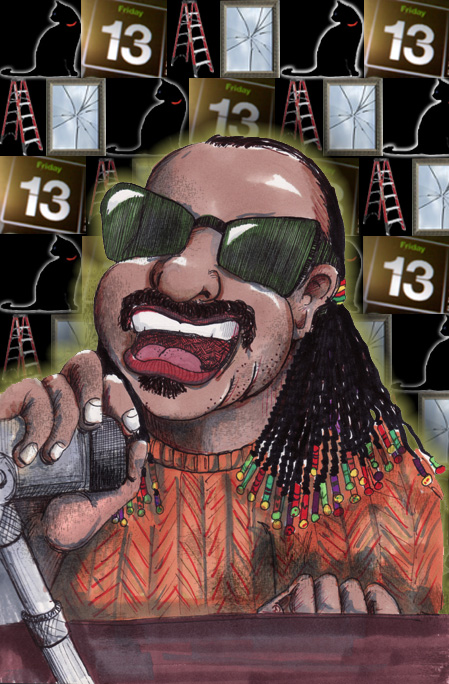
Stevland Hardaway Judkins (his name was later changed to Stevland Hardaway Morris) born prematurely in Saginaw, Michigan to Lula Mae Hardaway on May 13, 1950. It is thought that he received excessive oxygen in his incubator which led to retinopathy of prematurity, a destructive ocular disorder affecting the retina, characterized by abnormal growth of blood vessels, scarring, and sometimes retinal detachment. Mrs. Hardaway instructed her other children to treat Stevland the same as any other child, and not to tease or over-assist him because of his blindness. The family moved to Detroit and Stevland began singing and playing instruments in church at an early age. He took to the piano, congas, and harmonica in particular. He was educated at the Michigan School for the Blind in Lansing, where he was trained in classical piano.
In 1962, at the age of 12, Stevie was introduced to Ronnie White of the popular Motown act The Miracles. White brought Stevie and his mother to Motown Records. Impressed by the young musician, Motown CEO Berry Gordy signed Stevie to Motown’s Tamla label with the name Little Stevie Wonder.
At the age of 13, Little Stevie Wonder had his first major hit, “Fingertips (Pt. 2)”, a 1963 single taken from a live recording of a Motor Town Revue performance. The song, featuring Wonder on vocals, bongos, and harmonica, and a young Marvin Gaye on drums, was a #1 hit on the US pop charts and launched him into the public consciousness. Dropping the “Little” from his moniker, Stevie went on to have a number of other hits during the mid-1960s. He also began to work in the Motown songwriting department, composing songs both for himself and his labelmates, including “Tears of a Clown“, the number one hit performed by Smokey Robinson & the Miracles.
In 1972, Stevie wrote “Superstition“. It reached number one in the USA, and number eleven in the UK, in February 1973. Stevie had actually written this song for Jeff Beck, but at the insistence of his own manager, Stevie recorded it first. Beck was instead offered “Cause We’ve Ended As Lovers“, which he recorded for 1975’s Blow by Blow. Jeff Beck played guitar on Stevie’s version of the song and later recorded his own version of “Superstition” with Beck, Bogert & Appice.
SFG: flight
The challenge word this week on sugar frosted goodness is “flight“.
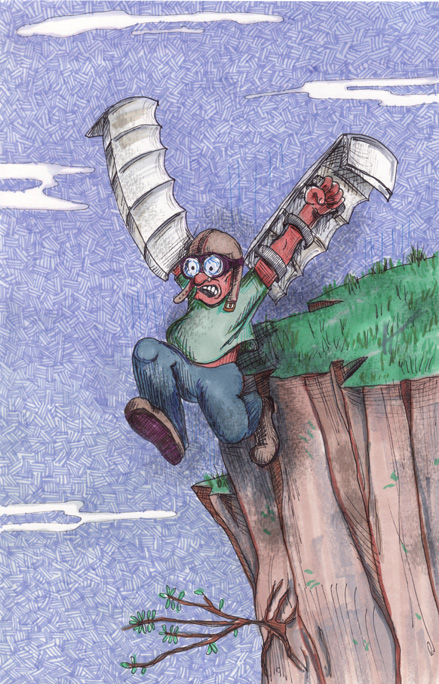
Can’t keep my mind
from the circling skies
Tongue-tied and twisted
Just an earth-bound misfit,
I
Comments
DCS: clara blandick
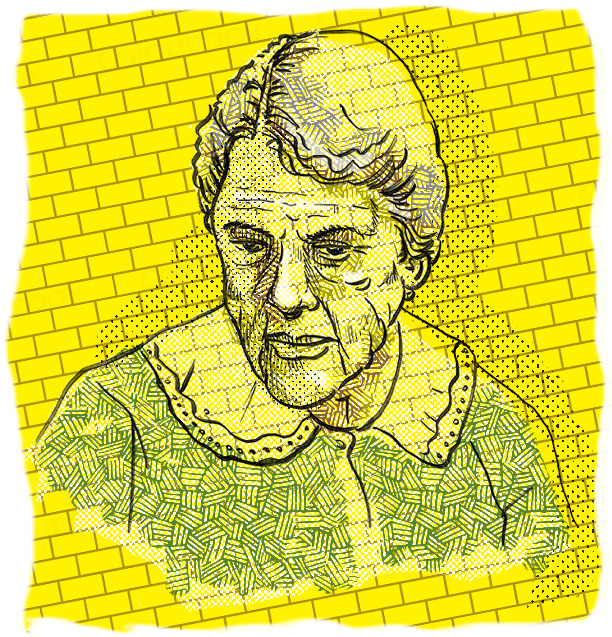
In the 1930s, Hollywood placed many actresses on the “goddess” pedestal. There was Barbara Stanwyck, Carole Lombard, Betty Grable, Jean Harlow, Lana Turner and many others. There were other actresses, appearing in hundreds of movies, who never achieved “goddess” status. Clara Blandick falls into this category.
Clara was born in 1876 on a ship, captained by her father, harbored in Hong Kong. Her parents eventually settled in Quincy, Massachusetts and she began her acting career at age 24. After numerous successes in many stage plays, Clara moved to Hollywood in 1929. Though she landed roles like Aunt Polly in the 1930 film Tom Sawyer (a role she reprised in the 1931 film Huckleberry Finn), she spent much of the decade as a character actor, often going uncredited. At a time when many actors were permanently attached to a single studio, Clara played a wide number of bit parts for almost every major Hollywood studio. In 1930, she acted in nine different films. In 1931 she was in thirteen different films. It’s impossible to make an exact tally of the films in which Clara appeared. A reasonable estimate would fall between 150 and 200.
Her most famous role was that of Dorothy’s Aunt Em in 1939’s The Wizard of Oz. Clara filmed all her scenes in a single week, for which she was paid $750. Although it was a small part, the character was an important symbol of protagonist Dorothy’s quest to return home throughout the film. After The Wizard of Oz, Clara returned to her staple of character acting in supporting and bit roles. She would continue to act in a wide variety of roles in dozens of films, including a surprised customer in the 1941 Marx Brothers film The Big Store and a cold-blooded murderer in the 1947 mystery Philo Vance Returns. Her final two roles both came in 1950 — playing a housekeeper and a landlady in Key to the City and Love That Brute respectively. Poor health forced Clara to retire soon after.
Throughout the 1950s, Clara’s health steadily began to fail. She started going blind and began suffering from severe arthritis. On April 15, 1962, she returned home from Palm Sunday services at her church. She began rearranging her room, placing her favorite photos and memorabilia in prominent places. She laid out her resume and a collection of press clippings from her lengthy career. She dressed in an elegant royal blue dressing gown. Then, with her hair properly styled, she took an overdose of sleeping pills. She lay down on a couch, covered herself with a gold blanket over her shoulders, and tied a plastic bag over her head. Clara left the following note: “I am now about to make the great adventure. I cannot endure this agonizing pain any longer. It is all over my body. Neither can I face the impending blindness. I pray the Lord my soul to take. Amen.” Her body was found by her landlady.
After researching Clara and her chosen method and ritual of dying, I have watched her in The Wizard of Oz differently than before.
She will never be remembered as a silver screen goddess.
Comments
IF: scale
The challenge word this week on illustration friday is “scale“.
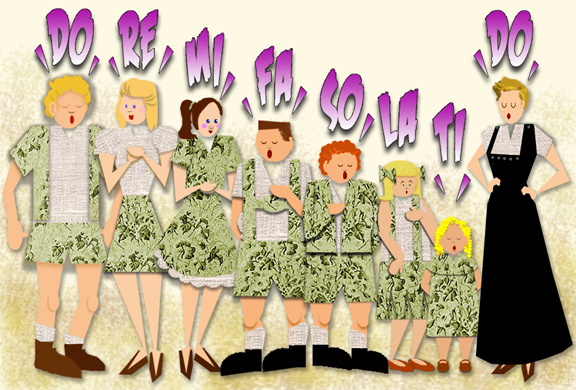
The Sound of Music portrayed the life of Maria Kutschera, a young woman studying in a Roman Catholic sisterhood, and her relationship with widower Georg Ritter von Trapp and as governess to his children. Details of the history of the von Trapp family were altered for the musical. Georg Ritter von Trapp lived with his family in a villa in Aigen, a suburb of Salzburg. The real Maria was sent to be a tutor to one of the children, not a governess to all of them. The Captain’s oldest child was a boy, not a girl, and the names of the children were changed (at least partly to avoid confusion: the Captain’s eldest daughter was also named Maria). The von Trapps spent some years in Austria after Maria and the Captain married — they did not have to flee right away — and they fled to Italy, not Switzerland. Maria von Trapp is said to have enjoyed the stage show but to have hated the movie: her standard response to praise was, “it’s a nice story, but it’s not my story.”
I took a slightly different approach for this illustration. This was created entirely in Photoshop.
Comments
SFG: signs
The challenge at sugarfrostedgoodness.com this week is “signs“.
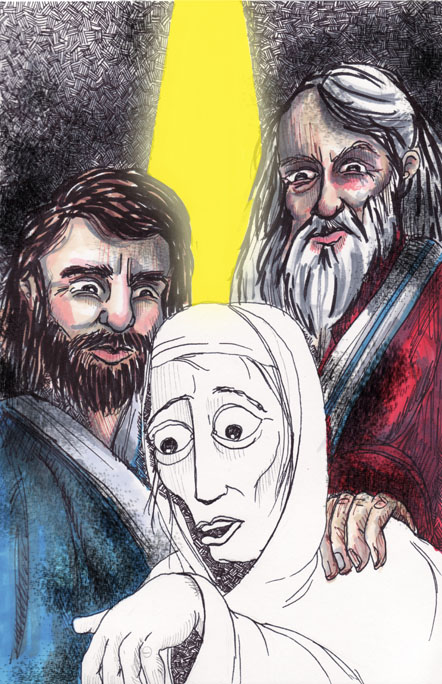
I was looking for a story to illustrate “a sign from God“.
The story of Miriam was told to me by this guy, and it goes like this…
Miriam was the sister of Moses and Aaron. Her name means either “wished for child”, “bitter” or “rebellious”, but it might be derived originally from an Egyptian name, myr “beloved” or mr “love” or even Meryamun “beloved of Amun”.
Miriam was essentially the first racist. Moses’ wife, Tzipora, was a Cushite. In the Bible, a large region covering northern Sudan, southern Egypt, and parts of Ethiopia, Eritrea, and Somalia was known as Cush. It is possible (and probable) that people from this region had a darker skin color than the Israelites. She was also a Midianite. In the Bible, the Midianites are described as worshipping a multitude of gods, and therefore, not Jewish. Although no bad feelings or ill will was ever expressed previously towards the Cushites and Midianites, Miriam disapproved of Moses’ marriage and she didn’t make a secret of how she felt. God was angered by Miriam speaking Lashon hara (gossiping, or speaking negatively about someone), and she was struck with tzaraat, often mistranslated as leprosy, but manifesting as a whitening of the skin and covering the whole body with sores. After Aaron asked Moses to intercede for her, Moses uttered a five-word prayer: El nah refa nah-la “O Lord, make her well,” and she recovered within seven days.
The moral of this story is (and I quote Captain Wow): “Don’t be talking smack about God’s friends.”
(Just as a side note: Illustration Friday posed the word “signs” as a challenge in May 2007. Here is the illustration I did then. When I did the drawing above, I did not remember doing one for the word “signs” before. I think it’s funny that I went in a totally different direction with this one.)
Comments
Monday Artday: hygiene
The weekly challenge word on Monday Artday is “hygiene”
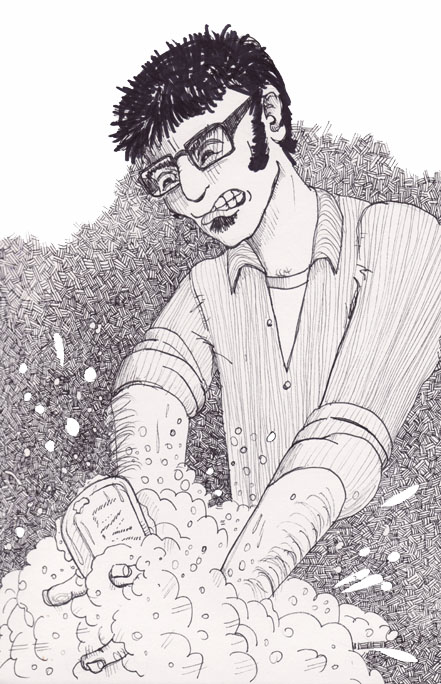
Mysophobia is a term used to describe a pathological fear of contact with dirt to avoid contamination and germs. Someone who has such a fear is often referred to as a “mysophobe”. The term was introduced by William A. Hammond in 1879, when describing a case of obsessive compulsive disorder exhibited in repeated washing one’s hands.
This phobia is sometimes referred to as germophobia (or germaphobia), a combination of germ and phobia to mean fear of germs, as well as bacillophobia and bacterophobia.
Mysophobia has long been related to OCD or washing one’s hands, however Harry Stack Sullivan, an American psychologist and psychoanalyst, notes that while fear of dirt underlies the compulsion of a person with this kind of OCD, their mental state is not about germs, it is about the hands must be washed.
Comments
IF: hats (part 2)
The challenge on illustrationfriday.com this week is “hats“. I really couldn’t decide on one idea, so I did two. This is the FIRST idea. Here is the second.
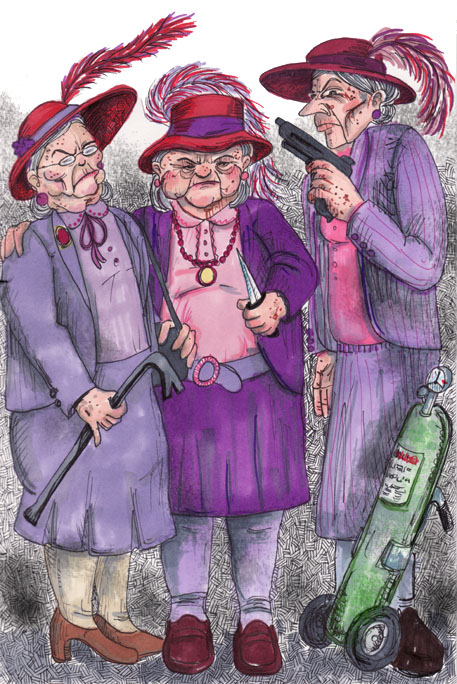
Over-50 communities and retirement homes across the country have seen vicious gangs appear. Gangs of desperate old ladies terrorizing shopping malls and Sunday brunches everywhere. They dress in gang colors of red and purple and they call themselves The Red Hat Society. Wherever they go, they strike fear in regular, upstanding citizens. These Red Hatters have been known to completely take over entire rooms in restaurants. They giggle and cackle and prance around in their decorated red hats and wild purple wardrobe. They commandeer buses and descend on malls and hotels and casinos. Sometimes, they even bring their own oxygen with them.
Their origins can be traced to a poem, written in 1961, by Jenny Joseph called Warning (a very ominous title, indeed). The first verse reads:
When I am an old woman I shall wear purple
With a red hat which doesnt go, and doesnt suit me.
And I shall spend my pension on guns and ammunition
And combat boots and flak jackets.
I shall push people who get in my way
And steal stuff from shops and totally ignore alarm bells
And fire my .45 into the air for no good reason
And make up for the sobriety of my youth.
I shall go out in my red hat and make people turn their heads
And I will kick their asses if they laugh and point
And I sure as hell wont take any shit from the man.
They are dangerous. Run for your lives!
Comments
IF: hats
The challenge word on illustration friday is “hats“.
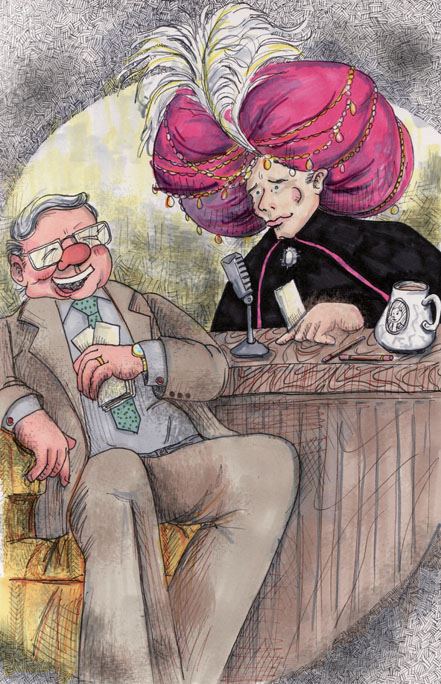
With the impending retirement of Jay Leno as host of the Tonight Show, it’s hard to believe that there is almost an entire generation who doesn’t know who Johnny Carson was. For many, Leno has always been the host of the Tonight Show. When Johnny stepped down on May 22, 1992, it most definitely was the end of an era. For 30 years, Ed McMahon‘s introduction of “Heeeeeeeeeeere’s Johnny” was the beginning of America’s bedtime ritual.
The Tonight Show featured many characters during its run. One of the most popular was Carnac the Magnificent. With the name taken from the stage name Johnny used as a magician, Carnac was “a seer, sage and soothsayer”. America’s excitement piqued when this “vistor from the East” was announced by Ed. The bit featured Johnny, decked out in an impossibly large turban and cape, as the psychic, who would divine the answers to the questions that were in envelopes “hermetically sealed” and had been kept in “a mayonnaise jar on Funk and Wagnalls’ porch since noon” that day. One at a time, Johnny would raise the envelopes to his forehead and announce an answer like “Dippity-do”. Then, he would tear open the envelope and read the question printed on a card: “What forms on your Dippity early in the morning?” The audience would laugh or groan (or both). And so it went.
A: Bible belt.
Q: What holds up Oral Roberts’ pants?
A: An unmarried woman.
Q: What was Elizabeth Taylor between 3 and 5 pm on June 1, 1952?
A: Clean air, a virgin and a gas station open on Sunday.
Q: Name three things you won’t find in Los Angeles.
If a particularly bad joke met with a large groan from the studio audience, Carnac would curse them with “May a crazy holy man set fire to your nose hair.” or “May a queasy camel freshen up your mother’s evening bath.”
I haven’t watched the Tonight Show since 1992. I think I know why. Who could possibly top Johnny Carson?
He was a tough act to follow.
Comments
SFG: black and white
The challenge this week at sugarfrostedgoodness.com is “black and white“.
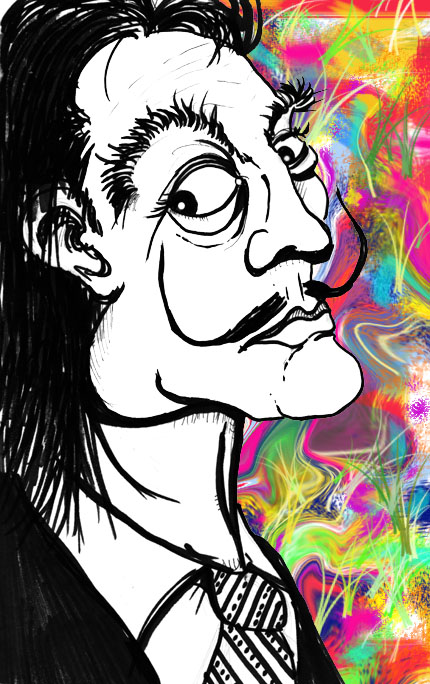
When presented with this challenge, the first image that came to mind was Salvador Dalí. I thought that the topic of “black and white” could give me the chance to experiment, as it is so non-specific. And what better experimental subject than Dalí.
Salvador Domingo Felipe Jacinto Dalí i Domènech, 1st Marquis of Púbol was born on May 11, 1904, in the town of Figueres, in the Empordà region close to the French border in Catalonia, Spain. Dalí’s older brother, also named Salvador, had died nine months earlier. His father, also named Salvador, was a middle-class lawyer and notary whose strict disciplinarian approach was tempered by his wife, (not named Salvador) who encouraged her son’s artistic endeavors. When he was five, Dalí was taken to his brother’s grave and told by his parents that he was his brother’s reincarnation, which he came to believe. Dalí had an affinity for doing unusual things to draw attention to himself. This sometimes irked those who loved his art as much as it annoyed his critics, since his eccentric manner sometimes drew more public attention than his artwork. He didn’t care what his critics thought of him and his actions. He relished the attention and enjoyed the feeling of pissing people off. When signing autographs for fans, Dalí would always keep their pens.
Dalí once said, “There is only one difference between a madman and me. I am not mad.”
I can relate to that.
Comments
Monday Artday: boo
The challenge on Monday Artday this week is “boo“.
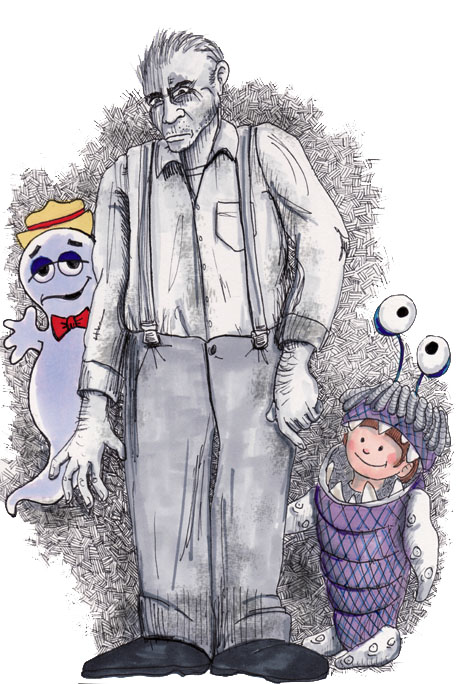
It’s the “phantom”, from Harper Lee’s To Kill a Mockingbird, Boo Radley protecting Scout and her brother Jem (played by Boo from Monsters Inc. and Boo Berry).