IF: resolve

The first word of the new year on illustrationfriday.com is “resolve”.

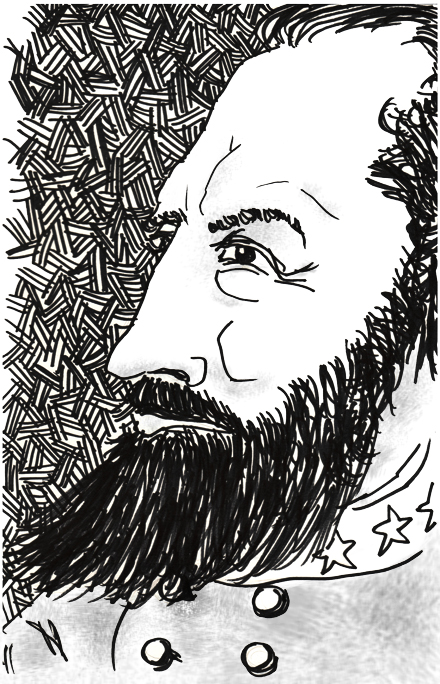
“You may be whatever you resolve to be.”  — General Thomas “Stonewall” Jackson
I've been on the floor lookin' for a chair/I've been on a chair lookin' for a couch/And I've been on a couch lookin' for a bed
Thomas “Stonewall” Jackson was arguably the most well-known Confederate commander after General Robert E. Lee. Military historians consider Jackson to be one of the greatest tactical commanders in United States history. His Valley Campaign of 1862 and his envelopment of the Union Army at Chancellorsville in 1863 are still studied worldwide as examples of innovative and bold leadership. He excelled as well at the First Battle of Bull Run, the Second Bull Run, Antietam, and Fredericksburg.

Darkness ended the Confederate assault at Chancellorsville. As Jackson and his staff were returning to camp on May 2, 1863, they were mistaken for a Union cavalry force by a Confederate North Carolina regiment who shouted, “Halt, who goes there?,” but fired before evaluating the reply. Jackson was hit by three bullets, two in the left arm and one in the right hand. Several other men in his staff were killed. Jackson was dropped from his stretcher while being evacuated. Because of his injuries, Jackson’s left arm had to be amputated. He was thought to be recovering, although he complained of a sore chest. This soreness was mistakenly thought to be the result of his rough handling in the battlefield evacuation. It was, however, a symptom of pneumonia.

As Jackson lay dying in a make-shift hospital in a southern plantation, General Robert E. Lee sent a message to him through a Confederate chaplain, saying “Give General Jackson my affectionate regards, and say to him: he has lost his left arm but I my right.” Jackson died of complications from pneumonia on May 10, 1863. He was buried in a family plot in Lexington City, Virginia. His left arm is buried one hundred and thirty-one miles away in Ellwood Family Cemetery in Spotsylvania, Virginia.

Comments

comments

from my sketchbook: brief encounter

For my first post of 2009, I’ll relate an interesting story that I recently came across.

As I write this, incumbent Norm Coleman and challenger Al Franken are battling for the lead in a heated race for a US senator from Minnesota. A tedious recount has taken place since November 2008 and a winner has still not been determined. A former writer for Saturday Night Live, Al Franken is an Emmy Award–winning comedian, radio host, political commentator, and politician.

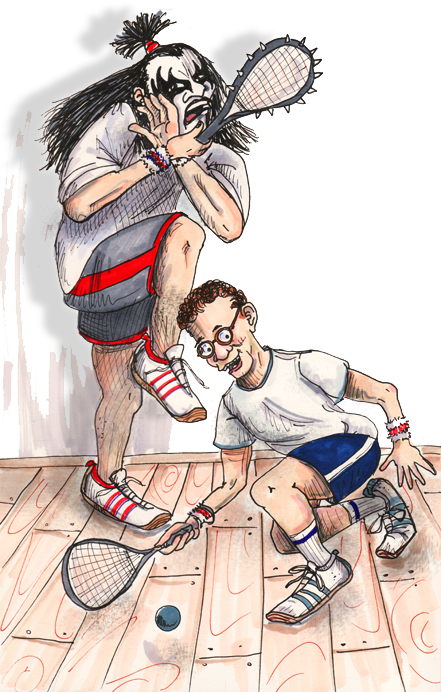
Israel-born grade-school teacher Gene Simmons, the former Chaim Witz, formed the rock group KISS in 1972 with his friend New York cab driver Stanley Eisen, later known as Paul Stanley. Gene parlayed his stint as a blood-spewing, fire-eating bassist in an over-the-top heavy metal band into a multi-faceted career as a musician, singer, songwriter, record producer, actor, entrepreneur and marketer.

In 1982, Al Franken and Gene Simmons’ paths crossed.
Wouldn't it be funny, if underneath all this makeup, he was just a nice Jewish boy?
Al Franken left the writing staff of Saturday Night Live briefly between 1980 and 1985, although he still maintained residence in New York City. One day in 1982, Franken was waiting for a friend at a New York City racquetball club for some scheduled game time. While Franken was waiting, in walked Gene Simmons, looking for trouble. Franken didn’t recognize him because Simmons was not sporting the Kabuki-monster makeup that made him and KISS household names. Simmons challenged Franken to a game. Franken politely explained he was waiting for somebody else. Simmons, the voice behind “Calling Dr. Love,” growled, “I’ll kick your ass!”

Annoyed, but ready for a challenge, Franken agreed to a match and proceeded to humiliatingly defeat the rocker in a matter of minutes. Furious, Simmons demanded another opportunity and still taunted Franken with claims of “I’ll kick your ass!”  By then, Franken’s racquetball partner had arrived. Franken explained he would have to pass on a pointless rematch. Simmons began to cluck his famous tongue in mock chicken noises. The “buck-buck-buck”  teasing pissed Franken off. Franken grudgingly agreed to another round, but only for a $500 stake. This caused multi-millionaire Simmons to back off and sheepishly exit.

Franken’s friend asked, “Do you know who that was?” Franken had no clue. “That was Gene Simmons from KISS!”, his friend informed. Franken shrugged and replied, “I thought he was just some creep who liked to pick fights at racquetball courts.”

Comments

comments

from my sketchbook: parkyakarkus

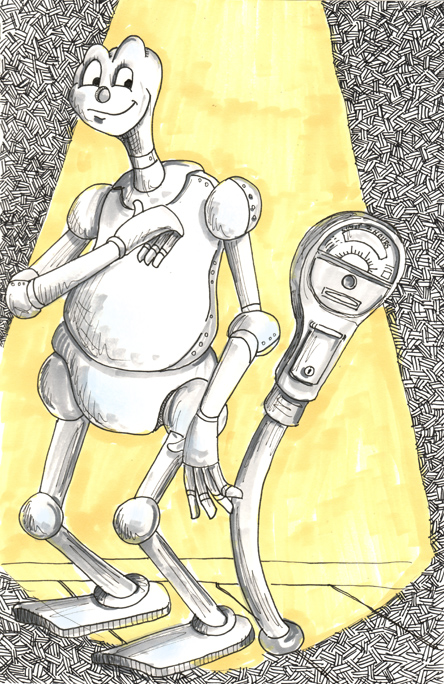
Park Yer Carcass!
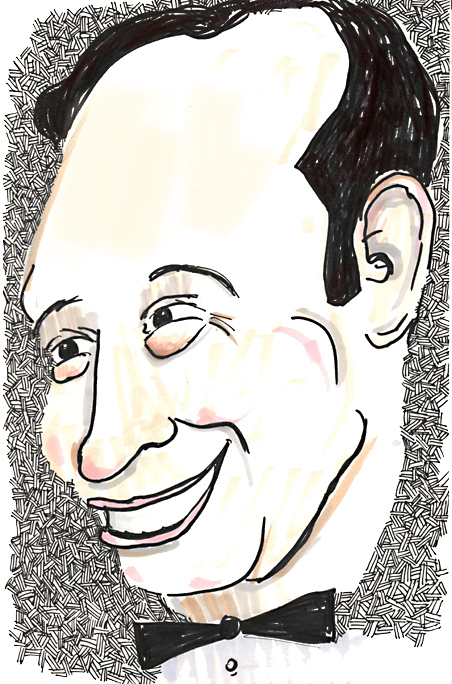
1930s radio comedian Harry Einstein changed his name to Harry Parke. But, he was most famous as “Parkyakarkus”,  a name taken from a line in his act. When he asked you to sit down, he’d say “park yer carcass!” He became known by his character name rather than his stage name. He was a featured performer on Al Jolson’s, and later, Eddie Cantor’s radio show. His shtick was as an English language-mangling Greek restaurateur.

Parkyakarkus was also the father of actor Bob Einstein, Marty Funkhauser on Curb Your Enthusiasm and most famous as dim-witted stuntman, Super Dave Osborne. Bob’s brother is Albert Brooks, the comedic director of Defending Your Life and Modern Romance. (That’s right, Albert Brooks’ real name is Albert Einstein.)

Paryakarkus appeared in eleven movies through the 30s and 40s. He moved on to gag writing when health issues prevented him from the activity that motion pictures required.

On November 24, 1958, Paryakarkus appeared at a Friars Club roast for Lucille Ball and Desi Arnaz. He got bigger laughs than most of the famous speakers. He delivered the traditional jabs and friendly insults associated with a celebrity roast. He finished his bit and received lavish applause as he returned to his seat on the dais next to Milton Berle. The audience and guests were still applauding when Parkyakarkus slumped over against Berle. Parkyakarkus had suffered a fatal heart attack. Berle shouted, “Is there a doctor in the house?” This remark was met with laughter, as the crowd was unaware that Berle was being serious. Berle then directed singer Tony Martin to sing a song to divert the crowd’s attention; Martin’s unfortunate choice was “There’s No Tomorrow.” But Parkyakarkus went out hearing the pure joy of an audience’s response.

In a 1991 interview, Albert Brooks said of his father: “The interesting thing to me was that he finished. He could have died in the middle. He could have done it on the way over there. But he didn’t. He finished. And he was as good as he’d ever been in his life.”

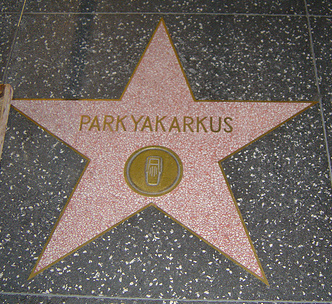
Parkyakarkus was honored on Hollywood’s Walk of Fame.
you can see all the stars as you walk along Hollywood Boulevard/Some that you recognize/Some that you hardly even heard of

Comments

comments

IF: voices

at the end of the tour... end uh da toor...
You may not know Paul Frees, but you know his voice.

Paul had one of the most sought after and recognizable voices in movie and television history. At one time, he was employed by nine different animation studios. He started as a voice actor in the 1940s in radio. His career led him to movies, providing additional, off-screen voices and documentary narration. Paul got plenty of work for his Orson Welles-like vocalizations. He provided introductions to many science-fiction movies when the actual Welles would have been too costly. He was featured prominently in many attractions in Disneyland, specifically as the “Ghost Host” in the Haunted Mansion, the narrator of “Great Moments with Mr. Lincoln” and “The Pirate Auctioneer” in The Pirates of the Caribbean ride. It’s also Paul repeating the key phrase “Dead Men Tell No Tales”  throughout the ride.

Paul’s knack for character was put to use in commercials, as the voices of The Pillsbury Doughboy, Froot Loops’ Toucan Sam and The Little Green Sprout, among many others.

He even provided the speaking voice for K.A.R.R in a memorable episode of “Knight Rider”.

On record, Paul’s impression of Peter Lorre was featured on Spike Jones’ “My Old Flame.” Paul gave the introduction on the popular comedy album Stan Freberg Presents The United States of America Vol. 1.

Paul’s cartoon work is unforgettable, having voiced such beloved characters as Barney Google, Ludwig Von Drake, Fluid Man from The Impossibles, Morocco Mole, Boris Badenov, Inspector Fenwick on Dudley Doright, Fred the Lion from Super Chicken, Squiddley Diddly, The Thing from 1967’s Fantastic Four cartoon, and John Lennon and George Harrison on The Beatles cartoon. Paul also gave speech to characters in the Rankin/Bass stop-motion Christmas specials over the years. He is most famous as Burgermeister Meisterburger in 1970’s Santa Claus is Coming to Town.

Some of his lesser-known works include “Paul Frees and the Poster People,” an album featuring Paul singing current pop songs in the voices of actors like Boris Karloff and Clark Gable.  He directed one film, 1960’s “The Beatnik,” a Reefer Madness-like warning about beatnik culture.

Paul died suddenly from heart failure in November 1986. His voice lives on.

Comments

comments

IMT: mistletoe

You know the song — “Ho ho the mistletoe/Hung where you can see/Somebody waits for you/Kiss her once for me”. Aside from a creepy vision of Burl Ives asking you to plant a wet one on your wife on his behalf, these lyrics bring to mind the question “why do people kiss under the mistletoe?”
oh by gosh by golly!
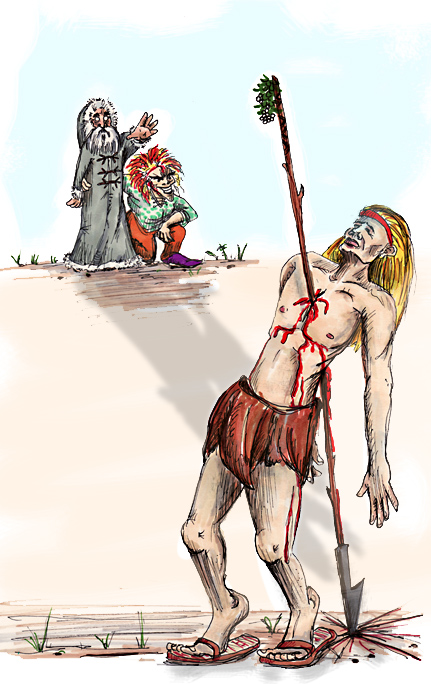
The tradition originates in ancient Norse mythology. Balder, the Norse god of light and beauty, had a dream that foretold his own death. His mother, Frigga, the goddess of love, was frantic about his dream and said that if he died, everything on Earth would die. To ensure her son’s safety, Frigga went to all of the elements — air, fire, water and earth, as well as to all of the animals and plants — and asked them not to kill Balder. Loki, an evil and mischievous god referred to as the “contriver of all fraud”, found a loophole in Frigga’s request for her son’s safety — mistletoe. Mistletoe is a parasitic plant and grows on the tree it attaches itself to, and therefore has no roots of its own and could not be affected by Frigga’s request. Loki made a poisoned spear with mistletoe. What’s worse, Loki tricked Balder’s blind brother, Hoder the winter god, into tossing the spear at Balder. Balder’s heart was pierced by the spear and he died.
For three days, all the elements tried their hardest to bring Balder back to life, but failed. Finally, the tears that Frigga cried for her dead son changed the red mistletoe berries to white, bringing Balder back from the dead. To show her gratitude, Frigga reversed mistletoe’s bad reputation, making it a symbol of love and promising to kiss anyone who passes under it.

Incidentally, the word “mistletoe” comes from the German Mist, meaning dung and Tang meaning branch. So mistletoe means “shit tree”, for its parasitic characteristics. Mistletoe also causes acute gastrointestinal problems, including stomach pain and diarrhea, if eaten.

Happy holidays!

Comments

comments

IF: rambunctious

The illustrationfriday.com challenge word this week is “rambunctious”.
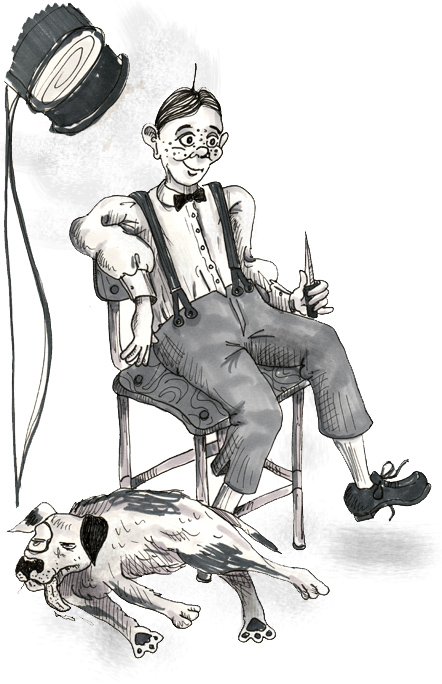
he-man woman hater
Carl Switzer, and his older brother Harold, were discovered by producer Hal Roach while they were on a studio tour with their parents. The Switzer brothers were singing in the studio commissary and Roach was impressed by the performance. He signed the Switzer kids to appear in the “Our Gang” film series. Harold was nicknamed “Slim”. Carl was dubbed “Alfalfa.”

The Switzer brothers first appeared in the 1935 Our Gang short, “Beginner’s Luck”. By the end of the year, Alfalfa was one of the main characters in the series, while Harold had been relegated to the role of a background player.

Alfalfa had a mischievous and sometimes cruel sense of humor. To keep himself entertained during long stretches of filming, he took to playing tricks on his fellow cast and crew members. He once put fish hooks in the pants of Our Gang co-star George “Spanky” McFarland. Spanky suffered severe cuts that had to be closed with stitches. Another time, Alfalfa tricked co-star Darla Hood into putting her hand in his pocket, telling her he had a ring for her, but in reality it was an open switchblade knife. Hood almost lost her fingers from that incident.

Though he and Spanky got along, Alfalfa’s best friend among the Our Gang kids was Tommy Bond, who played his on-screen nemesis “Butch”. Bond and Alfalfa became good friends because they played opposite characters and there was no fear that one could ever replace the other.

After Hal Roach sold Our Gang to MGM Studios in 1938, the now-adolescent Alfalfa’s behavior was even more extreme. He often sabotaged the production of the Our Gang films. Once, during a break in filming, Alfalfa urinated on the set’s lights. When filming resumed, the lights heated up and filled the set with such a stench that filming had to be halted for the rest of the day. On another occasion, intending to get back at a rude cameraman, Alfalfa convinced the other kids to chew as much gum as they could, and then stuffed the wads of spent chewing gum inside the camera.

At twelve years-old, Alfalfa’s tenure with Our Gang had ended. He went on to appear in bit parts in Going My Way, Courage of Lassie, and It’s a Wonderful Life  (he was the little bastard who opened the gymnasium floor during the dance).

After his demand waned and the acting roles dried up, Alfalfa worked as a bartender while running a successful business breeding hunting dogs and offering guided hunting expeditions. Notable clients included Roy Rogers and Dale Evans, and Jimmy Stewart.

As part of one of those hunting expeditions, Alfalfa had borrowed a dog from a friend, Moses Stiltz. The dog was lost, but eventually found. Alfalfa rewarded the man who returned the dog $35 and bought him $15 worth of drinks from the bar at which he was working. Alfalfa felt that Stiltz should reimburse him for the reward money — after all, it was Stiltz’s dog. On January 21, 1959, an intoxicated Alfalfa, along with his friend, Jack Piott, arrived at the home of Moses Stiltz to collect the money he felt he was “owed”. Alfalfa banged on Stiltz’s front door, demanding, “Let me in, or I’ll kick in the door.” Once inside, Alfalfa and Stiltz got into an argument. Alfalfa insisted to Stiltz, “I want that 50 bucks you owe me now, and I mean now.” When Stiltz refused to hand over the money, the two came to blows. Piott  struck Stiltz in the head with a glass-domed clock, drawing blood from his left eye. Stiltz retreated to his bedroom and returned wielding a loaded .38-caliber revolver. Alfalfa struggled to get the gun away from him, resulting in a shot that hit the ceiling. Alfalfa forced Stiltz into a closet, despite Stiltz having regained possession of the gun. Filled with drunken rage, Alfalfa pulled a switchblade knife and screamed, “I’m going to kill you.” He opened the closet door and lunged at Stiltz. Stiltz raised the gun and shot Alfalfa.

Alfalfa was taken to the hospital and pronounced dead on arrival from massive internal bleeding. He was 31 years old.
Now, that’s rambunctious.

One of the dogs that played Petey was poisoned during the time that Our Gang was in production. It was not pinned on Alfalfa.

Comments

comments

from my sketchbook: mary kay bergman

Wow, that sucks. Do you think it'll hurt?
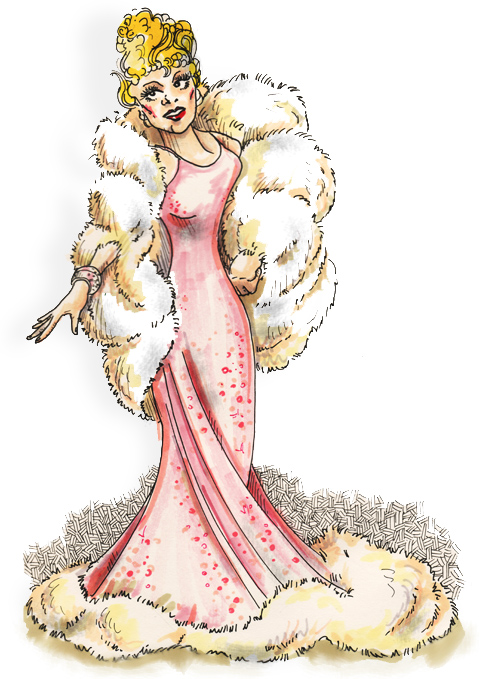
Mary Kay Bergman’s idols were Carol Burnett, Gilda Radner, Tracey Ullman and Lucille Ball. She wanted to be like those funny women.

Mary Kay became a voice actress. At different times, she provided the voice for Daphne on “Scooby-Doo”, Timmy on “The Fairly Odd-Parents“, Ariel’s sister in “The Little Mermaid” cartoon series and the modern Snow White. She was also the yodeling voice of Jessie in “Toy Story 2” and the voice of “Jay Jay the Jet Plane”. She sang on Weird Al’s “Pretty Fly for a Rabbi”. But, she is most famous for voicing most of the female characters on “South Park”. However, due to her association with more child-friendly shows, she was credited as “Shannon Cassidy”. In addition, her voice was featured in over 400 commercials.

On November 11, 1999, Mary Kay’s husband and fellow voice actor Dino Andrade, along with a friend, arrived at their West Hollywood apartment. They found Mary Kay dead,  with a 12-gauge shotgun pointed at her forehead, just above her nose. She had shot herself. A suicide note revealed a secret lifetime battle with depression.

Comments

comments

from my sketchbook: chung ling soo

nothing up my sleeve.... PRESTO!
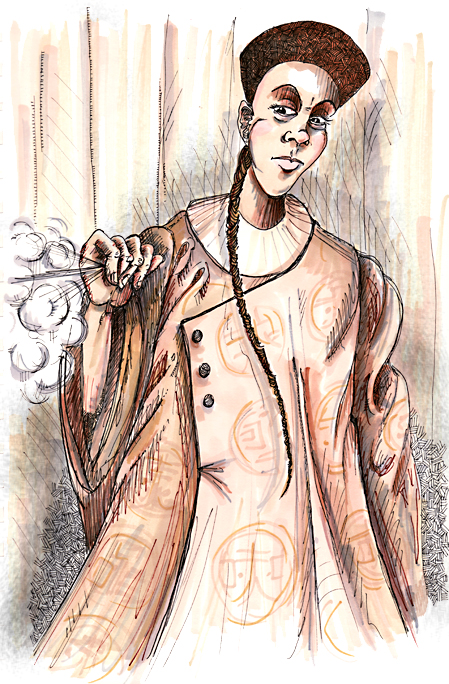
Chung Ling Soo was the stage name of American magician William Robinson. He changed his name to Chung Ling Soo to add an air of foreign mysticism to his act. The name was a variation of a real Chinese magician’s name – Ching Ling Foo – and he performed many of the tricks that Foo had made famous.
Chung Ling Soo maintained his role as a Chinese man scrupulously, keeping in character even off-stage. He never spoke onstage and always used an interpreter when he spoke to journalists. Only his friends and a few other magicians knew the truth. (A similar character was briefly featured in the 2006 film “The Prestige”.)
Soo’s most famous trick was known as “Condemned to Death by the Boxers” (as in The Boxer Rebellion ). In this trick Soo’s assistants — sometimes dressed as Boxers — took two guns to the stage. Several members of the audience were called on the stage to mark a bullet that was loaded into one of the guns. When the gun was fired at Soo, he seemed to catch the bullets from the air and drop them on a plate he held before him. In some variations he pretended to be hit and spit the bullet onto the plate. Actually, Soo palmed the bullets, hiding them in his hand during their examination and marking. The muzzle-loaded guns were rigged such that the gunpowder charge fired in the chamber and the bullet would drop into a chamber below the barrel. The bullet in fact never left the gun.
Soo was performing in London, on March 23, 1918. Soo had not cleaned the gun properly. Over time, the gap that allowed the bullet to drop out of the barrel into the chamber slowly built up a residue from the build-up of gunpowder. The bullet remained in the barrel and the gun was fired in the normal way. The bullet hit Soo in the chest. “Oh my God.”, he said, “Something’s happened. Lower the curtain.” It was the first (and last) time in 19 years that William “Chung Ling Soo” Robinson had spoken English in public.

Comments

comments