IMT: altered ancestors

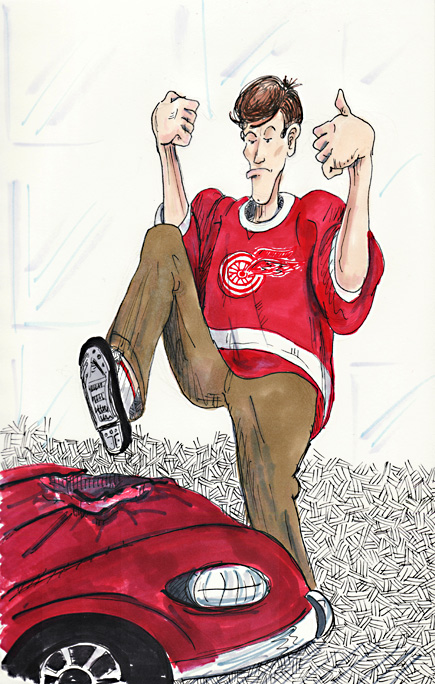
Shake hands with your Uncle Max, my boy, and here is your sister Shirl, and here is your cousin Isabel, that's Irving's oldest girl
This is the story of my great-great uncle, Aloysius Josh Pincus, the man for whom I am named.

Just prior to the turn of the twentieth century, Aloysius ran the soda fountain at Blehall’s Pharmacy, a sprawling retail establishment housed on the street level of a massive and ornate building at the corner of 14th and Broad in center city Philadelphia. The multi-department store offered a variety of merchandise that met the needs of the developing downtown community. A small stock of a multitude of items allowed Blehall’s to be in mild competition with the powerhouse department stores like Gimbel Brothers, Lit Brothers and the iron-fisted, fearsome Wanamaker Triplets. But it was Aloysius’s soda fountain that gave Blehall’s a competitive edge. Owner Emil Blehall operated the retail end of the store. He allowed Aloysius complete control of the fountain, a decision with which he was quite comfortable.

The fountain area, a beautiful marriage of dark oak and elegant white marble with sparkling swan-head seltzer dispensers, was tucked along the back wall of Blehall’s, adjacent to the pharmacy. Customers filling prescriptions would often bide their waiting time with a slice of pie or a quick liquid refreshment. Aloysius’s fruit beverages were wildly popular and famous throughout the city. Excited praise for his wonderful citrus and dairy blended concoctions reached as far as the Jersey shore. Sure, the sandwiches served at the fountain’s small counter were good — sometimes even rivaling the surrounding luncheonettes and pushcarts— but, it was Aloysius’s nectar amalgams that brought the crowds in.

But Aloysius Pincus was never satisfied. He was on a constant quest to find new and innovative flavors. He took tediously long trips. He traveled around the world — by train, motorcar, carriage, barge, and sometimes horseback — to find exotic essences and extracts that would add a unique zing to his standard offerings. Besides fulfilling his loyal customers’ cravings, Aloysius was driven by another purpose. He needed to bring down Julius Orangestein, the bane of his existence.

Julius Orangestein was the inventor of the renowned “Orange Julius,” a sweet fruit and milk beverage that was gaining popularity on the West coast. Orangestein had set up a single 10 foot by 10 foot stand in an empty lot in downtown Los Angeles and thirsty patrons came from miles, sometimes standing in line for hours. Cheerful teens in bowties and paper hats rapidly took customers’ orders and served them as fast as they could. They squeezed and poured and blended the ingredients with lightning-quick choreography. Orangestein stocked the barebones stand with three blenders, milk from northern California cows and bushels and bushels of southern California oranges. In an area at the rear of the stand rested a large and ominous chest freezer. The freezer held the secret to the success of the Orange Julius. The fresh-faced employees would first fill the blender canisters with the juice from several squished oranges and add a few glugs from a pitcher of milk. Then, with their backs to the customer, they would scoop something from the freezer and, in one fluid motion, place the container on the base and whirr the mixture into cold, frothy heaven.

Aloysius was determined to outdo his cross country rival. He tirelessly worked long after Blehall’s posted closing time, until the wee hours of the night. He mixed and blended the assortment of fruits, berries and other exotic additives he collected on his globe-spanning journeys. He experimented with different measurements of the ingredients and after much tasting and trial-and-error, Aloysius was content. This was his chance to show up old Orangestein before he had the opportunity to move his product eastward. Aloysius felt he had a few advantages over Orangestein. He used ingredients to which Orangestein had no access. He had also befriended a young and eager appliance salesman named Hamilton Beach and purchased exclusive distribution rights to his new blending machine. So, armed with his culinary knowledge, special ingredients and Beach’s “Electro-fied Blenderizer,” Aloysius defiantly took on his enemy.

The next day he displayed a huge hand-painted sign on a large easel near the fountain counter. The sign announced the arrival of the newest delight — “The Delicious Aloysius.” So well respected was Aloysius’s soda fountain prowess, the queue for the new beverage stretched for blocks within the first few minutes of the store’s opening. The general reaction from the crowd was positive, but soon a few contrary comments caught Aloysius’s ear.

“This is good,”  began one bearded gentleman after a sip of his Delicious Aloysius, “but I just returned from Los Angeles and it really is no comparison to the Orange Julius.”

Several more men, those who traveled extensively for business, echoed the first man’s sentiment. Soon, Blehall’s Pharmacy was buzzing with curiosity and praise for the Orange Julius. Aloysius was incensed. Damn Orangestein. Damn him and his Orange Julius.

The World’s Fair was held in Chicago from May to October of 1893. People from across the country came to see the newest innovations in technology – a veritable glimpse into the future. Julius Orangestein and Aloysius Josh Pincus each planned to introduce their product on a national level at the event. They were given similar-sized stalls in the food section of the Fair, among the booths introducing Cracker Jack, Cream of Wheat, Juicy Fruit gum and hamburgers. Aloysius had secured a ride to the fair from his friend Milton Hershey, who came to observe and possibly purchase a European exhibitor’s chocolate manufacturing equipment. Hershey had designs on adding chocolate to his failing caramel business, hoping that would give it the boost it needed. Aloysius began setting up his stand, making it presentable for the Fair’s opening the next day. He was lugging trays of boxed chokeberries and fresh maypops, when he looked up and saw Julius Orangestein directing some workmen at a stand one away from his own. The workers were guiding equipment, wooden crates of produce and serving paraphernalia, all piled on a huge chest freezer set upon four wheeled dollies. Aloysius fumed. He realized he would have to spend the next six months with his mortal and commercial foe, separated only by the ten feet that was the Fair’s Aunt Jemima pancake mix headquarters. Suddenly, Aloysius had an intriguing thought. He eyed the mysterious freezer. He was now determined to uncover the secret of Orangestein’s prosperity.

The Fair was bustling on opening day. The crowds were excited by the buildings, lit electrically thanks to a joint venture by Nikola Tesla and George Westinghouse. They visited the wondrous exhibition halls that touted marvels of the future and offered visual insight into the lives of those from foreign lands. They sampled the varied food offerings. Both Aloysius and Orangestein were doing brisk business. From the piles of discarded cups, it looked as though Orangestein was doing slightly better. Aloysius still kept his pace, serving his namesake drinks, but he also kept Orangestein and his staff in his peripheral vision. While he worked, he stood on tiptoes and craned his neck to sneak a peak each time the chest freezer lid was raised a slender crack, just enough to extract a portion of the secret ingredient. To his dismay, the staff was well-trained. Aloysius wasn’t able to catch the tiniest glimpse of the elusive component that set the Orange Julius head-and-shoulders above the Delicious Aloysius.

After one night – opening night – Aloysius could not stand it any longer. He could not stand the competition. He could not stand the animosity. And he could not stand Orangestein’s triumph. He decided to make his move. By late evening, the food vendors were tidying up their stands and securing their wares and equipment for the night. Everyone was in a hurry to get a good viewing spot for the spectacular fireworks display and even the exhibitors didn’t wish to be left out. The food area was deserted. Aloysius silently slunk through the aisles amid the locked stands. He dropped to the ground and squeezed his way under the brightly-colored, thick oilcloth surrounding the wooden frame that was the Orange Julius stand. In the dim lighting, the clean blenders glowed ethereally. The oranges were crated and stacked neatly, waiting for the next day’s business. The silver milk cans stood like silent sentinels. At the rear of the stand, the freezer hummed malevolently. Aloysius crept to it. The only obstacle that stood between Aloysius and the freezer’s contents was a small hasp through which a tiny padlock had been threaded. A new secretarial-assistance item of twisted tin called “The Paper Clip” was introduced at the Fair and Aloysius used a straightened one to deftly pick the lock, which he then tossed aside. He carefully but eagerly lifted the heavy lid and — at long last — looked inside. He was astonished. He was furious. It was so…. so obvious!  He reached in and tried to grab a handful. It was cold, frozen solid. A metal pick with a gnarled wooden handle lay on the surface. Aloysius grabbed it and feverishly chipped away. After several minutes of labor, he lifted a helping in his cupped hand and raised it to his nose and mouth. He inhaled. Sweetness filled his nostrils. He licked. Tartness flowed across his taste buds. Again, he was overcome by both anger and bewilderment. All at once, Aloysius leaped to his feet and burst through the protective white sheet that encircled Orangestein’s closed concession. He scrambled down the sawdust-covered walkway, first muttering, then screaming.

“Frozen!,” he yelled, “He freezes it!”

The majority of the crowd had their sights trained on the colorful explosions in the sky. The ones in close proximity to Aloysius turned their gaze towards him, dumbfounded. Some were even drawn out of the Streets of Cairo exhibit, finding the commotion outside more compelling than Little Egypt doing her “hootchie-cootchie” dance. They wondered what prompted this lunatic’s ranting. He continued to shout. His legs flying in all directions, his outstretched hands filled with glowing pale orange crystals, some dropping as he ran.

He headed towards George Ferris’s 264-foot tall Observation Wheel. Aloysius hollered as he ran. “He freezes it!,” he shrieked,” That’s his secret!”

As the Wheel moved in a slow “loading and unloading” pattern, Aloysius jumped into the last empty gondola. The Wheel began to make its single non-stop revolution and picked up speed. The shocked onlookers on the ground murmured and pointed as Aloysius fidgeted in the gondola, anxious to announce his discovery to as many as would listen. He was giddy at the notion that he was about to unleash information that would ruin Orangestein, earning the Delicious Aloysius its rightful position as favorite blended fruit and dairy drink. Aloysius, a man possessed, precariously stood up in the gondola. “It’s frozen, goddammit!” cried Aloysius, “Orangestein freezes the orange j… ”

He trailed off. An errant piece of Orangestein’s secret ingredient had fallen from Aloysius’s hand and landed on the metal footrest of the gondola. Aloysius slipped on it and plummeted to the ground, never able to finish his revelation. And never able to finish Orangestein. The Delicious Aloysius was soon forgotten and the secret of the Orange Julius remained a secret.

Comments

comments

IF: adapt

The illustrationfriday.com word this week is “adapt”.
There's a man outside with a wooden leg named Smith.
A man is sitting at a table in a bar having a beer. He looks up and sees a interesting looking guy standing at the bar. The guy has a wooden leg, a hook for a hand and an eyepatch. He’s dressed in stereotypical pirate garb. The man thinks this is a once-in-a-lifetime encounter and gets up enough courage to ask the guy if he’s a real pirate.

The guy answers, “Arrrr, matey, that I am!”

The man is fascinated. He begins questioning the pirate for more information. “You must have some great stories of adventure.” he began, “Like, how did you get the wooden leg?”

“Avast ye!,” the pirate says, “I was out on me ship, raising sheets on the yardarm. Some rough winds knocked me overboard. I got into a tangle with a forty foot shark. I drew my dagger and fought the beast as best I could, but he chomped off me leg. Me crew dragged me waterlogged body back on board. We docked in Port Au Prince in the Gulf of Gonâve. The village barrelmaker, who doubled as a doctor, fitted me the the wooden leg.”

“Wow! What a story! How about the hook? How’d you get the hook?,” the man eagerly inquires.

“Shiver me timbers!,” the pirate begins, “Just off shore at Barbados, me ship was shanghaied by a band of cut-throats as mean as me own. I engaged in swordplay with one of the motley bunch and, in the fit of battle, the scalawag sliced me hand off at the wrist. Me crew finally forced the scurvy dogs to retreat. At our next port, a silversmith forged this hook as a replacement for me own lost mitt.”

“Incredible!,” the man says, caught up in the pirate’s epic tale, “How about the eyepatch? How’d you get that?”

The pirate sort of shuffled, stares at the floor and answers, “Uh, a seagull crapped in me eye.”

The man was shocked. “That’s IT ?, ” he says, “A seagull? You tell me great stories of shark attacks and sword fights and the best story you can tell for your eyepatch is a seagull crapped in your EYE ???

The pirate answers, “It was me first day with the hook.”

Comments

comments

from my sketchbook: doug kenney

Some People Just Don't Belong
Doug Kenney was one of the founders of National Lampoon magazine. He served as writer and editor from its inception in 1972 until 1977, when he left to pursue his dream of screenwriting. Along with Chris Miller and Harold Ramis, he co-wrote the screenplay for National Lampoon’s Animal House. Kenney even had the small role of Stork and delivered one of the film’s classic lines — “Well, what the hell we supposed t’ do, ya moron?” – his only line of dialogue. Animal House became one of the most popular and most profitable comedies in motion picture history, making Kenney one of the most sought-after writers in Hollywood. He was a millionaire several times over. But, it was clear that all was not well. He would often disappear for days at a time, his marriage was failing, and his abuse of drugs was spiraling out of control. He longed to be doing what he considered to be serious work – writing a novel or producing a movie – and he increasingly thought of himself as a failure. He once threw and entire manuscript away after a writer friend gave it a negative review. Kenney co-wrote Caddyshack, with Brian Doyle-Murray and Harold Ramis. When it opened to negative reviews in 1980, Kenney became extremely depressed. At a press conference, he verbally abused reporters. Friends asked Kenney to seek professional help, concerned about his increased usage of cocaine. Close friend Chevy Chase took him to Hawaii, hoping the relaxing environment would help. However, Chase had to leave the island. After Chase left, Kenney called and invited him to come back. That was the last time anyone heard from Kenney.

Kenney’s body was found on August 31, 1980, one month after Caddyshack’s release. Three days earlier, he had parked his rented Jeep along the road, walked past the sign that warned of the nearby cliff edge, and plunged 40 feet to his death. Kenney died on impact, as his ribs were broken and his skull fractured. The death was ruled an accident.

Harold Ramis said “Doug probably fell while he was looking for a place to jump.”

Comments

comments

from my sketchbook: karl wallenda

Gonna free fall out into nothin/Gonna leave this world for a while
Karl Wallenda was born in Germany in 1905 to a circus performing family. He himself began performing at age 6. In 1922 he put together his own act with his brother Herman, a family friend, and a teenage girl, Helen Kreis, who eventually became his wife.

The act toured Europe for several years, performing some amazing stunts. When John Ringling saw them perform in Cuba, he quickly hired them to perform at the Ringling Brothers and Barnum and Bailey Circus. In 1928, they debuted at Madison Square Garden. The act performed without a net and the crowd gave them a standing ovation. At a performance in Ohio, the group fell off the wire, but were unhurt. The next day, a reporter who witnessed the accident wrote: “The Wallendas fell so gracefully that it seemed as if they were flying” — thus coining the name of The Flying Wallendas.

Karl developed some of the most amazing acts like the seven-person chair pyramid, a stunt they continued to perform until 1962. That year, while performing at a state fair in Detroit, the front man on the wire faltered and the pyramid collapsed, killing Wallenda’s son-in-law and nephew. Karl injured his pelvis, and his adopted son, Mario, was paralyzed from the waist down.

Despite other deaths of family members while performing, Karl decided to go on. He repeated the pyramid act in 1963 and 1977. Karl continued performing with a smaller group, and doing solo acts.

On March 22, 1978, at age 73, Karl attempted a walk between the two towers of the ten-story Condado Plaza Hotel in San Juan, Puerto Rico, on a wire stretched 121 feet above the pavement. Karl lost his footing in the 30 mile per hour winds and fell to his death.

Karl’s grandson, Rick Wallenda, went back the following year and completed the walk successfully.

that one's outta here!
Karl Wallenda walking across the top of Veterans Stadium, former home of the Philadelphia Phillies in 1972.

Comments

comments

from my sketchbook: sarah holcomb

Mom, Dad, this is Larry Kroger. The boy who molested me. We have to get married.
Sarah Holcomb only appeared in four movies in her brief three-year career. Chances are, you’ve seen half of them.

At 18, Sarah made her film debut in National Lampoon’s Animal House as Clorette DePasto, the underage virginal daughter of shady mayor Carmine DePasto. She meets Larry (played by future Academy Award nominee Tom Hulce) when he is stealing from her employer, The Food King Supermarket, as part of a fraternity prank. Larry asks her to the infamous toga party and, afterwards, deposits her on her family’s front lawn, drunk and in a shopping cart.

After roles in two forgettable films, 1979’s Walk Proud and 1980’s Happy Birthday, Gemini, she returned as Danny Noonan’s inexplicably Irish girlfriend Maggie O’Hooligan in Caddyshack.

Then she disappeared.

Animal House screenwriter Chris Miller remembered that Sarah was much younger than the rest of the film’s cast and crew. He related how drugs and alcohol were plentiful and flowed freely on the set. He admitted in his autobiography that, in hindsight, it was a very bad influence on her impressionable mind. The same was true on the set of Caddyshack. This time, however, Sarah’s excessive drug consumption aggravated her previously undiagnosed schizophrenia.

In 2007, a railroad worker named Bobby wrote on his blog about his encounter with a woman he believed to be Sarah Holcomb. According to Chris Miller, she is “living a quiet, obscure life far from the madness of Hollywood under an assumed name and does not wish to be found.”

Comments

comments

IF: cracked

This is John Cameron Cameron downtown.
When I was a kid, my mom introduced me to what would become my life-long appreciation for novelty records. As long as there have been different genres and trends in popular music, there has been someone making fun of it. In my mom’s era, there was Spike Jones. My mom had several of Jones’ 78s and she loved to play them for me.

As an adolescent, I came to hear more of Spike Jones and his zany contemporaries on the syndicated Dr. Demento radio show. Dr. Demento was the radio name of Los Angeles DJ Barry Hansen. It was on The Dr. Demento show that I first heard Dickie Goodman. And Dickie’s recordings cracked me up.

Dickie Goodman (along with partner Bill Buchanan) originated the “break-in” record. Goodman and Buchanan were struggling songwriters in the early 1950s when they thought about how funny it would be if a flying saucer interrupted a radio DJ while on the air. Goodman came up with the idea of an on-the-spot reporter asking questions and having the answers be clipped lines from popular songs of the time. Within several days, Goodman and Buchanan spliced together “The Flying Saucer”, a modern reworking of Orson Welles’ “War of the Worlds”, using clipped lines from recordings as responses to the questions posed by John Cameron Cameron (played by Goodman).

The recording was wildly popular, spawning a slew of imitation and “answer” recordings. And after selling 500,000 copies in just three weeks, it caught the attention of the Music Publishers Protective Association. The MPPA claimed “The Flying Saucer” was guilty of at least 19 different instances of copyright infringement and unauthorized usages. The record companies, however, became reluctant to pursue a lawsuit. It seemed “The Flying Saucer” actually increased sales of records included in its recorded collage. As an example, a snippet of “Earth Angel” was part of “The Flying Saucer”. Public requests for the Penguins song forced DooTone Records to reissue their hit. A publishing representative told Time magazine, “It’s the greatest sampler of all. If you’re not on ‘Saucer,’ you’re nowhere!” But the publishing companies thought the “break-in” record was a fad and would soon disappear along with their worries.

After much negotiation, an agreement was finally reached. The publishing houses would split 17 cents in royalties from every 89 cent copy of “The Flying Saucer”. But much to the record companies’ chagrin, “break-in” records sprung up like weeds. Goodman and Buchanan released their next snippet-filled record ― an account of their court battles ― slyly titled “Buchanan and Goodman on Trial”. The record companies were up in arms again. A judge ultimately decided that the recordings fall under the laws of parody and Goodman and Buchanan were completely within their legal rights.

After Goodman and Buchanan parted ways, Goodman continued to release and chart with solo “break-in” records. In the middle 1960s, Goodman tried his hand at non-“break-in” records. He recorded non-novelty music as a solo and with several bands to little or no success. With the success of Jaws in 1975, Goodman returned to his roots and released “Mr. Jaws”, another “break-in”. It reached number 4 on the Billboard charts, ranking higher that the Jaws theme. He followed this with several more “break-ins”, including another hit with “Hey E.T.”

Goodman  had a serious gambling problem. His long affinity for racetracks and horse betting consumed all of his income. On November 6, 1989, with his wife gone, his savings gambled away, and bill collectors hounding him, Goodman died from a self-inflicted gunshot.

Click HERE to listen to Dickie Goodman’s recording of “Mr. Jaws”  from 1975.

Comments

comments

from my sketchbook: lena zavaroni

vanilla strawberry knickerbocker glory
Lena Zavaroni grew up on the Isle of Bute (a part of Scotland) and began singing at the age of two. At nine, she appeared on the British talent search program, Hughie Green’s Opportunity Knocks and won the show for a record-breaking five consecutive weeks. She released Ma, He’s Making Eyes At Me, a collection of standards, which reached #8 on the UK album chart. She became the youngest person to have an album in the British top 10, an accomplishment that still stands.

Lena also sang at a Hollywood charity show with Frank Sinatra and Lucille Ball in 1974. Backstage, Lucy commented to young Lena, “You’re special. Very special and very, very good.” Lena went on to appear and perform on The Carol Burnett Show, Johnny Carson’s Tonight Show, Cher’s variety show and The Jerry Lewis Telethon. She also appeared on a number of variety shows on the BBC and eventually performed at the White House for US President Gerald Ford. “Ma! He’s Making Eyes at Me,” an Eddie Cantor song from 1921, became her only US hit when it charted a four-week run on the Billboard Hot 100 in the summer of 1974. Always more popular in her native United Kingdom, Lena had her own TV series on the BBC in the early 1980s.

From the age of 13, Lena suffered from anorexia nervosa. While at school, her weight dropped to 56 pounds. Lena blamed her weight loss on the pressure placed upon her to fit into costumes while she was “developing as a woman.” Lena underwent a number of drug treatments and received electroshock therapy in an attempt to combat her anorexia. Lena also suffered from depression and begged doctors for an operation to give her relief. Although surgery would not cure her anorexia, she was desperate and threatened suicide if she did not receive an operation.

In September 1999 Lena was admitted to University Hospital of Wales for a psychosurgical operation, essentially a lobotomy. After the operation, she appeared to be in good spirits and recovering at a slow, but satisfactory pace. She even asked her doctors about the possibility of returning to the stage. But, three weeks later and weighing less than 70 pounds, she developed a chest infection and died from pneumonia. She was 35.

British electronic popsters Fujiya & Miyagi mentioned Lena in their 2009 song “Knickerbocker”.

Comments

comments

Monday Artday: lucky

The Monday Artday challenge word this week is “lucky”.
You're lucky, he's lucky, I'm lucky, we're all lucky!

On June 2, 1925, Yankees manager Miller Huggins replaced regular first baseman Wally Pipp in the starting lineup. Pipp was in a slump, so Huggins made the change to boost the team’s overall performance. Huggins started Lou Gehrig instead. He stayed in the lineup for fourteen years. Although he played with injuries or sometimes appeared only as a pinch-hitter, Gehrig played 2130 consecutive games.

At the midpoint of the 1938 season, Gehrig’s performance began to diminish. At the end of that season, he said, “I tired mid season. I don’t know why, but I just couldn’t get going again.” Although his final 1938 stats were respectable, it was a dramatic drop from his 1937 season.

Spring training 1939 showed Gehrig’s physical strength and coordination in serious decline. He struggled through April 1939. On May 2, 1939, Gehrig informed Yankee manager Joe McCarthy that he was taking himself out of the lineup. He never played baseball again.

After extensive testing at Mayo Clinic, the diagnosis of amyotrophic lateral sclerosis (ALS) was confirmed on June 19, Gehrig’s 36th birthday. The prognosis was grim. He would experience rapidly increasing paralysis, difficulty in swallowing and speaking, and a life expectancy of fewer than three years.

On July 4, 1939, the Yankees retired Gehrig’s uniform number “4” (the first uniform number retired by a Major League Baseball team), and honored him between games of a double header. Gehrig gave his famous “I consider myself the luckiest man on the face of the earth” speech before a packed and tearful Yankee Stadium crowd.

However, Gehrig was wrong. He is not the luckiest man on the face of the earth. Jim Belushi is.

Comments

comments

IMT: petals

The inspirational word on Inspire Me Thursday is “petals”.
you always take the sweetest rose and crush it 'til the petals fall.

Long before Stephen Lynch and Weird Al Yankovic and Allan Sherman, there was Spike Jones.

Spike Jones and his City Slickers kept Americans laughing from the early 1940s through the 1960s with his crazy versions of classical and big band standards. In addition to the usual band instruments, Jones and his crew injected gunshots, banjos, tin cans, whistles, cowbells, burps, gurgles, sneezes and any other unorthodox noisemakers they could think of. Their big break came with a recording of the anti-Hitler propaganda ditty, Der Fueher’s Face. Originally featured in a wartime Donald Duck cartoon, Jones and Company’s version delighted a patriotic America and allegedly enraged Hitler himself.

Jones followed with a string of fractured takes on popular tunes, like Cocktails for Two, The William Tell Overture, Chloe and The Hawaiian War Chant. Their version of My Old Flame  featured cartoon voice artist, the great Paul Frees, reciting the lyrics in a creepy Peter Lorre imitation, giving the love song an unexpected twist. The City Slickers’ take on Clink Clink Another Drink featured another legendary voice artist, Mel Blanc, hiccupping his way through the arrangement. Spike’s parody of Vaughn Monroe‘s Ghost Riders in the Sky  was performed with slurred speech, as if by a drunk, and even ridiculed Monroe by name. An insulted Monroe, a fellow RCA recording artist and also a major RCA stockholder, demanded an alternative take be released. Jones’ band released several holiday recordings, including the popular All I Want for Christmas is My Two Front Teeth, with just as wacky results.

Jones had his own radio show in 1945. He was so popular that top performers, like Frankie Laine, Mel Torme, Don Ameche, Burl Ives and Frank Sinatra, were happy to make guest appearances. The radio show led to Jones’ television show which ran for seven years on CBS.

In the late 1950s, the rise of rock-‘n’-roll and the decline of big bands hurt Spike Jones’s repertoire. Spike felt the new rock songs were already novelties, and he could not parody them the way he had lampooned the straight-forward big-band sounds. He recorded his last album, a send-up of the horror genre, again with guest vocalist Frees, in 1959.

Jones was a lifelong smoker. It was rumored he got through the average workday on coffee and cigarettes. Jones contracted emphysema. His already thin frame deteriorated, to the point where he used an oxygen tank offstage, and onstage he was confined to a seat behind his drum set. Jones died in 1965 at the age of 53.

Comments

comments

IF: contagious

The illustration friday challenge word this week is “contagious”.
There's flies everywhere, buzzing in the air/Filling my body with filth and disease
The Masque of the Red Death was written and published in 1842 by Edgar Allan Poe. It tells the story of a horribly contagious plague, called The Red Death, that is sweeping across the land. The symptoms of the Red Death are gruesome. The victim is overcome by convulsive agony and his pores emit sweats of blood. The plague kills within half an hour. Prince Prospero has invited one thousand other nobles to take refuge in this walled abbey, completely isolated from the Red Death plague and the common people, on whom the plague is most prevalent.

One night, Prospero holds a masquerade ball to entertain and boost the morale of his cooped-up guests. He has seven rooms of the abbey decorated for the ball, each in a different color: blue, purple, green, orange, white, and violet. The last room is decorated in black and is illuminated by a blood-red light. Few guests are brave enough to venture into the black and red room. At the stroke of midnight, Prospero notices one guest in a dark red robe. The mysterious guest hides his face with a hideous skull mask. The other guests are terrified by this silent and unwelcome stranger. Prospero demands to know the identity of the mysterious guest and threatens to hang him for scaring his other guests. He draws his dagger and chases the shrouded stranger through the six colored rooms. The mysterious figure is cornered in the seventh room, the black room where the windows are tinted scarlet. The figure turns to face Prince Prospero. The Prince looks back at the figure and immediately falls dead. The other guests, although frightened, surge into the black room and swarm the figure. They remove its mask, only to find the shroud empty. To the horror of all, the stranger is the personification of the Red Death itself, and all the guests suddenly contract and succumb to the disease.

And Darkness and Decay and the Red Death held illimitable dominion over all.

Don’t even try  to outwit Death. Nobody has yet.

Comments

comments