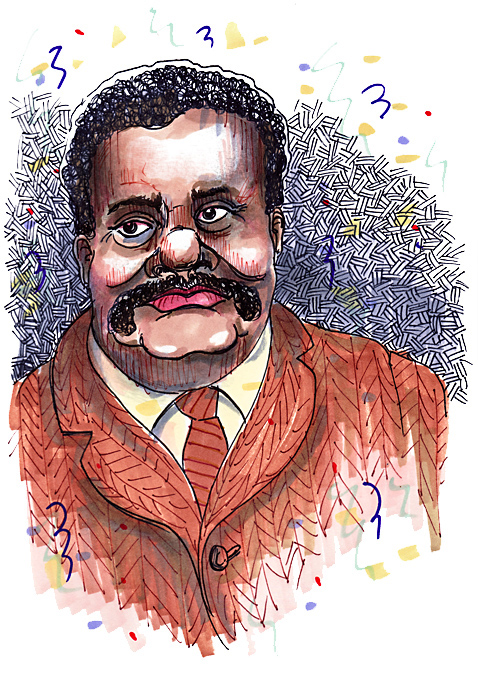
from my sketchbook: william darby

Having been some days in preparation/A splendid time is guaranteed for all
William Darby, the son of a freed slave, was born in 1796 and orphaned as a child. As a youngster, he joined up with William Batty, the owner of a small travelling circus. The young Darby quickly picked up numerous acrobatic skills. Soon after, he trained with another circus owner, Andrew Ducrow, under whose guidance he became a first-rate equestrian, acrobat, tightrope walker and trainer of show horses. By the 1830s, Darby was billed in the press as ‘the loftiest jumper in England.’ It was about this time that Darby began calling himself  “Pablo Fanque” and started a circus of his own. With just two horses, he performed mostly in the north of England until his show gradually developed into a full-fledged circus including clowns and acrobatic acts. He became the first black owner of a circus in England’s history.

Fanque’s circus featured such illustrious and renowned performers as aerialist and all around-performer William Kite and high wire-walker, equestrian, trampolinist and clown John Henderson and his equally-talented wife Agnes. The Hendersons had traveled all over Europe and Russia during the 1840s. John Henderson’s specialty was executing somersaults (or “somersets”, as they were then called) over banners, known as “garters”, held between two people. He became airborne with the aid of a trampoline, which in those days, was a wooden springboard rather than a stretched canvas. By the late 1840s, Fanque’s circus was one of the best known in the country. During one performance, part of a wooden seating structure collapsed and Fanque’s wife, Susannah, was struck on the head by several heavy planks and killed.

Fanque continued to run his circus after his wife’s death and eventually included his children in the performances. He encountered relatively little racism in the course of his career. A prominent member of the British Showman’s Guild said “In the great brotherhood of the equestrian world there is no color line. Although Pablo Fanque was of African extraction, he speedily made his way to the top of his profession. The camaraderie of the Ring has but one test and that is ability!”

Pablo Fanque passed away in Stockport, in Greater Manchester, England, at the age of 75. Nearly a century later, John Lennon discovered an old playbill from 1843 advertising a benefit performance for one of his circus’s stars. Lennon adapted some of the wording on the poster to write the song “Being for the Benefit of Mr Kite”.

Comments

comments

IF: equipment

Hey, you've got to hide your love away!
My dad was a simple man and he loved simple things. He loved the Philadelphia Phillies. He loved breakfast at the Heritage Diner. And he loved pornography.

I’m not talking about the occasional Playboy magazine that, as a nine-year old, I stumbled across hidden under some shirts in a bottom drawer or the lurid novel stashed behind the clothes hamper in the bathroom. Sure, my dad owned several copies of Playboy and Penthouse, but his tastes leaned towards the more — shall I say — exotic.  These weren’t artful shots of lithe beauties, softly-lit and airbrushed to flawless perfection. I’m talking full-color, foreign-published, plain-brown-envelope, hard-core stuff. These tomes were filled with grainy photos of skanky women in various stages of undress, bent into impossible positions and inserting any one of a number of varied objects into any one of a number of body orifices. This was harsh and shocking stuff in the pre-Internet days of the 1960s. A thousand times more shocking than the sanitized material distributed by Hugh Hefner’s fledgling publishing empire.

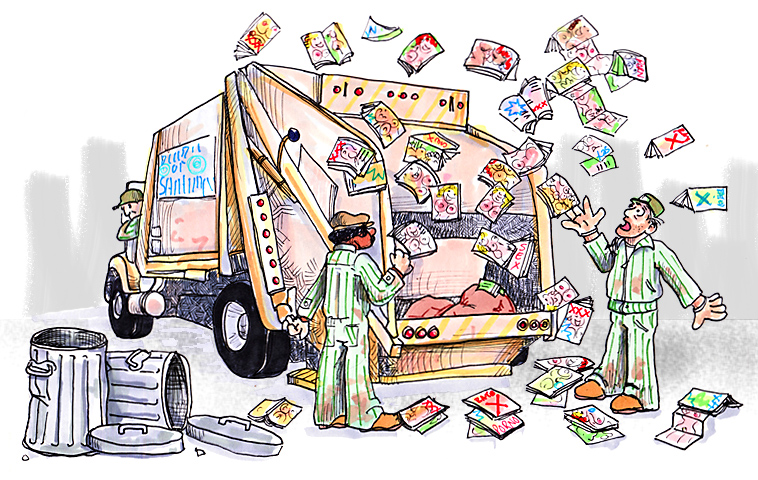
My dad thought he was clever and wily and that only he had knowledge of his pornography collection. I can’t understand how he could believe this while sharing a house with his wife and two young (and curious) sons. My father was terrible at hiding birthday gifts and his beloved Tastykake snacks  from his family and he was just as terrible at hiding his pornography collection. My mom used to joke that nothing could get past her, but my brother and I were not so sure she was joking. She knew about things that she couldn’t possibly have known — from the whereabouts of a mysteriously missing cupcake to a failing grade brought home on a hidden school test. My father’s porn accumulation was no exception. My mom was fully aware of my dad’s explicit cache. On a semi-regular basis, while my dad was at work, my mom would gather up his X-rated stockpile. She’d load it into several heavy paper grocery-store bags until they were at the point of bursting. Then she’d cap each one with another inverted bag for extra security and privacy. She’d carry each bag, sometimes numbering four and five, to the curb and place them alongside our metal trash cans, where they would wait until the municipal sanitation department truck came for its weekly pick-up. After a few days, my father was obviously frantic. He would search for his pornography in the most casual and unassuming manner. My mom would smile silently and relish in his frustration. He couldn’t very well come out and say to his wife, “Hey, where’s all my pornography?” It was an unspoken ritual. They were both aware of what had transpired, but neither one would dare give verbal acknowledgement.

One day, my mom decided the time was right to “clean house” of my dad’s smut reserve. While my father was at work, she went from hiding place to hiding place and gathered the material up into the grocery bags. With the second bag securely capped on top of each bundle, she placed five or six of the obscenity-stuffed packages at the curb in front of our house. Soon, the trash collection truck appeared, slowly making its way up the block as the workers methodically emptied the neighbors’ refuse into the truck’s rear receptacle. When enough trash had filled the open cavity at the truck’s posterior, one of the workers would pull a lever and the garbage would be compacted back into the large storage area that made up the bulk of the vehicle’s size. Eventually, the truck rolled up to the Pincus curb. One of the workers ambled over to our trash cans, while the other hefted two of the paper sacks holding the lewd contents. He tossed them into the truck. They mingled with the coffee grinds and empty cans and the usual household discards as he returned to the curb for the remainder of the bags. After adding the last few bags to the repugnant mix, he decided the mass needed compacting to make room for the rest of our blocks’ rubbish. He pulled the lever and the machinery roared to life, as a huge steel plate forced the garbage back into the depths of the truck’s auxiliary stowage. Suddenly, under the pressure of the equipment and the sheer volume of trash, several of the bags burst, spewing their lascivious filling into the air. A cloud of vulgarity rained down. One worker realized what had happened and yelled “Stop! Stop!” as the other quickly disengaged the compacting switch. The two workers dropped to their knees and grabbed at the printed material that was now scattered in all directions, shoving it in their pockets and arranging it into neat little stacks. The driver climbed out of the cab to investigate and soon joined his colleagues in their pursuit of free porn. My mother watched, unnoticed from our kitchen window, as the trash collection was halted for a good twenty-five minutes, while the three sanitation workers reaped the spoils of hitting the erotica jackpot. When every last piece of my dad’s collection had been retrieved, the truck continued on its way up the street.

In the house, my mom chuckled to herself. She knew she had a great story that she wouldn’t tell to me until years later. A story she never told my father.


Comments

comments

Monday Artday: flying machine

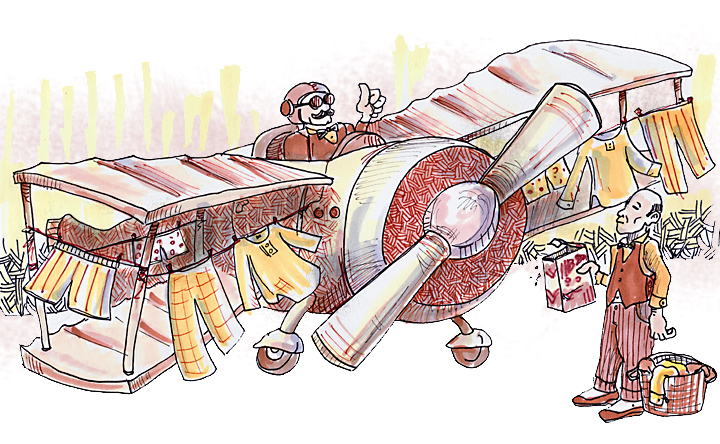
The current Monday Artday challenge is “flying machine”.
they go up tiddly up up, they go down tiddly down down.
Wilbur and Orville were two brothers, named Wright
The nicest pair of kids you’ve ever seen
They worked twelve years on a secret project
They thought it was a washing machine

I said, “Fellas, what are all those wings for?”
They said, “For hanging clothes out to dry”
I said, “You fools, take that washing machine out to Kitty Hawk
And see if the darn thing’ll fly

— “Good Advice” by Allan Sherman

CLICK HERE to hear Allan Sherman’s “Good Advice” in its entirety (all glorious eight minutes and twenty-six seconds).

Comments

comments

Monday Artday: favorite food

The Lord said to Moses, I have heard the grumbling of the Israelites. Tell them, At twilight you will eat meat, and in the morning you will be filled with bread. Then you will know that I am the Lord your God. -Exodus 11:11-12
I began to observe kashrut (keeping kosher) shortly after I got married in 1984. I figured it was easier than trying to explain to our (potential) children “why Mommy eats this but Daddy eats whatever he wants.” So, without as much sacrifice as I had anticipated, I eliminated shellfish, bacon, pork chops and the mixing of meat and dairy products from my diet. I also ceased eating non-kosher certified meat period. The Philadelphia area was home to few kosher eating establishments. I could only choose from a single kosher deli several blocks from my suburban home or my in-law’s house — also several blocks from my home (and the prices were way more reasonable). A few kosher restaurants sprouted up over the years, but they were either not very good or didn’t remain in business very long. Fortunately, Philadelphia is conveniently located just a two-hour drive from New York City, a smorgasbord of kosher offerings, specifically, 2nd Avenue Deli, my favorite restaurant on the planet.

In 1939, the Soviets occupied western Ukraine and nationalized all businesses. Abe Lebewohl’s father was arrested and exiled to Siberia. Young Abe and his mother were banished to Kazakhstan, escaping the horrors of the Holocaust. After the war, the Lebewohl family reunited and returned to western Ukraine and then to Poland. Escaping Poland illegally, the family traveled through several European locales until they arrived in America in 1950. Upon his arrival in New York, Abe found work at a small coffee shop at Second Avenue and 10th Street in East Greenwich Village. In 1954, Abe and his family pooled their funds, purchased the shop and reopened it as a delicatessen. Over the next few years he expanded the deli into a twisting maze of added rooms filled with Yiddish theater posters, cramped booths and tiny tables. The deli, now able to accommodate 250 hungry customers at a time, exuded an atmosphere as warm and comforting as the Old-World fare being prepared in the kitchen. Despite the additional space, there was usually a wait for tables at 2nd Avenue Deli. But, patient customers were appeased with slices of rye bread slathered with homemade chopped liver served by the hostess-on-duty — sometimes right out on the Second Avenue sidewalk. Abe and his operation provided a steady stream of artery-clogging creations, like gribenes, cholent and kreplach, to the customers that paraded through his doors for the next several decades. In addition to the time-honored dishes that could stand flanken-to-flanken  with anything your bubbe could make, Abe and company engineered enormous triple-decker meat-stuffed sandwiches that would make you kvel.

One morning in 1996, Abe took the previous night’s receipts to a bank one block from his deli, like he had done a thousand times before. He was shot twice in broad daylight by an unknown assailant and shoved into his van. Abe was dumped in the street on East 4th, and with his dying breath, he gasped “He shot me.” Even with reward money offered by comedian and long-time customer Jackie Mason, Abe’s murder remains unsolved. After a brief closing to observe mourning, Abe’s brother Jack continued operation of the business.

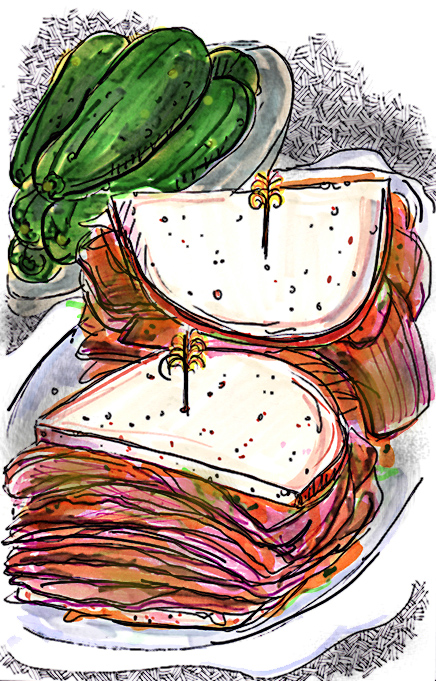
In 1982, when I was dating Mrs. Pincus, we would often drive to The Big Apple. That’s when I was introduced to 2nd Avenue’s corned beef on rye with Russian dressing and cole slaw. This skyscraper of meat was unlike any sandwich I had ever seen. It was easily six inches tall, dripping with fresh cabbage and carrot slaw and homemade relish-flecked dressing… and it was like biting into manna. Sure, I knew that this sandwich wasn’t doing my circulatory system any good, especially when accompanied by a bowl of hot matzo ball soup and a side of gravy-covered kishke, but it was irresistible. Many, many visits to New York City were capped off with a “dressed” corned beef sandwich, as they called it. Sometimes, we would shoot straight up to the East Village after a Sunday afternoon Phillies game for dinner at 2nd Avenue Deli. That succulent corned beef and those crunchy kosher dills made the two-hour drive worth every minute. The guys behind the deli counter waved and the waitresses would “cheek-kiss” my wife when the couple from Philadelphia dropped in. I could inhale one of those sandwiches and I would often think about the next time I’d have one after polishing one off. My wife and in-laws make an annual trip to a Lower East Side bakery for special cake for Passover. They would stop to eat at 2nd Avenue Deli and to pick up a corned beef sandwich for me, which I would happily consume no matter what time it was brought home to me — even if I had already eaten dinner. Interestingly, I was never a big meat-eater. I even toyed with the idea of becoming a vegetarian. But, as long as 2nd Avenue Deli was in business, I had a reason to continue being a carnivore. I even said that the day 2nd Avenue Deli closes is the day I stop eating meat.

On January 1, 2006, my family and I dined at 2nd Avenue Deli. My wife had her usual roast beef with mustard on a club roll. My son, a vegetarian since the age of two, had a huge plate of plump, tender, potato-stuffed pierogen  with fried onions. I started off with a sauerkraut-topped frankfurter as the lead-in to my usual “dressed” corned beef sandwich. It would be my last. Unbeknown to us, because of a dispute over a rent increase, 2nd Avenue Deli would never open again.

My family and I were planning a trip back to New York on Presidents’ Weekend 2006. My son called a New Yorker friend to arrange a meeting, perhaps getting Mom and Dad to spring for dinner. My son mentioned 2nd Avenue Deli as a possible (read: probable) spot for dinner. His friend said, “I think that place closed.” My son relayed that report to me. “Closed?,” I repeated, dismissing the notion,” They’ve been open for fifty years! We were just there!  There’s no way  they’re closed!” My son’s friend emailed us a link to an East Village neighborhood website displaying these photos:
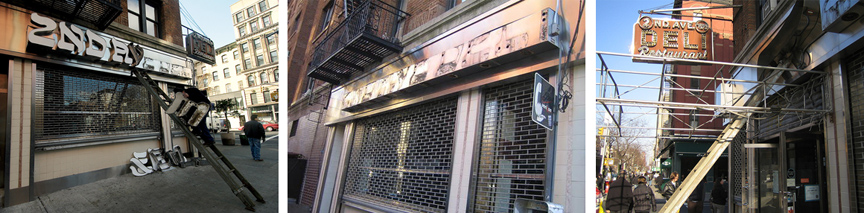
oy vey izmir!
and an article describing the rent increase and Jack Lebewohl’’s decision not to open on January 2nd — the day after our last visit. I was crushed. However, I pride myself on being a man of my word. As of that moment, I was a vegetarian.

On December 17, 2007, in the former location of a tapas restaurant at 33rd Street and 3rd Avenue, Jeremy Lebewohl continued his Uncle Abe’s legacy and reopened 2nd Avenue Deli. When we heard this news, my family and I anxiously planned our first trip to the new digs. Soon, we found ourselves on tiny 33rd street in the shadow of the Empire State Building and under a familiar awning emblazoned with pseudo-Hebraic block letters. The new restaurant was considerably smaller, narrower and cleaner than the original, but the amiable faces and bustling ambiance made us feel at home. My wife looked at me smiling, but then her expression turned to one of wonder. She didn’t need to ask the question. It was in her eyes. Since 2nd Avenue Deli reopened, would I continue to keep my vow? Would I eat meat?

The Deli always had an extensive menu but I never read it. I always ate the same thing. Always. However, I felt that I needed to be true to the integrity of my word. My son ordered three potato latkes, each roughly the size of his head and a bowl of applesauce that was just a bit smaller than Lake Michigan. My wife ordered a juicy beef burger topped with several slices grilled pastrami. And me?  Well, after a long perusal of the many meatless options, I settled on French toast made from thick sliced challah bread. I also added a piece of kugel, a traditional noodle pudding, the portion of which was about as large as the average sofa cushion.

I didn’t eat meat that night and I haven’t had any since.

Comments

comments

from my sketchbook: trent lehman

...and so many silly things keep happening.
A small role as the young George Jorgenson in the controversial Christine Jorgenson Story  led ten-year-old Trent Lehman to be cast in the sitcom Nanny and The Professor  in 1970. Trent co-starred opposite Juliet Mills as mischevous middle son Butch Everett. Fifty-four episodes of the popular show were filmed and it held a coveted time slot on ABC between The Brady Bunch  and The Partridge Family  on Friday nights.

After Nanny and The Professor  was canceled, Trent had difficulty finding acting roles. By the time he reached his teens, he had given up on seeking the spotlight, electing instead to do odd jobs around his neighborhood. In 1981, he moved back to Los Angeles. He had a short relationship with a girl and was devastated when they broke up.

On January 17, 1982, still upset over his romantic break-up and the recent burglary at his apartment, Trent was drinking with some friends. Late in the evening, he was dropped off at his van that was parked across the street from Vena Avenue Elementary School. Trent had attended the school as a youngster during the run of Nanny and The Professor. His friends told him to get some sleep before a scheduled court appearance the next day for a traffic violation. A drunken Trent stumbled towards his van and his friends drove off.

The friends returned to check on Trent’s condition. They found Trent hanging by the neck from the eight-foot chain-link fence that surrounded the school. He had fashioned a noose from his belt. A hand-written will, leaving his few possessions to his mother, was found in his shirt pocket. It was written on the back of his court summons. An autopsy revealed large amounts of alcohol and cocaine in his system. Trent was 20 years old.

Comments

comments

IF: cocoon

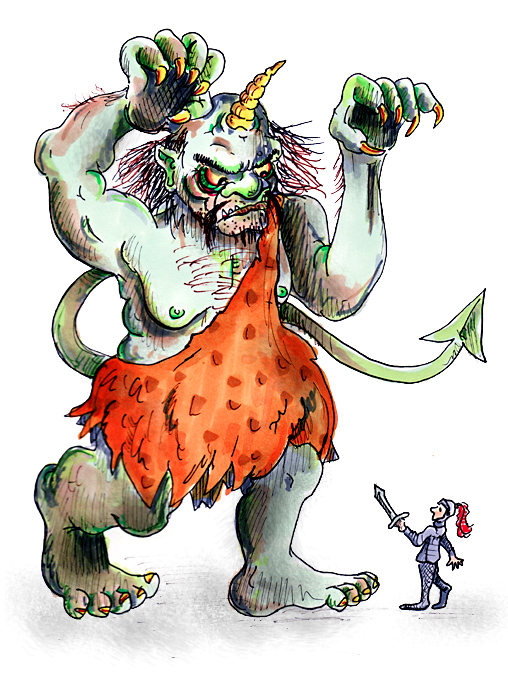
This week’s challenge word on the Illustration Friday website is “cocoon”.
No, I`m still Rael and I`m stuck in some kind of cave
I saw a cocoon
All wrinkled and drawn
Like a deep ocean prawn
From the shore of Rangoon

I poked the cocoon
It had a strange shape
Not unlike an ape
Or a hairy baboon

The cocoon I inspected
‘Twas webby and white
Layered thick and so tight
All predators deflected

For hours I stood
And watched the cocoon
Sunday afternoon
Would it stay there for good?

So, I left the cocoon
So shriveled and dried
Butterfly still inside
That the world would see soon.

Comments

comments

from my sketchbook: elizabeth hartman

Blue, blue, my world is blue/Blue is my world now I'm without you
In the fall of 1964, Elizabeth Hartman was offered the leading role of Selina in A Patch of Blue, with Sidney Poitier and Shelley Winters. The role won Elizabeth widespread critical acclaim and the crew at the Youngstown Ohio playhouse, where she got her start, were especially proud. Twenty-two year-old Elizabeth received an Academy Award nomination for Best Actress in 1966. At the time, this made her the youngest nominee ever in the Best Actress category.

Elizabeth’s career took off. In addition to a number of stage productions, she appeared in films with Clint Eastwood, Geraldine Page, Alan Bates and Candice Bergen and worked with such respected directors as John Frankenheimer, Sidney Lumet and Francis Ford Coppola. She played Joe Don Baker’s wife in the original Walking Tall  in 1973 and provided the voice for Mrs. Brisby in the animated The Secret of NIMH  in 1982.

Throughout much of her life, Elizabeth suffered from depression. In 1984, she divorced her husband after a five-year separation and moved to Pittsburgh to be closer to her family. She abandoned her acting career, opting instead to work at a museum in Pittsburgh. On June 10, 1987, Elizabeth called her doctor seeking help for extreme despondency. Shortly after that phone conversation, she threw herself from her fifth floor apartment window.

Comments

comments