from my sketchbook: william holden

I open up the paper / there's a story of an actor / who died while he was drinking / he was no one I had heard of
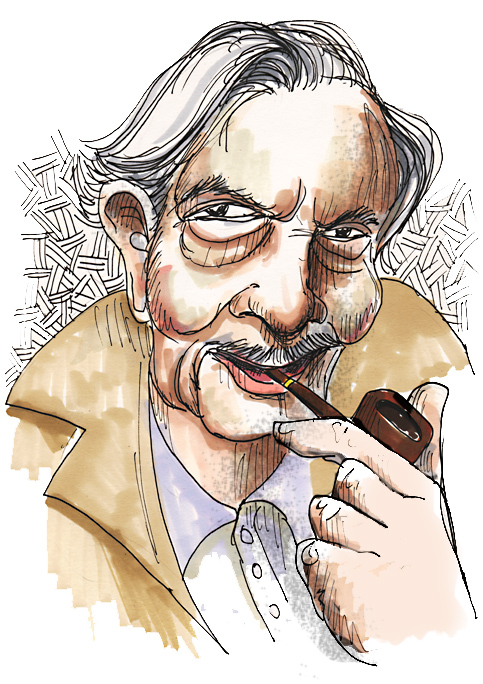
In 1939, ruggedly handsome, gravelly-voiced William Holden had the starring role in Golden Boy  opposite Barbara Stanwyck. He followed that with minor, forgettable parts through the 1940s until his breakout role as Joe Gillis in Billy Wilder’s classic — the hauntingly memorable Sunset Boulevard  in 1950. William received his first of three Best Actor Oscar nominations for the part and his career took off. Perfecting the part of “everyman” leading man, William won the Academy Award in 1953 for another Billy Wilder vehicle, Stalag 17.

William was one of the top box office draws of the 50s, appearing in Picnic, Bridge on the River Kwai, the controversial The Moon is Blue and opposite Humphrey Bogart and Audrey Hepburn in Sabrina. He started a romantic relationship with Hepburn during filming until she broke it off when William revealed he had undergone a vasectomy.

By the 1960s, William’s films had less commercial success, but due to contractual obligations he was forced to make them. In 1964, he was paired again with a now-married Audrey Hepburn in Paris When It Sizzles.  He tried to rekindle a romance, but was rebuffed. That uncomfortable situation coupled with William’s increasing alcohol consumption had disastrous effects of the film’s production. William’s advanced alcoholism began to take its toll. In 1966, he was convicted of vehicular manslaughter in Italy after a car accident in which he killed the other driver.

In 1974, William Holden, now beginning to show his age,  joined the all-star cast of the disaster film The Towering Inferno  and two years later he earned his third Oscar nomination for a role more suited to the acting talents of his heyday as Max Schumacher in the acidly-satiric Network.  He lost to costar Peter Finch, who received the first posthumous performance Oscar.

In the early 70s, William began a relationship with Stefanie Powers, an actress 24 years his junior and famous for the TV series Hart to Hart. She was very aware of his drinking problem.

In the early 80s, William was a part owner of an apartment building in Santa Monica, California, and he lived in a unit on the fourth floor. He was known to be a very private person, sometimes not emerging from his apartment for days. In November 1981, the building manager became concerned after not seeing William for several days. He used his passkey to enter William’s apartment. Upon entering the bedroom, he found William’s body partly clad in a bathrobe and lying in a pool of blood. There was a large gash in William’s forehead and he was surrounded by bloody tissues and a rumpled throw rug. A wooden nightstand was obviously moved from its original position and the far corner of the square top was jammed about three inches into the wall. An empty bottle of vodka was found in a trash can and several beer and liquor bottles were found in the kitchen. A subsequent autopsy concluded that a drunken William (with a blood alcohol level of .22) had tripped on the rug and smacked his head on the table, resulting in the wound. He hit the table so hard, he drove it into the wall. Not realizing the severity of his injury, he attempted to stop the bleeding with Kleenex until he passed out from loss of blood. When he was found, he had been dead for almost four days. There was a working telephone just inches from his body. William Holden was 63.

Comments

comments

from my sketchbook: orson welles

There's only one person in the world who's going to decide what I'm going to do and that's me.
Orson Welles lived a life filled with accomplishment.

At the age of 20, he presented a version of Shakespeare’s Macbeth, reworked in a Haitian setting with the three witches as voodoo priestesses. The production was highly praised for its originality.

In 1938, he gained international fame when he frightened the entire country with his radio broadcast of  War of the Worlds.

At the age of 25, he co-wrote, produced, directed, and performed the lead role in the magnificent Citizen Kane, one of the greatest films of all time. The movie earned nine Oscar nominations and won the award for Best Screenplay for 1942.

He was voted by one of the greatest American actors of all time by the American Film Institute, based on his forty-six years in Hollywood as a true auteur.

He had a torrid affair with Latin bombshell Delores Del Rio and later married screen siren Rita Hayworth.

Welles lent his booming baritone voice as narrator to countless films, in addition to documentaries and commercials.

He was a frequent and popular guest on talk shows, often discussing his rich history in films, as well as his varied interests in magic, forgery, and the supernatural. In 1985, he gave his last interview on The Merv Griffin Show, two hours before he died of heart failure.

But, Welles’ greatest accomplishment is one that still holds today. One that is seemingly impossible to surpass. Welles holds the unmatched record for eating the most hot dogs in one sitting at renowned Los Angeles hot dog stand, Pink’s. He ate 18.

winner and still champion!

Comments

comments

from my sketchbook: donna reed

since she left me, I've never been the same.
Donna Reed’s career ran the full spectrum from her humble beginnings opposite Mickey Rooney in The Courtship of Andy Hardy  to her popularity as a pin-up girl during World War II to her Academy Award-winning performance as prostitute Lorene Burke in 1953’s From Here to Eternity.

Network executives must have been focusing on her role as Mary Bailey in the beloved Frank Capra holiday classic It’s a Wonderful Life  when they offered her the role of perfect housewife Donna Stone on a new ABC sitcom (unless they just dug her as the From Here to Eternity  hooker). Donna vacuumed and washed dishes in pearls and high heels for eight seasons in The Donna Reed Show. Her character is still perceived as the model for the All-American subservient homemaker.

When actress Barbara Bel Geddes decided to step down as Ewing family matriarch “Miss Ellie” on the popular nighttime drama Dallas, Donna was recruited to fill the part. After one season Bel Geddes returned and Donna was unceremoniously fired. She sued the production company for breach of contract and settled out-of-court for over a million dollars. Shortly after, Donna was diagnosed with terminal pancreatic cancer and passed away just shy of her 65th birthday in 1986.

Donna experienced an unusual twist of fate early in her personal life. In 1945, Donna flew to Mexico to obtain a divorce from her first husband, Hollywood make-up man Bill Tuttle. Returning home, Donna boarded a plane in El Paso, Texas headed for Los Angeles. Just before take off, Donna was bumped from the flight to make room for a military officer. On its approach to Burbank’s Lockheed Air Terminal, the plane crashed, killing everyone on board.

Comments

comments

DCS: stanley adams

Is that an offer or a joke?
Stanley Adams was a television staple for three decades, appearing in numerous roles in countless series. He was cast in parts as diverse as policemen and bartenders to con men and aliens. Among his more than a hundred guest spots, he played Otis the drunk’s equally-soused brother in an episode of The Andy Griffith Show, a time traveller in The Twilight Zone, a head-hunting savage in the final episode of Gilligan’s Island and Tybo the Carrot Man in a memorable, yet typically hokey, episode of Lost in Space. Possibly, his most famous TV appearance was that of Cyrano Jones in “The Trouble with Tribbles” episode of the original Star Trek series. Stanley was a scriptwriter for several television series, too, including “The Mark of Gideon” episode of Star Trek.

Stanley also enjoyed a successful career playing assorted small character roles in over fifty theatrical films. He was the wealthy Rusty Trawler in Breakfast at Tiffany’s and the Hispanic cafe owner opposite Oscar-winner Sidney Poitier in Lilies of the Field. Stanley also had an uncredited part as Lieutenant Harding in Hitchcock’s North by Northwest.

Success as an actor and writer was obviously not enough for Stanley. He died from a self-inflicted gunshot in 1977.

Comments

comments

from my sketchbook: michael curtiz

Into the valley of Death rode the six hundred.

Hungarian-born Michael Curtiz was one of the most prolific directors that ever worked in Hollywood. He directed over one hundred films beginning with The Third Degree in 1926, just after his arrival in America. (He directed nearly a hundred films in his native Hungary).

As the 20s became the 30s, Michael was cranking out five and six pictures a year for Warner Brothers, helping the studio to become one of Hollywood’s most successful. Michael was a perfectionist and expected the same level of output from his actors. He was prone to berate and insult his cast and crew, noting that “acting is fifty percent a bag of tricks”.  Because of this, a great many actors refused to work with him. He had a tumultuous working relationship with Errol Flynn. The pair teamed up for twelve films, including The Adventures of Robin Hood and Captain Blood,  until Flynn was finally fed up with Michael’s temperament and another director was chosen for 1948’s Adventures of Don Juan.

Michael had a better relationship with Humphrey Bogart and James Cagney, directing the former eight times including the classic Casablanca. He evoked great results from Bogart and Cagney in the quintessential gangster film Angels with Dirty Faces and Cagney’s Oscar-winning tour de force Yankee Doodle Dandy. Actress Fay Wray, however, once remarked that Michael was just like a piece of machinery; an extension of the camera crane. His relationship with the great Bette Davis was so volatile that he once called her a “no good sexless son of a bitch” in the middle of a movie set. Michael’s films crossed genres and he was just as comfortable directing a drama as he was a musical or horror movie. No matter what the subject, Michael was a workaholic. He never broke for meals and referred to those who did as “lunch bums”.

Although it was never a hindrance, foreign-born Michael’s poor grasp of English was notorious. A prop man on the set of Casablanca  was baffled by Michael’s request for “poodles”. Over and over, he demanded “poodles” be scattered about the set. He soon realized Michael actually wanted “puddles” during a rain scene. During the filming of 1936’s Charge of The Light Brigade, a scene called for a stampede of riderless horses. When he was ready, Michael announced to “bring on the empty horses”.

In the early 1950s, Michael’s association with Warner Brothers waned and he began freelancing for rival studios. He directed King Creole (his only teaming with Elvis Presley) and the holiday favorite White Christmas for Paramount. His last film, 1961’s The Comancheros  with John Wayne, was released six months before Michael lost his battle with cancer at age 75.

Comments

comments

from my sketchbook: june preisser

Spring being a tough act to follow, God created June.
Nine-year old June Preisser, along with her sister Cherry, performed as child acrobats from their hometown of New Orleans to New York City, to the famous music halls of Paris, Berlin and London. They even were given an audience with King George of England. Their act caught the interest of show-biz impresario Florenz Ziegfeld and they went to work in the famous Ziegfeld Follies in the late 1930s.

Cherry married and retired from the act leaving June to continue as a solo. June was soon signed to a contract with MGM and was cast as Judy Garland‘s rival for Mickey Rooney’s affections in the musicals Babes in Arms in 1939 and Strike Up the Band in 1940. She appeared as essentially the same character in several of Rooney’s popular Andy Hardy pictures. After her marriage at 22 and the birth of her son, MGM expressed little interest in further promotion of her career. June signed on with Monogram Pictures, a studio known for their low-budget pictures. She made eight films in the “Teen Ager” musical series playing peppy high-schooler Dodie Rogers, despite being in her middle 20s.

June called it a career in 1948 following her appearance in a stage production of Annie Get Your Gun. After a bitter divorce, she opened a chain of dance schools in Los Angeles.  Her dance school endeavor tanked and she moved to Florida with her grown son.

June’s name surfaced in the news in 1984, when it was reported that she and her son had died in a car accident during a severe Florida rainstorm. June was 63.

Comments

comments

IF: mail

This week’s Illustration Friday challenge word is “mail”.
Stop! Oh, yeah, wait a minute...
Everyone knows the creed of the United States Postal Service, right?  Say it with me…
“Neither snow nor rain nor heat nor gloom of night stays these couriers from the swift completion of their appointed rounds”

Wrong. The United States Postal Service has no official creed or motto. The famous line about rain and snow and gloom of night (whatever that is) is inscribed on the James Farley post office building in New York City. It was chosen by the architectural firm that designed the building. The quote is from Greek historian Herodotus’ writings from 440 BC called The Histories  and refers to the couriers of ancient Persia. The actual carving was done by Ira Schnapp, a skilled stone-cutter who went on to design the Comics Code seal and the Action Comics logo for DC Comics. The inscription is merely decoration and has no official representation.

If the United States Post Office were to have a motto, it would probably be “I have no idea when your letter will arrive. Next window, please.”

Comments

comments

IF: phenomenon

This week’s Illustration Friday challenge word is “phenomenon”.
In every phenomenon the beginning remains always the most notable moment.
On the evening of October 28, 2005, both the New York City Office of Emergency Management and the city’s 311 system (the non-emergency municipal services center) were flooded with calls from panicked Manhattan residents. The frantic callers told of the overwhelming aroma of maple syrup permeating the air. While most of the calls received were centered in the Upper West side, some complaints came from as far as Queens. After a few hours the smell dissipated and was soon gone as mysteriously as it had arrived. The questions, however, continued for days. Was it dangerous?  Was it a terrorist attack?  Where did it come from?  The city was baffled and the citizens’ inquiries remained unanswered.

The mysterious maple syrup smell returned several more times over the years, most recently in 2009. At that time, a group from the New York City Department of Environmental Protection, gathering and analyzing atmospheric data, determined the smell to be harmless. They traced the odor to its source, a fragrance and food additive processing plant in northern New Jersey. The factory processes fenugreek seeds, a spice commonly used in maple syrup substitutes.

In anticipation of the possible return of the maple syrup smell, New Yorkers can often be found wandering the city streets carrying plates of naked pancakes and optimistically looking to the skies.

It's a jolly holiday with JPiC!
My annual Christmas music compilation is available as a FREE DOWNLOAD for a limited time.
26 unusual songs, an annoying BONUS track and a custom full-color cover with track listings — all for you and for FREE!
Just CLICK HERE for “A Non-Traditional Christmas 2010.”

Happy Holidays from your pal JPiC!
(Please contact me if you have trouble with the download.)

Comments

comments