IF: duet

He who fucks nuns will later join the church
Jeanne Deckers was a nun in the Dominican Fichermont Convent in Waterloo, Belgium. She wrote, sang and performed her own songs, which were so well received that the monastery decided to let her record an album, which visitors to the monastery would be able to purchase. In 1963, Jeanne (who chose the name Sister Luc Gabriel) released the song “Dominique,” which became an international hit. Radio stations embraced the song and in the United States it became wildly popular and brought a sort of distracting comfort in the days following the assassination of President Kennedy. Almost overnight, Sister Luc Gabriel, the Dominican nun, was an international celebrity with the stage name of “Sœur Sourire” (Sister Smile). She gave concerts and appeared on The Ed Sullivan Show in early 1964.

Sister Luc Gabriel’s unlikely rise to fame was chronicled in the 1966 film The Singing Nun  starring Debbie Reynolds. Sister Luc Gabriel dismissed the film as pure fiction. In 1967, she released a second album that was poorly received. Meanwhile, her label, Phillips Records, kept a majority of the revenue from her debut release and maintained right to the name “Sœur Sourire, forcing Sister Luc Gabriel to take the altered stage name “Luc Dominique”. Still determined to maintain a singing career, she released a third album, this time geared toward religious songs for children. Again, it went nearly unrecognized. Between her failing music career and her increasing criticism of Catholic doctrines, she left the Church. Still using the name “Luc Dominique,” she recorded an ode to her strong advocacy of birth control called “Glory Be to God for the Golden Pill.” It, too, was a commercial failure. Sister Luc reverted back to being plain old Jeanne Deckers and faded into show business obscurity.

With her music career in her past, Jeanne opened a school for autistic children with her friend Anna Pécher, also a former nun. In the late 1970s, the Belgian government claimed that she owed approximately $63,000 in back taxes. Jeanne countered that the royalties from her recording were given to the convent and therefore she was not liable for payment of any personal income taxes. Lacking any receipts to prove her donations to the convent, Jeanne ran into heavy financial problems. Despite being a solo act in her early days, Jeanne performed a suicide duet with Anna. The pair – friends for ten years – composed a note reading “We hope God will welcome us. He saw us suffer. He should show clemency.” Then, they each downed a fatal dose of barbiturates and alcohol.

Jeanne was 51.

Comments

comments

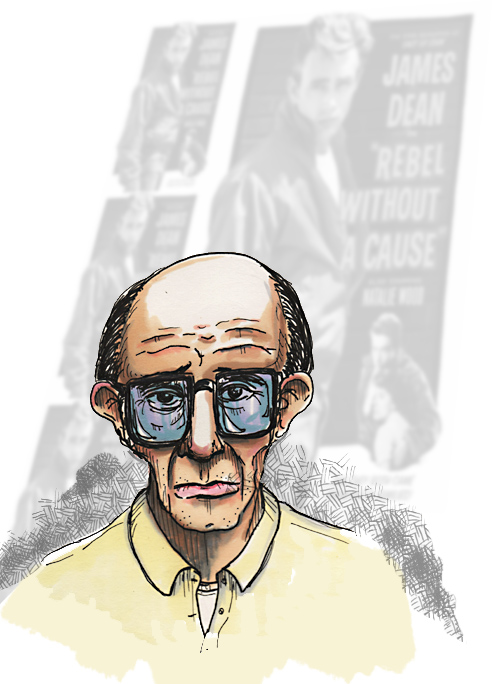
from my sketchbook: joseph kearns

Martha! Bring me my nerve medicine!
Character actor Joseph Kearns began his career in the heyday of radio in the unlikely role of a pipe organ player. He soon was performing regularly on radio programs like I Married Joan, December Bride, Burns and Allen, Sam Spade and many others. He was the mysterious announcer “The Man in Black” on the radio drama Suspense. His best known radio role was that of Ed, the security guard for Jack Benny’s underground money vault, on The Jack Benny Program. The “running gag” was that Benny had kept Ed on duty at the vault’s door so long that the guard was not aware of current events. When Benny informed him that “The War had ended,” Ed asked whether the “North” or the “South” had won.

In 1951,  Joseph made his motion picture debut in the Ida Lupino-directed Hard, Fast and Beautiful  with Claire Trevor. The same year, he lent his voice to The Doorknob in Walt Disney’s animated Alice in Wonderland. He appeared on both comedy and dramatic series in the early days of television. He was a regular cast member on Our Miss Brooks, Professional Father  and How to Marry a Millionaire. He even reprised his role (appearing exclusively in shadow) as Ed the guard on the TV version of Jack Benny’s show. In 1959, Joseph landed the role for which he is most remembered. He was cast as the irascible Mr. Wilson, the long-suffering neighbor of Dennis Mitchell on the CBS sitcom Dennis the Menace. For three seasons, Joseph’s Mr. Wilson was tortured by Dennis, the eternal pain-in-the ass. On February 11, 1962, CBS aired the Dennis the Menace  episode entitled “Where There’s a Will”, in which Mr. Wilson made out his will and explained to Dennis that he would inherit his gold watch when he dies. Joseph Kearns died from a cerebral hemorrhage on February 17, 1962.

A week or so ago, I called my brother to wish him a “Happy Birthday”. He was lamenting over turning 54. Later, I called him to tell him a bit of information that I hoped would make him feel better about passing another year over the half century mark. I told him that I was watching Dennis the Menace, a show we both agreed we hated watching in our youth. Feeding my obsession for the trivial, I went on to say that I was researching the fate of the show’s various cast members. I knew that Joseph Kearns had passed away during the program’s third season. (He was replaced by the equally annoying Gale Gordon.) What surprised me was Joseph Kearn’s age at the time of his death. He was 55. My brother’s reaction was the same as mine. Fifty-five!?  Jeez! I thought he was at least seventy!  I informed my brother that he looks a hell of a lot better than Mr. Wilson did at practically the same age.

I think I cheered him up. At least a little.

Comments

comments

from my sketchbook: dorothy dell

Hey Nineteen/No we got nothin' in common/No we can't talk at all
Dorothy Dell aspired to fame from the time she was a child. She won a “Beautiful Baby” contest in her native Hattiesburg, Mississippi at one year old and continued to enter and win others throughout her childhood. In high school in Louisiana, she made friends with Mary Leta Dorothy Slaton, another aspiring actress. The pair became known as “The Two Dorothys” and decided the first one to make the big break into show business would help the other. The two Dorothys entered the Miss New Orleans Pageant in 1930. Dorothy Dell won the contest. Later the same year, Dorothy was named winner of the International Pageant of Pulchritude, the forerunner to the Miss Universe Pageant.

Dorothy turned down initial offers from master showman Florenz Ziegfeld. She insisted on a part for her friend, the other Dorothy, but Ziegfeld said she was too short for the chorus line. Dorothy instead opted for the vaudeville circuit and was accompanied on tour by her family and friend. She finally accepted a stint in what would be the final Ziegfeld Follies in 1931. She stood in for an ailing Ruth Etting and was soon drawing comparisons to Mae West. Hollywood took notice and came calling.

In 1933, Dorothy moved to Hollywood and signed a contract with Paramount Pictures. She was cast as a saloon girl in 1934’s Wharf Angel, beating out established stars like Mae Clarke and Isabel Jewell. She is proclaimed as “the find of the season” in the press. Her next part was in the Shirley Temple vehicle Little Miss Marker  later the same year. She made the musical Shoot the Works  which garnered Dorothy more comparisons to Mae West. Just after the premiere of Shoot the Works, co-star Lew Cody and actress Lilyan Tashman passed away. At Cody’s wake, Dorothy wondered to a friend, “The old theater superstition says death strikes in threes. “I wonder who’ll be next?”

Paramount scheduled her to re-team with Shirley Temple in Now and Forever, co-starring Gary Cooper. Before filming began, Dorothy attended a party in Altadena, California with Dr. Carl Wagner, an oral surgeon who operated on her mother a few months earlier. Wagner, a prominent society figure in Pasadena, figured in the police probe into the mysterious murder of Dr. Leonard Siever, a leading Pasadena dentist, who was killed in December 1933. Wagner drove Dorothy back to Pasadena, but the trip was cut short when the car struck a telephone pole, caromed off a palm tree and finally smashed into a boulder. Wagner died in the hospital six hours later. Dorothy was killed instantly. She was 19. Newcomer Carole Lombard took over Dorothy’s part in Now and Forever.

Dorothy’s childhood friend, Dorothy Slaton moved to Chicago and took a job as an elevator operator at the Marshall Fields department store. A chance meeting with popular singer Rudy Vallee led to a singing gig in Manhattan, where she met Louis B. Mayer, head of the MGM Studios. Mayer arranged for a screen test and Dorothy’s career took off. On Vallee’s suggestion, she changed her last name to the French word for “love” — Lamour. Dorothy Lamour always credited her childhood friend Dorothy Dell as the person responsible for the beginning of her own film career.

 This post marks the fourth anniversary of the josh pincus is crying blog.

Comments

comments

from my sketchbook: lorene yarnell

what do you see/you people/gazing at me
After meeting while filming the Sid and Marty Krofft special Fol-de-Rol  in 1972, tap dancer Lorene Yarnell married mime Robert Shields in a flamboyant, but silent ceremony in San Francisco’s Union Square. Soon, the duo were cast as regular performers on The Mac Davis Show  and later, The Sonny and Cher Comedy Hour.  They performed their blend of dance, mime and slapstick humor on hundreds of television and live shows, prompting CBS to give them their own variety show in 1977. The show was a popular summer series, although it was dropped in early 1978 when rival ABC ran Laverne & Shirley  as competition in the same time slot. Lorene Yarnell and her husband appeared before two presidents and Queen Elizabeth, on Broadway (albeit unsuccessfully) and a tour of China with Bob Hope. They headlined in Las Vegas, Reno and Atlantic City. The couple eventually divorced in 1986, but continued to work together until 2009. Playing off of Mrs. Clinker, the robotic character she developed on the variety show, Lorene appeared in the identity-hiding costume of Dot Matrix in Mel Brooks’ 1987 sci-fi send-up Spaceballs, with comedian Joan Rivers providing the voice.

Married to her fourth husband, Bjorn Jansson, Lorene moved to his native Norway where she owned and operated a dance studio. She returned to her first love and taught tap and jazz. The dancer, whose skills Gene Kelly once called “flawless”, lived in virtual anonymity among her students.

On July 29, 2010, while watching television at home with her husband, Lorene died when a previously undetected cerebral aneurysm ruptured. She was 66.

Comments

comments

Monday Artday: villain, part 2

This week’s Monday Artday challenge word is “villain.”  Here is the second of two illustrations for this suggestion. (Here is the first.)
And when Alexander saw the breadth of his domain, he wept, for there were no more worlds to conquer
One of the slimiest, shiftiest villains to ever grace the silver screen was the despicable Hans Guber, as portrayed by Alan Rickman, in the original “Die Hard”.

Under the guise of a group of international terrorists, the cold and ruthless Hans and his cohorts merely wish to steal 640 million dollars in bearer bonds from the vault of the Nakatomi Building in Los Angeles. Their plans are eventually thwarted by visiting New York City cop, resourceful John McClane, the self-proclaimed “fly in the ointment; monkey in the wrench”.

“Die Hard” is actually based on the 1979 novel “Nothing Lasts Forever” by Roderick Thorp. The book, itself a sequel to Thorp’s novel “The Detective” (filmed in 1968 with star Frank Sinatra), was adapted for the action film with several alterations, most notably the inclusion of the Hans Gruber character, who did not originally appear.

Comments

comments

Monday Artday: villain, part 1

This week’s Monday Artday challenge word is “villain”.  Here is the first of two illustrations for this suggestion. (Here is the second.)
Oh what a world! What a world!
She spent her entire screen time in “The Wizard of Oz” tormenting Dorothy Gale. Whether it was in her role as Miss Almira Gulch, the wealthy but crotchety landowner who takes Dorothy’s beloved Toto away under court order or as the main roadblock in Oz keeping Dorothy from returning to Kansas, The Wicked Witch of the West was as evil as they come. (Okay, so Dorothy killed her sister with a house, but she was a witch, after all.) The Wicked Witch was eventually served her just desserts when a slow reaction to a hurled bucket of water brought her to a bubbling and steamy demise. (Of course, Dorothy met her own fate forty years later.)

Margaret Hamilton, who portrayed the Witch, was in reality a former kindergarten teacher who loved children. (Two of her students during her teaching days were future actors Jim Backus and William Windom.) After her iconic, career-defining role in “The Wizard of Oz”, Margaret often visited schools as part of her advocacy for public education. She loved the childrens’ reaction when she told them that she played the witch and was often coaxed into performing the famous cackle to squeals of delight.

A veteran of over 100 movies, television productions and a turn as “Cora” in a popular series of Maxwell House coffee commercials, Margaret passed away at age 82 in 1985.

Comments

comments

Monday Artday: spy

The current Monday Artday website challenge is “spy”.
Quick. Name three presidents.
Super spy Phil Moskowitz, with the help of the beautiful Suki Yaki, recovers the secret recipe for the world’s greatest egg salad, stolen by the evil Shepherd Wong. The tale of double-crossing and international intrigue unfolds in Woody Allen’s 1966 directorial debut, What’s Up, Tiger Lily?

Comments

comments

from my sketchbook: geli raubal

are you really going out with Adolf?

After her husband passed away at the age of 31, desperate and destitute Angela Raubal took her three children and sought refuge with her half-brother. Angela became his housekeeper and he allowed her family to move into his home in the Bavarian Alps in Obersalzberg, Germany.

Angela’s half-brother took an unnatural affection to Angela’s youngest daughter Geli as she grew into a young woman. He lavished attention and presented her with gifts, but he also kept close reins on her activities and closely monitored and limited her association with friends. She called him “Uncle Alf”, but to the rest of the world, he was Adolf Hitler.

A forty year-old Hitler began an incestuous relationship with Geli Raubal, his seventeen year-old half-niece, in 1925. In the early days of Hitler’s ascent to power, Geli was Hitler’s live-in companion at his home in Munich. Hitler obsessively watched and questioned Geli’s every move and the actions of those around her. When he believed that Emil Maurice, his chauffeur, was expressing a romantic interest in his beloved Geli, the possessive future Führer had him fired. During the time she lived with Hitler, Geli entered medical school, dropped out and then took up singing lessons, which she also abandoned. She was known to be religious and attended Mass regularly. Although she dressed rather conservatively, Geli wore a small gold swastika on a chain around her neck — a gift from her Uncle Alf.

Geli soon grew angry over Hitler’s control and jealous over his affair with a nineteen year-old photographer’s model named Eva Braun. In September 1931, after a vicious argument that ended when Hitler stormed out, twenty-three year-old Geli shot herself, point-blank in the heart, with Hitler’s gun. Her body was discovered by a member of Hitler’s staff.

Hitler had left town the previous afternoon for a speaking tour, but immediately returned on hearing the news of Geli’s suicide. He threatened suicide himself, but was reasoned with by other high-ranking officials in the Nazi Party. Hitler instructed his staff never to mention Geli’s name. Nazi photographer Heinrich Hoffmann said Hitler was so affected by Geli’s death that “it was what caused the seeds of inhumanity to grow”.

Comments

comments

IF: cultivate

This week’s Illustration Friday challenge word is “cultivate”.
Stop me if you heard this one.

In the nearly thirty years that I have known my father-in-law, he has told me this joke countless times. Whenever a piece of conversation triggers something in his memory that reminds him that this joke would be an appropriate anecdote, he delivers it as though it was the first time anyone has ever heard it. Of course, it is best told in a stereotypical Yiddish accent, which my father-in-law masterfully parrots.

It goes sort of  like this:

A teacher calls on a little boy in a classroom and asks him to use the words “commercial” and “cultivate” in a sentence. Herschel, the offspring of Russian Jewish immigrant parents, stands up proudly, clears his throat, and announces to the teacher “Vun day, ven I vas vaiting mit mine mother for de bus und de vind vas blowing und de snow vas blowing, she says to me ‘Come ‘erschel, it’s too cul-ti-vate’ “.

(Say it out loud a few times using the accent. You’ll get it.)

Comments

comments