IF: puzzled (part 2)

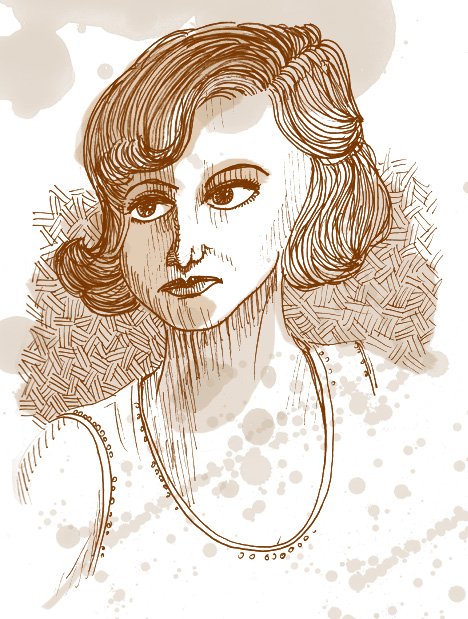
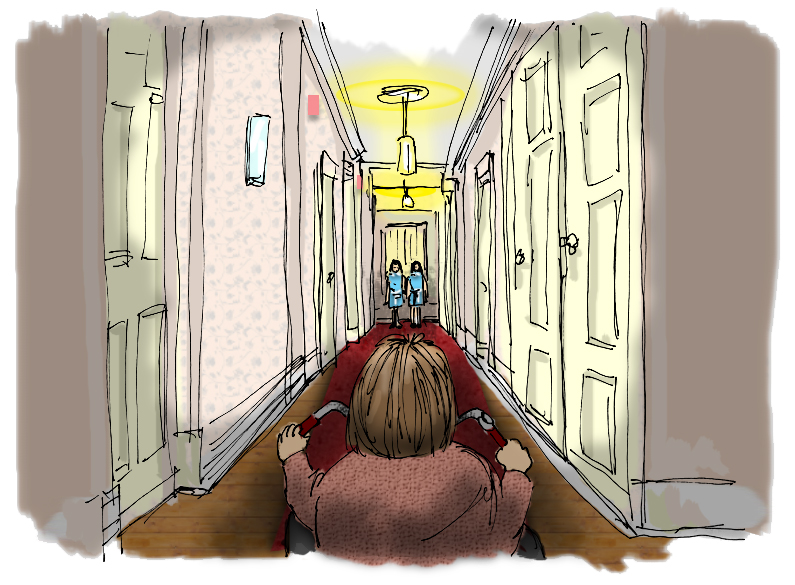
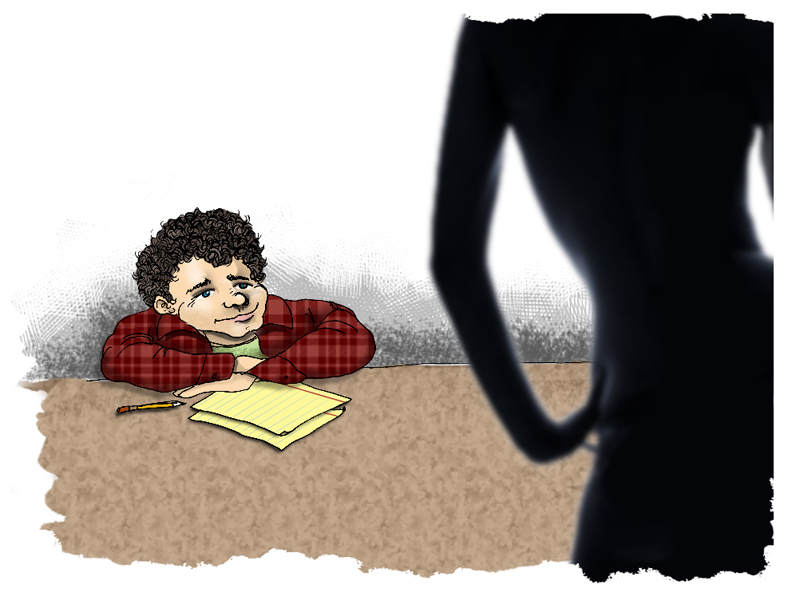
This week’s Illustration Friday word is “puzzled”. This is one of two illustration that fit the topic. HERE is the other.
Every day I work so hard, bringin' home my hard-earned pay/Try to love you, baby, but you push me away/Don't know where you're goin', only know just where you've been/Sweet little baby, I want you again
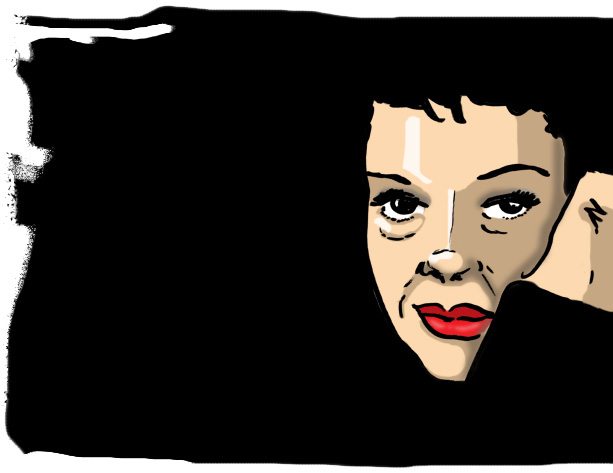
Where ever she was — whether it was on the front lawn with the other evacuees or in her home watching it all unfold on the live local news coverage — Robyn Anderson was puzzled. Just three days earlier, Robyn was dancing at her senior prom. She mingled with classmates — laughing, reminiscing — with some, prophetically, for the last time. But, as she watched, in horror and disbelief and confusion, she remembered what she had done six months earlier.

Robyn was a church-going, straight-A student who made her parents proud. In ninth grade, she met an awkward and brooding boy in her class and the two became friends. They studied together and, although she didn’t share  his interest, Robyn watched as he spent hours playing computer games. Over the years, Robyn was always “one of the gang.” The two grew close and she knew of his social troubles at school. She tried her best to encourage and support him, as any friend would. Despite the lack of a mutual romantic feelings, Robyn asked him to the upcoming prom, knowing full well that he never dated. He accepted, with the provision that she do something for him. She agreed, later telling a girlfriend, “I am either really cute or just really persuasive!”

In November 1998, the boy, Dylan Klebold, asked Robyn to accompany him and his pal Eric Harris to a gun show in Denver, Colorado. Dylan and Eric, their birthdays still several months away, knew Robyn had turned 18 (the legal age to purchase firearms) two weeks before. Robyn figured that since Dylan had a job and income and didn’t spend money on dating, this is what interested him. He was certainly free to spend his money on whatever he wished. The trio arrived and entered the enormous room that housed the gun show. It was stocked with row after row, table after table of every shape and size of legal firearm imaginable. They approached one table and Dylan spotted a double barrel shotgun lying on its side, its black muzzle pointing at the curious and prospective customers. Dylan asked the price — $245 — and Robyn announced to the vendor that she was eighteen. When questioned, Robyn produced her driver’s license and after a little scrutiny, the sale was completed. Dylan reached for the gun first and the vendor asked, “Being a gentleman and carrying it for the lady?”

Dylan smiled and answered, “Yes.”

During the afternoon, they made made two more purchases — another shotgun and a rifle. Each transaction went as smoothly and uneventful as the first. As they made their way back to Littleton, Robyn was satisfied that she upheld her end of the deal. Now, she had high-school-girl visions of herself and Dylan at the prom.

When they arrived at Dylan’s house, a disturbing thought crossed Robyn’s mind, and she bluntly asked, “You aren’t going to do anything stupid, are you?”

“No,” Dylan replied.

Comments

comments

from my sketchbook: rod hull

Well, don't you know about the bird/Well, everybody knows that the bird is the word
British-born Rod Hull moved to Australia in the early 1960s and got a job as a lighting technician on Sydney’s Channel 9 Network. Soon, he was appearing as Constable Clot, a popular daydreaming character on daytime television aimed at children. At the request of the show’s producer, Rod began performing with an ingenious emu puppet. Rod’s hand and arm became the emu’s head and elongated neck, while a false arm extending from Rod’s jacket appeared to wrap around the giant bird’s torso. Rod perfected his interaction with the emu character so well that it looked as though the puppet was actually alive — and out of control. On numerous television and nightclub appearances, the emu would wreak all sorts of destructive havoc while poor Rod tried — helplessly and unsuccessfully — to maintain composure and keep the beast restrained. The effect was convincing — and hysterical.

Rod returned to his native England. He was a guest on many television programs, including the popular Michael Parkinson interview show, where, again, Rod attempted to corral the emu as it attacked both set and host. The audience was in stitches, as was Parkinson. Crossing the ocean, Rod was a semi-regular on The Hudson Brothers Razzle Dazzle Show,  a Saturday morning variety show for kids. He famously appeared on The Tonight Show,  where he ignored producer’s warnings and “allowed” the emu to attack Johnny Carson and guest comedian Richard Pryor, who was fresh from recent surgery.

As the 80s became the 90s, Rod’s popularity diminished and his television appearances were less frequent. A British documentary, Rod Hull: A Bird in the Hand,  revealed that Rod resented the puppet. He felt that, despite overwhelming but brief success, the emu held him back from pursuing other areas of show business.

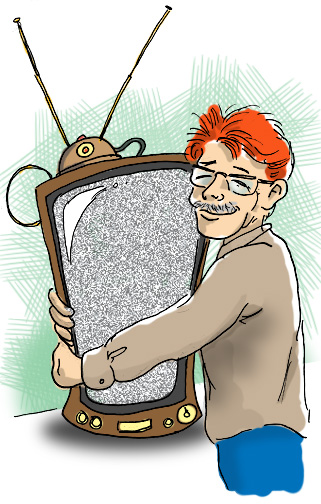
In March 1999, Rod was watching a championship football match at his home in Southeastern England. He climbed up on the roof to adjust an antenna to improve reception, when he slipped and crashed through the roof of an adjoining greenhouse. He was pronounced dead at a hospital, having sustained severe skull and chest injuries. Rod was 63.

Comments

comments

DCS: wendy o. williams

Oh, goodbye cruel world, I'm off to join the circus/Gonna be a broken-hearted clown/Paint my face with a good-for-nothin' smile
In the end, Wendy O. Williams had just about enough of the world’s shit.

As a child in Webster, New York, Wendy was a student of music, studying the clarinet and even making an appearance on The Howdy Doody Show.  At 16, she ditched school and hitchhiked her way across the country, selling crocheted bikinis to pay expenses. In 1976, she arrived back in New York and found an audition ad for an experimental performance group that piqued her interest. She showed up at Captain Kink’s Theatre and instantly clicked with “The Captain” Rod Swenson. Rod, a Yale MFA graduate, encouraged Wendy and with his assistance, she formed the seminal punk/metal band The Plasmatics in 1978.

The Plasmatics, with bleached-blond mohawked Wendy at the helm, were pioneers in the shocking stage antics that made “punk” punk. During performances, they would destroy guitars with a chainsaw, demolish televisions with sledgehammers and, on occasion, detonate a Cadillac piled high with explosives. In 1981, Wendy was arrested in Milwaukee for simulating sex onstage. She was additionally charged with battery when she allegedly attacked the arresting officer. In Cleveland, she took the stage dressed only in dollops of shaving cream and was, again, promptly arrested for public nudity and obscenity. All of the charges were eventually dropped and Wendy took to wearing strategically placed strips of electrical tape to avoid further incidents. Offstage, she was fined $35 dollars for punching a photographer after he took a picture of her on her morning jog.

Despite her notorious reputation, Wendy was nominated for a Grammy in 1985 for Best Female Rock Vocal Performance. (She lost to Tina Turner.) She recorded several solo albums including a 1984 effort produced by KISS bassist Gene Simmons. As an actress, Wendy appeared in the exploitation film Reform School Girls and the X-rated feature Candy Goes to Hollywood.

In 1991, she put the music business behind her. She and Rod Swenson moved the tiny community of Storrs, Connecticut. Leaving her controversial career and fearsome behavior in her past, Wendy devoted her attention to wildlife rehabilitation while working in a local heath food store. She became a vocal proponent for animal rights and vegetarianism.

On April 6, 1998, Rod returned to their home after a trip to the supermarket. He found a note from Wendy that read:

I don’t believe that people should take their own lives without deep and thoughtful reflection over a considerable period of time. I do believe strongly, however, that the right to do so is one of the most fundamental rights that anyone in a free society should have. For me, much of the world makes no sense, but my feelings about what I am doing ring loud and clear to an inner ear and a place where there is no self, only calm.

Rod searched a wooded area behind the house — an area where Wendy liked to walk, feed the forest animals and gather her thoughts. He found her body on the ground beneath the trees — a pistol lying by her side and a gunshot wound in her head. Wendy was 48 years old.

Comments

comments

from my sketchbook: barbara bates

Life is a beautiful thing/as long as I hold the string/I'd be a silly so-and-so/if I should ever let go
For aspiring model Barbara Bates, the world was her oyster. As a teenager, she won a train ticket to Hollywood as a prize in a beauty contest in hometown Denver. During her whirlwind trip, she met Cecil Coan, a publicist for United Artists. 45-year old Cecil was smitten with 19-year old Barbara. Through his show business connections, Cecil got Barbara a contract with Universal Pictures. She was cast a one of several dancers behind star Yvonne DeCarlo in the 1945 film Salome Where She Danced.  A short time after filming wrapped, Cecil left his wife and four children and married Barbara. Barbara began regularly appearing in uncredited background roles in films and pin-up spreads in publications like the Armed Forces magazine Yank.

In 1947, Barbara signed with Warner Brothers. Warners presented Barbara as “the girl next door”. Her wholesome image landed her opposite Danny Kaye in the musical comedy The Inspector General.  During production, Barbara began an affair with co-star Kaye and soon had her contract with Warners terminated when she refused to take part in a promotional publicity tour for the movie.

Despite her being fired, she was quickly snatched up by 20th Century Fox. Within the year, she appeared in her most memorable role as “Phoebe” in the final scene of the Bette Davis tour-de-force All About Eve.  Although her screen time was brief, Barbara was critically praised for the powerful, yet prophetically evil, performance that brought the film’s story full circle. She followed All About Eve  with Cheaper By the Dozen, Let’s Make it Legal  and even a turn with Dean Martin & Jerry Lewis in The Caddy.

The early 50s brought Barbara unfounded feelings of insecurity, resulting in irrational mood swings and chronic depression. She began work on a TV sitcom called, ironically, It’s a Great Life,  co-starring a pre-Andy Griffith Show  Francis Bavier. Seven episodes into the series, Barbara’s character was written out of the show. Barbara’s erratic and disruptive behavior got her fired. Gaining a bad reputation in Hollywood circles, Barbara traveled to England to find work. She signed as a contract player with noted producer J. Arthur Rank’s studio. After two months, Barbara’s missed appointments and emotional instability again caused her to be dismissed.

She returned to the United States in 1960 where she and Cecil moved into a small Beverly Hills apartment. Later that year, Cecil was diagnosed with terminal cancer. Barbara was devastated and rarely left her husband’s side. She doted over him until the pressures became too much and she slit her wrists in an unsuccessful suicide attempt. Cecil passed away in January 1967. Depressed and despondent, Barbara totally abandoned her acting career. She returned to her Denver roots where she worked, at various times, as a secretary, a dental assistant, and a hospital aide. She married a childhood friend, but just four months later, Barbara purposely locked herself in her mother’s garage with her car’s engine at full power. She died of carbon monoxide poisoning at 43.

Comments

comments

Monday Artday: miscalculated/IF: puzzled (part 1)

funny... you don't look Jewish.
For years, my wife has been in pursuit of the perfect hamburger. While a lot of carnivores share this quest, it should be noted that Mrs. Pincus has kept a strictly kosher diet for over forty years. Eating kosher meat within the privacy of one’s home is a fairly easy task. At one time, a kosher butcher shop was the only outlet for certified kosher meat. As time went on and the number of families seeking kosher products increased, major supermarkets began stocking a variety of commercially-packaged meats along with other mashgiachsupervised groceries. Thus, the preparation of kosher meals at home is not difficult, however finding a decent kosher restaurant in the Philadelphia area is another story.

In New York, the city that never sleeps, you can swing a tallit over your head and hit six kosher restaurants with no effort. But Philadelphia, the fifth largest city in the country with the sixth largest population of Jews (206,000 of ’em), can’t keep a kosher restaurant in business to save its life. In the thirty years since I began to observe the laws of kashrut, I have seen kosher eateries come and go as quickly and abruptly as the Red Sea swallowed up Pharoah’s army. The problem with the majority of these places is they are either run by people with no business or restaurant experience or they are filthy and unappetizing. One day, my in-laws told us of yet another new kosher restaurant that opened in Northeast Philadelphia and my wife and I decided to give it a try. Perhaps this will be the one that makes Mrs. Pincus’ Hamburger Hall of Fame.

We drove out to the Northeast and pulled into the parking lot of one of the many cookie-cutter strip centers that line Castor Avenue. Squeezed between a credit union and a dry cleaner was a small storefront passing itself off as a restaurant. Once inside, we had our choice of tables, since we were the only customers. (That was not particularly encouraging considering it was the customary dinner hour.) We sat and were greeted and handed laminated menus by a young waitress. I perused the surprisingly numerous offerings. My wife, however, studied the “Hamburger” section of the menu, her eyes not straying to other areas — no matter how enticing. A few minutes later, the waitress returned and we placed our order. I’m sure I ordered something simple and sandwich-y. My wife ordered a hamburger with some cutesy name, but a hamburger no less. The restaurant’s decor left a lot to be desired. So with little distraction, we chit-chatted while we waited for our meals.

Soon, the waitress approached our table with two plates laden with steaming food. My wife’s burger looked delicious — decorated with green lettuce, red tomato and a variety of condiments — and judging from the way she savored every bite, it tasted delicious as well. All through dinner, Mrs. Pincus talked about how much she was enjoying her burger and when we finished and were presented with the check, she expressed her pleasure with the meal to the waitress before even being asked.

When I arrived home from work the next day and inquired about dinner plans, my wife excitedly suggested the restaurant from the previous evening. She said she had thought about the burger from the night before and really wanted another one. So, again, we trekked out to the Northeast for a repeat performance from the chef at the new kosher restaurant. We essentially mimicked our actions from the night before, right down to occupying the same table. On this evening, a different waitress took our order and we chuckled that a place with such sparse business needed more than one server. Of course, Mrs. Pincus ordered the same burger. A short time later, the waitress returned and placed a platter before my wife. It didn’t look remotely like the burger she had enjoyed so much a mere twenty-four hours earlier. It was on a different type of bun. It had different accoutrements and the burger itself was speckled with unidentified bits of red and green that weren’t present in the previous version. My wife beckoned the waitress over to our table and asked, “Is this what I ordered? I’ve gotten this before and it looked… er… different.”

The waitress replied, “I’ll ask.” and she scooped up the plate and walked toward the visible open grill behind the counter not ten feet away from us. The grill was being manned by a burly fellow with a white napkin knotted around his neck. Smoke rose from several meat patties sizzling on the grill, but for whom they were intended I couldn’t say, since again, we were the only patrons. The waitress pointed to us and began to converse with the chef in Hebrew, intending to keep their dialogue confidential.

Luckily, my wife, a graduate of many years of Hebrew studies, speaks fluent Hebrew and she smiled as she whispered the entire translated exchange to me as it unfolded.

“She says it looks different from the last time she got it.,” said the waitress in Hebrew, her finger jabbing the air in our direction.

The chef, not looking up and focusing his attention on his frying burgers, replied in Hebrew, “Just tell her that how we make them in Israel.”

A frown wrinkled our waitress’s face and she studied my wife for a moment. From afar, she examined her long, straight, dark hair cascading over her shoulders. She scrutinized her dark complexion and analyzed her dark eyes. She then turned back to the chef and, again in Hebrew, reported her conclusion in a tone of trepidation.

“I can’t.,” she said, “I think she’s Israeli.”

Needless to say, that was our last visit and the place didn’t last out the month.

Comments

comments

from my sketchbook: spade cooley

in spades
In the late 1940s, Spade Cooley had one of the highest rated TV shows in local Los Angeles television. With his infectious take on a blend of Western honky-tonk and danceable Big Band, the “King of Western Swing” was also the king of Saturday nights on KTLA in Los Angeles, attracting 75 percent of viewership to his live broadcast from the Santa Monica Ballroom. Guests on his show included top stars of the day, like Frank Sinatra and Dinah Shore. In addition to his band-leading, Spade appeared in 38 Western films alongside Roy Rogers. Spade Cooley was riding high and his ego increased at the same rate as his popularity.

As the rock and roll era approached, KTLA needed an excuse to ditch the now-heavy drinking Cooley. He was fired by the station. He managed a daily fifteen-minute show on rival station KTTV, but his popularity waned. He sought other avenues of revenue as he was desperate for income. He had married young Ella Mae Evans, the vocalist from his band and he had three children from a previous marriage. Spade pursued the idea of a themed Southern California water-park hoping to cash in on some of the popularity of Walt Disney’s recently opened park in Anaheim. He faced rejection after rejection as he pitched his idea to potential (and soon uninterested) financial backers. His increasing frustration, coupled with his increased alcohol intake, made Spade delusional. He was convinced that his wife Ella had a long-term affair with Roy Rogers and was still unfaithful.

On April 3, 1961, after another heated accusation of infidelity, and in the presence of his 14-year-old daughter Melody, Spade beat Ella to death, stomping repeatedly on her head as she lay on the floor pleading for her life. He then burned her stomach with a lit cigarette to make sure she was dead. As Melody fled the house in horror, Spade screamed that she was next. Four months later, a jury delivered a unanimous guilty verdict on first-degree murder charges. Spade was sentenced to life in prison.

After eight years, the state of California decided to grant Spade parole in early 1970. In November 1969, Spade received a 72-hour furlough to play benefit concert for the Sheriffs Association of Alameda County. His fiddle playing was inspired and his performance was greeted with a warm reception. Immediately after leaving the stage, Spade suffered a fatal heart attack and died backstage at the Oakland Auditorium. He was 58.

Comments

comments

from my sketchbook: kim walker

Que sera sera/Whatever will be will be/The future's not ours to see/Que sera sera
Kim Walker appeared in guest roles on a dozen television shows. She was featured regular cast member in the nearly forgotten, short-lived series The Outsiders,  based on the film of the same name. Kim’s big screen roles mostly included a handful of throwaway roles in little-known films. The exceptions being the John Cusack favorite Say Anything  and the part for which she is most remembered.

Kim embodied the malicious high-school queen bitch Heather Chandler in the 1988 black comedy Heathers.  In the film featuring Winona Ryder and Christian Slater, Kim lit up the screen with her wicked performance as the loathsome leader of the school-ruling clique that passed judgement and spewed insults at her fellow students.  In Heathers,  Kim delivered her most famous and memorable line – “Did you have a brain tumor for breakfast?”

Thirteen years later, Kim died of a brain tumor at the age of 32.

Comments

comments

IF: shades

I'm doing alright/gettin' good grades

But today there is no day or night,
Today there is no dark or light,
Today there is no black or white,
Only shades of gray.

My wife and I are avid accumulators.  Our house is an interesting amalgam of pop culture pieces from our youth and antiquities that predate even our parents’ childhoods. Don’t expect to see us on Hoarders anytime soon. Our collections are displayed in an orderly fashion throughout our three-story residence. We do, however, have a collection of collections. One morning in the early 90s, my wife and I set out to browse the offerings of a collectibles show at a convention center in Valley Forge, PA, not far from our home.

The facility was bustling with dedicated collectors searching for that elusive piece or unusual knick-knack. Mrs. Pincus and I prowled the aisles of merchandise, anxious to spot that one cool item that all others had overlooked. Along with the opportunity to view the wares of hundreds of dealers, the show promoters booked an appearance by two celebrities whose presence would have nostalgic appeal to the attendees. It was here I began another collection — this one of autographed celebrity photos. At a small folding table, covered with various glossy 8 x 10 photos, sat Butch Patrick. Butch played child werewolf Eddie on the 60s sitcom The Munsters. As a youngster, he also starred in the feature film The Phantom Tollbooth and, after the cancellation of The Munsters, he took on a handful of guest roles in episodic television. And then, he grew up. No longer a cute little kid, Butch had much difficulty finding acting work. He began showing up at fan conventions and collector shows, signing autographs and posing for pictures for a few bucks. He essentially made it a second career. I was intrigued at meeting Butch. After all, I had watched and enjoyed The Munsters as a kid and later in countless reruns. Butch was a nice guy and he chatted with my wife and me, as our young son sat in his stroller and played Game Boy, totally uninterested.  I happily handed five bucks to Butch in exchange for a personalized black & white photo of him in full Eddie makeup. We talked more and it seemed as though he didn’t want us to leave. I looked around and, unfortunately, we were the only ones expressing any interest in meeting Butch Patrick. Just a few feet away was the ever-lengthening end of a long, snaking line of fans, excitedly awaiting their chance to meet the event’s other celebrity — Davy Jones. The Monkees, TV’s “Pre-Fab Four,” were enjoying a new-found popularity with a new generation (based on a recent re-introduction by cable television) and the Philadelphia-area contingency were out in full force. The convergence of recent and long-time admirers queuing up to spend a few brief minutes with the diminutive Mr. Jones was so long and so far from his “meet & greet” set-up, we couldn’t even get a fleeting glance of him. We knew he was in the building, but there may as well have been an ocean dividing us. We decided to finish perusing the remainder of the dealers’ tables and call it a day. Hopefully, I’d get the opportunity to cross paths with Davy again.

In 2006, my family attended the annual eBay Live convention where buyers and sellers, who frequent the internet’s largest auction website, interact and rejoice in all things eBay. (Mrs. Pincus has maintained the Mars Hotel eBay store for over 15 years.) This particular convention was held at the Mandalay Bay resort in Las Vegas. For three days, we ate, drank, slept, complained about, marveled at and discussed eBay. It was an interesting experience and the surreal atmosphere of Las Vegas was the perfect setting for the sometimes otherworldly crowd that eBay proudly boasts as its core community. The first evening featured a keynote speech by then-CEO Meg Whitman, who stopped short of waving pom-poms in the air and forming a human pyramid with other eBay staffers, as she sang the company’s praises with crowd-stirring enthusiasm somewhere between that of a high-school cheerleader and a gospel preacher. At the time, eBay was using The Monkees’ tune “Daydream Believer” in their TV commercials, focusing on the lyric “oh, what can it  be,” as an anthropomorphic “IT” cavorted with happy and satisfied eBay customers. At the conclusion of Meg’s speech, the curtains behind her parted to reveal a full band, complete with go-go booted-back-up singers, on a moving platform advancing to the edge of the stage. While the band played the opening bars of the aforementioned Monkees’ classic, none other than Davy Jones himself appeared at the stage-front and belted out the familiar first verse. Suddenly, every woman over 45 — and there were hundreds  of them — rushed to the stage and the orchestra pit became a sea of waving, vintage 1960s female hands. Davy happily leaned his tiny frame over the edge of the stage and pressed the girly palms of as many swooning 70s high-school graduates as he could. For the next forty-five minutes, Davy and the band plowed through hit after bubble-gum hit from the Monkees’ songbook. When the house lights finally flickered back on, the throng was ecstatic, entertained and most of all, sufficiently surprised by the impromptu performance. Especially, one Mrs. Pincus, whose hand was among those graced by a quick brush with Davy’s.

This past September, I drove down I-95 to a nondescript Marriott hotel in the Baltimore suburb of Hunt Valley. It was the site of the 6th Annual Mid-Atlantic Nostalgia Convention (MANC). In addition to the usual vendors hawking movie posters, long forgotten toys (still in their original packages) and poorly-duplicated, unathorized DVDs of films and TV programs that nevertheless elicit smiles, the MANC presented a diverse line-up of celebrity guests with an appeal to post-Atomic Age attendees. Seated behind long, photograph-laden, banquet tables were the likes of Oscar-winner Patty Duke, Room 222  cutie-pie Karen Valentine and her gruff co-star Michael Constantine, Father Knows Best  TV siblings Billy Gray and Lauren Chapin and Leave It to Beaver  big brother Tony Dow. A late addition to the roster and relegated to an outside hallway, away from the majority of his peers, was Davy Jones. When I arrived, the gray-tressed Davy was standing alongside a small folding table, wedged between a guy selling boxed bobble-head dolls and a fellow displaying cardboard crates crammed with theater lobby cards for movies no one has thought about for decades. He was scribbling on a torn sheet of paper, careful to avoid the small stacks of glossy photos covering the bulk of the table’s surface.

“Hey,” I spoke up to Davy, “What’re you doing?”

Davy stopped his writing, touched my shoulder, pointed to the page with his pen and answered me as though he were my best friend and we had spoken regularly. “I’m doing a concert for the Boys and Girls Club of Miami and I’m writing out a set list. I took the show over from Clarence Clemons (Bruce Springsteen’s longtime saxophone player who passed away in June 2011). I have to figure out what songs to do.” He turned his focus back to the paper, his Sharpie poised just above a recently deleted entry on his list.

I thought to myself: “Are you kidding  me?!? Daydream Believer, I’m a Believer,  that song you sang on The Brady Bunch  and Hey! Hey! We’re The fucking Monkees! You’ve been singing these songs for 40 years, for crying out loud!  You really think you need to write a set list?”  Instead, I politely commented, “Oh.”

Davy asked if I’d like to purchase a photo and I selected a standard shot of the youngest Monkee in his signature double-breasted blue shirt shaking a pair of colorful maracas. As Davy inscribed the picture with an exaggerated flourish from his marker, I told him I was in the crowd at the eBay Live event in Las Vegas a little over five years earlier. He gently blew a drying breath towards the ink on the freshly-personalized picture and his eyes looked skyward while he searched his mind to corroborate my reference.

“Oh, right,” he began, “and they dropped green slime all over me while I sang! I remember!”

What?,” I replied with inquisitive disbelief as I narrowed my eyes, “No. No. It was a concert at Mandalay Bay for eBay. You performed after the keynote speech.”

“Oh yeah,” he said and he pointed to the air in front of his nose. It was obvious that he had absolutely no idea what I was talking about. He added. “I thought you looked familiar.”

I cocked my head. “No, we didn’t meet.  I was in the audience. You shook my wife’s hand. She was so happy. You nearly brought her to tears!”

“Why?,” Davy questioned, “Was I that bad?”

“No!,” I said, slightly raising my voice, “because you’re Davy Jones, for Christ’s sake!”

Davy had no reaction and not the slightest glimmer of recognition of the event. He graciously posed for a picture with me. I thanked him, expressed my pleasure of making his acquaintance and walked toward the inside room to meet the other celebrities.

Twenty or so minutes later, I had made the rounds, met the other celebrities, quickly examined wares of the other vendors and finally, exited the room in the direction of the hallway. I passed Davy and, again, he was hunched over his table, busily scribbling.

“How’s that set list going?,” I said as I strolled by Davy’s little table.

Davy looked up and gestured to the paper with his pen. “Yeah,” he began, “I’m doing this concert for the Boys and Girls Club of Miami that I took over for Clarence Clemons.”

“I know, Davy,” I answered, “We just had this conversation a few minutes ago.”

He stared back at me without expression and turned his attention back to his list. I turned my attention to the hotel’s parking lot and to locating my car.

Several weeks ago, I was listening to the radio at work. Between songs, the DJ announced that news came in reporting Davy Jones had suddenly passed away at age 66. He then segued into a Monkees song. As part of the generation that grew up watching The Monkees,  I was genuinely saddened. As someone who had met Davy Jones a mere five months earlier, I was saddened a little more. However, as I reflected on the absurdity of our conversation, I smiled.

Me and Mister, Mister Jones/We got a thing goin' on
JPiC and Davy, September 24, 2011

Comments

comments