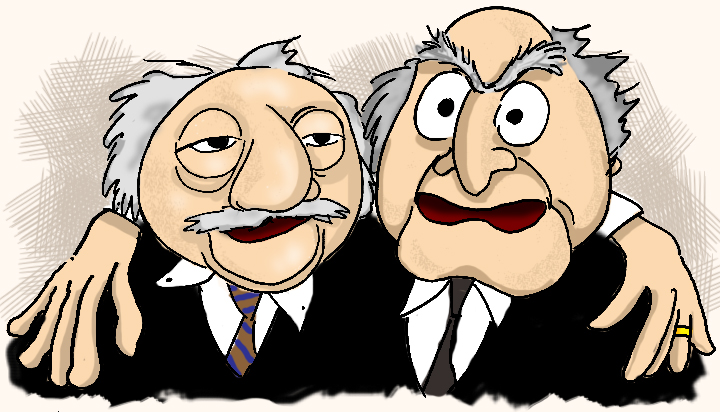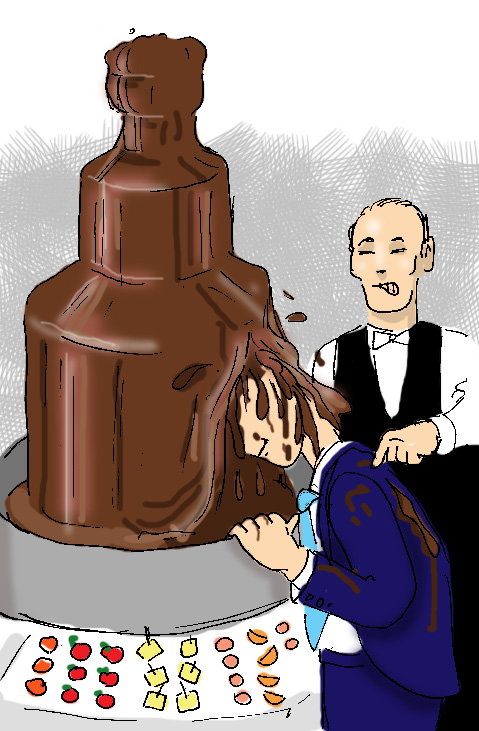
“Lorraine… I’m your density.”
* * * * *
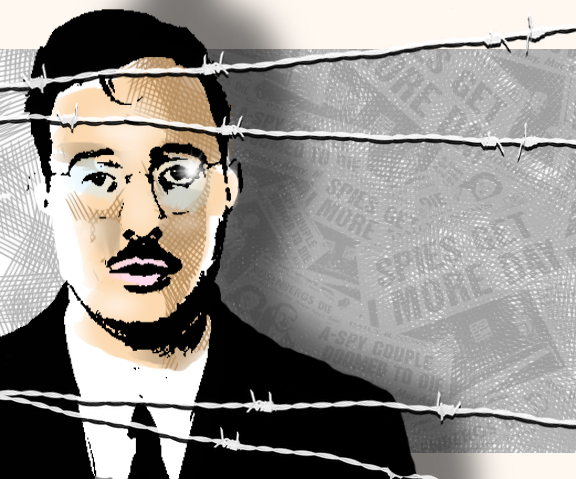
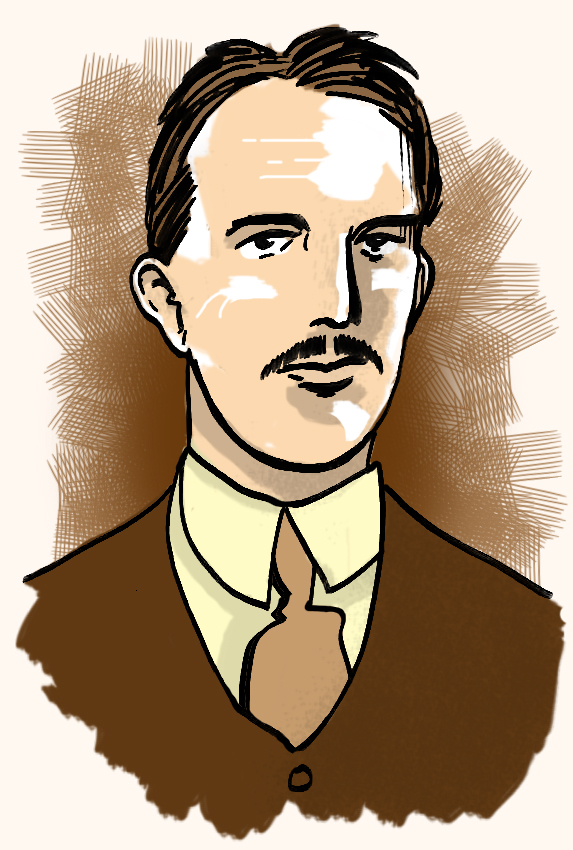
But, wait! There’s more!. HERE is another illustration for the word “future”!

“Lorraine… I’m your density.”
* * * * *
But, wait! There’s more!. HERE is another illustration for the word “future”!

Character actor Louis Calhern started off as a bit player and prop boy in touring burlesque companies. After a stint in the service in World War I, Louis returned to the stage, using his experience as a springboard to film. He worked in silent pictures for innovative and controversial director Lois Weber, one of Hollywood’s first female directors still revered today.
Louis’ varied roles showcased his versatility. He played the straight man to the zany Marx Brothers in the classic Duck Soup, a singing Buffalo Bill opposite Betty Hutton in Annie Get Your Gun and the shifty attorney keeping a young Marilyn Monroe as a mistress in The Asphalt Jungle. Louis also tackled Shakespeare, with the title roles in Julius Caesar and King Lear. In addition, he was directed by Alfred Hitchcock in Notorious.
Louis was married four times, including eleven years to Natalie Shaffer, best remembered as Lovely Howell on Gilligan’s Island.
While filming The Teahouse of the August Moon, on location in Nara, Japan, Louis suffered a fatal heart attack. He was replaced in his role by actor Paul Ford. Six years earlier, actor Frank Morgan (best known as The Wizard in The Wizard of Oz) suffered a fatal heart attack while shooting Annie Get Your Gun. He was replaced in his role by Louis Calhern.

Hollywood sure loves dumb blondes. But, no matter how hard it tried, Hollywood just couldn’t find one in Joi Lansing.
Joi was born Joyce Brown and, after her divorced mother remarried, she took her stepfather’s last name – Loveland. At the young age of 14, Joi was signed to a contract with MGM and altered her last name to “Lansing.” She soon found herself appearing as the ditsy sexpot, capitalizing on the fame of contemporaries Jayne Mansfield and Mamie Van Doren. Her wardrobe, as an uncredited chorus girl, cocktail waitress or model, usually consisted of a skimpy skirt, a curve-hugging sweater or a bathing suit – anything to exploit her voluptuous figure.
Joi moved into roles on television anthology series as well as modeling. As the 1950s came to a close, respected director Orson Welles recognized Joi’s acting ability and cast her in the lengthy but pivotal opening scene of his film Touch of Evil. She went on to star opposite Frank Sinatra in Hole in the Head and Dean Martin in Who Was That Lady?
Soon, her acting services were in high demand. She appeared in numerous guest spots on dramas and comedies throughout the 60s, including a multi-episode run on the popular “Beverly Hillbillies” and a memorable episode of the Superman series called “Superman’s Wife,” in which she played the title role. (She nearly became a regular character, but the show was canceled before she was hired.)
Despite her dim-witted on-screen persona, Joi was well-read, well-educated and very intelligent. She was also an observant Mormon and did not smoke or drink.
The end of the 1960s also brought an end to Joi’s career. She was relegated to mostly B pictures, including the country-music embarrassment Hillbillys in a Haunted House, a film turned down by Jayne Mansfield. Just after the film wrapped, Joi was diagnosed with breast cancer. She passed away in August 1972 at the age of 43.

The family of the late Sam Born, the recognized inventor of sprinkles, gather together to give him a very fitting tribute.

In its 130 year history, The Philadelphia Phillies have had their share of high points and low points. They have made it to the World Series several times, including two wins. Their line-ups have featured such celebrated players as Chuck Klein, Grover Cleveland Alexander, Steve Carlton, Mike Schmidt and the always controversial Pete Rose.
Their low points were illustrated by their eleven-game skid in 1964, denying them a spot in the post-season, their heartbreaking loss to Toronto in the 1993 World Series and their inexplicable bad luck in choosing the wrong brother (Mark Leiter, Juan Bell, Vince DiMaggio, Jeremy Giambi, Mike Maddux) time and time again.
But none match the low of Ben Chapman.
Ben began his career in 1930, as a teammate of Babe Ruth and Lou Gehrig. He led the American League in stolen bases for three consecutive seasons, finished four seasons hitting over .300 with 100 runs scored and was the first American League batter in the first All-Star Game in 1933. But it wasn’t Ben’s baseball prowess that garnered attention.
As a member of the New York Yankees, the Tennessee-born Ben often taunted Jewish fans with Nazi salutes and racial slurs. He provoked Washington Senators’ Jewish infielder Buddy Myer into a fight that involved 300 fans and resulted in fines and suspensions. Ben was traded and traded again over the course of his 16-year career until he finally ended up on the Phillies as a player-manager, then as full-time manager in 1945 when he was brought in to replace Freddie Fitzsimmons. The Phils were in the basement of the National League East.
In 1947, the Brooklyn Dodgers brought in a new first baseman, a young African-American named Jackie Robinson. This was unheard of in the segregated Major Leagues. Ben Chapman, his gravelly voice booming across the field from the Phillies’ dugout, derided Robinson with calls of “Come over here and shine my shoes, boy.” and “Why ain’t you a Pullman porter?” However, fans and players alike rallied around Jackie Robinson and Ben looked like the narrow-minded, bigoted fool that he was. Robinson’s one-time roommate Dixie Walker quipped, “I never thought I’d see old Ben eat shit like that.”
Jackie Robinson went on to an illustrious career, an honored place in history and an induction into the Baseball Hall of Fame. Ben Chapman went on to a losing managerial record and a playing career overshadowed by unfounded hatred.
He died of a heart attack at his Alabama home in 1993.

Early on Friday morning, September 20, 1991, my family gathered together to bury my mother. We all met at the facility — a large building surrounded by a huge blacktop parking lot. It was constructed just outside the city as an auxiliary to the funeral directors’ main location on a busy thoroughfare in Philadelphia. The main office, which houses a small chapel, has serviced the Philadelphia Jewish community since 1877. The new suburban operation could accommodate larger attended funerals while cutting down on the hassle of traffic, parking and overall inconvenience.
Just two days earlier, my wife and I, along with my father and my brother, found ourselves sitting in the administrative offices of the same building we were in now. Ben, the patriarch of the funeral directing family, personally guided us through the gut-wrenching process of picking out a casket and making the other arrangements. The whole ritual was very surreal, but it all hit home when we assembled again for the actual ceremony.
We arrived an hour or so before the predetermined start time and long before any mourners. We filed in to the building — first my father, then my brother and me and our respective wives — through a side door that led to a special “family only” room behind the main chapel. We were met by Ben who shook our hands and nodded his head in solemn sympathy, an action he’d been practicing and performing for decades. Ben briefly explained the minimal procedure of the ceremony and then the room was silent. Suddenly, my father — awkwardly trying to make small talk — asked Ben how he liked the new suburban faculty as compared to the compact building in Philadelphia.
Ben began to compare the easy-going police force of pastoral Southampton to the famously belligerent and corrupt Philadelphia law officers. And then he told a story…
When funerals were taking place, Ben had to arrange for Philadelphia Police to direct traffic on busy Broad Street, as the hearse, limousines and other members of the funeral procession maneuvered out of the tiny parking lot. Of course, the policemen would receive generous (but unmentioned) compensation from Ben, although they despised the assignment. At one funeral, in particular, Ben had to quickly jump out of the lead car and assist an elderly member of the immediate family who needed the help of a walker. The car stopped at the end of the driveway, with its front end in the street, as Ben leaped out and ran up to help the older woman with the walker into the car. A veteran policeman — one who knew Ben, but resented funeral duty — pounded on the hood of the temporarily-stopped vehicle.
“Get this car outta here!,” the cop yelled.
Ben, his arm wrapped around the shoulders of the woman as they inched their way towards the open car door, called back in a more appropriate half-whisper, “I’ll be there in a second, as soon as I get her settled.”
The policeman, a big mustachioed lug with a face reddened from years of heavy drinking, spit back, “You goddamn Jews think you own Broad Street! Now get this car going!”
Stray members of the funeral contingency froze in place and whipped their heads in the policeman’s direction. Several car windows quickly rolled down so the occupants could get a better listen. Ben leaned over to the woman and said, “I’ll be right back.”
He marched up the the policeman, and — in his best suit and in full view of the entire group of mourning family and friends — reared back and punched the officer square in the mouth, his heavy class ring connecting with the officer’s mandible. The officer tumbled backwards. Within seconds, six policemen had surrounded Ben while one forced his wrists into a pair of handcuffs. Another member of Ben’s family jumped into Ben’s place and took over the proceedings, as Ben was whisked away to police headquarters.
The desk officer looked up from his log book.
“Ben? What are you doing here?, ” he asked. He had known Ben for many years.
Ben, flanked by two officers, told his story and mentioned the trouble-making cop by name.
“Ugh! Him!,” the desk officer said, rolling his eyes, “I would’ve figured!”
Ben was released.
Several months later, the Philadelphia Inquirer ran a story about a policeman who was caught in the middle of the day, drinking in a bar during his shift and dancing on the bar, stripped down to his boxers. It was Ben’s instigator. He was relieved of his duties.
Ben finished his little anecdote and looked up at my family. We were dumbfounded.
“Okay, folks,” he said, smiling and pointing to the chapel door, “Time to go out there.”

Thomas and his pals finally had enough of Sir Topham Hatt’s slave-driving bullshit.

One evening, Mrs. Pincus and I ventured to Harrah’s Casino in Atlantic City to have dinner at their buffet. (Boy! How many of my stories have started out with that sentence?!) After dinner, we wandered into the casino for a little play on the many slot machines. As a member of the Harrah’s Slot Players Club, my wife had several promotional vouchers redeemable for play. Knowing that I get bored quickly by slot machines and I really don’t like handing over my hard-earned income to casinos, she offered the vouchers to me. Meanwhile, she handed over my hard-earned income. Somehow, that indirect path makes it a little less painful.
I took my $25 voucher and parked myself in front of a blinking little machine called “Sneeki-Tiki”. The six electronic “reels” featured a Polynesian theme and winning combinations were rewarded with the strains of digital bongo drums and slack key guitars, along with a monetary gain. I slid my voucher into the cash slot*, selected my bet (2 credits per line, equivalent to 80 cents a spin) and hit the big “SPIN” button. The video reels spun into a blur and finally stopped, giving me a payout of just under a buck. I repeated the procedure, but this time the monitor did not show a single combination of winning symbols… nothing. Once more, I spun, since I had to use the remainder of the non-refundable promo money. On this spin the first reel filled with a monkey, a parrot, a coconut and a bamboo stick. The next four reels displayed a cartoon tiki sculpture that each suddenly expanded to fill the entire reel. The animated character grinned and bellowed “Go Wild” in a distinctly island-tinged accent, indicating that the symbol was “wild” and could be substituted for any and all symbols in play. The last reel slowed to a stop and the machine exploded in music, sound effects and multicolored graphics. A banner proclaiming “BIG WIN” splashed across the screen. For my 80¢ bet, I had just hit for $997.00.
“Cool, ” I thought, but since Mrs. P had disappeared to another part of the casino, I had to celebrate my good fortune silently. I played until my promo funds were exhausted. (I actually hit for another fifty-five bucks on top of my big win, before cashing out.) I grabbed the newly-printed voucher from the machine and set off to locate my spouse.
Clear on the other side of the casino, I found Mrs. P sitting before an Egyptian-themed machine, with a relatively sad look on her face. She was smacking the “SPIN” button on her machine. It was answered, for the most part, with the silence of loss.
“How are you doing?,” I asked.
“Not good.,” she said, “You?”
Without a word I displayed the plain, black & white, bar-coded piece of paper at eye-level. Her eyes zoomed in on the large, bold print that read $1052.00.
A grin spread across her face, followed by a barrage of questions: “What machine did you play?,” “How much did you bet?,” “How on earth did you walk away?”
I explained my brief – and really uneventful, except for the payoff –encounter with the Sneeki-Tiki machine. Mrs. P. cashed out her meager cash reserve and we left for home.
The next week, we found ourselves, once again, walking the slot machine-lined paths of Harrah’s Casino. I bee-lined to the Sneeki-Tiki, reaching for my wallet before I was even seated. Mrs. P tried to persuade me to increase my bet, mimicking her recklessly exorbitant wagers, but I stuck to my guns and repeated my lucky 80¢ bet. Within seconds, the machine was again ringing with good fortune. A single spin had yielded a return of $275.00. I mashed the “CASH OUT” button and my voucher slid out of the slot.
“That’s it?,” my wife inquired, “You’re finished?”
“Sure,” I replied, “I’m happy with two-hundred and seventy-five bucks that I didn’t have when I walked in here.”
For the rest of the evening, I stood alongside Mrs. P, feeding bill after bill into a variety of slot machines, as she sought out her elusive big pay out.
A few weeks had passed before we were back at Harrah’s, but once exiting the parking garage, I headed straight for my personal, colorful ATM. I strode up to the secluded alcove just off the hotel’s front desk where I was met with a huge shock. Sneeki-Tiki was gone. GONE! In its place was some differently-configured mermaid-themed machine. I scanned the immediate area. The other machines were all the same ones that had always been there. I went over to the convenient “Slot Finder” directory and punched “S-N-E-E-K” into its virtual keyboard. Nothing. “No Matches Found” was my result. I took my search into the further reaches of the casino floor, but Sneeki-Tiki was nowhere to be found. While I searched, I’m pretty sure I heard echoing laughter in a distinct, island-tinged accent.
See what I saw, except for the payout… I keep that.
* I don’t know the last time you were in a casino, but slot machines no longer take nor dispense actual coins.

I don’t believe there is such a thing as a “guilty pleasure.” I think if you like something, you like it and you should enjoy it and not be embarrassed by the fact that you enjoy it.
I am proud to say that I am the owner of the Frankie and Annette “Beach Party” DVD box set. I don’t hide the fact that I love each and every one of those hokey, paper thin-plot masterpieces. I love watching them and I do so quite often. When I pop one into my DVD player, it’s like an old friend has come to visit, pulling up in my living room in its woody, waxing down its longboard and catching a wave. The dialogue is awful. The acting is sub-par. The songs are formulaic from one film to the next… and I just can’t get enough of ’em. The best thing about these films is they don’t pretend to be anything more than what they are. They were conceived to cash in on the popularity of the California surfing craze, the budding rock & roll market and the precious teenage demographic. With producer William Asher at the helm, they hit their mark and lasted for twelve films over five years. When Beach Party, the first film in the series premiered in 1963, its main draw was every adolescent boy’s dream girl, little Annette from Walt Disney’s Mickey Mouse Club – now all grown up and twisting on the beach in her two-piece bathing suit (not revealing her navel, as requested by dear old Uncle Walt).
Annette passed away today. She was 70 years old and she had been living with multiple sclerosis for 22 years. She had lost the ability to walk and soon after, lost the ability to speak. I will miss Annette, but I can always have a visit from her anytime I wish. She can be dancing with her Frankie, waving the checkered flag at the end of a hot rod race or conspiring with Peanut and Animal to get even with those no-good boys!
Annette will always be the Pineapple Princess.

I’m the Urban Spaceman, baby,
I’ve got speed.
I’ve got everything I need.
I’m the Urban Spaceman, baby,
I can fly.
I’m a supersonic guy.