
The Monday Artday challenge this week is “illustrate the comic book hero, Wonder Woman, in your style.”
This is the second of two illustrations for this challenge.
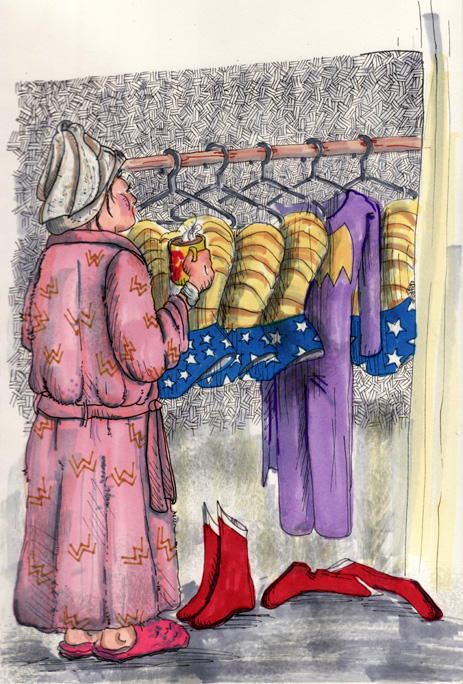
“hmmmm, I guess I’ll wear the Wonder Woman costume…..again.”
Monday Artday: wonder woman
The Monday Artday challenge this week is “illustrate the comic book hero, Wonder Woman, in your style.”
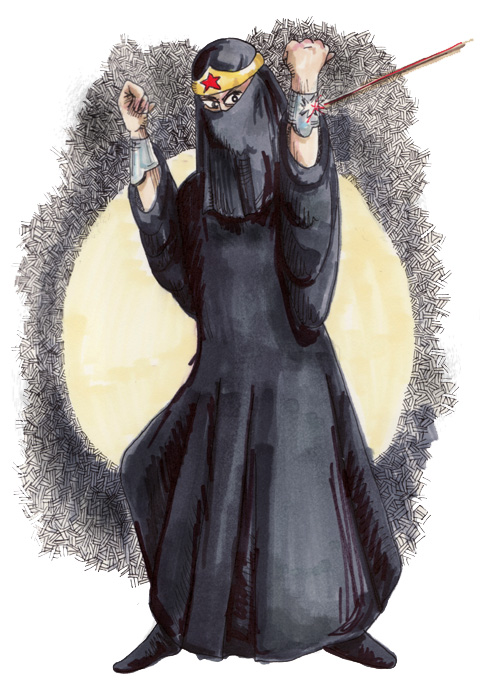
What if, in 1941, Diana Prince didn’t go to the United States when she left Paradise Island?
What if she ended up in a Muslim country?
Comments
IF: heavy
The illustrationfriday.com challenge word this week is “heavy”.
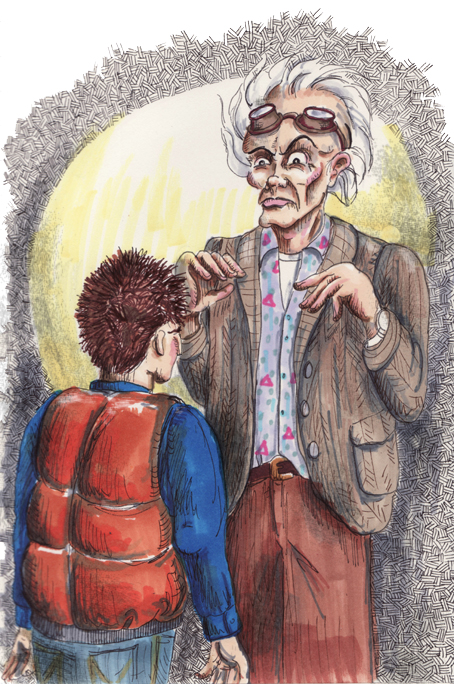
“There’s that word again ‘heavy’. Why are things so heavy in the future? Is there a problem with the earth’s gravitational pull?”
Comments
SFG: innocent
The sugarfrostedgoodness.com challenge word this week is “innocent”.
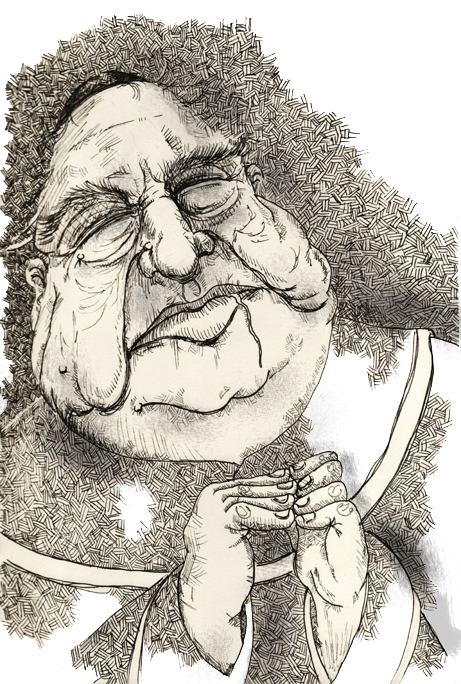
On August 29, 1484, Pope Innocent VIII succeeded Pope Sixtus IV (for whom the Sistine Chapel was named). And it was all downhill from there.
After his coronation, he went back all his promises and left his signatures unhonored, slyly revelling in his immunity. He abandoned the decorum of Pope Sixtus IV, and settled down to enjoy life in his own slothful way. He was a despicable creature; ungrateful, avaricious and cowardly. His only interest seems to have been the establishment of his numerous illegitimate progeny. The Vatican became overrun by his sons and daughters, their children and grandchildren.
Innocent VIII slept almost continuously. When awake his favorite pasttime was persecuting Jews. He squeezed every shekel he could out of them, and reduced the Jewish ghetto to a state of misery and terror. Such gross self-indulgence would naturally undermine the strongest constitution. The Pontiff grew immensely fat and his health gradually declined. By the summer of 1492, he had become an inert mass of flesh, incapable of taking any nourishment with the exception of being breastfed by a hired young woman.
A Jewish doctor offered to attempt a blood transfusion to save Innocent VIII’s life. The doctor indicated that the Pope only needed the blood of three healthy young menChristians presumably. The donors, three 10-year-old boys, were procured from their parents, at one ducat (a gold coin used before World War I) each. The operation resulted in the three healthy young men dying.
Innocent VIII died on July 25, 1492, leaving behind numerous children, of whom only two were publicly acknowledged, the others presented in the usual way as nephews. Octo nocens pueros genuit, totidemque puellas; Hunc merito poterit dicere Roma patrem. The wicked man begat eight boys, and just as many girls, so that Rome might justly call him Father.
Comments
from my sketchbook: edward hickman & marian parker
“She left her home one morning/For her school not far away./And no one dreamed that danger/Was lurking near that day”
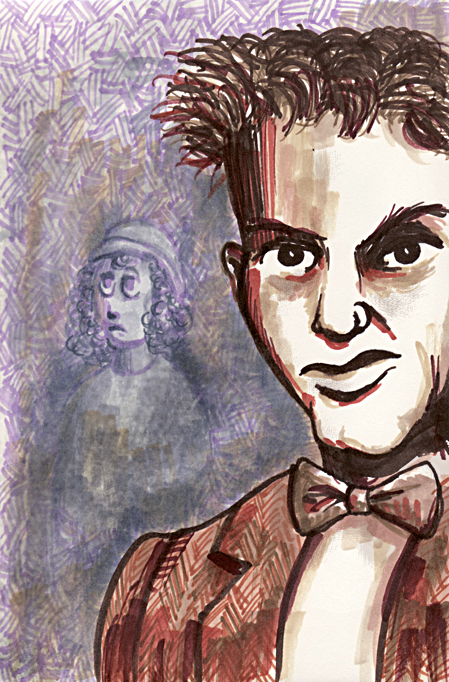
On December 15, 1927, Marion Parker, the 12-year-old daughter of Perry Parker, a prominent banker in Los Angeles, was abducted from her school. Nineteen-year-old Edward Hickman showed up at the school Marian attended with her twin sister, Mt. Vernon Junior High School in Los Angeles. He told officials at the school that the girls’ father had been taken seriously ill and that he wanted “the younger daughter” to come quickly to his side. The girls’ teacher was somewhat confused by the request for just one of the twins as well as the man’s request for “the younger daughter.” When queried again, Hickman corrected himself and asked for “the smaller one.”
After Marian’s disappearance was reported to police, the Parker family received a pair of telegrams, signed by “George Fox.” The telegrams told the family to expect further communication and ransom demands. The next day, Parker received a note from “Fox.” The note began with the header “Δ ε α τ η” meant to spell the word “Death” using Greek characters. “Fox is my name, very sly you know,” began Hickman’s note. “Get this straight. Your daughter’s life hangs by a thread and I have a Gillette ready and able to handle the situation.”
Mr. Parker placed the ransom money, $1,500 in cash, in a black bag and drove off to meet “The Fox.” Hickman and Parker met at the corner of 5th Avenue and South Manhattan Street in Los Angeles about 7:30 p.m. on December 17th. Hickman drove up in his car, pointed a gun at Parker and said “You know what I’m here for. No monkey business.” Parker asked, “Can I see my little girl?” Hickman pointed to a tightly tied package in the car that revealed only Marian’s head. Parker handed over the ransom and as they agreed, Hickman drove a block down the road and pushed Marian out of the car. Parker ran down to where his little girl was lying and picked her up in his arms. Marian was dead. The package contained just her head and torso. Her arms and legs had been chopped off where they joined her body. A wire had been wrapped around her head just above her eyes, keeping them open. Her body had been disemboweled and her empty abdomen stuffed with rags. She had also apparently been flogged to such an extent that the flesh on her back was flayed. Her internal organs had been cut out and, along with her severed limbs, were later found wrapped in newspaper and strewn all over the Los Angeles area.
A massive manhunt for her killer began. Huge cash rewards were offered to anyone who could provide information that led to the identification and capture of “The Fox.” Suspicion quickly settled upon a former employee of Mr. Parker named William Edward Hickman. Several years earlier, Hickman was arrested on a complaint by Mr. Parker regarding stolen and forged checks. Hickman was convicted and did prison time. Investigators compared his fingerprints with prints found on the ransom note. They matched. Hickman’s photo was plastered all over the newspapers and sent to every police department on the west coast. Only a week after the kidnapping murder, two officers who recognized him from the wanted posters, found Hickman in Echo, Oregon. He was conveyed back to Los Angeles where he promptly confessed to another murder he committed during a drug store hold-up. Eventually, Hickman confessed to a dozen armed robberies. Hickman never said why he had killed the girl and cut off her limbs, but he did say he was sorry she was killed. His attorneys attempted to enter a plea of insanity for Hickman. The jury wouldn’t buy it. He was convicted of murder. On October 19, 1928, Hickman was hanged at San Quentin Prison. He never expressed any remorse for what he did.
Comments
Monday Artday: wee folk
Here is a direct quote from Monday Artday introducing the weekly challenge:
“THIS WEEK’S CHALLENGE
Wee Folk – use any medium to illustrate the theme. Wee Folk are leprechauns, faeries, sprites, brownies, etc.”
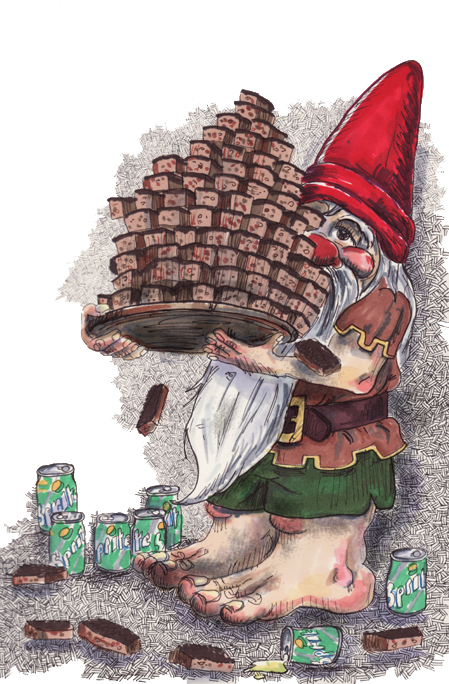
maybe I misunderstood…
Comments
IF: garden
This week’s challenge word on illustrationfriday.com is “garden”.
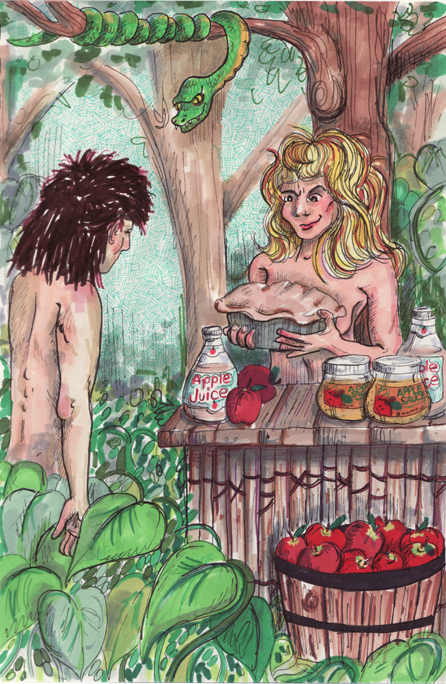
In the Garden of Eden (or as Iron Butterfly said “In-A-Gadda-Da-Vida”) story from Genesis, God molds Adam from the dust of the Earth, then forms Eve from Adam’s “side”, and places them both in the garden, eastward in Eden. “Male and female he created them; and blessed them, and called their name Adam, … ” It may be allegorical, in as much as “Adam” may be a general term, like “Man” and refers to the whole of humankind.
God charges Adam and Eve to tend the garden in which they live, and specifically commands Adam not to eat from the Tree of the Knowledge of Good and Evil. Eve is quizzed by the serpent why she avoids eating of this tree. In the dialogue between the two, Eve elaborates on the commandment not to eat of its fruit. She says that even if she touches the tree she will die. The serpent responds that she will not die, rather she would become like a god, knowing good and evil. Eve then eats from the Tree of Knowledge of Good and Evil and persuades Adam to eat from it too. God doesn’t take too kindly to being disobeyed. He finds them, confronts them, and judges them. God kicks them out of Eden, to keep Adam and Eve from partaking of the Tree of Life. At the gates of Eden, God places cherubim (angels) with an omnidirectional flaming swords to guard against any future entrance into the garden.
After they were removed from the garden, Adam was forced to work hard for his food. Eve went on to become the first CEO of Motts.
Comments
SFG: wicked
The challenge word on sugarfrostedgoodness.com is “wicked”.
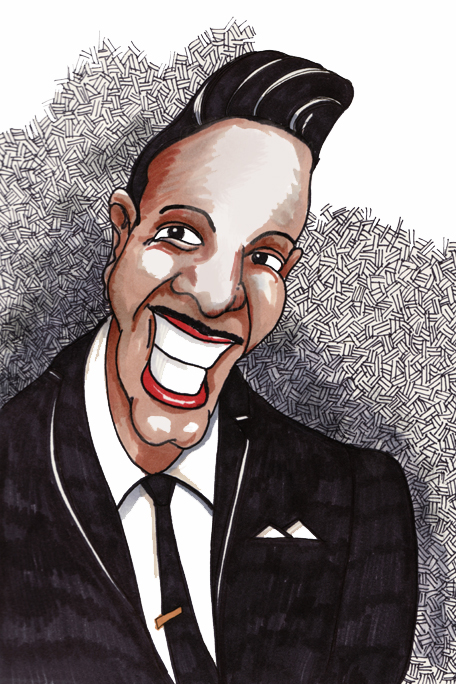
“Wicked” Wilson Pickett was born March 18, 1941 in Prattville, Alabama, and grew up singing in Baptist church choirs. He was the youngest of 11 children. He made reference to his mother as “the baddest woman in my book.” He said, “I get scared of her now. She used to hit me with anything, skillets, stove wood. One time I ran away and cried for a week. [I] stayed in the woods, me and my little dog.” Pickett eventually left to live with his father in Detroit in 1955.
He rose to stardom with such memorable hit songs as “In the Midnight Hour”, “Mustang Sally”, “634-5789”, “Land of 1000 Dances”, “Funky Broadway” and many, many more. Pickett was also a popular songwriter, as songs he wrote were recorded by such diverse artists as Led Zeppelin, Van Halen, The Rolling Stones, Aerosmith, the Grateful Dead, Booker T. & the MGs, Genesis, Creedence Clearwater Revival, Hootie & the Blowfish, Echo & The Bunnymen, Roxy Music, Bruce Springsteen, Los Lobos, The Jam, Ani DiFranco, among others.
Outside of music, Pickett’s personal life was troubled. Even in his 1960s heyday, Pickett’s friends found him to be temperamental and preoccupied with guns. In 1987, as his recording career was drying up, Pickett was given two years’ probation and fined $1,000 for carrying a loaded shotgun in his car. In 1991, he was arrested for allegedly yelling death threats while driving a car over the mayor’s front lawn in Englewood, New Jersey. The following year, he was charged with assaulting his girlfriend. In 1993, Pickett was involved in an accident where he struck an 86-year-old pedestrian with his car in Englewood. Pickett pled guilty to drunken driving charges and received a reduced sentence of one year in jail and five years probation. Pickett had also been previously convicted of various drug offenses.
Throughout the 1990s, despite his personal troubles, Pickett was continuously honored for his contributions to music, and was inducted into the Rock and Roll Hall of Fame.
Several years after his release from jail, Pickett returned to the studio and received a Grammy nomination for the 1999 album “It’s Harder Now”. The comeback also resulted in his being honored as Soul/Blues Male Artist of the Year by the Blues Foundation in Memphis.
Pickett died of a heart attack January 19, 2006 in the hospital near his Ashburn, Virginia home and, ironically, was buried next to his mother in Louisville, Kentucky.
Comments
from my sketchbook: susan cabot
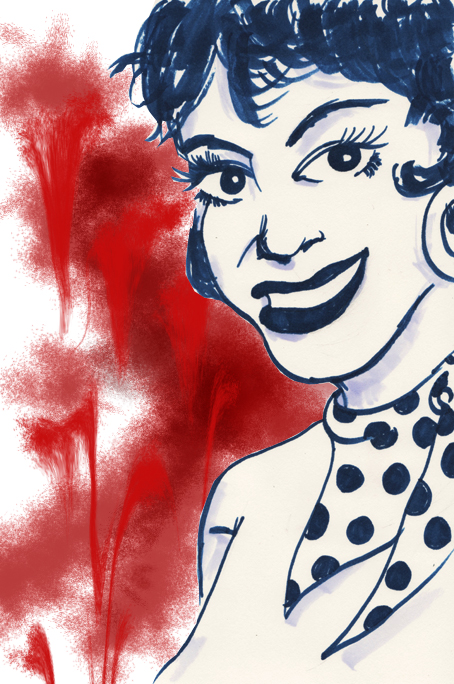
Born Harriet Shapiro on July 9, 1927 in Boston, Susan Cabot grew up shuffled between 8 foster homes. She developed an interest in acting and singing performing evenings at Manhattans Village Barn. A film career seemed destined when the nightclub singer appeared in the 1947 film Kiss of Death with Colleen Gray and Victor Mature. After the film she remained in New York for a bit and did some television work. She expanded her acting work into television and was seen by a Hollywood talent scout who took her to Hollywood to work for Columbia Pictures. This brief period was not successful, and she moved to Universal Studios where she was signed to an exclusive contract. After a series of roles which Cabot played mainly in “B” western films, she grew frustrated and asked to be released from her contract. Cabot moved back to New York and in 1957 she made a decision that would insure her screen immortality. She signed an exclusive contract with producer Roger Corman. First up, she was the villainous Enger in The Viking Women and The Sea Serpent. The same year she starred in Carnival Rock and Sorority Girl both costarring Dick Miller. She followed that with Machine Gun Kelly in 1958, co-starring a young Charles Bronson. However, Susan Cabots most famous role was also her final film. In 1960, she played cosmetics company president Janice Starlin in The Wasp Woman. During this time, Cabot had an affair with King Hussein of Jordan. He eventually dumped her when he discovered she was Jewish.
Cabot gave birth to a son, Timothy in 1963. Timothy suffered from dwarfism. Cabot was almost inseparable from Timothy. She devoted her life to him, insisting he take experimental growth hormones. She began to take her son’s hormones, too. The drugs affected their mental stability. Cabot became a recluse. Timothy found solace in weight-lifting equipment.
One night in December 1986, police responded to a call at the Cabot house. When they arrived, Timothy told them that “a tall Latino with curly hair, dressed like a Japanese Ninja warrior”, had attacked them both, making off with about $70,000 cash. He told the cops that he fought with the intruder, and was knocked out. According to the autopsy report, Susan Cabot was lying in bed, on her stomach. Her head was covered with a piece of bed linen. They noted blood spatters on the mirrored walls and ceiling and it appeared that she had the linen over her head during the attack. There were no defense wounds.
After becoming suspicious of her son, police questioned him further. Timothy cracked and directed them to the murder weapon. A weight lifting bar, probably from a dumbbell. It was hidden in a box of Bold 3 laundry detergent, in his hamper.
Timothy received a three-year suspended sentence and was placed on probation.
Comments
Monday Artday: change
The Monday Artday challenge this week is “change”.
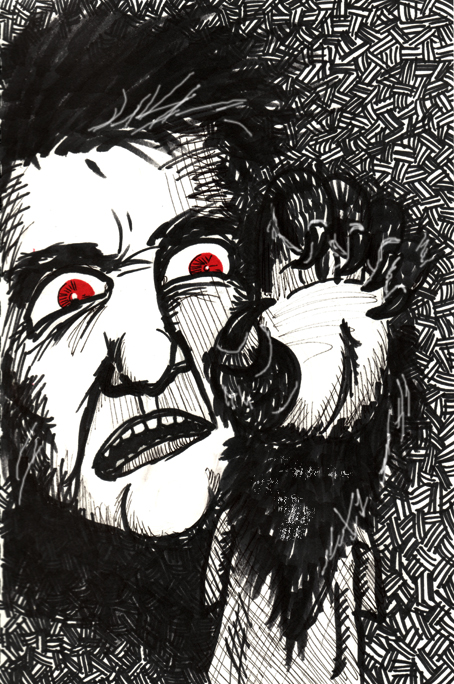
“Even a man who is pure at heart, and says his prayers by night, may become a wolf when the wolfbane blooms and the autumn moon is bright.”
This quote has been listed in some sources as an authentic Gypsy or Eastern European folk saying. Screenwriter Curt Siodmak admits that he simply made it up for 1941’s The Wolf Man. However, the rhyme would be recited in every future Universal film appearance of the Wolf Man, and would also be quoted in Van Helsing (2004).