DCS: judy tyler

How dare you think such cheap tactics would work with me!
At 17, Judy Tyler played Princess SummerFallWinterSpring on the Howdy Doody Show. She played the role for two years and moved to Broadway to star in the Rodgers and Hammerstein musical, Pipe Dream. Judy appeared on the cover of Life Magazine and was nominated for a Tony award. Although she lost to Lotte Lenya’s performance in “A Three Penny Opera”,  Judy headed for Hollywood. In 1957, she starred in her first film, Bop Girl Goes Calypso, with Bobby Troup, the songwriter who wrote “Route 66”. The same year, Judy began work on her second and final film – Jailhouse Rock. She played Peggy Van Alden, the young record promoter who takes Elvis’ character, Vince Everett, under her wing. She gets to deliver one of the classic lines from the film: “I like the way you swing a guitar!”

Three days after filming was completed on Jailhouse Rock, Judy and her husband, Greg, took a vacation. While driving through Rock River, Wyoming, their car swerved to avoid a truck and collided with another truck. Judy and Greg were killed instantly.

Elvis was infatuated with Judy during the filming of Jailhouse Rock. He said he could never watch the film because he was so saddened by her death.

Comments

comments

from my sketchbook: the vomit club

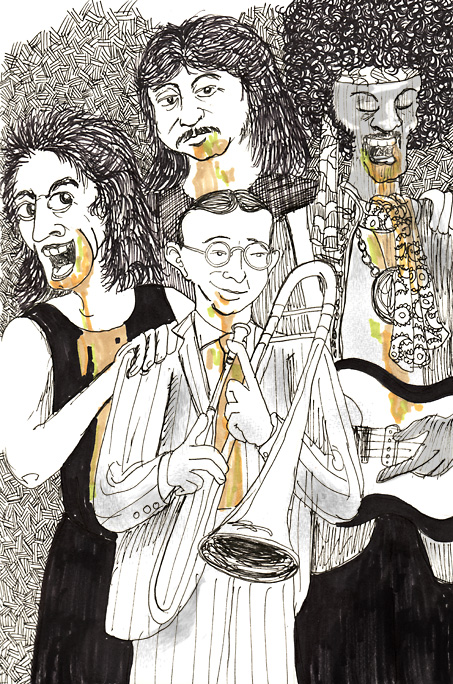
hey Joe, where you goin' with that vomit in your lungs?
The differences between genres of music has intrigued me for some time. And as different as they seem, these four performers from different eras have something in common.
Tommy Dorsey was a giant in the big band era. His orchestra included, at one time or another, trumpeters Doc Severinsen, and Charlie Shavers, drummers Buddy Rich, Louis Bellson and Gene Krupa, singers Jo Stafford, Dick Haymes and Frank Sinatra and trombonist Nelson Riddle. In 1956, Tommy Dorsey took some sleeping pills and rested after a heavy meal. While asleep, he choked to death on his own vomit.
Bon Scott was the lead singer for Austailia’s AC/DC. Originally, the band’s truck driver, Scott was recruited by Angus and Malcolm Young to replace current singer Dave Evans. Scott accepted the Young brother’s proposal and AC/DC went on to become a wildly popular heavy metal band in their native Australia and later the world. In 1980, at the age of 33, Scott went out for a night of heavy drinking with some friends. He was found dead behind the wheel of a parked car in South London. He had passed out and choked to death on his own vomit.
Jon Bonham was the drummer for Led Zeppelin. After the break-up of The Yardbirds, Jimmy Page saw Bonham drum at a performance and was convinced this was the guy he needed for his new band. Led Zeppelin’s live performances featured half hour drum solos culminating with a manic Bonham banging on his drumkit with his bare hands. Led Zeppelin gained worldwide popularity and are still revered after almost thirty years since their last studio album. In 1980, John Bonham attended a rehearsal for Zeppelin’s upcoming U.S. tour. On the way to the rehearsal, Bonham stopped for breakfast, which included sixteen shots of vodka. He continued to drink heavily after he arrived at the studio. The rehearsal ended late in the evening and the band retired to Jimmy Page’s house. After midnight, Bonham had fallen asleep and was taken to bed and placed on his side. Band manager Benji LeFevre and bassist John Paul Jones found him dead the next morning. During the night, Bonham had choked to death on his own vomit.
Jimi Hendrix was a guitarist, singer and songwriter whose guitar playing was cited as the main influence for many guitarists. Although he only produced three studio albums, his live performances were legendary. His stage act included playing his guitar behind his head, playing with his teeth and then setting the instrument on fire. One evening in September 1970, Hendrix attended a party in London. Afterwards, he was picked up by his girlfriend and driven to her room at the Samarkand Hotel. He had taken nine of her prescription sleeping pills. During the night, Hendrix had choked to death on his own vomit.

Four performers. One common bond.

Comments

comments

IF: enough

The illustrationfriday.com word this week is “enough”.
why is this illustration different from all other illustrations?
Dayenu is a song that is part of the Jewish holiday of Passover. The word “Dayenu” means “it would have been enough for us”. This traditional Passover song is about being grateful to God for all of the gifts he gave the Jewish people, such as taking them out of slavery, giving them the Torah and Shabbat, and had God only given one of the gifts, it would have still been enough. This is to show much greater appreciation for all of them as a whole. The song appears in the haggadah after the telling of the story of the exodus and just before the explanation of Passover, matzah and the maror.
 

Dayenu has 15 stanzas representing the 15 gifts God bestowed. The first five involve freeing the Jews from slavery, the next describe the miracles he did for them, and the last five for the closeness to God he gave them. After each of the stanzas, participants sing the word “Dayenu” (“that would have been enough”). The 15 stanzas are:
 Five Stanzas of Leaving Slavery
1. If He had brought us out of Egypt.
2. If He had executed justice upon the Egyptians.
3. If He had executed justice upon their gods.
4. If He had slain their first born.
5. If He had given to us their health and wealth
 Five Stanzas of Miracles
6. If He had split the sea for us.
7. If He had led us through on dry land.
8. If He had drowned our oppressors.
9. If He had provided for our needs in the wilderness for 40 years.
10. If He had fed us manna.
 Five Stanzas of Being With God
11. If He had given us Shabbat.
12. If He had led us to Mount Sinai.
13. If He had given us the Torah.
14. If He had brought us into the Land of Israel.
15. He built the Temple for us.

Jews in Afghanistan traditionally hit each other over the head with green onions during the refrain of the ninth stanza of Dayenu. This may be due to a passage in Numbers 11:5-6, where the Israelites see manna and recall Egypt. “We remember the fish that we used to eat in Egypt, the cucumbers, the melons, the leeks, the ONIONS and the garlic.

Zebulon Simentov hasn’t had anyone to smack on the head with green onions since Passover 2004. Although Jews have a 2,500 year history in Afghanistan, Zebulon and Ishaq Levin were the only two left since late 1999. They shared living space in the synagogue for which Ishaq was the “shamash” or caretaker. Despite sharing living quarters, Zebulon and Ishaq were bitter enemies and never spoke to each other. The two men silently went through their prayer rituals and their holiday preparations. They blamed each other for their regular arrests and beatings at the hands of the Taliban. Ishaq would tell Taliban officials that Zebulon was a spy. Zebulon blamed Ishaq for the confiscation of the synagogue’s Torah. They glared at each other when they crossed paths in the synagogue’s courtyard. One morning in January 2005, Zebulon found the 70 year-old Ishaq dead in his room in the synagogue. Zebulon contacted his own family, who in turn contacted Ishaq’s family. Ishaq’s family and the Israeli government arranged for burial at The Mount of Olives.

Zebulon’s wife and daughter live in Israel, leaving Zebulon as the only Jew in Afghanistan. He has no plans to leave. He will continue to read from his tattered scriptures and, when Passover rolls around, he will smack himself with green onions.

Comments

comments

Monday Artday: steampunk

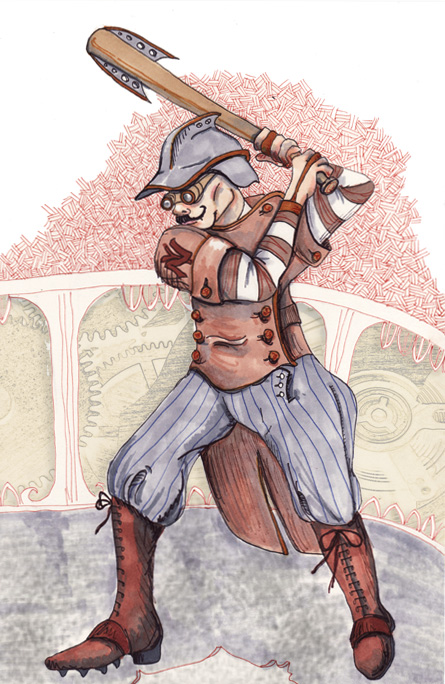
The challenge word this week on Monday Artday is “steampunk”. This may be an unfamiliar concept to some, so I’ll do my best to explain it. According to Wikipedia,  the Internet source for everything (including a little bullshit), steampunk is a genre of  fiction that came into prominence in the 1980s and early 1990s. The term denotes works set in an era or world where steam power is still widely used—usually the 19th century, and often set in Victorian era England—but with prominent elements of either science fiction or fantasy, such as fictional technological inventions like those found in the works of H. G. Wells and Jules Verne, or real technological developments like computers occurring at an earlier date. Clear on that? I didn’t think so. Well, If you are one of the six people who saw the Will Smith-Kevin Kline movie Wild Wild West“, you get the idea. That said, let’s get to my illustration.
I say, hurl the spheroid in the directional path of the striker... quite rapidly!
In the late nineteenth century, a field game called base-ball  was becoming popular throughout the countryside. With the game still in its infancy, participants sought ways and means with which to gain an edge over their adversaries. Long before the abundance of steroids infiltrated these contests, players relied on technology to enhance their performance. One such player was C. Abercrombie Wheatsworth III. “The Crom”, as he was known to be called by spectators, was the mid-short fielder for the Manhattan Island Gyroscopes of Greater New York State.
In the late summer of 1896, The Gyroscopes were embroiled in a brutal struggle with the Cleveland Steamers, their league division rivals. Tempers were high and nerves were on edge as the score stood in a dead heat at 3-3 in the crucial bottom of the ninth inning. The winning run was on third base. “The Crom” approached the lime-delineated batter’s box and keenly stared down the hurler on the mound. The Steamers’ pitcher, Dirk T. Sanchez, was a mysterious foreign import who had previously played for the Mexican League in Zihuatanejo in the western part of Guerrero.
“The Crom” motioned to the equipment boy to bring his secret weapon. The boy scampered to the dugout and returned with a gleaming length of polished brass, chrome and wood, topped with ornate and elaborate wind deflectors affixed to the massive barrel. “The Crom Pulveritizer” he called it. These were times of limited equipment stipulations and few regulated ordinances. The lanky Sanchez deftly pitched the cowhide-covered projectile at full velocity in Wheatsworth’s direction. Wheatsworth reared back and struck the orb squarely across the brown leather stitches. The sphere rocketed high and far. With his chest puffed out like a Christmas goose, “The Crom” triumphantly circled the bases and once again was the hero of Old New Amsterdam.

Comments

comments

from my sketchbook: karl dane

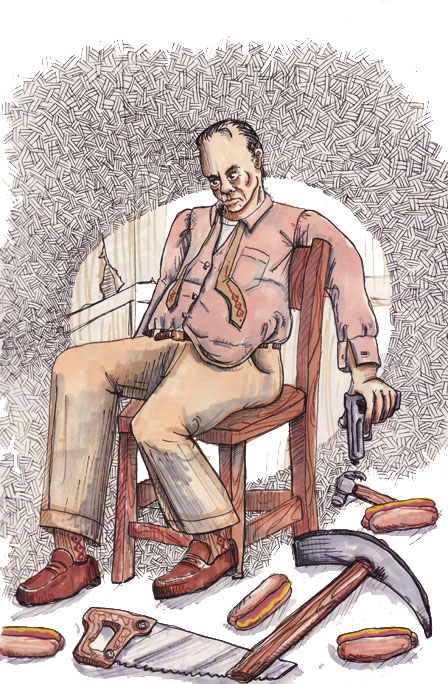
hot diggity dog ziggity/ooh, what ya do to me
Rasmus Karl Therkelsen Gottlieb was born in 1886 in central Copenhagen, Denmark. As a teenager, he apprenticed as a machinist. He married and had two children, but with the outbreak of World War I, he entered the military. In 1916, after his discharge from military service, he headed to America alone, hoping to send for his family later (he didn’t). He had $25 in his pocket and spoke no English. He found work in a foundry. By summer 1917, he worked as an auto mechanic.

In Denmark, Karl’s father worked as a curtain-puller at a theater. Hanging around the theater, Karl got the inspiration to act. In late 1917, Karl appeared in his first picture. It was the first of a series of anti-German propaganda films. Karl was paid three dollars a day. He was making three dollars a week as a mechanic. The films were very successful. Rasmus Karl Therkelsen Gottlieb changed his name to “Karl Dane” and officially became an actor.

In December 1924, Karl was cast in King Vidor‘s “The Big Parade”. The movie was a major success, becoming the second highest grossing silent film of all time, making almost $6.5 million.

Karl worked alongside Rudolph Valentino in “Son of the Sheik”. This film was also a success. Karl signed a contract with MGM in 1926. He began to appear as comic relief in several films including “The Scarlet Letter”, “La Boheme” and “Alias Jimmy Valentine”. Soon after signing his MGM contract, Karl teamed with George K. Arthur as a comedic duo. Together they were dubbed Dane & Arthur. In May 1927 the duo’s first film was an instant success, as were their subsequent films. By June 1927 MGM signed Karl to a long term contract. Dane & Arthur’s last silent short was released in 1928. Their first talkie was released a short time later. George Arthur had distinct British accent. Karl, however, had a thick guttural Danish accent which made his English hard to understand. Five films later, Karl lost his contract with MGM and suffered a nervous breakdown. After some much-needed rest, Dane & Arthur made a few shorts for Paramount and RKO and set out for a short vaudeville tour.

In November 1931, after the tour, Karl and some friends formed a mining corporation. The venture failed. Karl headed back to vaudeville with a solo comedic act. His act was panned by critics and was short lived.

By the summer of 1933, unable to get a movie contract, a desperate Karl had given up on films and turned again to mining. He spent three months driving up and down the West Coast trying to find a good mining deal and ended up losing $1,100 when various ventures never took off. Deeply depressed and broken down, Karl took on several jobs including mechanic, waiter, and carpenter. He was unable to hold any of these jobs. In late 1933, Karl purchased a hot dog stand outside MGM Studios, where just five years earlier he was a huge and productive star. The business failed, as it was shunned by his former friends. Karl tried to find work with his former studio as an extra or carpenter but was turned away. He was seeking a job that would pay $5 a day.

On April 13, 1934, Karl was pick-pocketed of all the money he had — $18.

On April 14, 1934, Karl didn’t keep his movie date with a young woman named Frances Leake. A worried Frances arrived at Karl’s apartment. After receiving no response at the door, Frances got his landlady to unlock his apartment door. Inside the tiny unit they found Karl, slumped in a chair, a revolver at his feet and surrounded by his scrapbooks filled with rave reviews and studio contracts. There was also a note which read, “To Frances and all my friends — goodbye.”

Karl had shot himself in the head.

Comments

comments

IF: foggy

The illustrationfriday.com challenge word this week is “foggy”.
Let me start off by stating that although this story ultimately ends with THIS, it is not the same type of celebrity story found elsewhere on this blog.
Zaz turned blue/What were we supposed to do
Mel Tormé was most famous for his beautifully mellow voice, but he accomplished so much in his career.
He was an actor in radio serials.
He wrote over 250 songs.
He was an accomplished drummer, playing drums in a big band led by Chico Marx. Mel befriended drummer Buddy Rich and eventually wrote a book about him. Mel also owned a drumset that drummer Gene Krupa had used for many years and he played this drumset at the 1979 Chicago Jazz Festival with Benny Goodman on the classic “Sing, Sing, Sing”.
He helped pioneer cool jazz.
He wrote songs and musical arrangements for the The Judy Garland Show. He later had a falling out with Garland and wrote a very unflattering book about her and his experiences with her show.
He was a licensed pilot.
He appeared in nine episodes of Night Court and one episode of Seinfeld.
He disliked rock and roll music, calling it “three-chord manure”, although he recorded a guest vocal with Was (Not Was) in 1983.
And Mel hated the nickname “The Velvet Fog”.

Mel Tormé’s career spanned seven decades and there was no denying his diverse talent. However, the inspiration for this illustration was a beautiful and touching story that I came across on povonline.com, the website of Mark Evanier (a very talented guy in his own right!). Mark wrote about his “almost encounter” with Mel at the Los Angeles Farmer’s Market. I urge you to read Mark’s story HERE. It is perfect.

Mr. Evanier even gave me a mention in the “News From Me” section of his website HERE.

This drawing was created entirely onsite at the 2008 WXPN XPoNential Music Festival.

Comments

comments

Monday Artday: cocktail lounge

The challenge for this week on Monday Artday is “cocktail lounge”.
in some secluded rendezvous...
I’m sure the topic of “cocktail lounge” conjures up images of swingin’ little cozy hideaways where a cool cat can order a hip martini-du-jour and smooth-talk a sophisticated chick. Think Frank Sinatra, Buster Poindexter and Dean Martin with a bit of Lord Buckley’s silky speech.
I admit when I saw the topic, the first thing I thought was “loser”.
I don’t drink. I haven’t been in a bar or cocktail lounge in twenty-five years. And my only frame of reference is Steve Buscemi‘s directorial debut “Trees Lounge”.
The film, Trees Lounge, was about a cocktail lounge filled with losers, talking about their loser lives, hanging out with their loser friends and screwing up every opportunity to better themselves. It was a really depressing movie.
I highly recommend it.

Comments

comments

IF: sour

The illustrationfriday.com challenge word this week is “sour”.
You scream and everybody comes a running/Take a run and hide yourself away.
The Fox and The Grapes
One hot summer’s day a Fox was strolling through an orchard till he came to a bunch of Grapes just ripening on a vine which had been trained over a lofty branch. “Just the thing to quench my thirst,” quoth he. Drawing back a few paces, he took a run and a jump, and just missed the bunch. Turning round again with a One, Two, Three, he jumped up, but with no greater success. Again and again he tried after the tempting morsel, but at last had to give it up, and walked away with his nose in the air, saying: “I am sure they are sour.”

The moral: It is easy to despise what you cannot get.

For your information, Mr. Fox, grapes are readily available at the grocery store. You can try a couple before you make a purchase and they don’t make you jump for them.

Comments

comments

SFG: spots

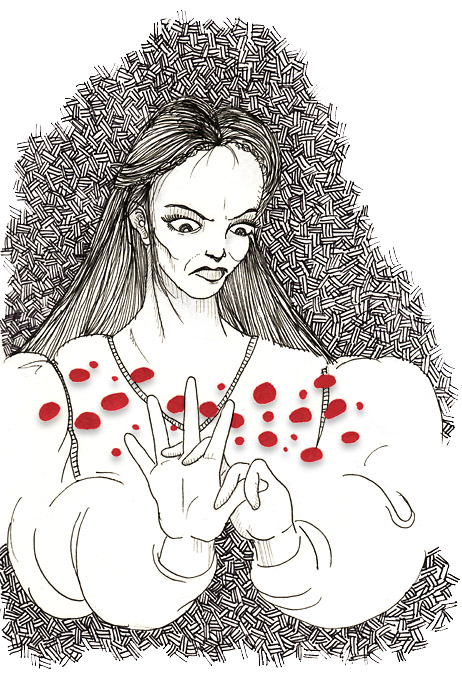
lady in red
Out, damned spot; out, I say. One, two,’why, then ’tis time to do’t. Hell is murky. Fie, my lord, fie, a soldier and afeard? What need we fear who knows it when none can call our power to account? Yet who would have thought the old man to have had so much blood in him?

These words are spoken by Lady Macbeth in Act V, scene 1 in Shakespeare’s Macbeth. Lady Macbeth is sleepwalking through the castle. She is subconsciously thinking and feeling guilty about being the driving force behind the murder of Duncan. After the murder, Macbeth believed his hand was irreversibly bloodstained. Lady Macbeth told him, “A little water clears us of this deed.” Now, she sees blood on her own hands. She is completely undone by guilt and descends into madness.

“What need we fear who knows it when none can call our power to account?,” she asks, asserting that as long as her and her husband’s power is secure, the murders they committed cannot harm them. But her guilt-wracked state and her mounting madness show how hollow her words are. So, too, does the army outside her castle. “Hell is murky,” she says, implying that she already knows that darkness intimately. It is implied, although not directly stated, Lady Macbeth commits suicide.

Comments

comments

Monday Artday: hair

The challenge this week on Monday Artday is “hair”.
I dream of Julia with the light brown hair.
The details of Julia Pastrana’s early life are sketchy. She was discovered in Mexico where she worked as a housemaid. She had hypertrichosis terminalis. She had a beard, was covered in glossy black hair. Her ears and nose were unusually large and her teeth were irregular. Theodor Lent discovered her and purchased her from a woman who might have been her mother. Lent taught her to sing and dance and play music, preparations for Julia’s introduction to the circus sideshow where she would spend the rest of her life. She joined a traveling circus when she was 20. She was regarded as some sort of hybrid or other “freak of nature” that did not fit in the order of things. Some doubted that she was even human, as a flyer from 1854 proclaimed “its jaws, jagged fangs and ears are terrifically hideous… nearly its whole frame is coated with long glossy hair. Its voice is harmonious, for this semi-human being is perfectly docile, and speaks the Spanish language.” A sense of mysticism surrounded people and creatures that deviated from “normal” and even into the mid-19th century, it was worried that even looking at Julia would cause women to miscarry or have monstrous births of their own. Her appearance was often considered to be an obscenity not fit for the public to view.
Lent married Julia during the course of her sideshow career. She became pregnant and gave birth to a son, also covered with hair. Her son died after only 36 hours and Julia died two days later. Julia’s death did not stop Lent. He had the bodies of Julia and the child mummified and took them on an extended tour of Europe, putting them on display at any chance available, for a quick buck. Victorian England loved stories of apes, lurid tales of savage gorillas coming in from Africa and the scientific description of animals. Rather than being some monstrous aberration meant to make people turn their gaze to God, Julia now represented a “missing link,” and the popularity of apes was just too tempting for Lent to let his wife rest in peace. Julia’s mummified remains were easier to approach and many people still turned out to see her body and discuss her anatomy. Ultimately, her body and that of her child wound up in a hospital storage room in Norway where they have disappeared and resurfaced multiple times since the 1860s.

Comments

comments