IF: germs

This week’s challenge on Illustration Friday is “germs”.

Hand me down a strong panacea/ One that's guaranteed to make me feel like Hercules
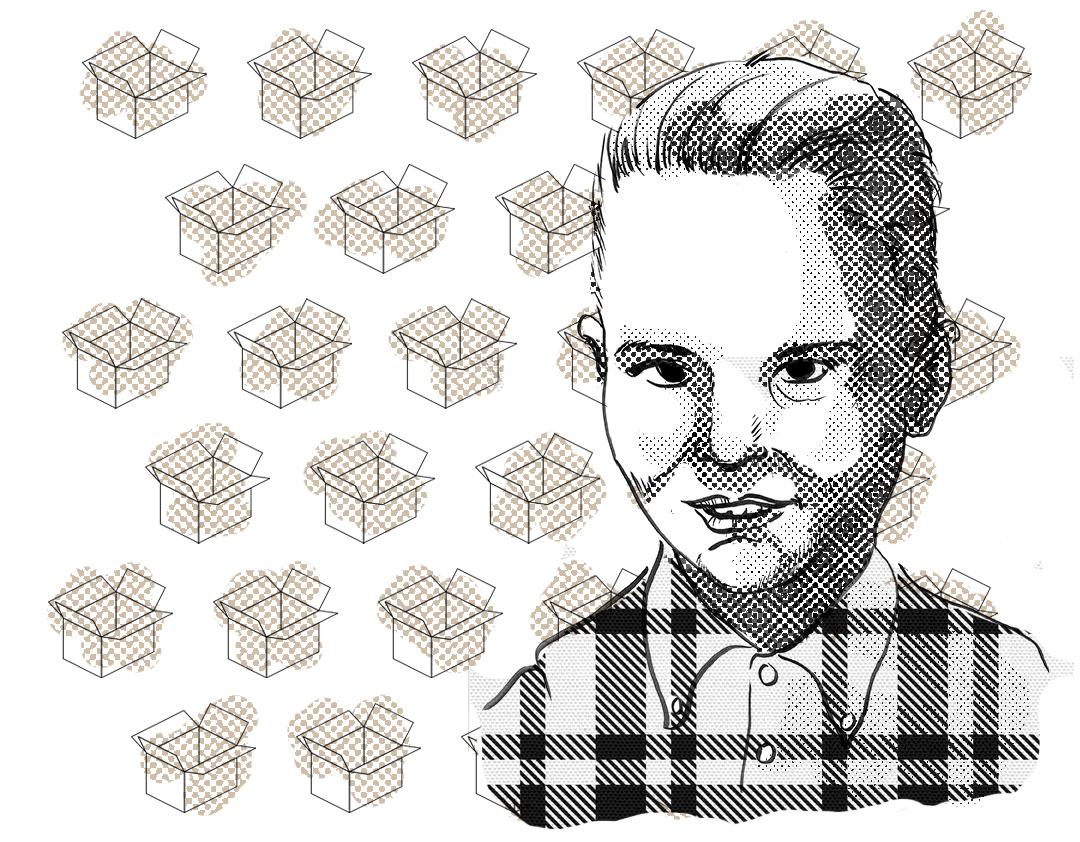
Howard Hughes was an innovative aviator, engineer, industrialist, film producer and director, philanthropist, and one of the wealthiest people in the world. Marvel Comics founder Stan Lee used Hughes as the inspiration for playboy Tony Stark, the alter-ego of Iron Man.

Hughes also suffered from obsessive-compulsive disorder and mysophobia. His odd and eccentric behavior began to surface in the early 1930s. when he would sort peas by size prior to eating them.  When he was directing The Outlaw, he became obsessed with an imperfection in Jane Russell‘s blouse which he claimed gave the appearance of her having two nipples on each breast. Production was held up while Hughes scribbled out lengthy instructions on how to solve the problem.

In December 1947, Hughes told his aides that he wanted to screen some movies at a film studio near his home. Hughes  didn’t leave the screening room for more than four months and consumed only chocolate bars and milk during the time. He urinated in bottles which he meticulously kept and arranged on shelves. He was surrounded by dozens of Kleenex boxes, which he continuously stacked and re-arranged. He wrote detailed memos to his aides on yellow legal pads giving them explicit instructions not to look at him, speak to him, and only to respond when spoken to. Throughout this period, Hughes sat fixated in a chair, often naked, continuously watching movies, reel after reel, day after day. When he finally emerged in the spring of 1948, his hygiene was terrible, as he had not bathed or cut his hair and nails for weeks.

Hughes moved into a bungalow at the Beverly Hills Hotel and his erratic behavior continued. He would sit naked in his room, on a deck chair covered with paper towels, with a pink hotel napkin placed over his genitals and empty tissue boxes on his feet, watching movies. He became obsessed with the 1968 film Ice Station Zebra and had it running on a continuous loop. Hughes insisted on using tissues to pick up objects, so that he could insulate himself from germs. He instructed his aides to wrap eating utensil handles in tissues for his use at meals and to use a minimum of ten tissues when turning doorknobs. He would also notice dust, stains or other imperfections on people’s clothes and demand that they take care of it. Hughes only had his hair cut and nails trimmed once a year. Several doctors were kept in the house, but Hughes rarely saw them and rarely followed their advice. Toward the end of his life, his inner circle was largely composed of Mormons, as they were the only people he considered trustworthy, even though Hughes himself was not a member of their church.

As a result of numerous plane crashes, Hughes suffered broken many bones and third degree burns He eventually became severely addicted to codeine, morphine, and other pain medication. His addiction compounded the symptoms of his obsessive–compulsive disorder.

Hughes died on April 5, 1976, on board a private aircraft en route from Acapulco, Mexico to The Methodist Hospital in Houston. His reclusive activities and drug use made him practically unrecognizable. His hair, beard, fingernails, and toenails were quite long and he weighed barely 90 pounds. The FBI had to resort to fingerprints to identify the body. An autopsy noted kidney failure as the cause of death. Hughes was in extremely poor physical condition at the time of his death. X-rays revealed broken-off hypodermic needles still embedded in his arms and severe malnutrition. While his kidneys were damaged, his other internal organs were perfectly healthy.


Comments

comments

Monday Artday: fire

This week’s challenge on Monday Artday is “fire”.
You've been living like a little girl/In the middle of your little world/And your mind, your tiny mind/You know you've really been so blind/Now 's your time, burn your mind/You're falling far too far behind
Paula: “Stretch the dough a little bit, so it’s the right size for the rock.”
Frank (off-camera): “Are you gonna put right in the fire?”
Paula: “Right in the fire.”
Frank (off-camera): “Whoa!”
Paula: “Right on the rock.”
Frank (off-camera):  “Whoa! Look at that! Is it on fire? No! But, it’s on the hot rock.”

Riveting action! It has to be seen to be believed.

Comments

comments

from my sketchbook: clara bow

It, hell. She had those!
Clara Bow was born in a Brooklyn slum. She was the third child; the first two, also daughters, died in infancy. Between 1905 and 1923, the Bows lived at at least 14 different addresses. Aside from being a weak provider, Clara’s father, Robert was often gone, leaving his family without means to survive, forcing Clara’s mother, Sarah, to become a prostitute. Clara came to understand that a visiting “Uncle” meant food on the table.

At sixteen, young Clara entered a contest in Motion Picture magazine, the grand prize being a part in a film. A cheap Coney Island photographer took two pictures of her which she delivered to the magazine in person. The secretary who accepted them wrote on her entry form “Called in person. Very pretty.” After numerous screen tests, Clara was selected the winner, and she debuted in Beyond the Rainbow in 1922. Sarah Bow suffered from psychosis due to epilepsy. She was subject to seizures, delusional ideas, paranoia and aggressive behavior. Her illness became progressively worse and when she realized her daughter was set for a movie career, she found it disgraceful. One night Clara woke up with a butcher’s knife against her throat but managed to fend her deranged mother off. In the morning, Sarah had no recollection of the episode. Eventually Sarah was committed to a mental institution.

Throughout her career, Clara was involved romantically with many co-stars and directors. Clara made almost forty films between 1922 and 1927 when she starred in “It”. With this performance, Clara hit the height of her popularity. Clara became Hollywood’s It Girl. According to the film, “It is that strange magnetism which attracts both sexes…entirely unself-conscious…full of self-confidence…indifferent to the effect”. This image was enhanced by off-screen love affairs. She was very open — for the 1920s — about her sexual escapades with many famous men of the time. Bela Lugosi, Gary Cooper, Gilbert Roland, John Wayne, director Victor Fleming, and John Gilbert were all reputed to have been among her many lovers. In 1929, Lugosi’s wife, Beatrice Weeks, cited Clara as the other party in their divorce.

However, most of Hollywood considered her socially undesirable. Clara was not liked by other women in Hollywood. No matter how great her popularity, Clara’s bohemian lifestyle, thick Brooklyn accent and dreadful manners pegged her as a low life and a disgrace to the community.

In 1927, Clara starred in Wings, a  film that went on to win the first Academy Award for Best Picture. Clara’s career continued into the early sound film era, but she began experiencing microphone fright. A nervous Clara had to do a number of retakes on the set of The Wild Party because her eyes kept wandering up to the overhead microphone. However, her performances in sound films improved, and she continued to be a box office success.

In 1932, Clara married cowboy actor Rex Bell. Opting for motherhood over acting, Clara retired from films in 1933 at the age of 28. In 1944, while Bell was running for the U.S. House of Representatives, Clara attempted suicide. In 1949, she checked into a medical facility to get treatment for her chronic insomnia. Shock treatment was tried and numerous psychological tests performed. Clara was diagnosed with schizophrenia and her insomnia was attributed to childhood trauma. Clara spent her last years in a modest house in Los Angeles under the constant care of a nurse, living off an estate worth about $500,000 at the time of her death. She died on September 27, 1965 of a heart attack while watching a Gary Cooper movie.

Comments

comments

IF: pattern 2

The current challenge on Illustration Friday is “pattern”. This is my second illustration for this challenge. Here is the first.
hide in plain sight
“One of my favorite clothing patterns is camouflage. Because when you’re in the woods it makes you blend in. But when you’re not it does just the opposite. It’s like ‘hey, there’s an asshole.’”
— — Demetri Martin

Comments

comments

from my sketchbook: the boy in the box

heavenly father bless this unknown boy february 25, 1957

In 1957, Susquehanna Road was a narrow country lane in the sparsely settled Fox Chase section of northeast Philadelphia. A driveway providing access to the Sisters of the Good Shepherd, a religious order which operated a school for “wayward girls,” adjoined Susquehanna Road on the north near Verree Road. Directly across the street from the entrance to the Good Shepherd School was a wooded area that was often used by local residents as a place to illegally dump trash.

In late February 1957, a young man, checking on some animal traps he had set, stumbled across a large, weathered cardboard box. A quick examination inside the box revealed what looked like a doll wrapped in a blanket. Not wanting to bring attention to his illegally set traps, the young man left the box and its contents just as he had found them. A day or so later, a college student, driving along Susquehanna Road, spotted a rabbit running into the woods. He knew that area was popular with amateur trappers, so he stopped to investigate. He found the box and contacted police.

Police investigators discovered the box actually contained the nude body of a small boy, aged 4 to 6 years, wrapped in a flannel blanket. His body was covered with bruises. His feet and one of his hands were withered, as though they had been soaking for a long period of time in water. His hair was close-cropped and recently, and evidently hurriedly, cut. Clumps and strands of hair were found on his body, indicating that his hair had been cut just prior to or just after his death. His fingernails and toenails were also recently, however neatly, trimmed. The boy had several well-healed scars which were the result of several year-old surgical procedures. He was wrapped in a blanket which had been recently laundered and cut in half. By evidence of the thread and stitching, the blanket had been mended on a home sewing machine. The box had once contained a baby bassinet that, according to a shipping label, was purchased at J.C. Penney in Upper Darby, PA. A blue corduroy cap was found several yards away from the box.

An official investigation was launched. The Philadelphia Inquirer produced and distributed thousands of posters and the Philadelphia Gas Works included fliers in customers’ bills. A citywide plea for information was issued in hopes of obtaining clues about the mysterious boy.

Hundreds of dead-end leads and fifty-two years later, the case of the boy in the box remains unsolved.

Comments

comments

IF: pattern 1

The current challenge on the Illustration Friday website is “pattern”.
You can brush my hair / Undress me everywhere
” I thought if only we could take this play pattern and three dimensionalize it, we would have something very special. “
— — Ruth Handler

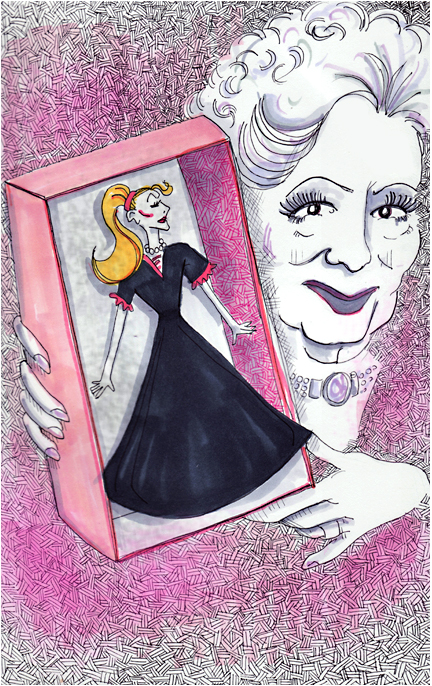
In 1945, Elliot Handler and Harold “Matt” Matson founded a small toy company. They called their new venture “Mattel” by combining part of their names and began manufacturing dollhouse furniture. They added to their toy line and soon had a top seller with the “Uke-a-doodle”, a toy ukulele.

Elliot’s wife Ruth noticed their daughter Barbara preferred playing with her infant dolls by giving them adult roles. Ruth presented the idea of an adult doll for girls, instead of those in the form of babies. On a European trip, Ruth bought a German Bild Lilli doll, not knowing that it was not intended for children but sold as a gag gift for adults. Ruth reworked the design of the German fashion doll, named it for her daughter and, in 1959, the Barbie doll made its debut.

It was an instant hit.

Ruth became president of Mattel in 1967. She and her husband resigned from their positions at Mattel in 1975 under allegations of stock manipulation and fraudulent reporting to the SEC. Ruth passed away from complications from colon cancer in 2002.

Comments

comments

Monday Artday: sailor

The challenge this week at the Monday Artday illustration blog is “sailor”.
a gathering of angels appeared above my head/they sang to me this song of hope and this is what they said
There’s a port, on a western bay
And it serves a hundred ships a day
Lonely sailors, pass the time away
And talk about their homes

And there’s a girl in this harbor town
And she works layin’ whiskey down
They say “Brandy, fetch another round”
She serves them whiskey and wine

The sailors say “Brandy, you’re a fine girl
What a good wife you would be
Yeah your eyes could steal a sailor from the sea”

Brandy wears a braided chain
Made of finest silver from the North of Spain
A locket that bears the name
Of the man that Brandy loves

He came on a summer’s day
Bringin’ gifts from far away
But he made it clear he couldn’t stay
No harbor was his home

The sailor said ” Brandy, you’re a fine girl
What a good wife you would be
But my life, my lover, my lady is the sea”

Yeah, Brandy used to watch his eyes
When he told his sailor stories
She could feel the ocean foam rise
She saw its ragin’ glory
But he had always told the truth, lord, he was an honest man
And Brandy does her best to understand

At night when the bars close down
Brandy walks through a silent town
And loves a man who’s not around
She still can hear him say

She hears him say ” Brandy, you’re a fine girl
What a good wife you would be
But my life, my lover, my lady is the sea”

Comments

comments