
This week’s Illustration Friday challenge word is “spent”.
(This is one of two illustrations I did for this topic. HERE is the other.)
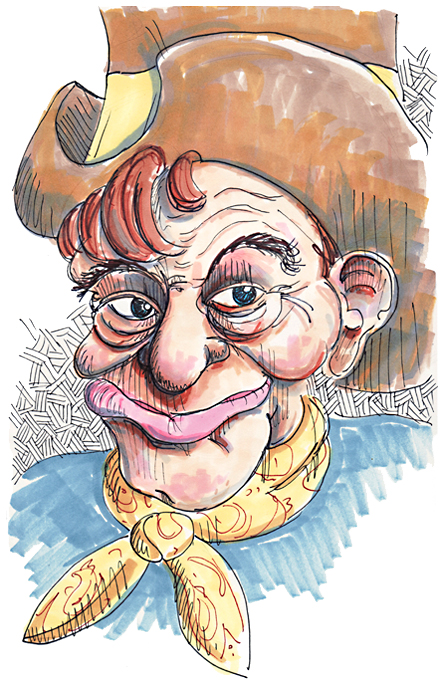
“If advertisers spent the same amount of money on improving their products as they do on advertising then they wouldn’t have to advertise them.” Will Rogers
IF: spent (part 1)
This week’s Illustration Friday challenge word is “spent”.
(This is one of two illustrations I did for this topic. HERE is the other.)
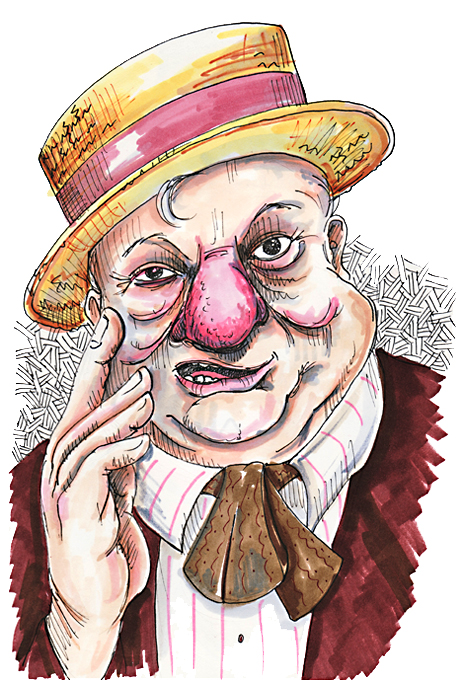
“I once spent a year in Philadelphia. I think it was on a Sunday.” W. C. Fields
Comments
IF: spooky (part 3)
This week’s challenge word on Illustration Friday is “spooky”.
(This is the third illustration I’ve done for this week’s word. HERE is the first and HERE is the second.)
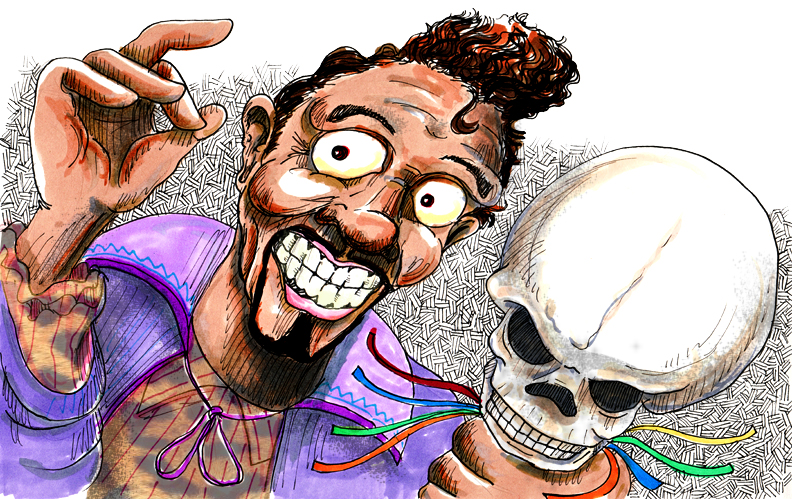
After a failed attempt at becoming an opera singer in the style of Paul Robeson, Screamin’ Jay Hawkins settled on playing piano and singing standard blues.
Soon, he was called to service with the Air Force in World War II. Hawkins told horrific accounts of being held captive and tortured. He claimed that after his rescue, he taped a hand grenade in the the mouth of his tormentor and pulled the pin. Upon returning home, Hawkins was an active boxer and became the 1949 Alaska middleweight champion.
In 1951, Hawkins returned to music, where he became renowned for his stylish fashions of leather and leopard skins, along with his inspired piano playing. In the middle 1950s, he, along with a studio full of drunken musicians, recorded “I Put a Spell on You”. What was planned to be a ballad became a raucous guttural recitation, punctuated by Hawkins grunts and yelps over a throbbing bass line. The performance was mesmerizing, although Hawkins himself blacked out and was unable to remember the session. Afterward he had to relearn the song from the recorded version in order to perform it live. It became the biggest commercial success of Hawkins career, selling into the millions upon its initial release. Hawkins’ stage antics featured his entrance in a coffin, voodoo-influenced props, rubber snakes and Henry a skull on a stick. He is recognized as the first “shock rocker”, paving the way for acts like Screaming Lord Sutch, Black Sabbath, Alice Cooper and Marilyn Manson.
Despite a career that spanned five decades, releasing over two dozen albums and singles and touring with bands like The Clash and Nick Cave and the Bad Seeds, Hawkins never achieved the continued success that his first song promised. After surgery to treat an aneurysm in 2000, Hawkins passed away at the age of 70. When news of his death spread, a contingency of people stepped forward claiming to be Hawkins’ children the result of relationships with a multitude of women. Careful review of documentation esimated that Hawkins had fathered 75 children in his lifetime. He sure put a spell on someone.
Comments
spooky (part 2)
This week’s Illustration Friday word is “spooky”.
(This is the second entry for this topic. Click HERE for entry number one and HERE for entry number three.)
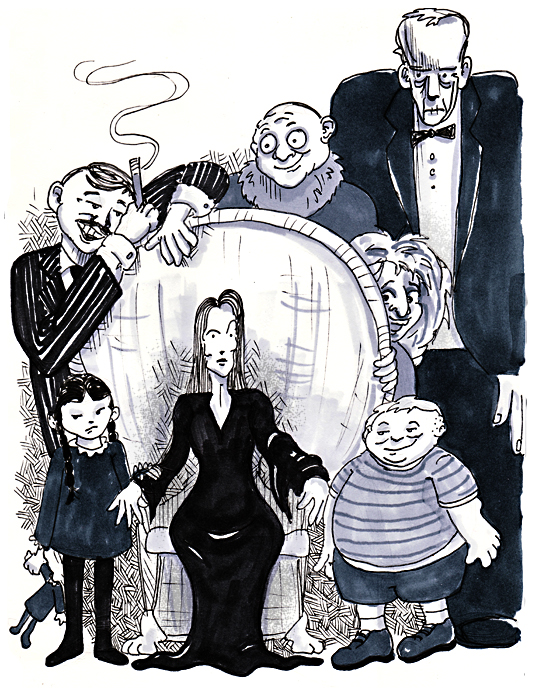
Careful observation of this family has revealed the members to be creepy, kooky and mysterious. Not to mention spooky.
The conclusion is they are all together ooky.
Comments
IF: spooky (part 1)
This week’s Illustration Friday word is “spooky”.
(This is the first of three entries for this topic. Click HERE for the second entry and HERE for the third.)

Spooky the Tuff Little Ghost was not nearly as popular as his more famous cousin Casper. I think I can understand why.
Comments
from my sketchbook: scotty beckett
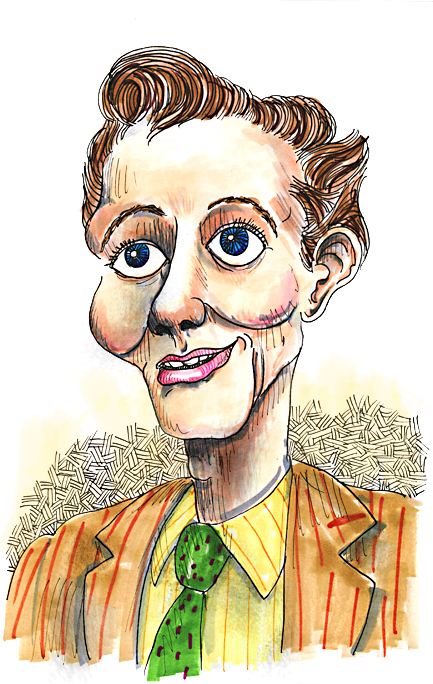
Lindsay Lohan? Lightweight!
Paris Hilton? Amateur!
They can’t compare to Scotty Beckett.
Scotty made his debut in the Our Gang comedies playing Spanky’s best friend for a little over a year until he left to star in feature films. He was replaced by Carl “Alfalfa” Switzer. From 1936 until the early 1950s, Scotty was one of the most popular and sought-after child actors, appearing in over sixty shorts and full-length features. He acted opposite big-name stars of the time, like Charles Boyer, Greta Garbo, Spencer Tracy and Errol Flynn. He became friends with other up-and-coming young Hollywood stars like Jane Powell, Elizabeth Taylor and Dickie Moore (who gave Shirley Temple her first on-screen kiss). His career included a mix of small, low-quality pictures and big-budget productions, including the Academy Award-nominated Anthony Adverse in 1936. Scotty landed the role of the young Al Jolson in The Jolson Story in 1946, despite a previous run of sub-par films.
At nineteen, Scotty, now a USC dropout, was arrested for drunk driving after crashing his car. During his booking, he bolted from the police station. In 1949, he eloped with tennis star Beverly Baker. On their Acapulco honeymoon, a jealous Scotty threatened a man at the hotel pool. The marriage lasted five months over allegations of Scotty’s controlling and abusive behavior. Scotty had tried to get Beverly to quit tennis and stop seeing her parents.
In 1951, Scotty married actress Sunny Vickers after she became pregnant. Scott Hastings Beckett, Jr. was born five months later. The bad publicity of his earlier divorce, coupled with his forced marriage to Sunny, made Scotty a Hollywood outcast. Between 1952 and 1954, Scotty was only able to get two small acting jobs. As his friends Elizabeth Taylor and Jane Powell had blossomed into bona-fide stars, Scotty was offered the sidekick role of Winky in the low-budget, hokey, space soap opera Rocky Jones, Space Ranger. He was also arrested again for carrying a concealed weapon and passing bad checks.
In February 1955, the Cavalier Hotel in Hollywood was robbed of a little more than $130 in cash. The masked bandit pistol-whipped the desk clerk, and disappeared. A search of the hotel revealed a man passed out drunk in the basement, armed with a gun and knife. It was Scotty Beckett. He was arrested and charged with possession of a weapon, but not with the robbery because the money was not found and the clerk could not provide a positive identification. After posting bail, Scotty and his family fled to Mexico, where he wrote several checks to local merchants drawn on non-existent banks. When Mexican authorities caught up with him, he exchanged gunfire with them until he was captured. Scotty spent four months in a Mexican jail. When he returned to Los Angeles, he was dropped from his role in Rocky Jones. A little more than a month later, Scotty was arrested in Las Vegas, once again for bouncing a check. Two years after that, he was arrested at the US-Mexican border smuggling illegal drugs. Sunny divorced him and took full custody of Scotty Jr. Scotty tried suicide by swallowing a bottle of sleeping pills. He was unsuccessful.
After his second drunk-driving arrest of 1959, Scotty smashed his car, fracturing his skull, thigh and hip, and suffered multiple lacerations to his head. The wreck crippled him for the rest of his life. Depressed and despondent, Scotty slit his wrists in another unsuccessful attempt at suicide. His third wife, Margaret, and her teenage daughter, had had enough and began packing to leave their home. Scotty assaulted his step-daughter with a wooden crutch he now used after his car accident.
Scotty checked into the Royal Palms Nursing Facility after suffering a beating from a drug deal gone wrong. Two days later he achieved the suicide result he was looking for. Scotty died from an overdose of barbiturates. He was 38 years old.
Comments
IF: transportation
The Illustration Friday challenge word this week is “transportation”.

In 2001, after a buzz of preliminary publicity, a two-wheeled, self-balancing electric vehicle was introduced to the public. It was called the Segway. By 2006, approximately 23,500 had been sold.
In December 2009, British billionaire Jimi Heselden bought the company Segway Inc.
On September 26, 2010, Heselden was riding his Segway on his Northern England estate when he veered off a cliff and plummeted thirty feet to his death.
His last words were: “Oh, Shi i i i i i i i i ….”
Comments
from my sketchbook: wallace wood
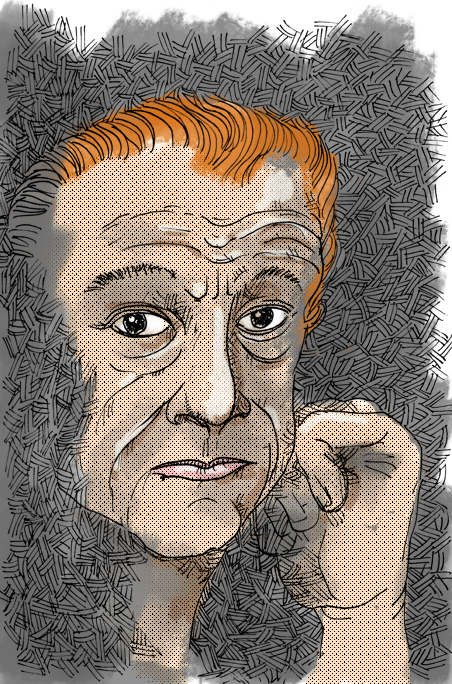
Wallace Wood began his influential career in art as an apprentice under several of his own influences, Will Eisner and George Wunder, who had taken over the popular comic Terry and the Pirates from creator Milton Caniff. Wallace, a graduate of New York’s School of Visual Arts. soon moved on to famed horror comic publisher EC, where he contributed to Tales from the Crypt. He then became one of the main writers and illustrators for EC’s fledgling humor magazine MAD. Wallace’s style was perfect for the comic parodies like “Superduperman” and “Batboy and Rubin”.
The prolific Wallace was in high demand, illustrating everything from children’s educational books to early issues of Daredevil for Marvel Comics. He provided drawing for the underground magazine The Realist, anonymously drawing the controversial Disneyland Orgy poster in 1967. He denied any connection to the piece for years, but the dead-on character copies were undeniably Wallace’s handiwork. In 1968, Wallace created the sexy adventure character Sally Forth exclusively for publication in Military News, a tabloid produced for male military readership, and later in Overseas Weekly, another military periodical.
Very much in demand, Wallace worked for the top comic publishers, including Marvel, DC, Warren, Gold Key, Avon and even the Wham-o Toy Company. He eventually tried his hand at publishing himself, creating Witzend magazine, featuring artwork by underground artists like Vaughn Bode and Jeff Jones, as well as his own creations. He also published several issues of explicitly pornographic comic parodies of Snow White, Prince Valiant and Tarzan, each using the identical styles of the originals.
Plagued by chronic headaches and bouts with alcoholism over his entire adult life, Wallace suffered kidney failure and a stroke that left him blind in one eye. With his health declining, as well as the demand for his artistic services, Wallace committed suicide by gunshot in 1981 at the age of 54.
Comments
IF: beneath

After a full week of the draining drudgery of elementary school, there was nothing I liked better than spending Saturday afternoon at a movie matinee. I’d call up a bunch of friends from school and we’d hastily make plans to meet at the nearby Leo Theater or the Orleans, which was a little farther away. Rarely, we would opt for the dreaded Parkwood Theater, although it was closer to my house than the other two theaters. The Parkwood was an ominous gray building at the end of a strip center that also housed a drug store, a barber shop and – if my memory is correct – seven beer distributors.
The Saturday matinees of the 1960s and early 70s would show a different offering than the regular evening feature. The program would usually start off with previews of the next weekend’s show, followed by a cartoon and the first of usually two films with – what the theater management believed – an appeal to children. One would think that kiddie entertainment would include Mowgli’s animated adventures in “The Jungle Book” or the musically whimsical “Chitty Chitty Bang Bang.” I, however, remember seeing such child-friendly features as “Dracula – Prince of Darkness,” “Witchfinder General” and the occasional K. Gordon Murray freak-out. I saw Walt Disney’s “Darby O’Gill and the Little People” with Scott, a friend from school. This deceitful Disney film had Scott screaming and fleeing from the darkened auditorium when the wailing banshee appeared on-screen in her green-glowing glory. It was a far cry from political correctness of “Night in the Museum” or “Legend of the Guardians: The Owls of Ga’Hoole.”
One Saturday, my mom dropped a station wagon full of my friends off at a showing of “Beneath the Planet of the Apes,” the inferior first sequel to the Charlton Heston sci-fi blockbuster. It didn’t matter that I had not seen the original. A couple of my friends were not even aware that an earlier, similar movie had preceded this one. We were there to stuff ourselves with candy and popcorn and not be bored for three hours.
Overstocked with snacks, my nine-year-old pals and I found three seats and sat down as the theater lights dimmed. When the movie began, we sat riveted as we watched stranded astronaut Charlton Heston (you know – Moses! ) disappear behind a wall of fire and a guy who looked just like him (low-budget substitute James Franciscus) begin his quest to find his fellow space traveller.
And then the armies of apes showed up! It was so cool! We didn’t need a plot anymore. All we needed to know was the apes were evil and the few mute and primitive humans had to survive behind the leadership of the guy who kind of looked like Charlton Heston. The ragtag troop of grimy humans came upon a race of other humans in an abandoned subway station. These cleaner humans wore long flowing robes and actually spoke, but, to my young ears, they sure spoke weird! One of the guys even looked like King Tut from our favorite show “Batman”. They explained that they were a peace-loving people and they showed off the deity they worshipped. It was a giant atomic bomb. (We knew what that was because it was brought up constantly by our parents and on the news amid speculations about the ongoing Vietnam War.) Despite the political overtones going right over our heads, we were pretty entertained.
Suddenly, the robe-wearing people began their worship service and, in unison, they announced “I reveal my Inmost Self unto my God.” Then, they all reached up and pulled their facial skin off of their heads, revealing a poorly-executed special effects appliance, slightly reminiscent of a mass of veins and Silly Putty. However, I thought it was pretty effective and it succeeded in scaring the proverbial shit out of me. I recoiled against the back of my seat and stared in horror at the hundreds of actors up there on that screen, baring the results of four hours in a make-up chair and holding a flimsy rubber replica of their real face.
Forty-plus years later, I can’t get that image out of my mind. And I’ll still watch any of the “Planet of the Apes” films, if I spot one in the television listings. Just, not the Tim Burton one.
Comments
from my sketchbook: barbara pepper
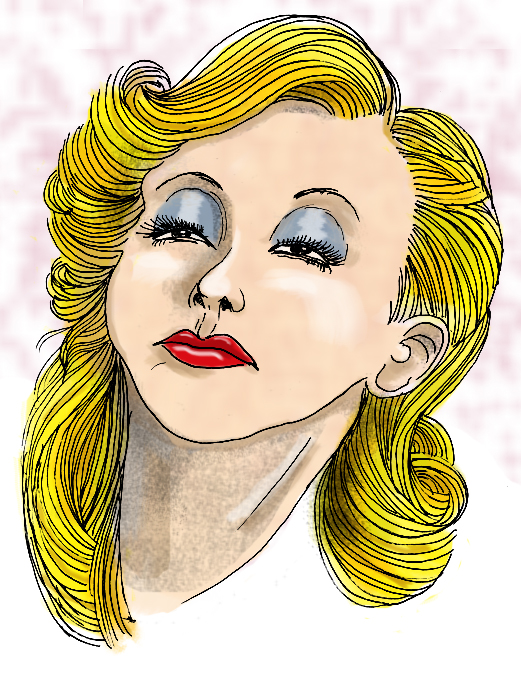
When she was just sixteen, blond-haired, blue-eyed bombshell Barbara Pepper was chosen to be a Ziegfeld Girl on Broadway. That was the springboard she needed to start her career in show business. Soon, she and friend, fellow Ziegfeld girl Lucille Ball, were chosen to join the Goldwyn Girls, as contract group of female dancers at MGM. She made her debut with Eddie Cantor in Roman Scandals in 1933. Her flashy appearance and hard-boiled “tough gal” personality allowed her to be featured in countless films throughout the 30s and 40s. She was romantically linked with a full spectrum of notable names like Howard Hughes and Peter Lorre to popular comedian Harry “Parkyakarkus” Einstein.
In 1943, she married actor Craig Reynolds. The couple had two sons before divorcing in 1949. Later the same year, Reynolds was killed in a motorcycle accident, leaving Barbara to raise her two small children as a single mother. She had to turn down acting jobs in order to devote time to her family. Soon, the demand for her acting services dried up and the one-time showgirl was forced to take jobs waiting tables and managing a laundry. She turned to alcohol to help her cope. She gained weight and her voice grew raspy as her alcohol intake increased.
Some of her showbiz friends, like Jack Benny and Lucy, offered her small roles when they could. Through the 50s and 60s, she humbly accepted guest spots on TV sitcoms and Westerns. Barbara desperately wanted the role of Ethel Mertz on I Love Lucy, but known alcoholic William Frawley had already been hired for the series and the production couldn’t risk having another drunk on the set.
Barbara continued to take any part she could, no matter how small. Finally, in 1965, she landed the supporting role of Doris Ziffel on the sitcom Green Acres. It was a steady paycheck despite her being upstaged by Arnold the Pig (who received more fan mail than Barbara and co-star Hank Patterson combined). After four seasons, Barbara’s failing heath forced her to turn the Doris Ziffel role over to character actress Fran Ryan.
Barbara Pepper, the glamorous showgirl turned TV dirt farmers wife, died of a coronary blood clot at age 54. Colleagues said she looked at least a decade older.