This week’s challenge word on the Illustration Friday website is “afterwards”.

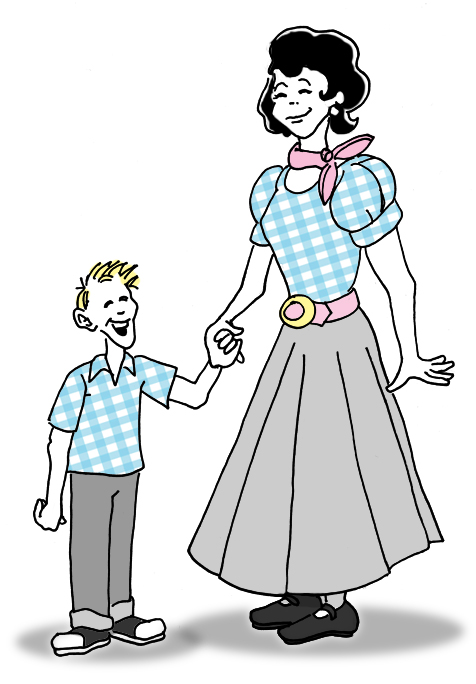
“Good morning, Wally. Good morning, Beaver. Your father is eating first. I’ll make your breakfast after Ward’s.”
This week’s challenge word on the Illustration Friday website is “afterwards”.

“Good morning, Wally. Good morning, Beaver. Your father is eating first. I’ll make your breakfast after Ward’s.”

My wife has celebrated 28 birthdays since we met. Last year, we enjoyed a wonderfully intimate concert by banjo impresario Tony Trischka at the elegant, historic Elkins Estate, around the corner from our house. Two years ago, we spent a wonderful birthday in New York City. We went to a huge street festival on Sixth Avenue, wandered around Times Square and capped the day uptown with dinner at Serendipity 3. For another birthday, five years ago, I coaxed my wife into seeing a live performance by quirky singer-songwriter Steve Poltz. Poltz is the former beau of popular singer Jewel. He co-wrote her hit “You Were Meant for Me” and maintains a modest, yet rabid, fan-base. The opening act for this particular show was one-time dB’s guitarist Chris Stamey and his new band, a four piece combo who, I swear to God, were playing four different songs simultaneously. Their irritating cacophony raged on loudly for over an hour. Mrs. Pincus’ seat for the show was, unfortunately, jammed into an awkward corner of the venue where a quick exit presented itself as extremely difficult and futilely attempted. She fidgeted on edge through the remainder of Stamey’s set and was too upset and filled with claustrophobic anxiety to enjoy Poltz’s portion of the bill. When the house lights rose and a path to the door became more accessible, Mrs. Pincus bolted and tore down the stairs of the second floor showroom as my son and I perused the merchandise table. As my wife approached the door to freedom, it was gallantly held open by none other than Chris Stamey himself, who had ducked down to the sidewalk for a smoke. He offered a gentlemanly smile as my wife crossed the threshold to which she spat out “You guys SUCK!” right to his face. She walked past him slowly enough to get an ample glimpse of his dumbfounded expression.
But, the first of her birthdays that we spent together was almost the last. It was our second or third date and I took her to see David Lynch’s 1977 apocalyptic account of industrial bleakness Eraserhead.
Eraserhead was Lynch’s first feature-length film. Five years in the making and drawing from experiences of living in Philadelphia, it was shot on a shoestring budget partially financed by Lynch’s childhood friend, production designer Jack Fisk. Fisk contributed all the money he could spare and convinced his wife, actress Sissy Spacek, to donate her salary from the successful Carrie to Lynch’s vision. The black and white production tells the story of Henry Spencer and… jeez! I don’t know what the fuck this movie is about! I’ve seen it countless times. I marvel at it. I am intrigued by it. I am repulsed by it. I find it compelling, haunting, riveting and poetic. I just don’t know what the hell is going on. There’s flashing lights, a shadowy, deformed figure pulling levers in an attic, a woman who sings on a stage in a radiator, giant sperm, miniature roasted chickens that ooze blood and that baby that awful, horrific baby. Lynch has never revealed how the special effects for the baby were created, but rumors of the use of an embalmed calf fetus are the most speculated. (At one point in the film, Mary, Henry’s girlfriend, says “They’re not sure it is a baby!” That just about sums it up.)
The lead role of Henry Spencer, the eventual Eraserhead to which the title refers, was played by Jack Nance. Jack met the director in the 70s and Lynch cast him in his first film. Jack and Lynch had a great working relationship, leading Lynch to cast him in seven more projects throughout his career. They were small parts, but Jack was happy for the work and Lynch was happy to help a friend.
Jack married his second wife, actress Kelly Van Dyke, daughter of Jerry Van Dyke in May 1991. Kelly, whose stage name was Nancee Kellee, worked exclusively in adult films. Six months into their marriage, Kelly hanged herself.
Distraught, Jack moved out of Los Angeles to South Pasadena. One morning in 1996, he got into an altercation outside a Winchell’s Donut Shop with a couple of guys considerably younger and stronger than he. Jack was intoxicated from a night of heavy drinking and his famous temper took over as he spewed insults at the two strangers. One of the men socked Jack in the face, knocking off his glasses and sending him crumpling to the ground. Later in the day, while lunching with friends, Jack related the story and complained of a headache. He excused himself and returned to his apartment. His lunch companions stopped by the next morning to check on Jack and found him dead. An autopsy revealed a blood alcohol level of .24.
A month or so ago, my son and I watched Eraserhead on the Independent Film Channel late one night. We sat silently as the film flickered before us, its eeriness unfolding with each scene. My wife popped her head into the room and asked what we were watching. Suddenly, she caught a flash of Jack Nance on the screen.
“Oh shit.”, she said, as she rolled her eyes and hurried down the stairs.
This week’s Illustration Friday challenge word is “spent”.
(This is one of two illustrations I did for this topic. HERE is the other.)

“If advertisers spent the same amount of money on improving their products as they do on advertising then they wouldn’t have to advertise them.” Will Rogers
This week’s Illustration Friday challenge word is “spent”.
(This is one of two illustrations I did for this topic. HERE is the other.)

“I once spent a year in Philadelphia. I think it was on a Sunday.” W. C. Fields
This week’s challenge word on Illustration Friday is “spooky”.
(This is the third illustration I’ve done for this week’s word. HERE is the first and HERE is the second.)

After a failed attempt at becoming an opera singer in the style of Paul Robeson, Screamin’ Jay Hawkins settled on playing piano and singing standard blues.
Soon, he was called to service with the Air Force in World War II. Hawkins told horrific accounts of being held captive and tortured. He claimed that after his rescue, he taped a hand grenade in the the mouth of his tormentor and pulled the pin. Upon returning home, Hawkins was an active boxer and became the 1949 Alaska middleweight champion.
In 1951, Hawkins returned to music, where he became renowned for his stylish fashions of leather and leopard skins, along with his inspired piano playing. In the middle 1950s, he, along with a studio full of drunken musicians, recorded “I Put a Spell on You”. What was planned to be a ballad became a raucous guttural recitation, punctuated by Hawkins grunts and yelps over a throbbing bass line. The performance was mesmerizing, although Hawkins himself blacked out and was unable to remember the session. Afterward he had to relearn the song from the recorded version in order to perform it live. It became the biggest commercial success of Hawkins career, selling into the millions upon its initial release. Hawkins’ stage antics featured his entrance in a coffin, voodoo-influenced props, rubber snakes and Henry a skull on a stick. He is recognized as the first “shock rocker”, paving the way for acts like Screaming Lord Sutch, Black Sabbath, Alice Cooper and Marilyn Manson.
Despite a career that spanned five decades, releasing over two dozen albums and singles and touring with bands like The Clash and Nick Cave and the Bad Seeds, Hawkins never achieved the continued success that his first song promised. After surgery to treat an aneurysm in 2000, Hawkins passed away at the age of 70. When news of his death spread, a contingency of people stepped forward claiming to be Hawkins’ children the result of relationships with a multitude of women. Careful review of documentation esimated that Hawkins had fathered 75 children in his lifetime. He sure put a spell on someone.
This week’s Illustration Friday word is “spooky”.
(This is the second entry for this topic. Click HERE for entry number one and HERE for entry number three.)

Careful observation of this family has revealed the members to be creepy, kooky and mysterious. Not to mention spooky.
The conclusion is they are all together ooky.
This week’s Illustration Friday word is “spooky”.
(This is the first of three entries for this topic. Click HERE for the second entry and HERE for the third.)

Spooky the Tuff Little Ghost was not nearly as popular as his more famous cousin Casper. I think I can understand why.

Lindsay Lohan? Lightweight!
Paris Hilton? Amateur!
They can’t compare to Scotty Beckett.
Scotty made his debut in the Our Gang comedies playing Spanky’s best friend for a little over a year until he left to star in feature films. He was replaced by Carl “Alfalfa” Switzer. From 1936 until the early 1950s, Scotty was one of the most popular and sought-after child actors, appearing in over sixty shorts and full-length features. He acted opposite big-name stars of the time, like Charles Boyer, Greta Garbo, Spencer Tracy and Errol Flynn. He became friends with other up-and-coming young Hollywood stars like Jane Powell, Elizabeth Taylor and Dickie Moore (who gave Shirley Temple her first on-screen kiss). His career included a mix of small, low-quality pictures and big-budget productions, including the Academy Award-nominated Anthony Adverse in 1936. Scotty landed the role of the young Al Jolson in The Jolson Story in 1946, despite a previous run of sub-par films.
At nineteen, Scotty, now a USC dropout, was arrested for drunk driving after crashing his car. During his booking, he bolted from the police station. In 1949, he eloped with tennis star Beverly Baker. On their Acapulco honeymoon, a jealous Scotty threatened a man at the hotel pool. The marriage lasted five months over allegations of Scotty’s controlling and abusive behavior. Scotty had tried to get Beverly to quit tennis and stop seeing her parents.
In 1951, Scotty married actress Sunny Vickers after she became pregnant. Scott Hastings Beckett, Jr. was born five months later. The bad publicity of his earlier divorce, coupled with his forced marriage to Sunny, made Scotty a Hollywood outcast. Between 1952 and 1954, Scotty was only able to get two small acting jobs. As his friends Elizabeth Taylor and Jane Powell had blossomed into bona-fide stars, Scotty was offered the sidekick role of Winky in the low-budget, hokey, space soap opera Rocky Jones, Space Ranger. He was also arrested again for carrying a concealed weapon and passing bad checks.
In February 1955, the Cavalier Hotel in Hollywood was robbed of a little more than $130 in cash. The masked bandit pistol-whipped the desk clerk, and disappeared. A search of the hotel revealed a man passed out drunk in the basement, armed with a gun and knife. It was Scotty Beckett. He was arrested and charged with possession of a weapon, but not with the robbery because the money was not found and the clerk could not provide a positive identification. After posting bail, Scotty and his family fled to Mexico, where he wrote several checks to local merchants drawn on non-existent banks. When Mexican authorities caught up with him, he exchanged gunfire with them until he was captured. Scotty spent four months in a Mexican jail. When he returned to Los Angeles, he was dropped from his role in Rocky Jones. A little more than a month later, Scotty was arrested in Las Vegas, once again for bouncing a check. Two years after that, he was arrested at the US-Mexican border smuggling illegal drugs. Sunny divorced him and took full custody of Scotty Jr. Scotty tried suicide by swallowing a bottle of sleeping pills. He was unsuccessful.
After his second drunk-driving arrest of 1959, Scotty smashed his car, fracturing his skull, thigh and hip, and suffered multiple lacerations to his head. The wreck crippled him for the rest of his life. Depressed and despondent, Scotty slit his wrists in another unsuccessful attempt at suicide. His third wife, Margaret, and her teenage daughter, had had enough and began packing to leave their home. Scotty assaulted his step-daughter with a wooden crutch he now used after his car accident.
Scotty checked into the Royal Palms Nursing Facility after suffering a beating from a drug deal gone wrong. Two days later he achieved the suicide result he was looking for. Scotty died from an overdose of barbiturates. He was 38 years old.
The Illustration Friday challenge word this week is “transportation”.

In 2001, after a buzz of preliminary publicity, a two-wheeled, self-balancing electric vehicle was introduced to the public. It was called the Segway. By 2006, approximately 23,500 had been sold.
In December 2009, British billionaire Jimi Heselden bought the company Segway Inc.
On September 26, 2010, Heselden was riding his Segway on his Northern England estate when he veered off a cliff and plummeted thirty feet to his death.
His last words were: “Oh, Shi i i i i i i i i ….”

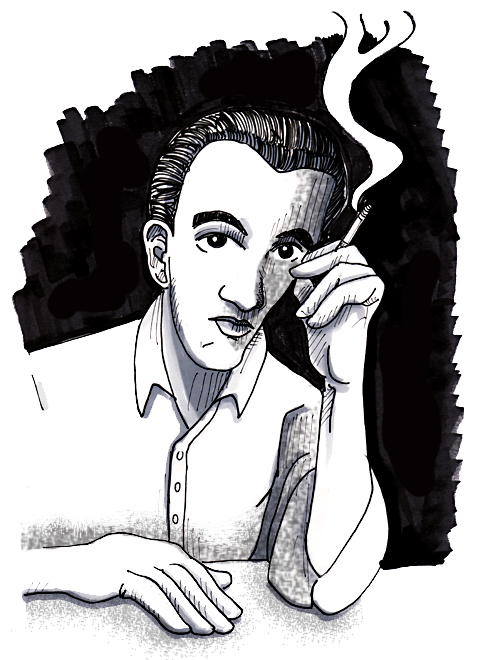
Wallace Wood began his influential career in art as an apprentice under several of his own influences, Will Eisner and George Wunder, who had taken over the popular comic Terry and the Pirates from creator Milton Caniff. Wallace, a graduate of New York’s School of Visual Arts. soon moved on to famed horror comic publisher EC, where he contributed to Tales from the Crypt. He then became one of the main writers and illustrators for EC’s fledgling humor magazine MAD. Wallace’s style was perfect for the comic parodies like “Superduperman” and “Batboy and Rubin”.
The prolific Wallace was in high demand, illustrating everything from children’s educational books to early issues of Daredevil for Marvel Comics. He provided drawing for the underground magazine The Realist, anonymously drawing the controversial Disneyland Orgy poster in 1967. He denied any connection to the piece for years, but the dead-on character copies were undeniably Wallace’s handiwork. In 1968, Wallace created the sexy adventure character Sally Forth exclusively for publication in Military News, a tabloid produced for male military readership, and later in Overseas Weekly, another military periodical.
Very much in demand, Wallace worked for the top comic publishers, including Marvel, DC, Warren, Gold Key, Avon and even the Wham-o Toy Company. He eventually tried his hand at publishing himself, creating Witzend magazine, featuring artwork by underground artists like Vaughn Bode and Jeff Jones, as well as his own creations. He also published several issues of explicitly pornographic comic parodies of Snow White, Prince Valiant and Tarzan, each using the identical styles of the originals.
Plagued by chronic headaches and bouts with alcoholism over his entire adult life, Wallace suffered kidney failure and a stroke that left him blind in one eye. With his health declining, as well as the demand for his artistic services, Wallace committed suicide by gunshot in 1981 at the age of 54.