
This week’s Illustration Friday challenge word is “launch”.

Some of the first-year NASA recruits were a little more ambitious than others.
(HERE is another illustration, from a few years ago, that fits the challenge too.)
This week’s Illustration Friday challenge word is “launch”.
Some of the first-year NASA recruits were a little more ambitious than others.
(HERE is another illustration, from a few years ago, that fits the challenge too.)
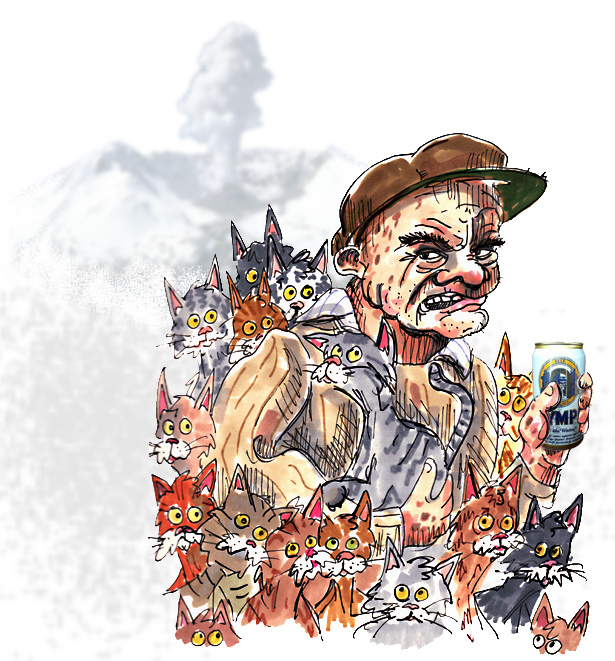
After his 1917 discharge from military service, West Virginia-born Harry R. Truman moved to Riffe, Washington. In 1926, he became the caretaker of a lodge on the shore of Spirit Lake. The lodge was a popular spot for hunters and fishing enthusiasts looking for rustic accommodations in a remote wooded area. Harry was a cantankerous character who took in feral cats and had an affinity for alcohol. He operated the lodge for 52 years.
In the late months of 1979, authorities issued warnings based on possible volcanic activity. Harry’s lodge was at the base of Mt. Saint Helens and he was told of the possibility of evacuation in early 1980. Stubborn Harry said that the findings and predictions were over-exaggerated and that he had no intention of leaving his dwelling. The authorities continued to issue words of caution and Harry and his cats continued to stay put. Harry maintained that, after years of side-by-side existence, he and the mountain had a mutual respect, saying “Spirit Lake is in between me and the mountain, and the mountain is a mile away, the mountain ain’t gonna hurt me”. Harry ignored the warnings and stood his ground.
Just as predicted, on May 18, 1980, Mt. Saint Helens erupted, spewing a mixture of superheated gas and rock sixteen miles into the air and into a surrounding area of 230 square miles. Buildings and vegetation were destroyed. Volcanic ash and debris one hundred and fifty feet deep engulfed Spirit Lake.
Harry, his cats and his lodge were, no doubt, buried, too.
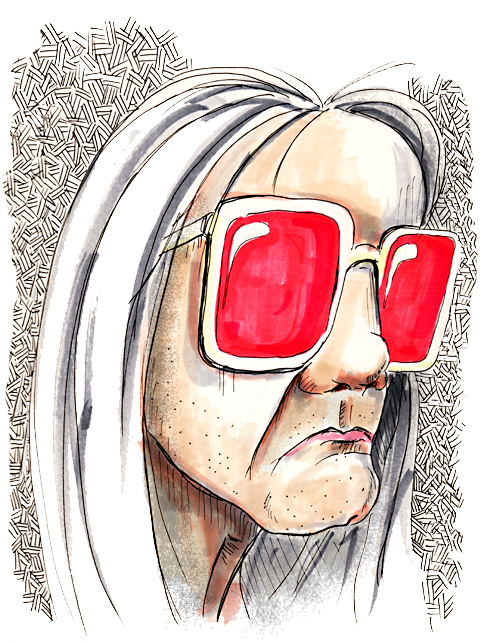
Gus Dudgeon worked his way from tea boy to sound engineer at Decca Records in the middle 1960s, where he worked on The Zombies hit “She’s Not There” and John Mayall’s Blues Breakers with Eric Clapton. By the end of the 60s, he produced albums by Ten Years After, The Bonzo Dog Band and a single called “Space Oddity” by a then-unknown David Bowie.
Gus left Decca and formed his own company. It was around this time he began his long collaboration with Elton John that started with “Your Song” in 1970. As Elton John’s populatrity increased, Gus was given free reign over the production of his albums. After recording sessions had ended, John and his band would exit the studio and leave Gus to “work his magic” alone at the controls. Gus was very critical of John’s work, calling his popular 1974 album Caribou “a piece of crap”. After a long run of successes, Gus parted ways with John, although they reunited in the 80s for three more albums. Branching out, Gus worked with a variety of other performers like The Moody Blues, Joan Armatrading, Fairport Convention, The Beach Boys, XTC and Elton John protege Kiki Dee..
Gus is credited in The Guinness Book of World Records for the first recorded use of “sampling”, for his inclusion of African tribal drumming in his 1971 recording of John Kongos’ “He’s Gonna Step On You Again”.
In July 2002, while driving home from a party with his wife Sheila, Gus fell asleep at the wheel and drove off an embankment at high speed. The car crashed in a ditch where he and his wife drowned. Gus was 59.
My father’s low tolerance for other humans kept my parent’s accumulation of friends to a minimum. There was one couple with which my parents maintained a close relationship and that was Jack and Myrna. They’d go out to dinner regularly. They’d visit each others homes, sometimes including a few other couples so the men could play low stakes poker while the wives played Mah Jongg and gossipped. But mostly, my parents stuck with Myrna and Jack, until Jack’s untimely death.
Every March, my parents would take a lengthy weekend vacation to the Nevele Resort in the Catskill Mountains, affectionately known as “the Jewish Alps.” Nevele was a real-life version of the type of resort depicted in the film Dirty Dancing. A sprawling conglomeration of buildings that housed guest rooms, ballrooms, dining rooms, banquet rooms and showrooms all surrounding a grassy common area with pools, playgrounds, tennis and basketballs courts, running tracks and a wide variety of benches just for “a little sit down, farshtaist?” The main activity for guests at Nevele (or any of the many Catskill resorts) was eating, followed a close second, by eating. In addition to a room and nightly shows, your stay included three meals a day – meals that would put the Roman bacchanalia to shame. If there’s one thing Jews love (besides getting their way and talking on top of other people’s conversations), it’s eating. The food for breakfast was abundant with a huge array of offerings. The wait staff would happily bring as many different dishes and as much of them as any guest desired. And after the early morning gorging ended, the dining room would refill within ninety minutes to start the process again for lunchtime. Dinners, too, were a repeat performance as guests eagerly sampled separate platters overflowing with roast beef and roast chicken – side-by-side at their place setting. After dinner, the overstuffed patrons would slowly waddle over to the showroom and fart their way through a schticky comedian and a female singer doing her best Barbra Streisand impersonation. My parents and their friends looked forward to four days of this each Spring. God bless ’em.
When my brother and I were past the age where the services of a babysitter was required, we looked forward to that weekend in March as well. One particular March, as my parents made their annual getaway plans, my brother and I had plans of our own. Early on Thursday morning, Jack and Myrna pulled their car up in front of our house. Jack, a jovial and kind-hearted but simple-minded guy, bounded out of the passenger seat to show my father the surplus of X-rated novelties he had stocked up on for the trip. Jack was so excited to pass out cigarette lighters in the shape of penises and fake dollar bills with a scene of fellatio in place of George Washington’s picture to a group of strangers at Nevele. (In the middle 1970s, this was, evidently, funny.) Myrna and Jack loaded their luggage alongside my parents’ bags in my Dad’s trunk. With goodbye waves and a couple of honks from the horn, the couples were off. That was the cue for my brother and I to set our plans into motion. I headed to school and announced a weekend party at my house to everyone who looked in my direction. My brother, now in college, did the same among his friends. On Saturday night, our house was overflowing with teens and beer and potato chips and pizza and music. Surprisingly, my high school friends and my brother’s older college pals got along swimmingly. I suppose enough alcohol will bridge any age gap. The party raged on until the small hours of the morning.
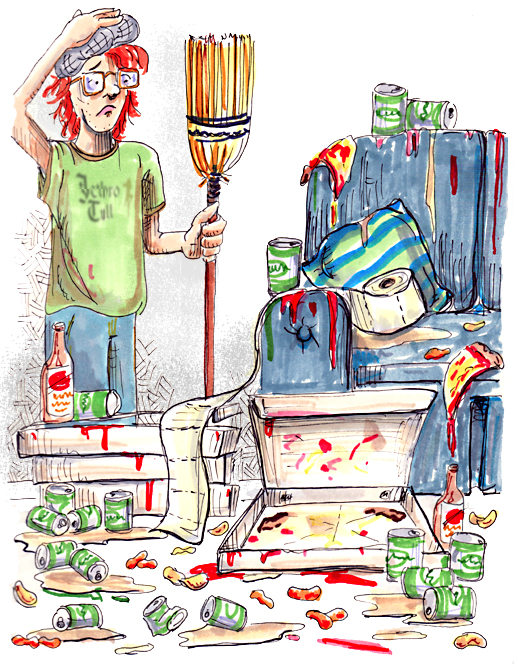
After just a few brief moments of sleep, my brother and I slowly woke and were greeted by the aftermath of the previous evening’s revelry. Our house was littered with beer cans, spills, pizza crusts, empty cups, the crumbs of various foodstuffs and several items that, to this day, remain unidentified. My brother silently went for the vacuum cleaner and I went to the kitchen cabinet for trash bags. Fighting through hangovers, we swept and vacuumed and scrubbed slowly, but efficiently. I tossed mounds of cans and cups into the trash. My brother picked each and every food particle out of the living room carpet. We straightened the furniture, realigned pictures on the walls and shook out area rugs. We even plucked a few stray bottles out of the azalea bush on our front lawn. Finally, we stood back and admired our work. Then, we collapsed on the sofa and tried to act innocent until our parents arrived home.
Eventually, my dad’s car pulled into the driveway. Jack and Myrna grabbed their bags and said their goodbyes. My mom came into the house first as my dad lagged behind with their luggage. Three steps into the living room, my mother surveyed the surroundings, squinted her eyes and said, “You had a party, didn’t you?”
My brother and I answered, “What are you talking about?,” putting on our best “what-are-you-talking-about” faces.
“This place is too spotless. I know damn well you didn’t spend the weekend cleaning.” my mother keenly surmised.,
Word of advice: You can’t get anything past your mother. So, don’t even try.
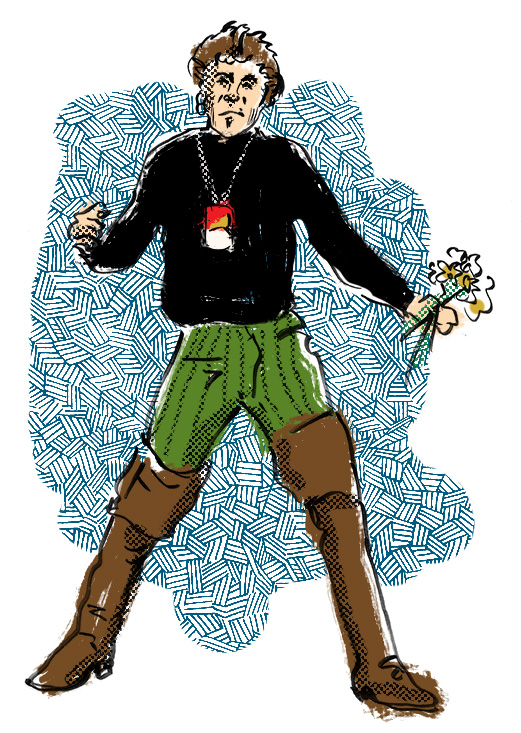
Dick Shawn was a difficult performer to peg. He was an film actor, a stand-up comic, a singer, a voice actor and a stage actor. And he did them all well. But he never achieved the fame for his performances that he really deserved. He actually became more famous for the circumstances surrounding his death.
Born Richard Schulefand in Buffalo, New York, Dick worked primarily as a stand-up comic in a one-man show that he performed internationally for over 35 years. Over the years, he appeared in films and television, including his most famous roles — Sylvester Marcus, Ethel Merman’s hippie son, in 1963’s It’s A Mad, Mad, Mad, Mad World and Lorenzo St. DuBois, the man would would be Hitler, in Mel Brooks’ original version of The Producers in 1968. He also lent his voice to the Snow Miser in the Rankin-Bass animated Christmas special The Year Without a Santa Claus in 1974. In one of his last filmed roles, he was cast as Commander Bog to Michael Jackson’s title character in the 3D space adventure Captain EO that played exclusively in Disney theme parks in the mid-1980s.
As a comedian, he was a frequent guest at celebrity roasts at the Friars Club. One particular night, after a parade of comics delivered some of the evening’s raunchiest, off-color remarks, Dick approached the podium, paused to slowly look around, opened his mouth and let flow a gush of pea soup over the microphone, his clothes and the surrounding area. He then returned to his seat on the dais — never uttering a word.
In April 1987, Dick was scheduled to perform his award-winning one-man stage show, The Second Greatest Entertainer in the Whole Wide World at UC San Diego’s Mandeville Hall. As the audience entered the theater, the curtain was opened and the entire stage was strewn with crumpled sheets of newspaper. The seats filled after a while and the play began. Suddenly, Dick emerged from beneath the piles of newspaper, having been lying still the entire time. The show — a mix of song, political satire and fantasy character play — included a bit featuring Dick as a promise-making politician. He uttered the line, “If elected, I will not lay down on the job” and immediately collapsed face down on the stage. The audience exploded in laughter. Dick lay motionless. The hearty laughter turned to nervous giggles then to uncomfortable awkwardness. Low muttering filled the theater as a stagehand ran over to check on Dick, calling out “Is the a doctor in the house?” The audience, believing it was part of the act, began laughing again, until another man came from backstage to administer CPR. Finally, paramedics arrived and confirmed that Dick had suffered a fatal heart attack.
He was 63 and he went out doing what he loved best.
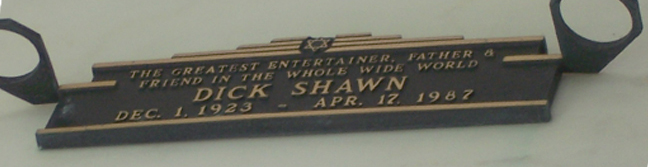
Here’s where Dick Shawn is today — at Hillside Cemetery in Culver City, California
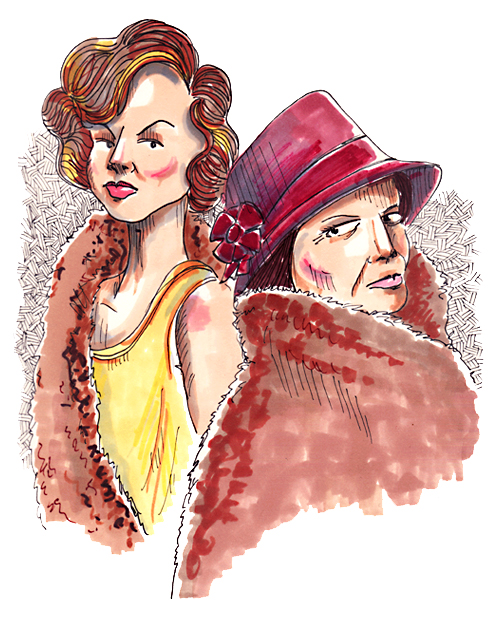
US presidents. What a bunch of fuckers. Literally. A larger collective of men who can’t keep it in their pants never existed. Take a look at this list:
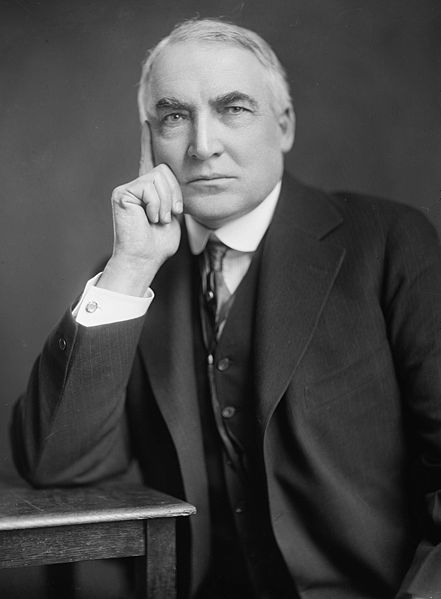
By looks alone, the most unlikely adulterer was 29th President Warren G. Harding. Historians rank Harding’s presidency as one of the worst in the country’s history. Scandals and corruption abounded in his administration, including his mishandling of the Great Railroad Workers Strike of 1922 and the notorious Teapot Dome Scandal that was tagged the most “sensational scandal in the history of American politics” until Watergate. A member of his cabinet and several of his appointees were convicted, and sent to prison for bribery and defrauding the federal government. But, none of this mattered to amourous President Harding, ’cause he was fighting the women off with a stick.
In 1912, sixteen year-old Nan Britton became infatuated with 47 year-old, married Warren Harding. Young Nan plastered the walls of her room with newspaper clippings and photos of the former Ohio Lieutenant Governor. Harding, a friend of Nan’s father, spoke with the girl, telling her that she would one day meet the man of her dreams. Harding, meanwhile was in the throes of a passionate tryst with Carrie Phillips, wife of James Phillips, owner of a prominent Ohio department store. As Harding’s bid for the US Presidency gathered steam, Carrie was given a new Cadillac, $20,000 and trip around the world to keep her mouth shut.
In June 1923, Harding set out on a cross-country “Voyage of Understanding” pubilicity tour to reconnect with the people. By the time he reached San Francisco in August, he was suffering from exhaustion and pneumonia. During a conversation with his wife at the Palace Hotel, Harding suddenly shuddered and died. In 1927, Nan Britton published what is considered to be the first “kiss-and-tell” book. She attested that, on numerous occasions, she and Harding had sex in a White House closet and that he was the father of her daughter Elizabeth. She also claimed the President’s life was a series of “cheap sex episodes”.
When Carrie Phillips passed away in 1960, over 100 letters from Harding were discovered among her personal effects. Most were flowery love letters, but a number of them were very erotic in nature.
Stuff you’d never expect from a guy that looked like this…
This week’s Illustration Friday challenge word is “shadows”.
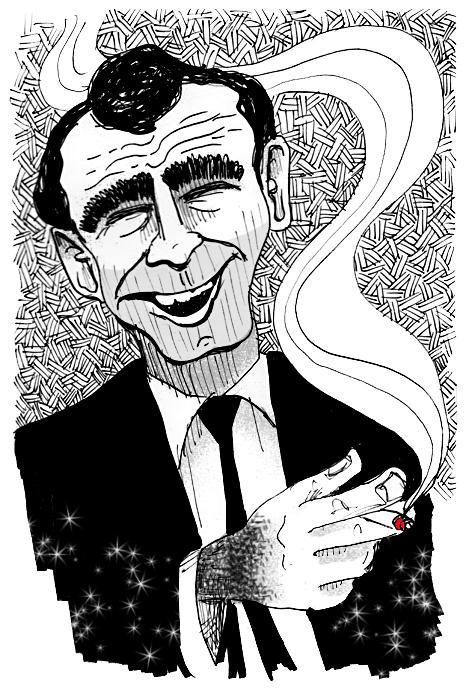
“There is a fifth dimension, beyond that which is known to man. It is a dimension as vast as space and as timeless as infinity. It is the middle ground between light and shadow, between science and superstition, and it lies between the pit of man’s fears and the summit of his knowledge. This is the dimension of imagination. It is an area which we call The Twilight Zone.”
For five seasons, Rod Serling used those words (or variations of them) to introduce The Twilight Zone, his classic science-fiction/supernatural anthology series. When The Twilight Zone premiered in October 1959, it was hailed by one TV critic from The Chicago Daily News as “the only show on the air that I actually look forward to seeing. It’s the one series that I will let interfere with other plans.” Daily Variety ranked it with “the best that has ever been accomplished in half-hour filmed television” and the New York Herald Tribune found the show to be “certainly the best and most original anthology series of the year.” The bulk of the series episodes were scripted by celebrated and respected writers Charles Beaumont, Richard Matheson and Serling himself. Serling also served as host as well as the show’s main advocate against network censorship. The series has been rerun in syndication since its cancellation in 1964, eventually gaining a fan base that has made the show bigger and more popular than in its initial run. My son, E., has numbered himself among those fans since he first discovered the show, in reruns, at the age of six. When my son graduated from the likes of kiddie shows like Thomas the Tank Engine and Mighty Morphin Power Rangers, he latched on to The Twilight Zone, in all its “out-of-place black-and-white” glory. Even at such a young age, he understood the irony of the twist endings at each episode’s end. (I realize that some of the payoffs were driven home with the blatant impact of a sledgehammer, but, still, he was six!)
Walt Disney World had become a favorite destination for me beginning with my first trip with my friends in 1980. The fondness began even earlier for my wife and her family. They first ventured to the central Florida entertainment mecca within a year of its grand opening. So, based on that shared history, Walt Disney World was the natural choice for our honeymoon when we married in 1984. We followed that trip with another one the very next summer. At the end of 1986, my wife and I drove to Disney World again. She happily sat behind the steering wheel and guided our car southbound on I-95, despite being six-weeks pregnant. With a baby due in August, we figured that this would be our last trip to the theme park for quite a while. With the additional expenses of a third member of the family, we settled for short trips to Atlantic City for recreation. It wasn’t until 1995, just a few months before our son’s eighth birthday, that we were able to financially swing a return visit to Disney’s Florida resort.
No longer appeased by regular visits to the Disney Store in the Cherry Hill Mall and by having this extensive collection in his house, my son was ecstatic at the idea of seeing and experiencing actual Disney attractions in person. With the opening of the so-called Value Resorts as part of the Disney roster of accommodations making it easier on our pocketbook, we made reservations for a room at the new All-Star Music Resort and my wife and I looked to forward to seeing how the property had changed in nine years. We also, of course, looked forward to enjoying a Walt Disney World vacation with our son.
Our first day in The Magic Kingdom was great. We marveled excitedly as E. took it all in the rides, the sights, the characters. After watching countless Disney’s Sing-Along and Vacation Planner videos and studying Birnbaum’s Official Guide to Walt Disney World with a level of concentration usually reserved for college entrance exams, E. was very familiar with the layout of the park and its numerous contents. He happily rode Peter Pan’s Flight and It’s a Small World, cheerfully singing the brain-washing theme song upon exiting. With trepidation, he entered the foreboding queue areas of Pirates of the Carribbean and the Haunted Mansion. E. nervously laughed, hiding his fear, as our “doombuggy” inched its way through the darkened halls of Master Gracey’s abode. As we followed the crowd on the exit ramp, E. opted to accompany his mother to The Hall of Presidents rather than another ride through the Haunted Mansion with me. Confounded, I reasoned that there were more dead guys among the Presidents than in the Haunted Mansion, but he would hear nothing of it.
Day Two brought us to Epcot, which evoked equal enthusiasm. Our Day Three objective was The Disney-MGM Studios (now called The Disney Hollywood Studios, after a 20-year licensing agreement ended). As usual for the Pincus Family, we arrived early at the park’s entrance gate. Since The Disney-MGM Studios had opened in 1989, this was to be the first theme park the three of us would experience together for the first time. We carefully followed park-issued guide maps and plotted our path to cover the most ground and optimize our full day. We were drawn to The Great Movie Ride, housed in a frighteningly-accurate reproduction of the famed Graumann’s Chinese Theater in Hollywood. After that, we encountered the Indiana Jones Stunt Show, Star Tours, the hokey Backstage Tour and the entertaining, yet confusing, Voyage of the Little Mermaid. The recently opened Twilight Zone Tower of Terror loomed high above the Studios, its faux lightning-burned, terracotta exterior defiantly inviting curious thrill-seekers to explore its equally-ominous interior. In spite of being a fan of the show, Twilight Zone Tower of Terror spooked my son to no end. He occasionally shot an over-the-shoulder glance towards the structure, but was not interested in the least of going near it. We weren’t going to force him to ride something that very thought of struck him with fear. For Christ’s sake, the word “terror” was right in the name of the thing! But, I wasn’t travelling all the way to Florida to stand in the shadow of a ride, only to leave and wonder what it was like. I told my wife that I wanted to ride and if I had to, I’d ride it myself. She agreed to wander the park with our son while I did. Ninety minutes later, I met up with the members of my family. I related my ride experience in animated jubilation. I told my wife she had to ride it. She just had to! E. looked up at me with fearful wide eyes. I explained that he would love it. “There’s nothing really scary about it.,” I began, “You see stuff from Twilight Zone and then you get into a fake elevator that drops real fast. It’s over in a minute and it’s fun!” Then, I joked, “Rod Serling’s arm hair is scarier than the whole ride.” alluding to the many comments I had made regarding Mr. Serling’s hirsute wrists that peeked out of his suit sleeves during his Twilight Zone introductions. Besides, if he didn’t wish a turn, Disney had an arrangement to allow children to take an alternate route out of the attraction building while parents enjoyed the ride. I assured E. that he would not, under any circumstances, be forced to ride. He would merely wait with us until the time came to part company and we’d meet up with him minutes later. My son knew I would never lie to him, but my credibility was waning.
We entered the queue area and E. grew silent, taking in the menacing overgrown garden and deteriorating façade of the Hollywood Tower Hotel, the themed edifice that conceals the actual ride. The line snaked through the (fake) mist-covered foliage and into a grand, yet cobweb-covered (also fake), reception lobby. The “castmembers” (Disney employees), clad in maroon and gold bellhop uniforms in keeping with the 1930s motif, directed groups of riders towards ornate doorways. My son, still convinced that he was going to ride this thing against his will, clung to my wife as our group passed through the doorways and into a small room whose walls were lined with books and curios, some representing props from the show. As I pointed a few of them out to my son, the lights dimmed, a large black-and-white television flickered to life and the familiar image of Rod Serling appeared on the screen. His narration, obviously dubbed by a dead-on impersonator, told of a group of guests who rode an elevator in the hotel during a lightning storm in 1939. The screen suddenly showed the actual hotel we were in being struck by a blazing bolt of electricity. My son, whom I was now holding, buried his face deep into my shoulder. The TV snapped off and a set of doors on the opposite wall opened and another “bellhop” instructed us to follow a narrow walkway through a pseudo-boiler room to the boarding area. E., again looked up at us and questioned about his opportunity to split. Again, I promised him he would not be forced to ride, although I was not sure at what point he would be offered alternate egress options. The ambient sound of grinding gears and hissing steam didn’t help my trustworthiness and we continued our approach to the pre-board area. Finally, we were waved in and advised to stand on one of an array of designated number plaques embedded in the floor. E.’s horror escalated until I informed the ride operator that my son did not wish to participate in this particular excursion into the realm of Disney magic. Barely breaking character, another bellhop smiled, took E.’s hand and led him to a nondescript doorway along side the elevator entrance. My wife and I entered the attraction elevator and we were off! We laughed and shrieked and howled with elation and, seconds later, we were told to “enjoy the rest of our day at Disney World”. The doors of the elevator opened and there stood a smiling E. still holding the hand of the bellhop. We thanked him as we regained possession of our son. As we walked out through the gift shop (as is the case with most Disney attractions), we asked about our few moments apart. E. told us that his elevator was just a regular elevator and he rode with just the bellhop and two wheelchairs. He asked the bellhop if the heavy wool coat of his costume was hot because it looked hot. The bellhop confirmed it was, indeed, hot. He also told us that his elevator didn’t go very fast.
We have been to Walt Disney World and Disneyland 12 more times since 1995. And, as far as my son’s relationship with Twilight Zone Tower of Terror is concerned — now we can’t get him off the damn thing!
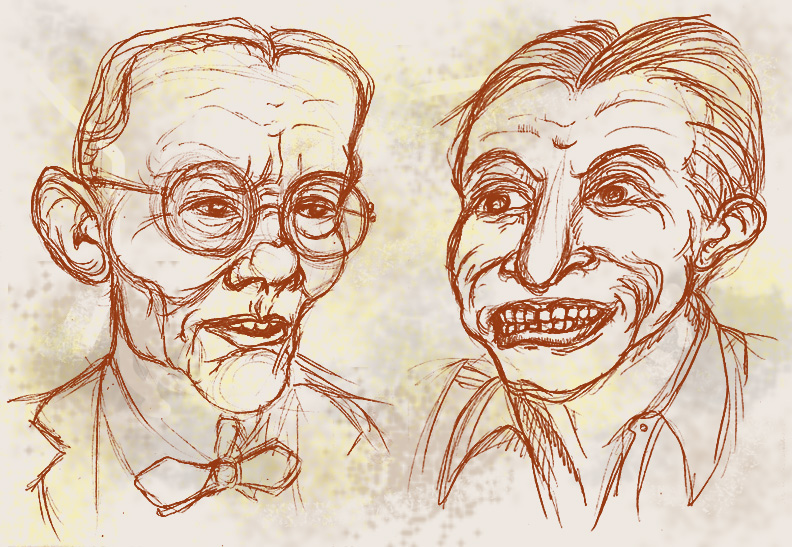
Have you ever watched an old movie on television and a nameless character actor prompts the rhetorical question, “How did this guy ever become an actor?” I’m sure Dwight Frye and Skelton Knaggs have evoked that query many times.
Dwight Frye made a career playing mentally unbalanced and deranged characters. He earned himself the nickname “The Man with the Thousand Watt Stare.” In over fifty films, he graced the silver screen with riveting portrayals of unnerving characters, the most famous having been “Renfield” the fly-eating madman in Tod Browning‘s Dracula and “Fritz”, the monster-tormenting, hunchbacked assistant in James Whale‘s Frankenstein, both from 1931. In addition to his film roles, Dwight aided the war effort by designing tools for Lockheed. While in preparation for a breakthrough role in a biopic of President Woodrow Wilson, Dwight died of a heart attack on a Hollywood bus a few days before filming was to begin. He was 44.
As Dwight Frye’s career was winding down, Skelton Knaggs was there as a competent replacement. Skelton was a trained Shakespearean actor in his native England. When he moved to Hollywood, his unusual looks thick glasses, pock-marked face and prominent front teeth made him the perfect candidate for the sinister roles usually reserved for Dwight Frye. In his nineteen year career, he played all sorts of henchmen, villains, pirates and creeps in mostly uncredited parts. Unfortunately, Skelton was an alcoholic and years of heavy drinking brought on the cirrhosis of the liver that took his life at age 43.
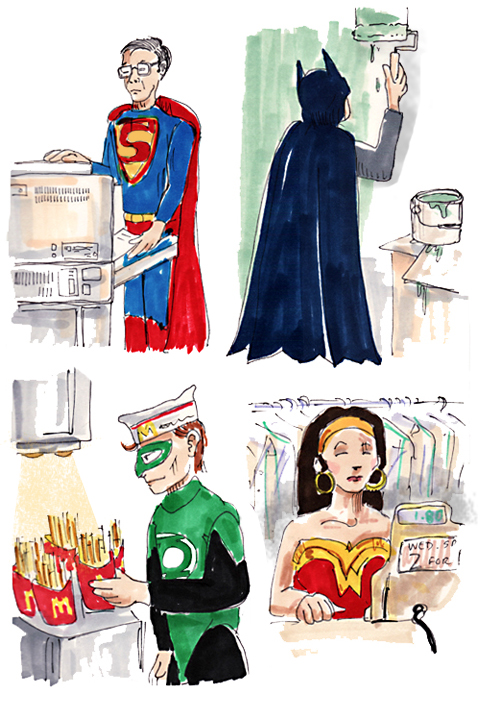
What if super hero costumes were just another option for everyday clothing available to everyone?
I guess super heroes would seem less super.
This week’s Illustration Friday suggested topic is “asleep”.
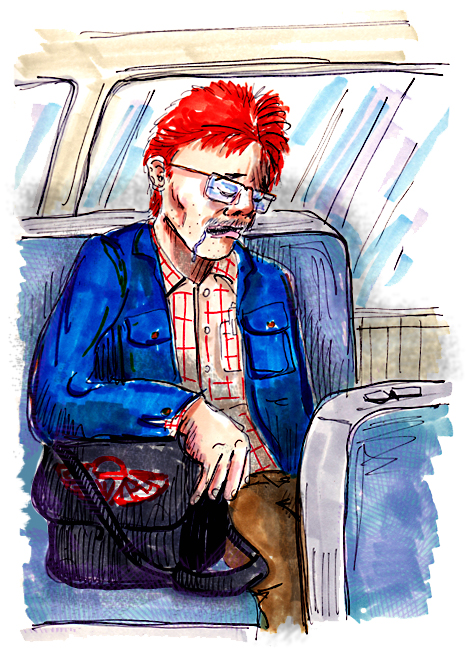
The morning began like every morning begins. My alarm went off at six and I smacked the snooze button every ten minutes until I kicked myself out of bed at 6:30. I showered, brushed my teeth and checked the mirror to see if I could get away without shaving for one more day. I exited the bathroom and headed downstairs. I flicked on our Keurig coffee maker and while the water was heating up I ran down the basement steps to grab a matching pair of socks out of the dryer. Back in the kitchen, I watched as hot water purged through my selection of K-Cup and emptied its brewed contents into a waiting mug. After adding a splash of half-and-half and one packet of Sweet ‘n Low, I carried my coffee and my socks back upstairs to watch the first half-hour of The Today Show while I got dressed. As the clock came up on 7:40 am, I snapped off the TV and grabbed my cellphone and canvas messenger bag. Mrs. Pincus was asleep, still snuggled under several blankets, when I kissed her and whispered “goodbye”. I crossed the hall to say “goodbye” to my son, curled up under his own blankets. Although they each uttered a closed-mouthed “hum”, they may or may not have heard my actual farewell as is the case most mornings. I scrambled down the stairs, grabbed my denim jacket and pulled it on as I hurried out the door. I ambled to the train station at the end of my block, less than a minute walk from my front door. Most mornings, I see my friend Randi and we ride the train together to our destination, as we both work in the same office building in center city Philadelphia. This particular morning, Randi was not on the platform. Too bad for me.
At 7:50, the train stops at Elkins Park and I get on. It then proceeds on to its scheduled station stops at Melrose Park, Fern Rock, Temple University and Market East until it reaches my journey’s end, Suburban Station. My entire morning commute covers five stations and lasts approximately twenty-five minutes. When I ride with Randi, we are engaged in conversation that lasts the whole trip, usually continuing until we reach the elevators in our building’s lobby. Since Randi was obviously relying on another route to work this morning, I turned to my dog-eared copy of Carson McCullers’ The Heart Is a Lonely Hunter to pass the time. I boarded the train, selected a seat at the rear of a relatively empty car, pulled the book from my bag and began to read. I had been struggling through Miss McCullers’ Southern Gothic debut, that it now had taken on the characteristics of a high-school reading assignment rather than a source of enjoyment. The train came to a stop at Melrose Park and, unable to focus, I returned the book to my bag and closed my eyes for a quick nap. Too bad for me.
Suddenly, my eyes shot open. The train was in a tunnel and the car lights were flickering. I was groggy and disoriented. Through bleary and unadjusted eyes, I looked at my watch and I saw it was 8:10. However, since I was in a tunnel, I didn’t know which 8:10 of the day it was. I couldn’t remember how long I had been asleep. The train pulled into Market East, the first underground station on my regular morning journey. My foggy and sleep-addled mind surmised that I was actually on my way home and it was 8:10 in the evening. I convinced myself that I must have traveled all the way to the end of my homecoming train’s line in Glenside where no train staff had awakened me and now I was on a return trip to center city. In a panic, I hopped off the train and frantically dialed my wife at home. As the phone rang, I was annoyed that she had not called, wondering why I had not arrived home at my usual 5:30. After four or five rings, my wife’s hushed voice whispered “Hello” from my cellphone’s speaker. I blurted out, “I’m okay! I’m on my way home. I must have fallen asleep on the train, came back from Glenside and now I’m at Market East. I’m getting on a train to Elkins Park and I’ll be home soon.” I rambled on so quickly, I didn’t allow my bewildered wife to get an interrupting word in. I paused and followed my rant with, “I can’t believe you didn’t call me! Didn’t you wonder where I was?”
She was silent, then she cleared her throat and said, “Well, I was asleep” and she trailed off.
“I’m three hours late coming home and you didn’t think to call me?” I was starting to get angry. “Well, forget it! I’ll be home soon.”
“What are you talking about? Why are you coming home?” She sounded as confused as I felt.
“I’m coming home!”, I said one last time and I pushed the “END” button on my phone as I approached the information desk at Market East to ask the time for the next train to Elkins Park.
My wife sat in our darkened bedroom and stared blankly at the phone. The first thought to cross her mind was “Well, a twenty-seven year marriage was a good run.” Knowing full well that I had just left the house twenty minutes earlier, she began to cry, assuming I had had a stroke while riding the train.
I boarded the Elkins Park-bound train and called home again. I lowered my voice, so as not to attract the attention of my fellow passengers to my slightly embarrassing situation. Once again, I explained the “fell asleep on the train” scenario to my emotional wife. During my explanation, the train emerged from the tunnel into the harsh sunlight of the morning. Suddenly, it hit me. I had been asleep for merely moments, on my way to work not hours, on my way home. It also occurred to me that Mrs. Pincus must have thought I had a stroke. “Um, I’ll call you right back.” I said to her and ended the call. All that had just transpired became instantly clear to me. I looked at my watch again and up to the sky and concluded the correct time of day. I jumped off the train at Temple University and I waited for the next train to my proper terminus. And I called my wife. Again.
Mrs. Pincus answered on the first ring. She hit me with a battery of inquiry. “Are you okay? Where are you? Did you have a stroke?” I assured her I was now fully aware of the situation and I was now headed in the right direction and I did not have a stroke. It took several repeat affirmations but I finally convinced her that I was, indeed, fine.
At last, I reached Suburban Station, ten minutes later than usual arrival. I walked my usual route to my office and as I snapped my office light on, two of my co-workers noted, “You’re later than usual.”
Too bad for me.