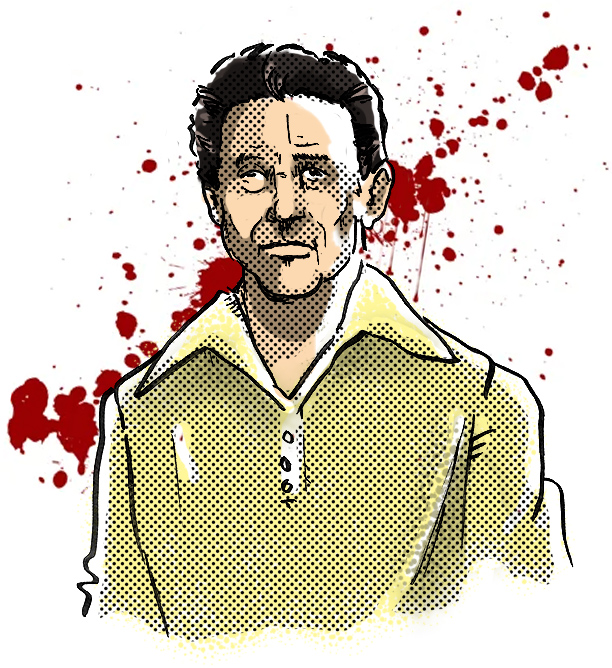
DCS: carlos tobalina

Born in Peru in 1925, Carlos Tobalina emigrated to California in 1956. He found work as a used car salesman and, in a second career, doing voice-overs on a Spanish language radio station. Taken in by the appeal of the Southern California film industry, Carlos founded his own production company in 1964. The company — “C. Tobalina Productions” — consisted of Carlos and his bookkeeper wife Maria. After five years as a struggling company with no output, Carlos filmed and released his debut feature. Infrasexum was a soft-core pornographic film featuring Carlos, his wife and a small stable of unknown actors. Carlos performed double duty, serving as director as well. Critics panned the film, calling it “downright weird” and citing a “production value that was close to zero.” Infrasexum found a small cult audience, but just after its release, Carlos was brought to court in the state of Colorado on obscenity charges. A trial ensued but the verdict was found in Carlos’s favor. Carlos then filed a counterclaim against the prosecution, including the mayor, state attorney general, and governor of Denver. After a screening in Alabama, a similar case was brought up. It, too, was dismissed. Carlos faced additional lawsuits into the 70s. He fought each one, invoking his First Amendment rights. The US Supreme Court eventually redefined its definition of “obscenity,” as a result, in part, of Carlos’s cases.

Carlos released a second, equally criticized, pornographic feature called Double Initiation. Despite poor reviews, Carlos’s film generated enough revenue that he was able to purchase two homes in the seaside California town of Pacific Palisades. His home, at 14930 Corona del Mar, served as his studio. The majority of his over forty sex exploitation films were shot at this location. Most of Carlos’s work was consistently berated as “nonsensical,” “confusing” and just “weird.”

In 1971, Carlos purchased the majestic Mayan Theatre in Los Angeles for $300,000. He used the one-time respected theatre as an exclusive outlet to screen his films. He later purchased two more theaters — the X Theater on Hollywood Boulevard and the Star Theater in La Puente, California. Carlos converted the X Theater into a twin screen facility, naming the two separate auditoriums “Adam” and “Eve.” The “Eve” side continued to screen Carlos’s pornography while the “Adam” featured mainstream films. The Star Theater was the last surviving lamella (curved wood) roof theater designed by master architect S. Charles Lee — until its demolition in 2019.

On March 31, 1989, Maria found Carlos in the rear patio of their home. A .38 caliber revolver lay on the ground next to him. There was a self-inflicted gunshot wound in his head. A discovered suicide note explained that Carlos had been diagnosed with terminal liver cancer. He was 64 years old.

Comments

comments

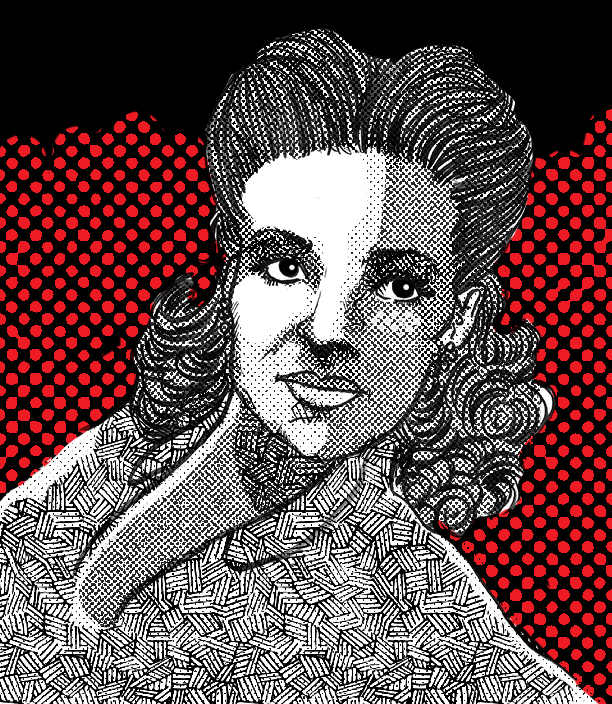
DCS: helen twelvetrees

While attending the American Academy of Dramatic Arts in Brooklyn, 19 year-old Helen Jurgens married fellow student Clark Twelvetrees and adopted his unusual and unique surname as her own. Clark was a troubled man, who once attempted suicide at a dinner party. He jumped from a high-story window, but survived. Helen divorced Clark in 1931. He died after a street altercation a few years later.

With minimal stage experience, Helen headed to Hollywood with the idea of replacing silent movie actors experiencing difficulty making the transition to the new trend — talkies. She nabbed roles with Fox Films, but after three screen appearances she was let out of her contract. She was immediately signed with Pathé and, along with contemporaries Constance Bennett and Ann Harding, Helen was featured in a succession of critically-acclaimed tear-jerkers. After Pathé was absorbed by RKO Pictures, Helen left to persue roles as a freelance actress.

The 1930 film Her Man defined Helen’s career as a sympathetic woman supporting the wrong man. She costarred with Spencer Tracy and Maurice Chevalier as her popularity grew. One critic was prompted to describe Helen as:  “having a gift for projecting emotional force with minimal visible effort.” Her career riding high, Helen filmed Thoroughbred, a film based on the celebrated racehorse Phar Lap, on location in Australia. However, she fell ill upon her return to the United States. Her slow recovery damaged her film career, but the always determined Helen left Hollywood for a career in summer stock.

She appeared across the country in numerous productions, including The Man Who Came to Dinner and A Streetcar Named Desire. Her Streetcar co-star Naomi Caryl recalled that Helen possessed “the saddest eyes I’d ever see.”

Helen married for a third time in 1947 and promptly retired from show business. Her husband, a US Air Force captain, traveled the world and Helen happily accompanied him.

In 1958, Helen Twelvetrees was discovered unconscious in her Central Pennsylvania home. Long suffering from a kidney ailment, Helen had purposely taken an overdose of prescription sedatives. She died at an Air Force base hospital, just a few months after her 49th birthday. Her funeral was attended by her widower and one close friend.

Comments

comments

inktober 2021: week 5

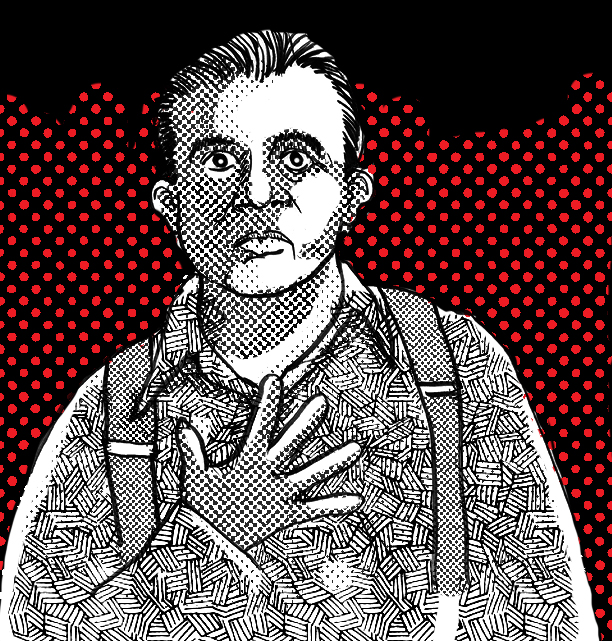
Inktober 2021 comes to a close and the final subject is Dwight Frye.

Dwight Frye packed nearly 70 screen credits into a career that spanned almost half a century. He is best remembered for tow roles in classic horror films — both released in 1931. Dwight played the sadistic assistant “Fritz” in the original Frankenstein. He also played the crazed, insect-eating “Renfield” in the original Dracula.

Just a few days before filming was to beginning on a biopic of President Woodrow Wilson, Dwight (who was slated to play the title role) suffered a fatal heart attack on a Hollywood city bus. He was 44 years old.

Alice Cooper paid tribute to Dwight on his 1971 album Love It to Death with the song “The Ballad of Dwight Fry” — the final “E” purposely left off.

Comments

comments

DCS: evelyn mchale

beautiful suicide

Twenty-year-old Evelyn McHale boarded a train at 7 in the morning in on May 1, 1947. She was headed back home to Tuckahoe, New York after visiting her fiance in Easton, Pennsylvania to celebrate his 24th birthday. When she arrived at Penn Station, she walked to the Empire State Building and purchased a ticket to the 86th Floor Observation Deck.

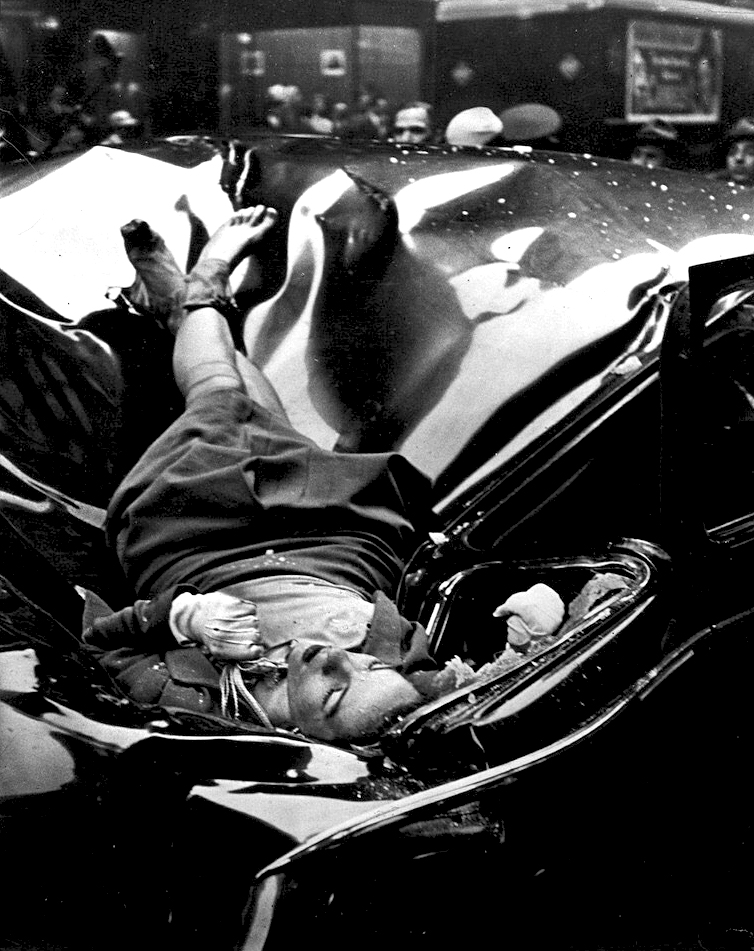
Around 10:30, a New York City police officer, who was directing traffic at 34th Street and Fifth Avenue, spotted a white scarf floating lazily through the air. A moment later, he heard a loud crash and saw a crowd of people gathering a few hundred feet away. A woman’s body was lying still, cradled in a large contour dent in the roof of a United Nations limousine that was parked by the curb. The woman was Evelyn — her eyes closed, one hand at her throat, her fingers entwined in a short string of pearls. He makeup appeared to have been freshly applied. Her ankles were casually crossed, although the impact of her body hitting the car roof had caused her shoes to come off and her right stocking to rip. She looked as though she was asleep.

A suicide note was found in Evelyn’s purse, which was stacked atop her neatly folded coat on the 86th floor observation deck of the Empire State Building. It read:

“I don’t want anyone in or out of my family to see any part of me. Could you destroy my body by cremation? I beg of you and my family – don’t have any service for me or remembrance for me. My fiance asked me to marry him in June. I don’t think I would make a good wife for anybody. He is much better off without me. Tell my father, I have too many of my mother’s tendencies.”

As the crowd milled around the ghastly scene, photography student Robert Wiles took a picture of Evelyn, a mere four minutes after she ended her life. The photograph appeared in Life magazine eleven days later, with the caption: “At the bottom of the Empire State Building the body of Evelyn McHale reposes calmly in grotesque bier, her falling body punched into the top of a car.” The photograph, which has achieved iconic status, has come to be known unofficially as “The Most Beautiful Suicide.”

Evelyn’s sister identified the body, and, according to her wishes, Evelyn was cremated and no memorial service was held.

Evelyn’s fiance moved to Florida and remained unmarried until his death in 2007.

Robert Wiles never published another photograph professionally.

Comments

comments

inktober 2021: week 4

Inktober 2021 winds down to week 4.

A popular pin-up during World War II, Anne Gwynne appeared dozens of film noir and musical comedy. But her few forays into horror were memorable among her fans. In 1940, she played Boris Karloff‘s daughter in Black Friday and 1944 she returned to the Universal lot for House of Frankenstein, a mish-mash of the of the genre that was so poor, screenwriter Curt Siodmak asked that his named be removed from the final cut.

Anne retired from the silver screen and passed away in 2003 at the age of 84.

Anne’s daughter, actress Gwynne Gilford, and son-in-law, actor Robert Pine, carried on the family acting mantle. She made guest appearances in episodic television. He was a featured regular in the TV series CHiPs. Anne’s grandson is actor Chris Pine.

Comments

comments