Monday Artday: cocktail lounge

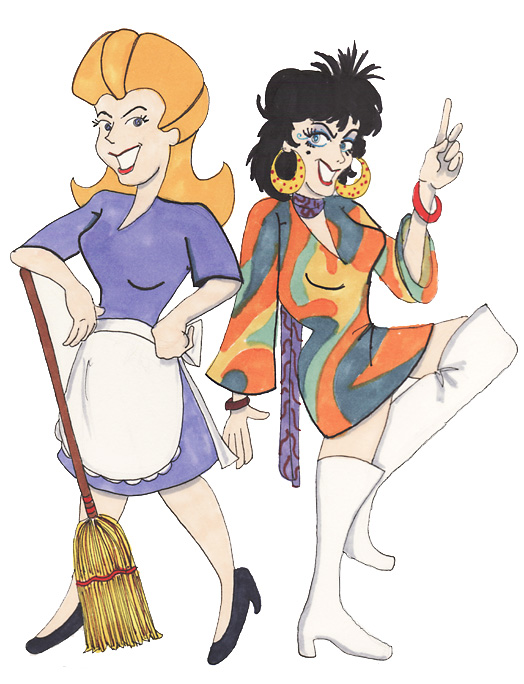
The challenge for this week on Monday Artday is “cocktail lounge”.
in some secluded rendezvous...
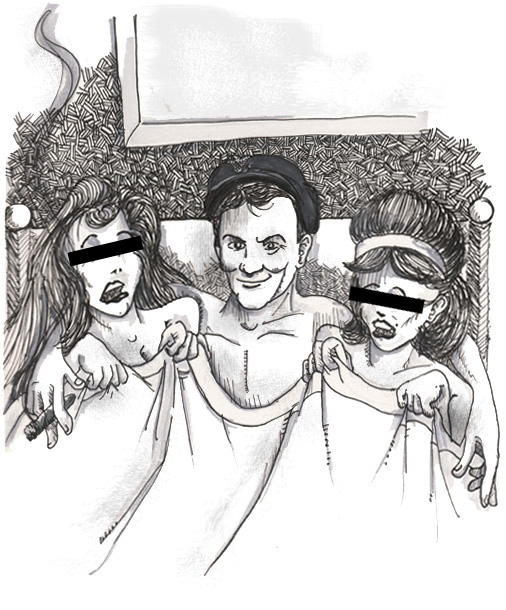
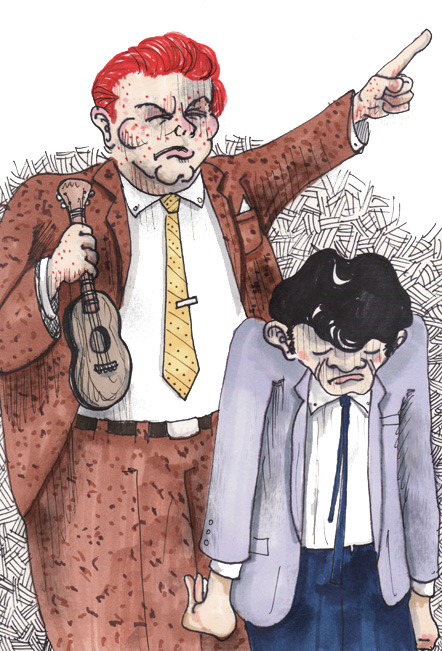
I’m sure the topic of “cocktail lounge” conjures up images of swingin’ little cozy hideaways where a cool cat can order a hip martini-du-jour and smooth-talk a sophisticated chick. Think Frank Sinatra, Buster Poindexter and Dean Martin with a bit of Lord Buckley’s silky speech.
I admit when I saw the topic, the first thing I thought was “loser”.
I don’t drink. I haven’t been in a bar or cocktail lounge in twenty-five years. And my only frame of reference is Steve Buscemi‘s directorial debut “Trees Lounge”.
The film, Trees Lounge, was about a cocktail lounge filled with losers, talking about their loser lives, hanging out with their loser friends and screwing up every opportunity to better themselves. It was a really depressing movie.
I highly recommend it.

Comments

comments

IF: sour

The illustrationfriday.com challenge word this week is “sour”.
You scream and everybody comes a running/Take a run and hide yourself away.
The Fox and The Grapes
One hot summer’s day a Fox was strolling through an orchard till he came to a bunch of Grapes just ripening on a vine which had been trained over a lofty branch. “Just the thing to quench my thirst,” quoth he. Drawing back a few paces, he took a run and a jump, and just missed the bunch. Turning round again with a One, Two, Three, he jumped up, but with no greater success. Again and again he tried after the tempting morsel, but at last had to give it up, and walked away with his nose in the air, saying: “I am sure they are sour.”

The moral: It is easy to despise what you cannot get.

For your information, Mr. Fox, grapes are readily available at the grocery store. You can try a couple before you make a purchase and they don’t make you jump for them.

Comments

comments

SFG: spots

lady in red
Out, damned spot; out, I say. One, two,’why, then ’tis time to do’t. Hell is murky. Fie, my lord, fie, a soldier and afeard? What need we fear who knows it when none can call our power to account? Yet who would have thought the old man to have had so much blood in him?

These words are spoken by Lady Macbeth in Act V, scene 1 in Shakespeare’s Macbeth. Lady Macbeth is sleepwalking through the castle. She is subconsciously thinking and feeling guilty about being the driving force behind the murder of Duncan. After the murder, Macbeth believed his hand was irreversibly bloodstained. Lady Macbeth told him, “A little water clears us of this deed.” Now, she sees blood on her own hands. She is completely undone by guilt and descends into madness.

“What need we fear who knows it when none can call our power to account?,” she asks, asserting that as long as her and her husband’s power is secure, the murders they committed cannot harm them. But her guilt-wracked state and her mounting madness show how hollow her words are. So, too, does the army outside her castle. “Hell is murky,” she says, implying that she already knows that darkness intimately. It is implied, although not directly stated, Lady Macbeth commits suicide.

Comments

comments

Monday Artday: hair

The challenge this week on Monday Artday is “hair”.
I dream of Julia with the light brown hair.
The details of Julia Pastrana’s early life are sketchy. She was discovered in Mexico where she worked as a housemaid. She had hypertrichosis terminalis. She had a beard, was covered in glossy black hair. Her ears and nose were unusually large and her teeth were irregular. Theodor Lent discovered her and purchased her from a woman who might have been her mother. Lent taught her to sing and dance and play music, preparations for Julia’s introduction to the circus sideshow where she would spend the rest of her life. She joined a traveling circus when she was 20. She was regarded as some sort of hybrid or other “freak of nature” that did not fit in the order of things. Some doubted that she was even human, as a flyer from 1854 proclaimed “its jaws, jagged fangs and ears are terrifically hideous… nearly its whole frame is coated with long glossy hair. Its voice is harmonious, for this semi-human being is perfectly docile, and speaks the Spanish language.” A sense of mysticism surrounded people and creatures that deviated from “normal” and even into the mid-19th century, it was worried that even looking at Julia would cause women to miscarry or have monstrous births of their own. Her appearance was often considered to be an obscenity not fit for the public to view.
Lent married Julia during the course of her sideshow career. She became pregnant and gave birth to a son, also covered with hair. Her son died after only 36 hours and Julia died two days later. Julia’s death did not stop Lent. He had the bodies of Julia and the child mummified and took them on an extended tour of Europe, putting them on display at any chance available, for a quick buck. Victorian England loved stories of apes, lurid tales of savage gorillas coming in from Africa and the scientific description of animals. Rather than being some monstrous aberration meant to make people turn their gaze to God, Julia now represented a “missing link,” and the popularity of apes was just too tempting for Lent to let his wife rest in peace. Julia’s mummified remains were easier to approach and many people still turned out to see her body and discuss her anatomy. Ultimately, her body and that of her child wound up in a hospital storage room in Norway where they have disappeared and resurfaced multiple times since the 1860s.

Comments

comments

from my sketchbook: anissa jones

buffy, buffy, come back to me
By the time she was six, Anissa (pronounced “ah-NEESE-ah”) Jones was hawking cereal in her first television commercial. A couple of years later, in 1966, Anissa’s acting talents caught the attention of two television producers who were preparing a new television sitcom called Family Affair. They felt Anissa would be perfect in the role of Elizabeth “Buffy” Patterson-Davis. Originally to be an older sister to Johnny Whitaker’s character Jody, upon Brian Keith’s (Uncle Bill) insistence, the role was rewritten to be Jody’s twin sister. Anissa played Buffy for the show’s entire 138-episode run. Her schedule was grueling, often requiring her to either work on the show or for show publicity all year round and sometimes seven days a week. But in June of 1969, Anissa’s hard work payed off. The show was number one in the ratings turning Buffy and Jody into household names. Buffy’s doll, Mrs. Beasley, became the best-selling doll in America during the show’s run.

Anissa’s fame continued to grow. She appeared in several television productions including guest roles in Rowan and Martin’s Laugh-In and To Rome With Love. She, along with Jimmy Durante, presented the 1967 Emmy Award to The Monkees, for Best Comedy Series. She also starred alongside Elvis in her only movie, The Trouble with Girls. Numerous merchandising deals came her way. There were Buffy paper dolls, Family Affair coloring books and lunch boxes, a Buffy line of children’s clothes, and a Buffy Cookbook in 1971, all prominently featuring Anissa.

Anissa’s younger brother, Paul almost always accompanied her to the studio. Anissa was very fond of her brother. As the star of a hit TV series, Anissa would quite often receive gifts. She demanded that an identical one for her brother accompany any gift she received and if two gifts were not received, she would give hers away.

Family Affair  was canceled in 1971, after five seasons. Anissa was thrilled that the show’s run was over, as it meant she could go to school and hang out with her friends. In 1972, Brian Keith contacted Anissa, offering her a role in his new TV sitcom. He assured her she could have the part without an audition. She graciously turned him down. Later in 1972, she auditioned for the part of “Regan MacNeil” in The Exorcist,  a role she lost to Linda Blair. Anissa did not want to continue her show business career.

With a deteriorating mother-daughter relationship, Anissa, along with her brother Paul, moved in with their father. After their father’s death, Anissa and Paul were forced to move back with their mother, but Anissa often spent much of her time at a friend’s house. This infuriated her mother so much, that she reported Anissa as a runaway. Anissa was picked up and spent some time in juvenile detention. Upon her release, she began drinking and using drugs.

Hoping to make ends meet until her eighteenth birthday when she would receive royalties from Family Affair,  Anissa took a job at Winchell’s Donut Shop in Playa Del Rey, California. At eighteen, Anissa received her $70,000 trust fund and $107,800 in US Savings Bonds from her Family Affair earnings. She and Paul got an apartment together. Anissa bought herself a new Ford Pinto and her brother a loaded Camaro that cost twice as much as her own car. With her newfound freedom, her new wealth and more drugs than she knew what to do with, Anissa began partying hard.

On August 28th, 1976, while attending a party at a friend’s house, Anissa ingested huge doses of the barbiturate Seconal (the drug of choice for Jimi Hendrix, Judy Garland, Charles Boyer and Marilyn Monroe), phencyclidine (PCP), cocaine and methaquaalone (Quaaludes). During the night, her boyfriend checked on her and she was fine. In the morning, her friends found an unresponsive Anissa and called the paramedics. Anissa was declared dead from what the San Diego County coroner called one of the most massive drug overdoses he’d ever seen.

Anissa was eighteen years old.

Eight years later, her brother, Paul, also died from a drug overdose.

Click HERE to hear Angel and The Reruns’ back-handed tribute to Anissa, “Buffy Come Back”!

Comments

comments

IF: fierce

The illustationfriday.com challenge word this week is “fierce”.
Scar tissue is stronger than regular tissue.
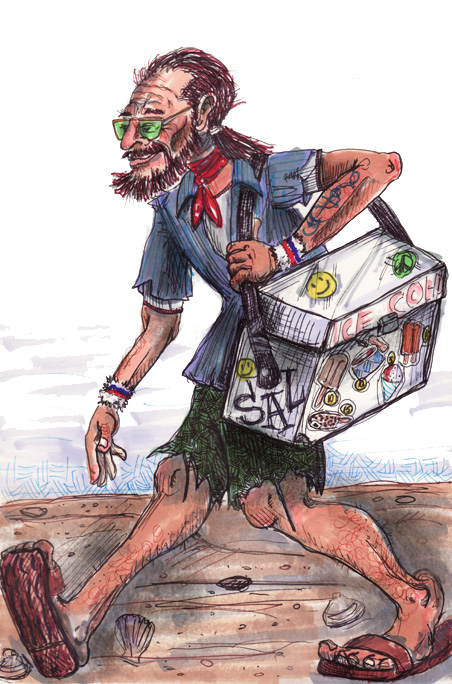
Henry Rollins is a fierce figure onstage. Born Henry Garfield in Washington, DC in 1961, Henry’s parents divorced when he was very young. He suffered from low self-esteem, a poor attention span, bad grades, a confrontational attitude, bad behavior and an uncomfortable feeling around women. He was regularly beaten up by black teenagers because of his race. He was sexually molested and lived with an abusive father. He had accumulated a lot of rage by the time he was seventeen.
He and his friend Ian MacKaye (eventual leader of Minor Threat and Fugazi and founder of Dischord Records) became involved in the Washington punk rock scene. His reputation as a singer spread throughout Washington’s underground music circle and Henry formed State of Alert with former members of Minor Threat. He financed the band’s first EP by working as the manager of a local Häagen-Dazs ice cream store.
In 1980, a friend gave Henry a copy of Black Flag’s Nervous BreakdownEP. Henry became a fan of the band, exchanging letters with bassist Chuck Dukowski and later inviting the band to stay in his parents’ home when Black Flag toured the East Coast in December 1980. When Black Flag returned to the East Coast in early 1981, Henry attended as many of their concerts as he could. At a show in a New York bar, Black Flag’s vocalist Dez Cadena allowed Henry to sing with the band. Unbeknown to Henry, Cadena wanted to switch to guitar, and the band was looking for a new vocalist. The band was impressed with Henry’s singing and stage demeanor that they asked him to become their permanent vocalist. Henry quit his job at Häagen-Dazs, sold his car, and moved to Los Angeles. Upon arriving in Los Angeles, Henry got the Black Flag logo tattooed on his left bicep and changed his surname to Rollins, a surname he and MacKaye had used as teenagers.
Rollins’ vocal style has been described as “spitting out the lyrics like a bellicose auctioneer” and his stage presence is so intense, it looks as though his head will burst right off his neck.

Comments

comments

Monday Artday: my hometown

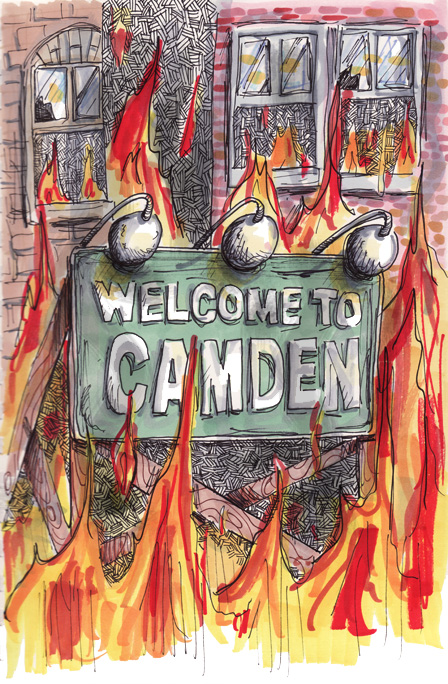
Once again, Monday Artday is using one of my suggestions as the weekly challenge. The challenge this week is “my hometown” — illustrate something specific to the city you live in or the city you are from.
the city that loves you back
Funny. When I make suggestions for topics, you’d think I’d have an idea in mind. I don’t. Not at all. I actually came up with this idea when I was driving to pick up my son at the radio station where he works in Philadelphia. He does not drive (by choice), so on Sunday nights, I drive from the predominantly white, predominantly Jewish, predominantly affluent suburb of Elkins Park, through an interesting array of neighborhoods, to West Philadelphia….. and it got me thinking.
Philadelphia is the sixth largest city in the United States. For such a large city, it is merely a series of neighborhoods all strung together by the Delaware and Schuylkill Rivers. The neighborhoods are mostly formed by ethnicity, religion, culture. Philadelphia has the second largest Irish, Italian, and Jamaican populations and the fourth largest African American population in the nation. Philadelphia also has the fourth largest population of Polish residents and the third largest Puerto Rican population in the continental United States. Philadelphia has one of the largest populations of Vietnamese, Cambodians, Chinese, and Koreans in United States. Philadelphia also has the fourth largest population of Indian Americans. The city is one big melting pot in the truest sense of the concept.
Besides that we have soft pretzels, Peanut Chews and we’re the home of Comcast.
Benjamin Franklin lived here.
We have a big bell with a crack in it.
And our baseball team hasn’t won a World Series in twenty-eight years.

Comments

comments

IF: hoard

The illustrationfriday.com challenge word this week is “hoard”.
hoard (hawrd, hohrd) –noun     a supply or accumulation that is hidden or carefully guarded for preservation, future use, etc.
Uncommonly Good....so, back off!
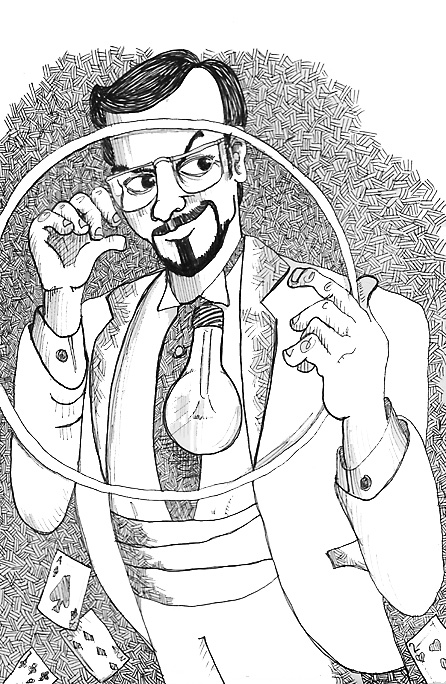
Throughout the nineteenth century, the United States boasted many regional bakeries, such as Chicago’s American Biscuit and Manufacturing Company, the New York Biscuit Company and the United States Baking Company. Also among these companies was the Keebler Baking Company.
Founded in 1853, Keebler has produced numerous baked snacks in the traditional method. Much like its competitors, Keebler used large amounts of manpower operating huge commercial ovens. The Keebler company employed this method for over one hundred years until they came upon the baking secret that they still practice today — magic.
In 1967, Keebler dismantled their entire facility in Elmhurst, Illinois and moved operations to a hollow tree in an undisclosed location. Maintained by just under a dozen elves and one magic oven, the Keebler company began producing cookies that, by industry standards, were “uncommonly good”. They ran a twenty-four hour-a-day shift producing baked treats. Because magic was involved, the finished product was stored in the hollow tree and took up no additional space along side the manufacturing equipment, administrative offices and the elves. The plant (or “tree”, in this case) manager, a firm disciplinarian named Ernie, ran the enterprise with a three-fingered iron fist. He personally upheld the security of the company’s cookie hoard.
The Keebler company was famous for its advertising slogan —
“You never would believe where the Keebler Cookies come from. They’re baked by little elves in a hollow tree. And what do you think makes these cookies so uncommon? They’re baked in magic ovens, and there’s no factory. Try to steal our cookies and — oh man — we will kick your ass!”

Comments

comments

DCS: herve villechaize

da plane! da plane!
Herve Villechaize was born in 1943 in Paris. A malfunction in his endocrine system would leave Herve at a full-grown height of just under 4 feet tall. Herve eventually studied painting and photography at the famed Beaux-Arts Museum in Paris. At the age of 18 he became the youngest artist to ever have his work displayed in the prestigious Museum of Paris.

At the age of 21 Herve sailed to New York City. After teaching himself English by watching American television and upon immersing himself in the New York City art scene, he would eventually land roles in several off-Broadway plays. In his first notable movie role, Herve played Beppo in the 1971 comedy The Gang That Couldn’t Shoot Straight starring Robert DeNiro. He wouldn’t experience his big break into show biz until 1974 however, when he landed the role of a tiny villain named Nick-Nack in the 1974 James Bond film The Man with the Golden Gun.

Herve moved to California, where he eventually hooked up with Aaron Spelling. Spelling would cast him opposite Ricardo Montalban on Fantasy Island. The show’s six season run made a household name out of his character, Tattoo, and injected his signature call of “de plane, de plane” into American pop culture. Herve’s newfound fame would lead him to command a whopping $25,000 per episode salary. Herve and his wife moved into a 2 1/2 acre ranch in the foothills of the San Fernando Valley. Soon, Herve began to sense he was not being treated as fairly as other Fantasy Island cast members. He responded by demanding the same money as Montalban, prompting ABC to drop Herve from the show.

Leaving Fantasy Island would prove to be beginning of his career decline. Herve, having blown through his Fantasy Island money, eventually had to sell his ranch in the Valley and move into a rental house in North Hollywood. His collapsing career and deteriorating health led Herve to the bottle. He would often consume two bottles of wine in a single night. While not that unusual for average sized people, it was detrimental to Herve as he tipped the scales at just 90 pounds.

Herve’s medical condition was worsening. With increasing pain from internal organs that were too large for his body, Herve was taking upwards of 20 pills a day to alleviate the symptoms. He realized that his body was beginning to shut down, and found himself fending off frequent bouts of depression.

In 1993 Herve’s luck would turn a bit towards the better. He found work in several TV commercials including a Dunkin Donuts spot that, despite his wishes to distance himself from his Tattoo days, found him asking for “de plain” “de plain” donut.

On September 3, 1993, Herve, accompanied by his common-law wife, Katherine Self, attended a movie screening in Hollywood. They later enjoyed dinner at a restaurant near their home.

In the early morning hours of September 4, Herve placed two sound-muffling pillows against his chest, and fired a pistol into them.

Comments

comments