from my sketchbook: lena zavaroni

vanilla strawberry knickerbocker glory
Lena Zavaroni grew up on the Isle of Bute (a part of Scotland) and began singing at the age of two. At nine, she appeared on the British talent search program, Hughie Green’s Opportunity Knocks and won the show for a record-breaking five consecutive weeks. She released Ma, He’s Making Eyes At Me, a collection of standards, which reached #8 on the UK album chart. She became the youngest person to have an album in the British top 10, an accomplishment that still stands.

Lena also sang at a Hollywood charity show with Frank Sinatra and Lucille Ball in 1974. Backstage, Lucy commented to young Lena, “You’re special. Very special and very, very good.” Lena went on to appear and perform on The Carol Burnett Show, Johnny Carson’s Tonight Show, Cher’s variety show and The Jerry Lewis Telethon. She also appeared on a number of variety shows on the BBC and eventually performed at the White House for US President Gerald Ford. “Ma! He’s Making Eyes at Me,” an Eddie Cantor song from 1921, became her only US hit when it charted a four-week run on the Billboard Hot 100 in the summer of 1974. Always more popular in her native United Kingdom, Lena had her own TV series on the BBC in the early 1980s.

From the age of 13, Lena suffered from anorexia nervosa. While at school, her weight dropped to 56 pounds. Lena blamed her weight loss on the pressure placed upon her to fit into costumes while she was “developing as a woman.” Lena underwent a number of drug treatments and received electroshock therapy in an attempt to combat her anorexia. Lena also suffered from depression and begged doctors for an operation to give her relief. Although surgery would not cure her anorexia, she was desperate and threatened suicide if she did not receive an operation.

In September 1999 Lena was admitted to University Hospital of Wales for a psychosurgical operation, essentially a lobotomy. After the operation, she appeared to be in good spirits and recovering at a slow, but satisfactory pace. She even asked her doctors about the possibility of returning to the stage. But, three weeks later and weighing less than 70 pounds, she developed a chest infection and died from pneumonia. She was 35.

British electronic popsters Fujiya & Miyagi mentioned Lena in their 2009 song “Knickerbocker”.

Comments

comments

Monday Artday: lucky

The Monday Artday challenge word this week is “lucky”.
You're lucky, he's lucky, I'm lucky, we're all lucky!

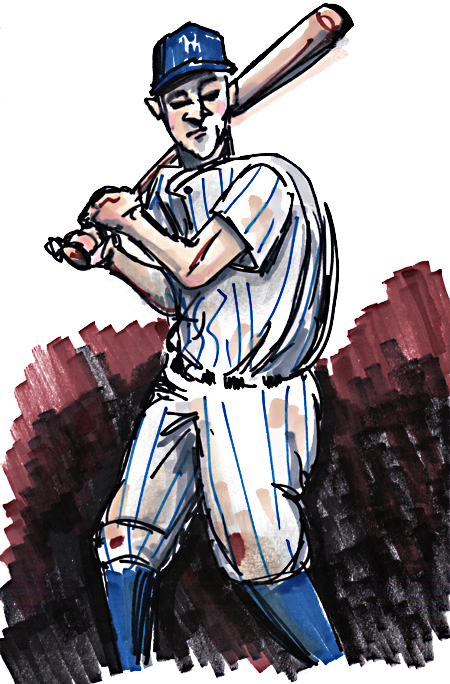
On June 2, 1925, Yankees manager Miller Huggins replaced regular first baseman Wally Pipp in the starting lineup. Pipp was in a slump, so Huggins made the change to boost the team’s overall performance. Huggins started Lou Gehrig instead. He stayed in the lineup for fourteen years. Although he played with injuries or sometimes appeared only as a pinch-hitter, Gehrig played 2130 consecutive games.

At the midpoint of the 1938 season, Gehrig’s performance began to diminish. At the end of that season, he said, “I tired mid season. I don’t know why, but I just couldn’t get going again.” Although his final 1938 stats were respectable, it was a dramatic drop from his 1937 season.

Spring training 1939 showed Gehrig’s physical strength and coordination in serious decline. He struggled through April 1939. On May 2, 1939, Gehrig informed Yankee manager Joe McCarthy that he was taking himself out of the lineup. He never played baseball again.

After extensive testing at Mayo Clinic, the diagnosis of amyotrophic lateral sclerosis (ALS) was confirmed on June 19, Gehrig’s 36th birthday. The prognosis was grim. He would experience rapidly increasing paralysis, difficulty in swallowing and speaking, and a life expectancy of fewer than three years.

On July 4, 1939, the Yankees retired Gehrig’s uniform number “4” (the first uniform number retired by a Major League Baseball team), and honored him between games of a double header. Gehrig gave his famous “I consider myself the luckiest man on the face of the earth” speech before a packed and tearful Yankee Stadium crowd.

However, Gehrig was wrong. He is not the luckiest man on the face of the earth. Jim Belushi is.

Comments

comments

IMT: petals

The inspirational word on Inspire Me Thursday is “petals”.
you always take the sweetest rose and crush it 'til the petals fall.

Long before Stephen Lynch and Weird Al Yankovic and Allan Sherman, there was Spike Jones.

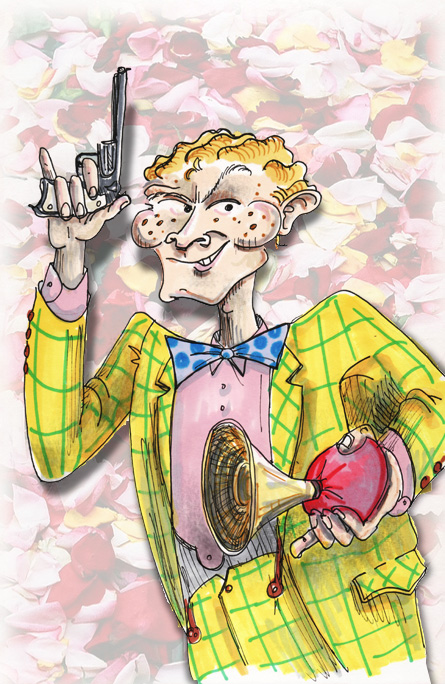
Spike Jones and his City Slickers kept Americans laughing from the early 1940s through the 1960s with his crazy versions of classical and big band standards. In addition to the usual band instruments, Jones and his crew injected gunshots, banjos, tin cans, whistles, cowbells, burps, gurgles, sneezes and any other unorthodox noisemakers they could think of. Their big break came with a recording of the anti-Hitler propaganda ditty, Der Fueher’s Face. Originally featured in a wartime Donald Duck cartoon, Jones and Company’s version delighted a patriotic America and allegedly enraged Hitler himself.

Jones followed with a string of fractured takes on popular tunes, like Cocktails for Two, The William Tell Overture, Chloe and The Hawaiian War Chant. Their version of My Old Flame  featured cartoon voice artist, the great Paul Frees, reciting the lyrics in a creepy Peter Lorre imitation, giving the love song an unexpected twist. The City Slickers’ take on Clink Clink Another Drink featured another legendary voice artist, Mel Blanc, hiccupping his way through the arrangement. Spike’s parody of Vaughn Monroe‘s Ghost Riders in the Sky  was performed with slurred speech, as if by a drunk, and even ridiculed Monroe by name. An insulted Monroe, a fellow RCA recording artist and also a major RCA stockholder, demanded an alternative take be released. Jones’ band released several holiday recordings, including the popular All I Want for Christmas is My Two Front Teeth, with just as wacky results.

Jones had his own radio show in 1945. He was so popular that top performers, like Frankie Laine, Mel Torme, Don Ameche, Burl Ives and Frank Sinatra, were happy to make guest appearances. The radio show led to Jones’ television show which ran for seven years on CBS.

In the late 1950s, the rise of rock-‘n’-roll and the decline of big bands hurt Spike Jones’s repertoire. Spike felt the new rock songs were already novelties, and he could not parody them the way he had lampooned the straight-forward big-band sounds. He recorded his last album, a send-up of the horror genre, again with guest vocalist Frees, in 1959.

Jones was a lifelong smoker. It was rumored he got through the average workday on coffee and cigarettes. Jones contracted emphysema. His already thin frame deteriorated, to the point where he used an oxygen tank offstage, and onstage he was confined to a seat behind his drum set. Jones died in 1965 at the age of 53.

Comments

comments

IF: contagious

The illustration friday challenge word this week is “contagious”.
There's flies everywhere, buzzing in the air/Filling my body with filth and disease
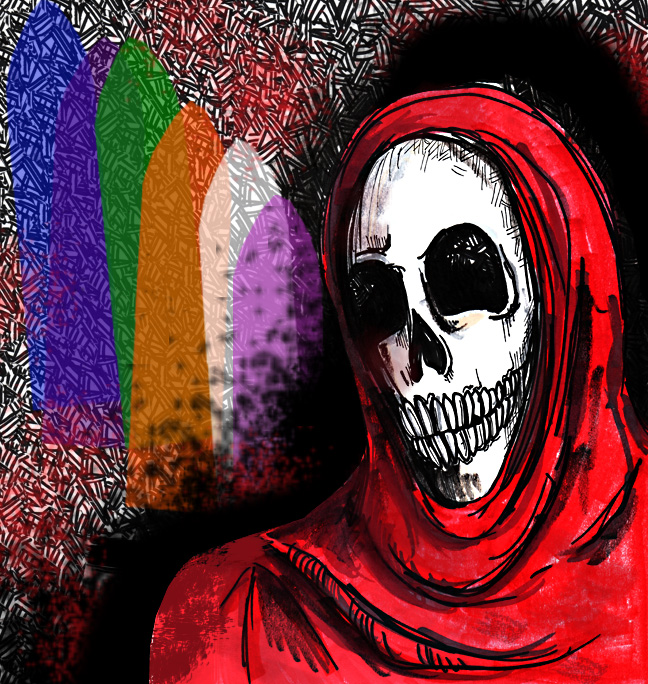
The Masque of the Red Death was written and published in 1842 by Edgar Allan Poe. It tells the story of a horribly contagious plague, called The Red Death, that is sweeping across the land. The symptoms of the Red Death are gruesome. The victim is overcome by convulsive agony and his pores emit sweats of blood. The plague kills within half an hour. Prince Prospero has invited one thousand other nobles to take refuge in this walled abbey, completely isolated from the Red Death plague and the common people, on whom the plague is most prevalent.

One night, Prospero holds a masquerade ball to entertain and boost the morale of his cooped-up guests. He has seven rooms of the abbey decorated for the ball, each in a different color: blue, purple, green, orange, white, and violet. The last room is decorated in black and is illuminated by a blood-red light. Few guests are brave enough to venture into the black and red room. At the stroke of midnight, Prospero notices one guest in a dark red robe. The mysterious guest hides his face with a hideous skull mask. The other guests are terrified by this silent and unwelcome stranger. Prospero demands to know the identity of the mysterious guest and threatens to hang him for scaring his other guests. He draws his dagger and chases the shrouded stranger through the six colored rooms. The mysterious figure is cornered in the seventh room, the black room where the windows are tinted scarlet. The figure turns to face Prince Prospero. The Prince looks back at the figure and immediately falls dead. The other guests, although frightened, surge into the black room and swarm the figure. They remove its mask, only to find the shroud empty. To the horror of all, the stranger is the personification of the Red Death itself, and all the guests suddenly contract and succumb to the disease.

And Darkness and Decay and the Red Death held illimitable dominion over all.

Don’t even try  to outwit Death. Nobody has yet.

Comments

comments

IMT: family

The inspirational word on the Inspire Me Thursday illustration website is “family”.
Blood is thicker than water/But thin and cold in the flood.
Two women meet on the street.
“Oh my goodness! How have you been, Mrs. Nolan? How are your sons?”

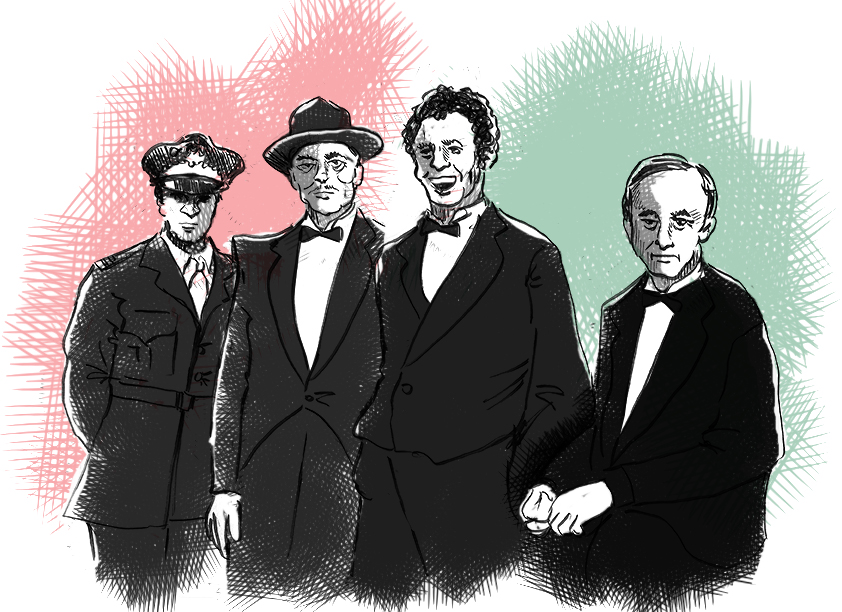
“Well, my sons! Let me tell you! My son Christopher, you know, is a big-shot Hollywood director! Oh, yes! He directed that backward movie, Momentus or whatever it’s called. He was nominated for an Oscar for that one. And he directed that other one, with the magicians and Wolverine. Oh, The Prestige!  That’s it. And then he directed that big The Batman movie with that boy who died and the crazy one from the movie set.”

“Oh my! K’neah Horah! That’s wonderful. I always liked Christopher. Such a mensch.

“Oh, and my Jonathan is a big-shot Hollywood screenwriter. He wrote so many of the movies that my Christopher directed. Momentus, the magician movie, that Batman movie. He also writes other big-time movies for other big-shot Hollywood directors. He wrote the new Terminal Man movie, you know, like the old one that had Arnold the Governor in it.”

“That is wonderful! And what about Matthew? I heard that Matthew kidnapped and murdered a businessman in Costa Rica and was an international fugitive until he was arrested in Chicago in March.”

” Um…………. I have two sons. Two.

Comments

comments

IF: parade

This week, the challenge word on the Illustration Friday website is “parade”.
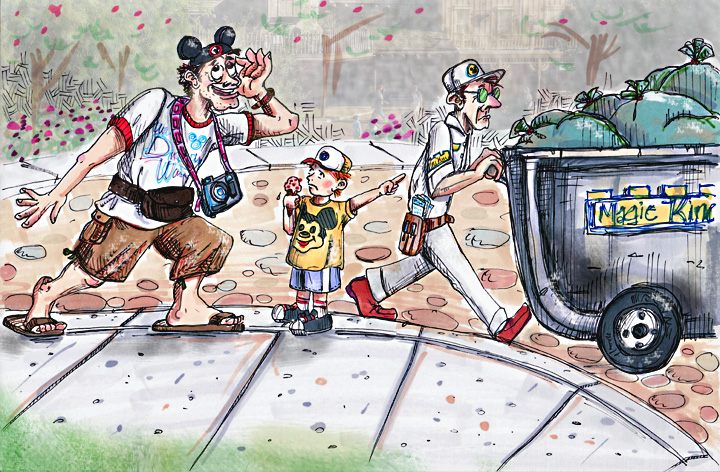
Listen for the sound and listen for the noise/Listen for the thunder of the marching boys
It has been made clear that I am a big fan of Disney theme parks. I’ve been to Walt Disney World in Florida and Disneyland in California many, many times. I have written about and illustrated many of my adventures in ol’ Walt’s entertainment enterprises. (Click HERE and you can see everytime I’ve mentioned “Disney”.)

In addition to the rides (“attractions”, as Walt preferred them to be called), the shows and the stuff to buy, a popular activity at both Disneyland and Walt Disney World is watching the daily parade. Families with smaller children particularly enjoy watching the parade, as this allows the kids to see their favorite Disney characters up close. It also allows Mom and Dad to stand in one place and keep a watchful eye on the kids instead of chasing them through the park’s maze of walkways. The parade route is similar in both Disneyland’s Magic Kingdom and its Florida counterpart. The parade floats emerge from a large but unassuming door at the head of Main Street USA, wind their way around the small park that harbors some benches and the park’s official flagpole, then make their way up the tourist-clogged Main Street. The parade then circles “the Hub” in front of Cinderella Castle (Sleeping Beauty Castle in Disneyland) and heads out to the walkway through Frontierland. Eventually, the whole parade ensemble returns to its original starting point at Main Street via a huge, unseen and interconnected backstage area. Due to space limitations in Disneyland, the parade is not able to turn around out of public view. The late afternoon performance of the parade, therefore, begins in Frontierland and retraces the route back to its origin on Main Street.

Because the parades are so popular, a prime viewing spot requires some shrewd planning. Seasoned parade watchers have the process down to a perfectly executed procedure, not unlike a drill-trained army regimen. Several hours before the designated parade start time, they will optically scour the walkways. They will mentally note and rank optimum viewing areas. Based on current park attendance, current and future positions of the sun and other variables, they will gather the members of their group, quicken their walking pace and claim the perfect piece of curbside real estate that will allow for heightened parade enjoyment. Sometimes, a portion of their plot is commandeered by some family of yahoos who obliviously wandered into previously-claimed territory. A strategically-placed full shopping bag usually discourages any further movement forward. If that fails, a well-placed elbow will do the trick.

On one particular trip to Walt Disney World, my family and I were getting ready to view one such parade. As long-time visitors to the Florida Magic Kingdom, we found a little-known viewing spot in Frontierland, near where the walkway splits and becomes the faux cobblestone streets of Liberty Square. Most visitors crowd into Main Street, eventhough the very same parade passes through the sparsely-populated Western-themed area mere minutes later. An hour or so before the parade was to make its way to us, my wife, my then-young son (he’s 21 now, and curiously, is still excited by Disney parades) and I were standing in Frontierland, patiently amusing ourselves. We looked in the windows of shops, careful not to stray too far from our three-person parade zone. We discussed which attractions we would visit after the parade. I’m sure a discussion of snacks came up in our pre-parade conversation. As the parade time slowly drew closer, the areas around us began to fill in with other families. To our right, an empty spot welcomed a dad about my age and his son, a boy around the same age as my own son. Dad was doing his best to engage Son in similar pre-parade entertainment. Son, however, was far more interested in defusing the dripping ice cream cone he held tight in his sticky fist. Dad warbled a brief medley of popular Disney film tunes, tripping over or misinterpreting the bulk of the lyrics. Suddenly, a distant thumping caught Dad’s ear. He cocked his hand to his ear in an exaggerated fashion. The thumping got louder. THUMP-THUMP-THUMPITY-THUMP!  Dad’s smile widened. “Hear that?,” he excitedly asked Son. Son continued to eye the ice cream. THUMPY-THUMPY-THUMP-THUMP!  “Oh!,” grinned Dad, “I hear drums! The parade is coming!” THUMP-THUMP-THUMP!  “I hear drums!,” Dad continued, hand still theatrically cupped to his ear, “The parade is coming!” Son finally looked up. In the distance, he spied the source of the thumping. The same source that everyone in the immediate area also spied… everyone but Dad, that is. A Disney custodial worker was pushing a large plastic refuse container loaded with dark-green bags of theme park trash. The employee was steering the rubbish across the cobblestones of Liberty Square, towards an unseen depository. With every bump of the wheels, a rhythmic thumping filled the air. Son pointed at the laborer and his cartful of trash. “Daddy, no,” he began, “Trash. The man has trash.” “No! No! No!,” Dad happily corrected, “I hear the drums!” Son continued to point, showing his proof like a proud prosecutor in court. “Daddy. That man is pushing trash.” Dad once again cut him off. “Drums!” Dad insisted, his voice reaching a climactic crescendo, “I hear drums! The parade is coming!”

Exasperated, Son rolled his eyes and returned to his ice cream.

Comments

comments

JPiC video

A friend of mine works in the marketing department of a local Audi/Porsche dealership in the Philadelphia area. Several months ago, he sent me an email about a contest that the dealership would be sponsoring. Honestly, I didn’t thoroughly read the rules, I just listened to his brief explanation and I’m not sure I even got a grasp on what he was looking for. The basic rules were: it has to include the dealer’s name (Don Rosen Imports), something about “the car of your dreams” and the website address. The rest was up to creativity. I came up with an idea. I figured that most of the submissions would look the same. Sleek cars winding around roads, hugging the turns, being driven by a guy with mirrored sunglasses and a leather jacket. Pretty much the result of stopping ten random people on the street and asking them to write a car commercial.
Here’s a car dealership promo, through the eyes of josh pincus is crying.

CLICK HERE for the actual company web page, where you can vote for your favorite video. I think you know which one to vote for.
By the way, in the production of my video, the bulk of my effort went into looking for my old Hot Wheels cars.

Comments

comments

from my sketchbook: robert lees

Chick Young: You're making enough noise to wake up the dead! Wilbur: I don't have to wake him up. He's up.
Robert Lees began his career as a screenwriter in the middle 1930s. He wrote several screenplays for the “Crime Does Not Pay” short subject series produced by MGM Studios and based on real-life crimes. He graduated to science fiction and ultimately wrote for Abbott and Costello, penning screenplays for five of the comedy team’s films, including the classic “Abbott and Costello Meet Frankenstein”. In the early 1950s, Lees’ career was virtually destroyed when he was put on the Hollywood blacklist by movie studio bosses during the McCarthy Era for alleged Communist activities. As a result of his blacklisting, he submitted manuscripts under the pseudonym “J. E. Selby.” After regaining his good name, he wrote for episodic television, including “Alfred Hitchcock Presents”, “Gunsmoke” and “Land of the Giants”, among many others.

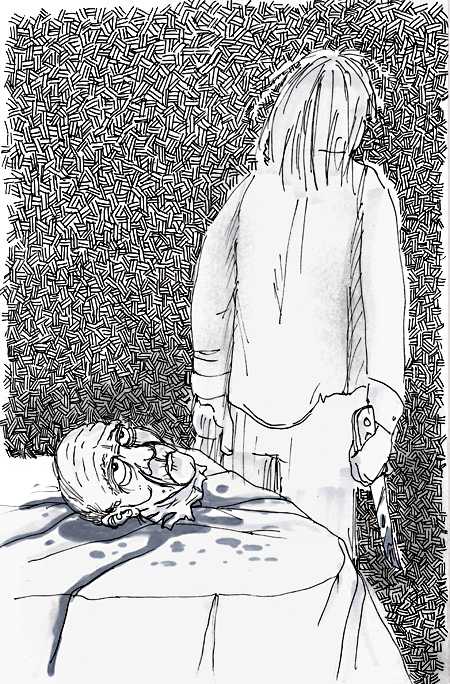
On June 13, 2004, one month shy of Lees’ ninety-second birthday, a 27 year-old homeless meth addict named Keven Graff broke into Lees’ home. Looking for money, Graff attacked Lees and decapitated him. Graff left Lees’ home, carrying Lees’ severed head, and broke into a neighboring house. Dr. Morley Engleson, Lees’ 69 year-old neighbor was on the telephone with Southwest Airlines, making a plane reservation. Graff attacked Engleson, stabbing him in the neck and killing him. The ticketing agent heard the attack through the phone and contacted police. Graff stole Engleson’s 2001 Mercedes-Benz and left the scene before police arrived. During a search of Engleson’s house, police discovered Lees’ severed head lying on a bed. Lees’ longtime girlfriend discovered Lees’ headless body, covered by blankets, in his bedroom five hours later.

The following day, Graff caught the attention of security guards at the gates of Paramount Pictures when he began behaving erratically; talking to himself and yelling at passing cars. One security guard identified Graff from a picture that was shown on a televised news conference about the double murders, and he phoned police. When questioned about the crimes, Graff claimed he was high on methamphetamine and Ecstasy the night before and had no memory of committing the murders.

In February 2008, Graff pleaded guilty to ten felonies for the murders of Lee and Engelson. He was sentenced to two consecutive life terms without the possibility of parole.

Comments

comments