from my sketchbook: peggy knudsen

Come stepping down the stairs, combing back your yellow hair
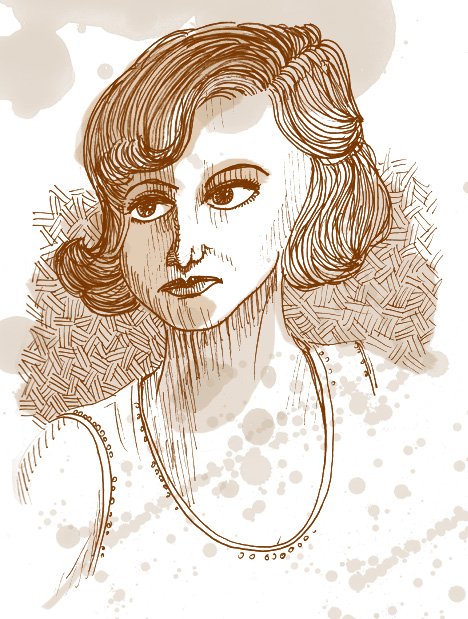
Nineteen-year-old Peggy Knudsen debuted on Broadway in the title role in the popular play My Sister Eileen,  replacing Jo Ann Sayers, in the role she originated. Soon, Peggy headed for Hollywood, appearing in her first film A Stolen Life  opposite Bette Davis. That performance led to her being cast as the icy Mona Mars in the noir  classic The Big Sleep  alongside Humphrey Bogart. Praised by critics, her career seemed to be ready to explode. With her striking good looks, she was even named “”the girl who fills our stockings best,” in a poll by the Hosiery Designers of America. But, her contracted studio, Warner Brothers, couldn’t quite decide what to do with the pretty young actress. As her contemporaries moved on to bigger and better, Peggy was relegated to small roles in B-grade pictures, playing one-dimensional homewreckers and “other woman” types. After 1957’s Istanbul  with Errol Flynn, she called it quits in motion pictures, turning her attention to the upstart medium of television instead.

In the 50s and 60s, she made guest appearances on both comedies and dramas, acting in several installments of Alfred Hitchcock Presents, Perry Mason, Pete & Gladys  and others. However, in 1965, following an episode of The Adventures of Ozzie and Harriet  that served as her swan song,  Peggy retired from acting for good.

Peggy suffered from crippling arthritis for most of her later years. She was in a degenerative state and was cared for by her close friend, Oscar-winning actress Jennifer Jones. After enduring daily pain for nearly fifteen years, Peggy succumbed to cancer in 1980 at age 57.

Comments

comments

from my sketchbook: ed delahanty

back, back, over the falls
On September 4, 2012, the struggling Philadelphia Phillies dropped another heartbreaking loss – this time to the National League Central-leading Cincinnati Reds. It was during this game that shortstop Jimmy Rollins racked up his 2000th career hit as a member of the Phillies, joining an elite club of only three additional members – each in the Hall of Fame. The leader, with 2,234 hits, is Mike Schmidt, who played eighteen seasons at the “hot corner” for the Fightin’ Phils, helping them to their first World Series title in 1980. Next, with 2,217 hits, is the late Richie Ashburn, a six-time All-Star whose popularity led him to a post-playing career as a Phillies broadcaster for 34 years until his death in 1997. The third name on the list, Ed Delahanty,  is one that may be unfamiliar to even die-hard Phillies fans, but one with the most interesting story.

Ed Delahanty — “Big Ed” as he came to be called — was a true superstar in the early years of professional baseball. His name and statistics were regularly mentioned in the same breath as Ty Cobb and Rogers Hornsby. Ed was a fearsome power hitter, maintaining a .388 average (he batted over .400 three times) and a yearly production of 115 runs batted in. He held the Phillies consecutive games hit record for over hundred years, until he was surpassed again by the aforementioned Rollins. He hit four home runs in one game and went 6-for-6 in a game twice in his career. He is the only player to win the batting title in both leagues, although that stat is still hotly debated.

In 1902 after thirteen seasons with the Phillies, Ed joined the Washington Senators in the fledgling American League. The Senators were terrible and the team’s incompetence greatly affected Ed’s own abilities. He soon turned to liquor and gambling to soothe his unraveling, on-field performance. In July 1903, after another loss, this time 1-0 to the Detroit Tigers, Ed had had enough. He boarded a train in Detroit bound for New York City, with visions of rejoining the National League filling his head. To pass the time on the long train ride, Ed threw back shot after shot of whiskey. He became belligerent and unruly. He pulled a woman out of a sleeper berth by her ankles.  He wielded a razor and began threatening the other passengers. The head conductor stopped the train in Niagara Falls and warned him to calm down or he’d be asked to leave.

Ed, slurring his words, angrily replied, “I don’t care if I’m dead or in Canada.”

True to his word, the conductor kicked Ed off the train. Several minutes later, a drunken Ed Delahanty tried to negotiate the narrow International Railway Bridge into Buffalo, New York. He lost his footing and plunged into the roaring waters below. His body was found a week later at the base of Niagara Falls. Big Ed was 35.

Comments

comments

from my sketchbook: gary vinson

ahoy!
Gary Vinson began showing up in guest roles on popular TV series in the late 1950s. He appeared in comedies like The Adventures of Ozzie and Harriet, dramas like Perry Mason  and Westerns, like Gunsmoke  and Bat Masterson.  In 1960, he was cast as a regular in the short-lived drama The Roaring 20s  with Dorothy Provine.

In 1962, he landed the role for which he was most associated – Quartermaster George “Christy” Christopher on the Ernest Borgnine military farce McHale’s Navy.  He appeared in seventy-nine episodes until the series’ end. He was then immediately cast as the town sheriff in the promising CBS sitcom Pistols ‘n’ Petticoats.  The series, conceived by George Tibbles, producer of My Three Sons and writer of the Woody Woodpecker  theme song,  was a Western spoof. The show was initially very popular, thanks to its star, 40s Hollywood actress Ann Sheridan. When Ann signed on to the series, she was already in failing health and twenty-one episodes in, she passed away. After struggling in the ratings, CBS canceled the show two months after Ann’s death.

From the late 60s until the 80s, Gary’s acting services were in high demand and he kept busy with many guest shots in episodic television.

In 1984, facing legal trouble from serious allegations of sexual misconduct, Gary committed suicide. He was 47.

Comments

comments

IF: imagination

it was just my imagination runnin' away with me

Holy Hero Worship!, did my Uncle Sidney love Batman! And, Holy Relatives!, did I love my Uncle Sidney!

My Uncle Sidney was married to my mother’s sister, Aunt Claire, for an undetermined period of time. I have very fond memories of my mom and Aunt Claire taking me to the zoo, to Cherry Hill Mall, to the swim club in the summer — all over the place. However, I can recall few instances when I actually saw Aunt Claire and Uncle Sidney together. At Thanksgiving, annually hosted at our house, I remember Aunt Claire, anxiously arranging and rearranging the place settings on the aluminum folding table set up in our living room and flitting into the kitchen to assist my mom (but only succeeding in getting in her way). But, I can’t quite place Uncle Sidney at any family gathering. That’s not saying that Uncle Sidney didn’t show up for meals at our house. On the contrary, he made it a point that, when he did stop by, it was just minutes before a designated meal. (My father made angry note of this phenomenon on many occasions.)

In 1966, ABC premiered a new show called Batman. Filled with campy acting, pop-art scenery and purposely hokey dialogue, it was an instant hit. My brother (at nine) and me (at five) — along with my Uncle Sidney — were captivated by the antics of the Caped Crusaders with their wild costumes and their onomatopoeia-filled fist fights with the henchmen of that week’s “special guest villain.”

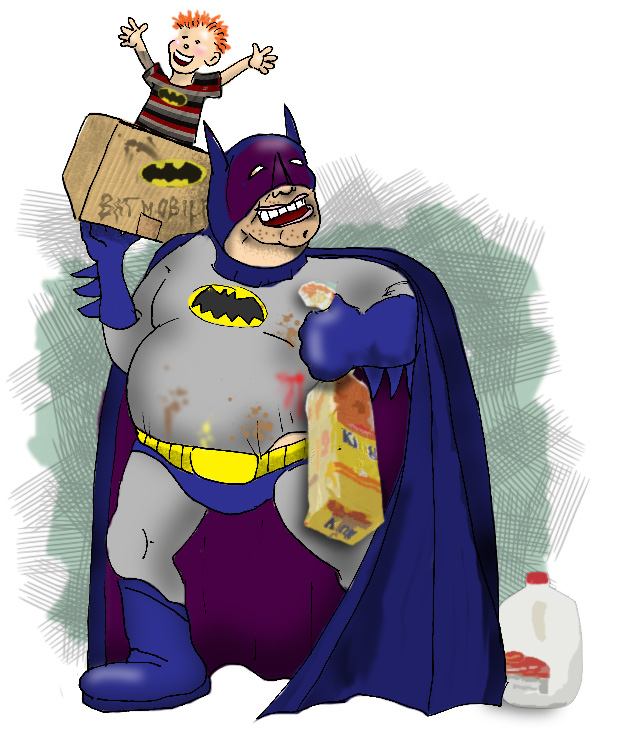
At the time, Batman  was unique in its broadcast schedule. Paying homage to the movie serials of the 1940s, Batman was shown twice weekly. The first episode would conclude with the Dynamic Duo caught in some impossible-to-escape predicament. The announcer would encourage viewers to tune in tomorrow at the “same Bat-time on the same Bat-channel.” Twenty-four hours later, ABC would air the exciting epilogue to the adventure and my brother and I were right there in front of the TV with Uncle Sidney spread out on the sofa, cheering the action on and eating every last crumb of food raided from my parents’ kitchen. Even after scarfing down a full dinner, courtesy of my mom, Uncle Sidney would park himself on my parents’ living room couch, with his two favorite nephews before him, and eat an entire loaf of bread and drink an entire gallon of milk.

One day while visiting my Aunt Claire at the small apartment she shared with her elusive spouse, my Uncle Sidney uncharacteristically arrived home with a large, empty, cardboard box. After Aunt Claire left the room (they never seemed to be in the same place at the same time), I was instructed by Uncle Sidney to use my budding artistic skills to transform that pasteboard receptacle into my own personal Batmobile. I went to town with an all out crayon assault — coloring, scribbling, emblazoning it with the closest approximation of the Batman insignia as I could — until it resembled The Batmobile, at least to my five-year-old imagination. I climbed in and sat down. Suddenly, Uncle Sidney, a burly fellow with arms like tree trunks, effortlessly lifted me and the box off the carpet and trotted across the floor, growling out “vvrrooom-vrrrrooom”  driving noises and simulating the motion of a superhero’s  car travelling at breakneck speed after an arch-enemy. After spinning in circles a few times, he deposited me — in my vehicle — on the top of the refrigerator for an aerial view of the tiny kitchenette.

As the Batman popularity took a stronghold on national pop culture, Uncle Sidney stepped it up on a personal level. One Friday evening, my mom took us out for dinner to the Cavalier Restaurant, a regular Northeast Philadelphia haunt for the Pincuses. During our meal, Uncle Sidney, who lived nearby, bounded in. He was so excited to tell us something, he could hardly contain himself. He told my mom he had something to show us outside. My mom smiled and watched as Uncle Sidney, as giddy as a six-year-old,  dragged my brother and me out to the the parking lot.

In the 1960s, convertibles were the coolest thing. What could be better than tooling across the open road at top speed with the wind whipping through your hair?! Nobody knew this better than Batman and my Uncle Sidney. Unfortunately, real-life technology had not yet caught up with TV technology. 60s convertibles, at least the one my Uncle Sidney purchased, had a real, solid glass  rear window that had to be zipped out and securely stowed before the soft top was retracted and roadway fun was enjoyed. I cannot stress enough how important this process was.

Once outside the restaurant, Uncle Sidney proudly waved his hand — with the finesse of a game-show model — towards a tank-like, white Pontiac. “Look!,” he began, “I just bought this! We’re gonna have fun!” He hopped in behind the wheel. “And watch this!” Uncle Sidney threw a switch on the car’s massive dashboard. In a symphony of mechanical whirrrs and grinding gears, the Pontiac’s roof came to life and began to fold back towards the rear of the vehicle. My brother and I marveled as my Uncle Sidney announced, nay, yelled, “It’s the Batmobile!”

Just then, our exhilaration was halted by a foreign, sickening sound. My Uncle Sidney’s face dropped. He recognized the sound before we did. In slow motion, he turned around — just in time to witness the rear window crack, compress and shatter, spitting zillions of pebble-sized pieces of glass across the trunk and around the car’s perimeter. My brother and I stood silent. Uncle Sidney, now behind the car and examining the colossal damage, alternately cursed and sobbed under his breath. He looked up at us.

“Don’t tell your mom or Aunt Claire., ” he said.

We were cool with not telling Mom, but what difference did it make to Aunt Claire. Those two hardly knew each other.

In the following weeks and months, Uncle Sidney hid the now-missing window from his wife. On the rare occasions the two were together, the car top would always be down. He would drop her off at their apartment entrance and gallantly offer to park the car. Once parked, he would raise the roof and cover the open space with a blanket in case of rain. Aunt Claire was none the wiser. Until one night…

Aunt Claire was given a lift home by a cousin. They passed by Uncle Sidney’s car as they approached the apartment building. Claire pointed out, “Sid left the back window down.” and she asked Cousin if he could zip it back it, since it looked like rain was headed their way. Happily obliging, Cousin climbed in the back seat and zipped. And zipped. And zipped again.

“Aunt Claire,” he called out through the big gaping space, “there ain’t no window.”

He waved his extended arm in the void that would otherwise be occupied by glass. Aunt Claire was dumbfounded. She turned on her heels and marched right upstairs to have a little talk with her husband. Obviously the ‘window incident” was the last straw in a years-long conflict between my aunt and uncle. I remember seeing him only once or twice after that.

When my brother was in is early twenties, he was in Florida on a vacation. He had heard through various family discussions that Uncle Sidney had moved to Miami. One day on his trip, he located a Miami telephone directory and looked up Uncle Sidney. He found the only one in the book and dialed the number.  A man with a feeble and breathy voice answered. My brother instantly recognized the aged, but unmistakable voice of our beloved uncle.

“Hi, is this Sidney? This is Max Pincus. I’m in Florida and I’d love to see you.”

An audible gasp followed by an audible sob came across the line. “You have the wrong number.’ said the man and the line clicked dead.

Comments

comments

from my sketchbook: lillian hall-davis

For me and Lily are together in my dreams
At 19, Lillian Hall-Davis entered the world of acting. Hoping to convey a sophisticated upbringing and high social status, she listed her place of birth as the fashionable Hampstead section of London. In reality, she hailed from the working-class neighborhood of Mile End, where she led a far-from-glamourous life as the daughter of a cab driver. The charade obviously was successful and by the early 1920s, Lillian was one of the most respected and popular actresses in British silent films.

Lillian became one of Alfred Hitchcock‘s favorite actresses. He directed her in two of his early silent pictures, The Ring  in 1927 and The Farmer’s Wife  the following year.

When silent films gave way to talkies, Lillian wasn’t able to comfortably make the transition. After a small role in 1931’s Her Reputation,  Lillian, experiencing exhaustion and chronic dizziness, suffered a nervous breakdown. Soon, the demand for her acting services dwindled to nothing.  On October 25, 1933, Lillian locked herself in the kitchen of her home, turned on the gas, stuck her head in the oven, and cut her own throat with a straight razor. She was 34 years old.

Comments

comments

from my sketchbook: robin graham

Somebody bless all these girls that I never have met/But damn you and curse you after all that you’ve done/You’re the one girl I’ll never forget
On November 14, 1970, Robin Graham went out with some friends. Around quarter-to-two in the morning, after a night of fun, Robin was dropped off at her car, which she had left in the parking lot of the Pier 1 Imports store where she was a part-time employee. Robin waved and bid her friends ‘good night’ and hopped on the Hollywood Freeway for her drive home.

Robin’s car only made it a little over a mile on Route 101 when it conked out. In the days before cellphones, Robin found her way to a California Highway Patrol roadside call box. She told the police dispatcher that she had run out of gas. A CHP officer on patrol saw Robin standing alone by her car. When the officer circled back, a late 1950s model Corvette was parked on the shoulder behind Robin’s car and she was speaking with the driver – a white man in his 20s with dark hair. The officer assumed Robin knew him and he continued southbound in his cruiser.

When Mr. and Mrs. Graham arrived at their Echo Park home around 2:30 am, Robin’s younger sister relayed the phone message from the CHP emergency operator. They hurried out to the location on the Freeway and found Robin’s locked car parked on the shoulder, but Robin was gone.

And she was never seen again.

In 1987, a small, mysterious ad appeared in the classified section of the Los Angeles Times.  It read:

DEAREST ROBIN You ran out of gas on the Hollywood Frwy. A man in a Corvette pulled over to help. You’ve not been seen of since. It’s been 17 years, but it’s always just yesterday. Still looking for you. THE ECHO PARK DUCKS.

The ad caught the attention of police who discovered, after a brief investigation, that it was placed by a neighborhood friend who just didn’t want Robin to be forgotten.

The case remains unsolved.

Comments

comments

IF: tall

This week’s Illustration Friday word is “tall”.
chalk on the sidewalk
Daniel Boone was a man,
Yes, a big man!
With an eye like an eagle
And as tall as a mountain was he!

Of course, the portrayal of Daniel Boone on the NBC television show that ran from 1964 until 1970 was very inaccurate. It was just actor Fess Parker reprising his popular role as Davy Crockett from the 1950s Walt Disney mini-series. Despite the theme song proclaiming Daniel Boone to be a “big man” in a “coonskin cap”, and the “rippin’est, roarin’est, fightin’est man the frontier ever knew!”, it didn’t really describe the real Daniel Boone well at all.

But it was a great show.

Comments

comments

IF: teacher

Teacher, I need you/Like a little child/You got something in you/To drive a schoolboy wild

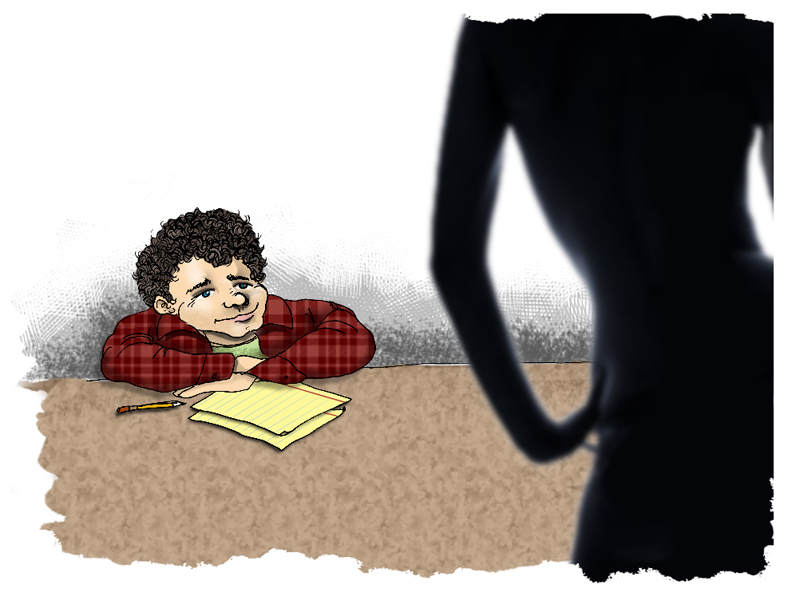
I entered George Washington High School in the Fall of 1975, just a short summer vacation after my older brother, Max, took his diploma and his reputation and headed off to college (as a commuter, but college just the same). Max was smart, athletic, good looking, a very good student and quite popular. I was… um…. an awkward former eighth-grader. It was not unlike the time Tommie Aaron replaced his power-hitting older brother, Hammerin’ Hank, for a brief period in the 1962 Milwaukee Braves lineup.  I’m not saying that my brother’s departure and my arrival had the same significant impact as that baseball  scenario, but there was a vague comparison that could be made. But, I digress.

My first day as a high school freshman was very hectic and a little overwhelming. I had to become accustomed to a huge, confusing maze of hallways and staircases. I needed to familiarize myself with the location of my classrooms, as determined by the computer-printed cardboard roster I was issued while half-asleep in my homeroom. After lunch in a lunchroom that was triple the size of any school cafeteria I’d ever seen, I navigated my way to the last scheduled class of my day — English.

I found an empty desk in the second row and sat down among a roomful of unfamiliar students my own age. As the clock ticked past the appointed class start time, there was still no teacher to lead the assemblage. Suddenly, the classroom door swung open and what appeared to be another student crossed the threshold. However, she approached the large desk at the front of the room and deposited the unruly stack of papers and folders she cradled in her arms on its surface. She was an up-to-date reflection of the “Charlie’s Angels -pre-disco” fashion of the time, wearing a tight-fitting jumpsuit with the full-front zipper undone well below an appropriate level. She had long, dark, feathered hair that fell down her back, cascaded around her shoulders and framed her face – a face that boasted a thousand-megawatt, pearly-white smile. She introduced herself to the class as “Mrs. Shacker” and Mrs. Shacker was pretty fucking hot.

Mrs. Shacker shuffled through the papers on her desk and produced a class attendance sheet from the pile. She took a seat on the edge of the desk, seductively swinging her leg while she took roll. She announced each name in a sensuously low, throaty timbre. Upon declaration of “here”  or “present” or the Philadelphia-centric “yo!”  from the student in question, she made a quick check-mark of confirmation in the proper column on the attendance form. She wended her way to the end of the alphabetical list and when she called out “Pincus”, she stopped — and her previously wide smile widened even more. Her dark eyes scanned the room until she spotted me in the second row, my hand timidly raised in hesitant acknowledgement.

“Are you Pincus?,” she asked.

“Yes,” I replied, “Josh Pincus.”

She eased her derriere off the desk and sauntered towards me in languid, deliberate strides. I gulped.

“Are you Max’s brother?,” she cooed, emphasizing my sibling’s name and bringing her face closer to mine.

“Yes.,” I gulped again.

A dreamy look captured the gaze in her heavy-lidded eyes and she sighed, “Tell him I asked for him.” She turned and started back towards her desk, her hips swaying as though adrift on an ocean. She finished roll call and began the first lesson of the school year. The first English lesson, that is.

At quarter-to-two in the afternoon, classes were dismissed and I headed home. Once through the front door of my house, my mom assailed me with a barrage of “how-was-your-first-day-of-school” questions. I described the vastness of the building, my varied classes and the population of unfamiliar students. I also told her, in the most homogenized, detail-free way possible, about Mrs. Shacker and her message to my brother. Max was in the next room, home for several hours and enjoying the far more leisurely schedule of college. He overheard our discussion and, upon the mention of his name, entered the room to join us.

Shacker?  That name doesn’t sound famil…” My brother stopped in mid-sentence as a new thought popped into his head. “Oh!,” he remembered. His face lit up and he snapped his fingers, “Blum! She was ‘Blum.’ She got married over the summer.”

My mother rolled her eyes as a memory surfaced. When Max was in his freshman year he was having a bit of difficulty in his high school English class. The problem seemed to be a lack of focus and this was very unusual for my otherwise academically-proficient brother. My mom arranged for a meeting with his teacher, the mono-syllabic “Blum” — as he dismissively referred to her — pronouncing her surname like the sound of a boulder dropping to the ground. One afternoon, long after student dismissal time, my mom entered Blum’s classroom. It was 1972 and Miss Maxine Blum (the future Mrs. Shacker) was dressed in a flowery, nearly see-through blouse, a micro-mini skirt and leather go-go boots and she was four years younger and four years hotter than she was now. “Well,” my mom thought to herself as she gave this pitseleh the once-over, “no wonder a 15-year-old boy can’t pay attention in this class.”

Sometime during my next week of ninth grade, Mrs. Shacker was discussing syllables, a typical subject for a freshman English class. She talked about how some words, even names, pair up nicely — even poetically — based on the same number of syllables in each.

“As an example,”  she began, “If my husband had a single syllable name, people would use my nickname to introduce us. Say my husband’s name was Max,” — and she looked right at me when she said “Max” — “we’d be introduced as ‘Max and Max’ … y’know short for ‘Maxine’.”  Mrs. Shacker slowly strolled among the students seated in the room while giving her lesson. As she finished her sentence, she lightly brushed my shoulder with her hand on her way past my desk.

Several weeks later, just before the long Thanksgiving weekend, Mrs. Shacker announced to the class that she had a visitor earlier in the day. She explained that a famous wrestler stopped by to say “Hello.” Again, she looked right at me as she informed the class that one Max Pincus, a member of Temple University’s wrestling team, had paid a visit. The class expressed their disappointment, hoping that a rousing tale of an encounter with Andre the Giant would follow. But, Mrs. Shacker wasn’t really interested in the class’s reaction. She just winked at me and flashed a smile.

The story of Max’s relationship with Mrs. Shacker continued to unfold through further investigation. After extensive questioning and maybe a little bribery, a few of my brother’s friends seemed to remember an incident at a school dance (perhaps a prom) where Mrs. Shacker (then Miss Blum) cornered Max and planted a pre-graduation kiss square on his lips. A claim of the inclusion of tongue is unsubstantiated and, to this day, still fervently debated.

Mrs. Shacker didn’t make it to my senior year. As a matter of fact, she didn’t return after I advanced to sophomore. She may have transferred to another school, moved to another locale or perhaps, even more likely, she left to give private instruction to a young Mary Kay Letourneau.

*****

The story you have read is true; the names have been changed to protect myself from broken bones. 

Comments

comments