from my sketchbook: berry berenson

xxxxxxxxxxxxxxxxxxxxxxxx

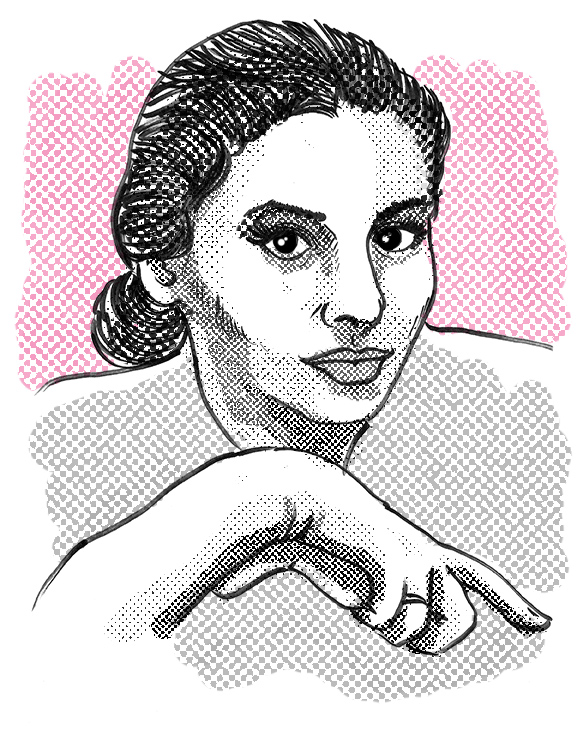
Berinthia Berenson was born into a privileged, aristocratic family in the upper-class Murray Hill neighborhood of Manhattan. Her father was an American diplomat. Her mother was Countess Maria-Luisa Yvonne Radha de Wendt de Kerlor, but was better known as socialite  Gogo Schiaparelli.  Berinthia, or “Berry,” as her family called her, was also a descendant of prominent fashion designer Elsa Schiaparelli, who waged a post-World War I rivalry with Coco Chanel.

Berry and her older sister Marisa attended exclusive European boarding schools. Upon graduation, Berry expressed an interest in fashion photography and she shot numerous magazine layouts featuring her statuesque sister. Berry, too, tried her hand at modeling and the Berenson sisters were splashed across the pages of 1960s & 70s issues of Life, Vogue and Glamour.

In 1972, through mutual friend director Joel Schumacher, Berry was introduced to actor Tony Perkins. They fell in love and, despite Tony being nearly 20 years her senior, were married in less than a year. Berry gave birth to sons Osgood in 1974 and Elvis in 1976.

With Tony as an inspiration, Berry appeared in several movies, including Winter Kills, the remake of Cat PeopleRemember My Name opposite her husband and the TV mini-series Scruples. She retired from acting to spend more time with her sons, although she remained an active photographer, collaborating with Marisa on a fashion book in the early 80s.

In 1990, Tony tested positive for HIV. Berry was devastated, but never left her husband’s side. He died in 1992. Berry spent the next years watching her children grow up. Osgood followed in his father’s acting footsteps, while Elvis leaned toward music, becoming a singer-songwriter.

In the summer of 2001, Berry  stayed at the family vacation home in Cape Cod, Massachusetts. As the summer drew to a close, she made plans to join her sons on the West Coast to commemorate the ninth anniversary of Tony’s death. She boarded American Airlines Flight 11 from Boston’s Logan Airport headed to Los Angeles. At 8:46 a.m., the aircraft flew into the 92nd floor of the North Tower of the World Trade Center in New York City. Berry died along with 87 other passengers and crew. She was 53.

Comments

comments

IF: hidden

Remember those dreaded visits to the doctor’s office when you were a kid? The only pleasant aspect of that terribly sterile and unwelcoming waiting room was the few cheerful moment spent perusing the latest issue of Highlights for Children.

Remember the lessons we learned from the antics of Goofus and Gallant? Remember the endearing, if somewhat creepy, qualities displayed by The Timbertoes? My favorite part of Highlights was always the Hidden Pictures page. I loved scouring those simply-drawn compositions looking for a toothbrush concealed in the length of a fishing pole or a clown hat camouflaged among a cluster of pine trees. Sometimes, the objects were so well shrouded that I had to tear my mother away from a dessert recipe in the latest Good Housekeeping to assist me in my quest for that elusive picture of a fork.

So, in tribute to my wonderful memories of time spent seeking out those hidden objects, I offer my own take on the hidden objects picture.

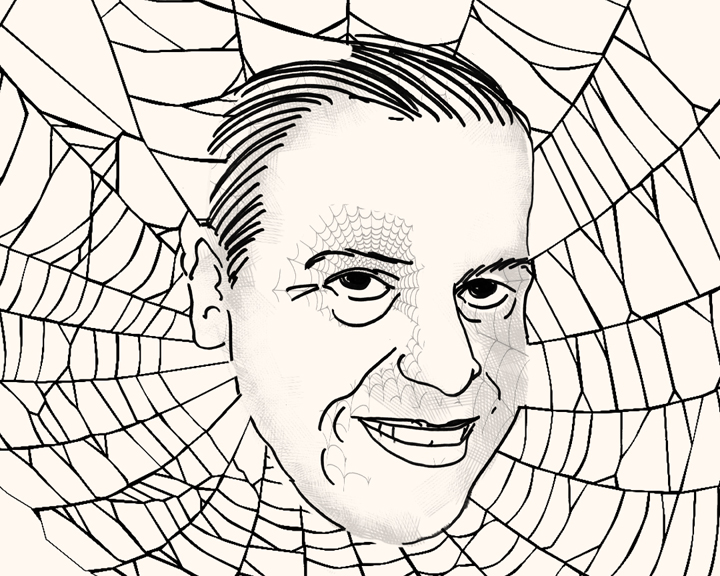
Here is a picture of notorious Philadelphia torturer, rapist and serial killer Gary Heidnik. There are fifteen bodies hidden in this picture. Can you find them? (Hint: Check the backyard.)

Good luck.

 Congratulations. You have just discovered the secret message. Please send your answer to Old Pink, care of the Funny Farm, Chalfont

Comments

comments

from my sketchbook: anissa jones revisited

What about Mrs. Beasley?

WFMZ, a local affiliate just outside of Philadelphia, picked up MeTV, the syndicated retro television network that presents programming exclusively from the 1950s, 60s and 70s, around the same time that Meredith Viera stepped down as co-host of The Today Show on NBC. When the insipid and unwatchable Ann Curry took over Meredith’s duties, I switched my morning television loyalties to MeTV… and I never looked back. Now, instead of watching plane crashes, police standoffs, celebrity scandals and other overhyped and sensationalized current events, I can start my day with a blast from my past. Instead of listening to some Washington pundit explain the detrimental backlash of the next Presidential proposal, I can happily lose myself in the inane antics of Jethro Bodine and stare dreamy-eyed at Katie Douglas.

In 1966, a new show called Family Affair premiered on CBS. MeTV added reruns of the series to their early morning line-up, wedged between Petticoat Junction and My Three Sons. As with all of MeTV’s offerings, the episodes were shown daily and in chronological order. Family Affair was the brainchild of Don Fedderson, whose creation My Three Sons was enjoying a successful run since it began six seasons earlier. It told the story of confirmed bachelor Bill Davis, a wealthy gruff construction consultant, whose life is turned on its ear when his teen-age niece and her twin siblings are dumped on the doorstep of his Manhattan high-rise after their parents are killed in a car accident. “Uncle Beel,” as the twins come to call Davis, is at first agitated by the situation, but soon develops a loving and protective relationship with the children — much to the chagrin of his stuffy British “gentleman’s gentleman,” Mr. French.

Anissa Jones was eight-years old when Family Affair began. She was cast as Buffy Davis, the female half  of the orphaned twins of Bill Davis’ brother. Buffy was supposed to be — and remain at the behest of creator Fedderson — six-years old for the full run of the series. So for all 138 episodes, Anissa grew and aged as a normal adolescent, but her onscreen persona stayed a child. In addition to the grueling shooting schedule, Anissa was sent on countless publicity appearances to promote Buffy paper dolls, lunchboxes, coloring books and other Family Affair-affiliated products. In 1971, during Family Affair‘s final season, thirteen-year old Anissa was having her blossoming chest bound and her hair fixed into youthful pigtails in a feeble effort to maintain a juvenile appearance.

Although I never really liked Family Affair when I was little, I watch it now on MeTV with a new appreciation. I saw that Anissa had something over her two young co-stars. She could act. I mean she could really display a convincing range of feeling and emotion. Kathy Garver (who played sister Cissy) was just another in a long line of cookie-cutter TV teens, bubbly and happy one minute and angst-ridden the next — all played with the subtly of a light switch. Johnnie Whitaker (four months younger than his on-camera twin sister) screamed his lines and mugged uncontrollably for the camera. His acting was amateurish at best, despite evolving into a career in Disney feature films where he held his own opposite a young Jodie Foster.

But Anissa was a real actress and you can really see it. She delivered her lines like a kid would. She was natural, unaffected and believable. In the Season Three episode “Christmas Came a Little Early,” in which Buffy’s classmate (played by a pre-Brady Bunch Eve Plumb) passes away, Anissa pulls off a gut-wrenching performance that defies her years and experience and is guaranteed to leave you weeping.

When Family Affair was cancelled, star Brian Keith was immediately signed to another series on rival NBC. Since they had forged a close relationship on the set of Family Affair, Keith called Anissa and offered her an audition-free role. She politely declined, wishing instead to “just be a kid for a while.”

Losing the role of Regan in The Exorcist to Linda Blair, Anissa called it a career in show business. She dropped out of high school and worked at a doughnut shop until her trust fund kicked in. Then, at age eighteen, Anissa was like an uncaged animal. She broke off contact with her abusive, controlling mother. She bought cars for her brother and herself and she fell in with an unsavory crowd.  Five months after her eighteenth birthday, Anissa was dead from a massive drug overdose. The LA County coroner called it the absolute worst he had seen in his career.

Anissa’s story is truly one of the saddest in Hollywood. She was a very talented girl and her talent was wasted.

* * * * * * * * * *

I wrote about Anissa Jones on this blog in 2008. I felt her story and accompanying illustration deserved another look.

Comments

comments

from my sketchbook: evelyn ankers

anchors away!

Evelyn Ankers was born in Chile to British parents. Once her family moved back to  England, young Evelyn was bitten by the acting bug. She took in small parts in British films, including The Bells of St. Mary’s with Laurence Olivier and Vivien Leigh in 1937.

Evelyn left England at the start of World War II. She headed for Hollywood and signed a contract with Universal Pictures.  She made her Universal debut alongside Abbott and Costello in the 1941 horror comedy Hold That Ghost. Later in ’41, she starred as Gwen Conliffe, the role for which she is most remembered,  in the classic The Wolf Man with Lon Chaney Jr.  Evelyn went on to make seven more films with Chaney, although their relationship was less than amiable. She once commented, “He’s the sweetest man in the world… when he isn’t drinking.”

Earning the nickname “Queen of the Screamers”, Evelyn found herself banished to “Horror Movie Hell.” She continually played the role of the classy society woman terrorized by the title monster in many films… and she kept it up for nearly 15 years. She has the dubious distinction of being the only actress to appear in a Wolf Man, a Dracula and a Frankenstein feature.

In 1950, Evelyn retired from the screen to live the domestic life of a housewife to her spouse, actor Richard Denning (best known for his role as Lucille Ball’s husband on the radio comedy My Favorite Husband – the forerunner to I Love Lucy). She came out of retirement in 1960 to star opposite Denning in her final film, No Greater Love.

Evelyn passed away in 1985, succumbing to ovarian cancer. She died just two weeks after her 67th birthday.

Comments

comments

from my sketchbook: william talman

Soy un perdedor

After serving in the US Army during World War II, William Talman found work in Hollywood as a character actor, first in films then in various roles in anthology television series. In 1957, he went to an audition that would change his career. He read for the lead in a proposed courtroom drama series opposite another character actor Raymond Burr as the Los Angeles District Attorney. The series was based on the adventures of a lawyer named Perry Mason, a characetr created by former attorney turned author Erle Stanley Gardner. During the reading, Gardner suggested that William switch roles with Mr. Burr and television history was made. Perry Mason  ran for nine years. It ranked in the top ten shows for six of those years. As the beleaguered DA Hamilton Burger, William suffered from the longest losing streak in history. Over the course of 271 episodes, William’s character lost all but three cases.

At the height of Perry Mason ‘s popularity, William was arrested on charges of “immoral conduct.” He was one of several guests at a Beverly Hills party that was raided by LA County deputies. Most of the guests (including William) were nude when authorities arrived on a tip to search for marijuana. Charges were dismissed when the judge ruled that “being naked in a private home cannot possibly be a crime.”

After Perry Mason was canceled, William appeared in guest roles on popular drama series, like Wild Wild West and The Virginian.  

A life-long smoker, William was diagnosed with lung cancer. He became the first actor in Hollywood to film an anti-smoking commercial for the American Cancer Society. He requested that it not be shown until after his death. The commercial opened with William saying, “Before I die, I want to do what I can to leave a world free of cancer for my six children… ”

William filmed a second commercial at his home with his family and friend, co-star Raymond Burr. In the short film,  he explained, “You know, I didn’t mind losing those courtroom battles, but I’m in a battle now I don’t want to lose at all. Because if I lose it, it means losing my wife and those kids you just met. I’ve got lung cancer…If you don’t smoke, don’t start. If you do smoke, quit! Don’t be a loser.”

Four weeks after filming, William passed away at the age of 53.

Comments

comments

from my sketchbook: dudley dickerson

This house has sho' gone crazy!
As a young boy, Dudley Dickerson was inspired by the Ringling Brothers Circus. After a stop in his hometown of Chickasha, Oklahoma, Dudley gathered some props left behind by the circus.  He cobbled together an act, calling it “Pin-Penny Circus” and performed acrobatics under the name “Paddlefoot” Dickerson.

Soon, Dudley was off to California in pursuit of a career in show business. He became a regular performer at the popular Sebastian’s Cotton Club in Culver City (just outside of Los Angeles), appearing in the company of top names like Lionel Hampton and Louis Armstrong.

He made his big screen debut in 1932, playing the first of a long line of uncredited roles of janitors, porters, cooks, and various other servants. However, he was featured alongside some of Hollywood’s biggest stars like Joan Blondell, Dick Powell, Ann Southern and even Laurel and Hardy.

In 1940, he appeared with The Three Stooges in his most memorable role in “A Plumbing We Will Go.” Dudley, as an innocent cook, is besieged by the result of Moe, Larry and Curly’s incompetent plumbing solutions. As he tries to prepare a meal for a houseful of snobby guests, he slips and slides all over the flooded kitchen as water pours from the oven, clock and electric light fixtures. Bewildered, he exclaims, “This house has sho’ gone crazy!” before making a hasty exit.  Dudley made appearances in nine more Stooges shorts, essentially reprising this role.

In the 1950s, Dudley was a semi-regular on the Amos ‘n’ Andy program, playing a character named Joe who had varied, but still menial, occupations. After filming the low-budget thriller The Alligator People in 1959, Dudley called it a career.

Dudley enjoyed some fleeting fame in the 1960s when a syndication package of Three Stooges short subjects was released to television stations across the country. In 1968, at the age of 61, Dudley passed away from a brain tumor.

Comments

comments