

First was Kevin, then came Lucy, third in line was me.

Once upon a time, a kindly old toymaker carved a little boy out of wood and named him Ben Affleck. Little Ben wished upon a star that one day he’d be a famous Hollywood actor. One night, a good fairy granted him that wish and he grew up to become a famous actor. However, he was never able to shake the fact that he was made of wood.
And his acting shows it.

Pete Duel landed a role in the touring company of the play Take Her, She’s Mine. Hoping to use the part as a springboard for film roles, Pete’s mother drove him across the country to Hollywood, sometimes sleeping in a tent along the way.
The good-looking 25 year-old found work in bit parts on episodic television in the middle 60s, including a few lines here and there in Gomer Pyle, USMC, Combat! and Mickey. Pete appeared in 22 episodes of the sitcom Gidget starring a young Sally Field. He played the title character’s (Field) brother-in-law, a psychology student. Gidget lasted one season, but Pete was soon cast in a starring role in his own sitcom, Love On a Rooftop, with Judy Carne as his wife. Despite good ratings, Love On a Rooftop was canceled after one season. Pete made more guest appearances in shows like Marcus Welby, MD and The F.B.I.
In 1970, Pete was cast in the light-hearted Western Alias Smith and Jones. He and co-star Ben Murphy played a pair of outlaws who signed a secret amnesty deal with a politically-shifty governor. The show was a hit, owing a portion of its popularity to the theatrical release Butch Cassidy and The Sundance Kid.
In December 1971, Pete and his girlfriend watched the evening’s episode of Alias Smith and Jones. After they went to bed, Pete awakened and told his girlfriend, “I’ll see you later” and he left their bedroom. Suddenly, she heard a gunshot and jumped from bed to discover Pete’s body. She later revealed that Pete had suffered from depression and had a drinking problem.
Although it has been debated, Pete’s death was ruled a suicide. He was 31.

Can’t do the work without the proper tool. Or cigar.
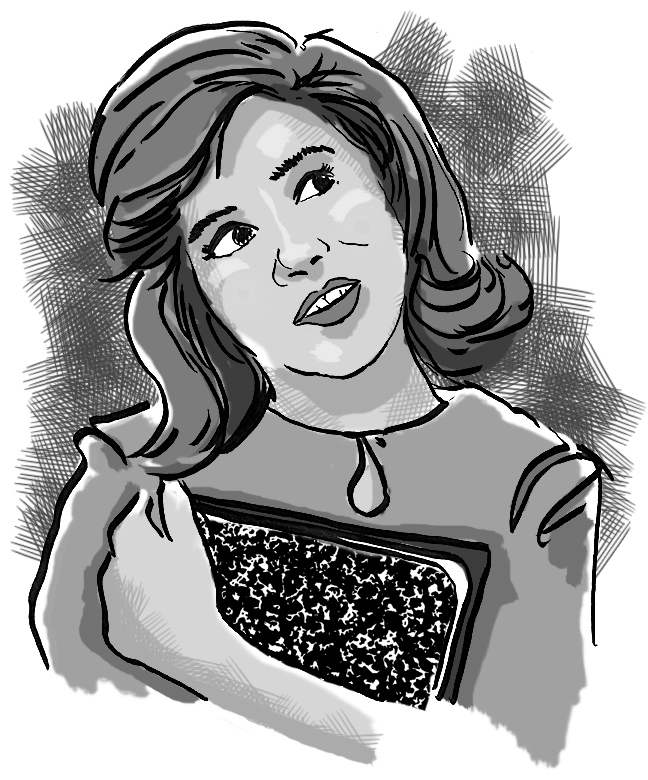
I met Patty Duke in 2011. I was at the Mid-Atlantic Nostalgia Convention in Cockeysville, Maryland, seventeen miles north of Baltimore. (That’s right… Cockeysville!) She was sitting behind a table filled with glossy black and white and color photographs that chronicled her long and illustrious career. I waited patiently as she engaged each and every autograph seeker in lively conversation. She was shorter and more frail than I expected, but she was animated and cheerful and friendlier than a lot of celebrities that I have met at similar shows. When it was my turn, I selected a group promotional shot from The Patty Duke Show. She smiled and inscribed it “Love to You, Patty Duke” in a swashy hand. I told her that I had met actor William Schallert, who played her father “Martin Lane” for three seasons on her self-titled sitcom. She beamed. Through a wide smile, Patty waxed lovingly about the esteemed veteran character actor, speaking as though reminiscing about her own father. She nearly welled up with tears.
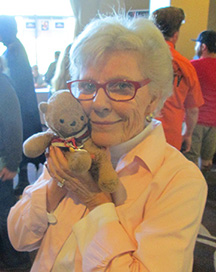 Two years later, Mrs. Pincus and I went to another memorabilia convention. This one was in northern New Jersey and, once again, we met Patty Duke. The line for Miss Duke snaked around the crowded convention floor. Patty was in front of her table this time, interacting with fans and looking like she was sincerely enjoying herself. We approached her at our turn and she greeted us warmly with that familiar grin stretched across her weathered face. We brought Pudge, our well-traveled, celebrity hob-nobbing plush bear, and Patty was smitten. She cuddled the bear to her cheek and she listened intently as Mrs. P explained the story of Pudge. We lauded Patty with praise for her acting and her wonderful, comfortable personality.
As a frequent attendee at conventions of this type, I have met many, many celebrities over the years. Some have been nice. Some have been jerks. Some have really been jerks. And then there are the ones who stand out and are remembered as personable, charming and genuine. Patty Duke was one of those.
She was a great talent and a sweet lady. She will be missed.
Click here to see the original color version of the above illustration.

Sometimes I doubt your commitment to Sparkle Motion!
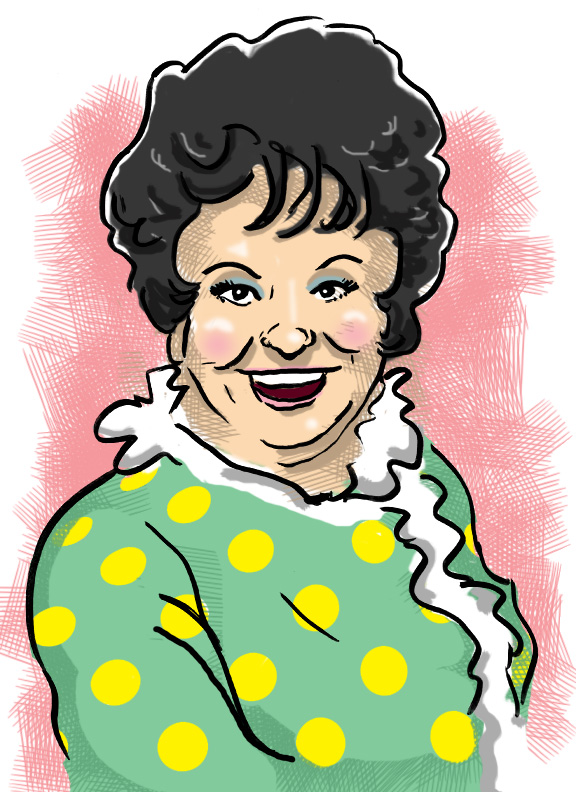
Totie Fields was just naturally funny.
While still in high school, she sang and told jokes in clubs in the Boston area, not far from her native Hartford, Connecticut. Her talent and unique routines brought her to larger venues, including New York’s famed Copacabana. It was here that Ed Sullivan caught her act. Intrigued by her humor in a field dominated by men, Sullivan booked Totie on his popular Sunday night showcase. She was a hit and made numerous appearances. Much in the vein of contemporaries Joan Rivers and Phyllis Diller, Totie used herself as the butt of her jokes. She became a regular guest on talk shows where she spoke her mind poked fun at her weight. During a stint as co-host on The Mike Douglas Show, Totie famously commented to a leather-clad and fully made-up Gene Simmons of KISS, “I’ll bet under all that, you’re a nice Jewish boy.” Simmons smiled and replied, “You have no idea.”
In 1976, health problems resulted in the amputation of Totie’s right leg. After a brief recovery, she went back out on the road, doing her act with the aid of a scooter and still joking about her health issues. The following year, she taped a comedy special for HBO, where she joked from the confines of a wheelchair, “I finally weigh less than Elizabeth Taylor.” She suffered two heart attacks during her rehabilitation. In December 1977, she was diagnosed with breast cancer and had a mastectomy. Afterwards, she still performed and joked about her health.
Just prior to opening a two-week engagement at the Sahara Hotel in Las Vegas, Totie experienced a fatal pulmonary embolism. She was pronounced dead at Sunrise Hospital. She was cremated and her ashes interred in a Las Vegas cemetery, later moved to Los Angeles upon the death of her husband. Totie was 48 years old.
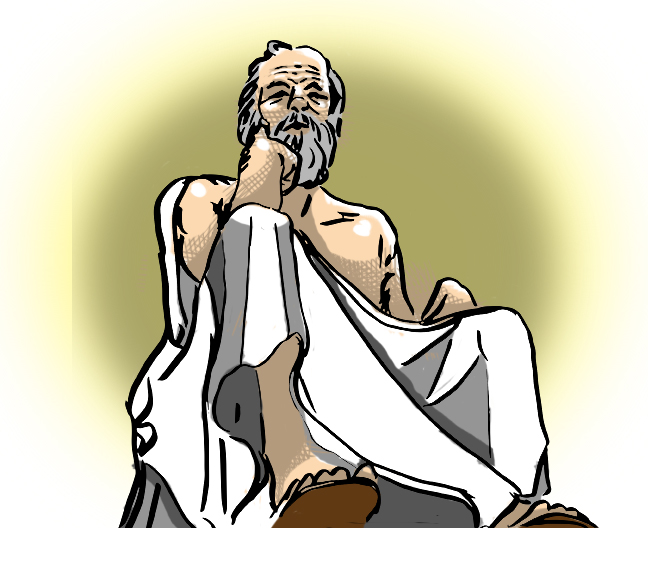
“The only true wisdom is in knowing you know nothing.” — Socrates
Smart guy, that Socrates. More people should listen to him.

Native New Yorker Andrea Feldman latched onto the crowd at Andy Warhol‘s Factory. She was featured in three of Warhol’s avant garde films, Imitation of Christ, Trash and Heat. Still a teenager, Andrea performed, what she called, the “Showtime,” a table-top striptease that was wildly popular among the regulars in the back room at Max’s Kansas City, the notorious Manhattan nightclub. She earned herself the nickname “Whips,” although she preferred to call herself “Andrea Warhol.” The patrons at Max’s just called her “Crazy Andy.” Like most of the crew at Max’s, she was heavily dependent on drugs, specifically amphetamines.
In August 1972, Andrea had just finished filming Heat and she felt she was on the verge of stardom. She phoned several of her former boyfriends, including poet Jim Carroll (of The Basketball Diaries and “People Who Died” fame). She asked them to meet her in front of 51 Fifth Avenue, her parent’s apartment building. While the guys waited out on the sidewalk, Andrea scribbled out this note: “I’m headed for the big time. I’m on my way up there with James Dean and Marilyn Monroe.” She grabbed a crucifix and a Bible and leaped from the fourteenth floor window to her death.
Andrea was 24 years old.

Pretty Dorothy Abbott ‘s career began in Las Vegas, when she worked as a showgirl at the Flamingo Hotel. She moved on to Earl Carroll’s Hollywood Revue, where the showbiz impresario gave her the baffling moniker “The Girl with the Golden Arm.”
In the mid 20s, Paramount Pictures offered her an unheard of $150 per week contract. She was stuck in bit parts as showgirls. nurses and waitresses and her career went nowhere. Although she appeared in top movies, including Little Women, Neptune’s Daughter, Annie Get Your Gun, There’s No Business Like Show Business, Rebel Without a Cause, Jailhouse Rock and South Pacific, she is practically unknown.
In the 1950s, she turned to television with guest roles on Leave It to Beaver and a brief stint as Jack Webb‘s girlfriend in Dragnet. At this time, Dorothy married former LA police officer Rudy Diaz. Diaz had quit the force to become an actor. He began to gain attention and was often seen out with other women. Soon he filed for divorce from Dorothy. The end of her marriage and her waning career was more than she could take. She took her own life on December 15, 1968 — one day before her 48th birthday.