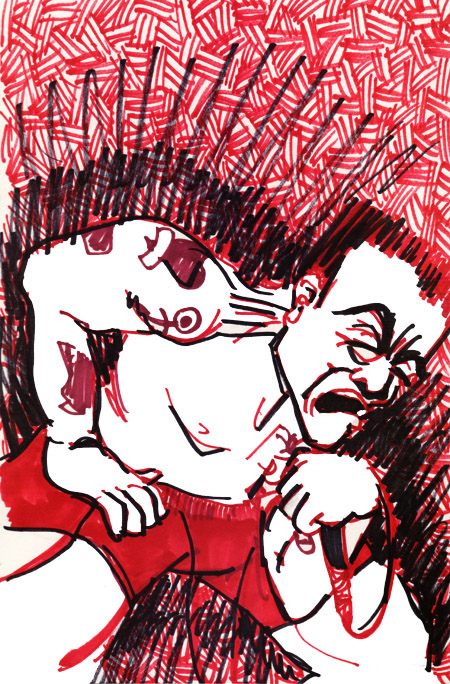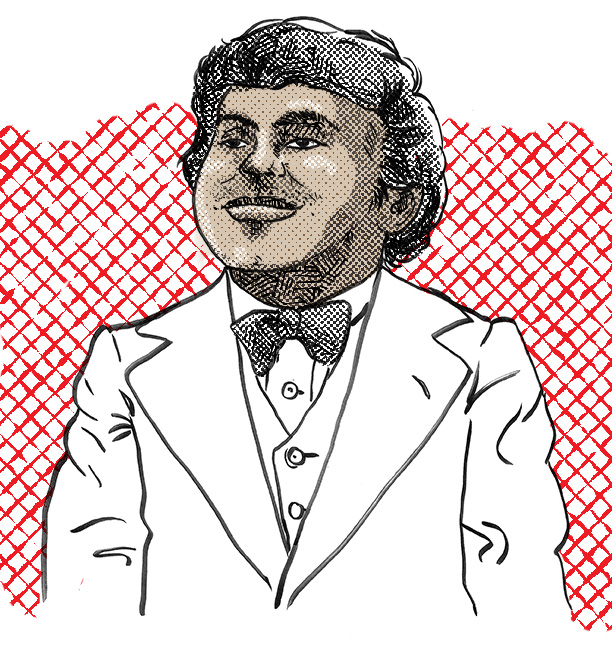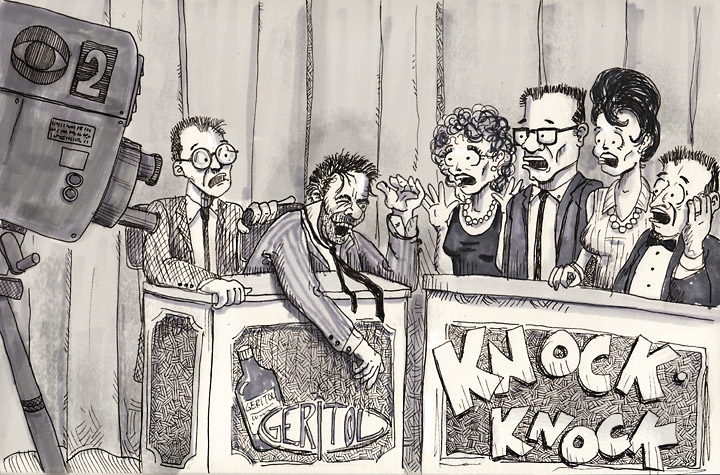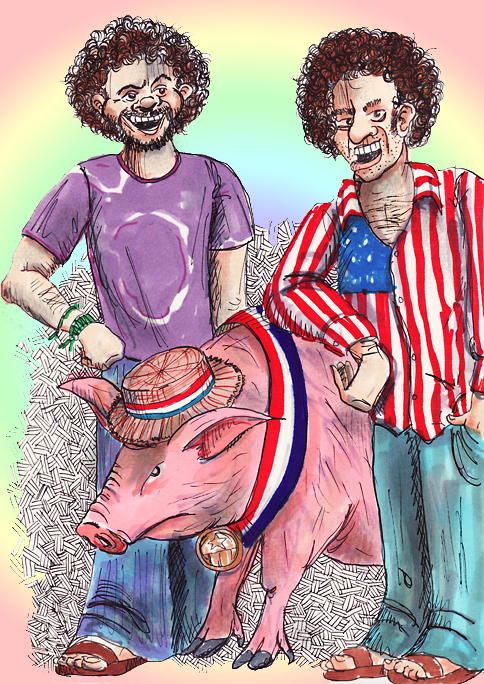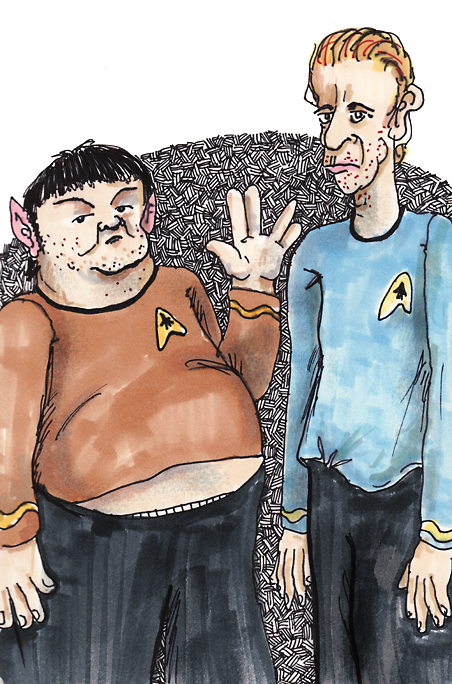
from my sketchbook: jerzy kosinski

court jester
Jerzy Kosinski walked a fine, sometimes blurred, line between bullshitter and storyteller. Kosinski was born Josek Lewinkopf in Poland in 1933. As a child during World War II, he avoided the Nazis by using a false identity. He lived with a Roman Catholic Polish family in eastern Poland under the name, Jerzy Kosinski, an assumed name given to him by his father. A Roman Catholic priest issued him a forged baptismal certificate. In 1957, Kosinski emigrated to the United States by forging letters from Polish authorities guaranteeing his loyal return, which were needed for leaving the country at that time. Once in the United States, he graduated from Columbia University. He was a lecturer at Yale, Princeton, Davenport University, and Wesleyan. In 1965, he became an American citizen.

His 1965 book The Painted Bird garnered mixed reviews. A story of a child during the Holocaust, Kosinski always insisted it was based on his own experience. However, when the book was translated and published in Poland, the family he had lived with took great exception to the abuse that was described in detail. Kosinski claimed “poetic license”.

In August 1969, Kosinski was invited, by his friend Wojciech Frykowski, to a small get-together in Los Angeles. Coming from New York, Kosinski’s luggage was lost by the airline. He phoned Frykowski, told him of this mishap and explained he would have to miss the party. The party was given by Sharon Tate and everyone there was murdered by intruders under the orders of Charles Manson.

He won the National Book Award in 1969 for Steps. In 1975, Chuck Ross, a Los Angeles freelance writer conducted an experiment with Steps by sending 21 pages of the book to four publishers under the pseudonym Erik Demos. The book was turned down by all of them including Random House (which originally published Steps) and Houghton Mifflin (which published three of Kosinski’s other novels). His 1971 book Being There was made into an Academy Award nominated film starring Peter Sellers.

A 1982 Village Voice article accused Kosinski of plagiarism. The article alleged that a great deal of Kosinski’s work was lifted from Polish manuscripts, virtually unknown by American readers. Kosinski always maintained that he loved to tell outrageous lies, particularly to the rich, intellectual and famous. They were so eager to be entertained, he explained, that they willingly suspended disbelief, and they were so confident of their superiority that they deserved to be played for fools. The truth of the Village Voice charges remained a matter of debate.

In addition to his writing, Kosinski appeared 12 times on The Tonight Show during 1971-73, posed half-naked for a New York Times Magazine cover photograph by Annie Leibovitz in 1982, and presented the Oscar for screenwriting in 1982. He also played the role of a Bolshevik revolutionary in Warren Beatty’s film Reds.

On May 3, 1991, despondent over a prolonged period of writer’s block, coupled with an irregular heartbeat as well as severe physical exhaustion, Kosinski took a fatal dose of barbiturates and washed it down with a rum and Coke. He then twisted a plastic shopping bag around his head and taped it shut around his neck. He was found dead in the bathtub in his New York apartment.

My illustration is being used HERE on the Library Thing website’s page for Jerzy Kosinski.

Comments

comments

Monday Artday: money

The challenge word on Monday Artday this week (at my suggestion) is “money”.
If you want to know what God thinks of money, just look at the people he gave it to.
On February 26, 1981, in Philadelphia, a twenty-eight year-old, meth-addicted, unemployed longshoreman named Joey Coyle had his life changed forever. Joey and two of his friends were on their way to buy drugs. They were driving behind a Purolator Armored Services truck that was returning from a pick-up at an Atlantic City casino. As the truck pulled away from a stop light, its back doors swung open and two money bags, containing 1.2 million dollars, fell out. As Joey grabbed the bags, his troubles began. Joey’s friends tried to convince him to return the money, but Joey could only see dollar signs in his eyes. He became the most popular guy at a South Philadelphia bar, handing out hundred dollar bills and bragging about his windfall.
Later, becoming nervous and paranoid, Joey tried to launder the money through some mob connections. Meanwhile, Joey’s friends, who were with him when he found the money, told authorities. Joey was a wanted man and planned his escape. However, he was arrested at Kennedy International Airport as he was checking in for a flight to Acapulco, Mexico. He was carrying $105,000 in 21 envelopes with $5,000 each. The envelopes were stuffed around his ankles in the tops of elastic socks. In February 1982, a jury found Joey innocent of theft by reason of temporary insanity. The armored car company recovered all but roughly $196,000 of the money.
In 1993, while awaiting sentencing for his sixth drug conviction, Joey hanged himself with an electrical cord.

Comments

comments

DCS: marie prevost

She was a winner/who became the doggie's dinner
Mary Bickford Dunn was born in 1898 in Ontario, Canada. After her father died, she moved to Los Angeles with her mother and sister. While working as a secretary, the attractive Marie applied for and landed an acting job at the Hollywood studio owned by Mack Sennett. Sennett dubbed her “the exotic French girl,” and rechristened her “Marie Prevost.” Prevost joined his gang of infamous Sennett Bathing Beauties. Marie was in good company with other Sennett Beauties including future screen legend Gloria Swanson, Mabel Normand (who is credited with throwing the first custard pie in movies, it’s target being Fatty Arbuckle), and future Mrs. Clark Gable, Carole Lombard.

Marie’s star was rising fast. She showed the studio heads that she was more than just a pretty face and was given roles that allowed her to display her smart, comic timing. Often playing roles just short of risqué, her characters always turned out to be good girls by the end of the pictures. Marie worked with some of the greatest directors of the time, including Frank Capra, Cecil B. DeMille, Mervyn LeRoy. She was one of the busiest and most popular actresses of the 1920s. In 1926, while traveling in Florida, Marie’s mother was killed in a car accident. Her mother’s death hit her hard and she drowned her depression in alcohol.

Marie continued working, but the alcohol started to affect her physical appearance and she started to put on weight…and the studios began to notice. She found herself sliding down the Hollywood ladder. In the early 1930s she was able to find work, often portraying the wisecracking best friend. But, the girl who had once been a major player was reduced to bit roles with few lines.

A star just a decade earlier, Marie was now in her mid-thirties and considered a has-been. By 1934, she had no work at all and her financial situation deteriorated dramatically. The downward spiral became greatly aggravated when her weight problems forced her into repeated crash dieting in order to keep whatever bit part a movie studio offered. Her “crash diets” consisted of large amounts of alcohol and no food.

On January 23, 1937, police were called to a rundown apartment building in Los Angeles after neighbors complained of a continuously-barking dog. Inside, they found Marie dead on her bed. Her dog, without food or water for days, had chewed up her arms and legs in a futile attempt to awaken her. With the combination of alcoholism and self-imposed malnutrition, Marie had starved herself to death.

Comments

comments

IF: wide

The challenge on illustrationfriday.com this week is “wide”.
Shut up bitch. Go fix me a turkey pot pie.
Well, we’re gettin’ a doublewide. I almos’ got enough Marlboro Miles saved up, soon as Billy Ray starts smokin’ more. C’mon y’ lazy shit!
We’re tryin’ t’ get little Britney t’ help, but she’s always cryin’ so much that th’ cigarette won’t stay in her yap!
Jerry Lee! Get the fuck out from under th’ house! Jesus H. Christ! If’n I gotta tell you agin, I’m gonna beat yer goddamn ass raw!
Kids! Oh yeah, we’re havin’ ‘nother one soon. Gonna name ‘er “Hannah Montana”.

Click HERE to hear the Southern Culture on the Skids’ ode to trailer park “Doublewide”, from their album “Mojo Box.

Comments

comments

SFG: monsters

The sugarfrostedgoodness.com challenge word this week is “monsters”.
The sound of your footsteps/Telling me that you're near/Your soft gentle motion, baby/Brings out the need in me that no-one can hear
In 1927 Tod Browning directed Lon Chaney Sr. in the film “London After Midnight”. This silent film classic has become the most famous “lost” motion picture.
The movie told the story of wealthy Sir Roger Balfour. Balfour is found shot to death in his home. Inspector Burke, as played by Chaney, is called in to investigate. A suicide note is found and the case is supposedly closed. Five years later, Balfour’s old residence is taken up by a man in a beaver-skin hat, with large fangs and gruesome, sunken eyes. His assistant is a ghostly woman, with flowing robes and raven black hair. It is suspected by neighbors that Balfour has returned from the dead.
In addition to his portrayal of the inspector from Scotland Yard, Lon Chaney Sr. also played the mysterious stranger that moves into the vacant Balfour Home. Chaney, known as “The Man of a Thousand Faces”, designed his own make-up for his film appearances. His visual effects for London After Midnight were particularly horrifying. The teeth Chaney wore were made of gutta-percha, a hard rubber-like material. The bulging, hypnotic eye effect was achieved with special wire fittings which he wore like monocles. He allegedly put egg albumen in his eyes to give them a “clouded” appearance.
The film was well-received at the box-office, grossing almost $500,000. It was even remade by Browning in 1937 as “Mark of the Vampire” starring Bela Lugosi. However, in 1965, an electrical fire broke out in MGM Film Storage Vault #7. Countless films from the silent era, including the last known print of “London After Midnight”, were destroyed.
In 2002, Turner Classic Movies commissioned film restoration producer Rick Schmidlin to produce a 45 minute reconstruction of the film, using still publicity photographs shot while the film was in production in 1927.
There are rumors that one copy of the original remains in a private film collection in Canada.

Comments

comments

Monday Artday: giant japanese monsters

In an effort to steer away from a proliferation of cuteness, Monday Artday offers “Giant Japanese Monsters” as this week’s challenge.
there's a prehistoric monster/that came from outer space/created by the martians/to destroy the human race/the FBI is helpless/he's twenty stories tall/what can we do?/who can we call?
In 1954, Japanese actor Haruo Nakajima portrayed Godzilla (known as “Gojira” in Japan). He eventually played Godzilla twelve times (more than any other actor) until 1972, when he retired the character, although he continued to act in other movies.
The original Godzilla suit, which weighed about 220 pounds was very stiff and heavy. Mr. Nakajima could only walk about 30 feet before needing to get out of the costume because of the heat. The lights in the studio also added to the heat inside the costume, sometimes reaching nearly 120 degrees. Mr. Nakajima never complained. He had fainted a few times inside the suit, falling over and ruining a few expensive miniature sets which had to be rebuilt.
Mr. Nakajima said that the most difficult aspect of portraying was shooting the ending for “Godzilla Raids Again” in 1955. He had to stand in the middle of the set while a large amount of crushed ice was poured down on him. It was very cold and there was an additional floor underneath the floor of the set. A set assistant was standing on the lower floor while the ice was tumbling down on Mr. Nakajima. The floor of the set collapsed from the weight of the ice, so both Mr. Nakajima and the assistant were buried under crushed ice.
Now, at 79, Mr. Nakajima attends Godzilla and Sci-Fi conventions on a semi-regular basis.

Comments

comments

SFG: c is for…

…Capgras delusion.
I'd hate to wake up some morning and find out that you weren't you.
Capgras delusion (or Capgras syndrome) is a rare disorder in which a person holds a delusional belief that an acquaintance, usually a spouse or other close family member, has been replaced by an identical looking impostor. The Capgras delusion is classed as a delusional misidentification syndrome, a class of delusional beliefs that involves the misidentification of people, places or objects. It can occur in acute, transient, or chronic forms.
The delusion is most common in patients diagnosed with schizophrenia, although it can occur in a number of conditions including after brain injury and dementia.

Comments

comments