
Here’s a joke I like…
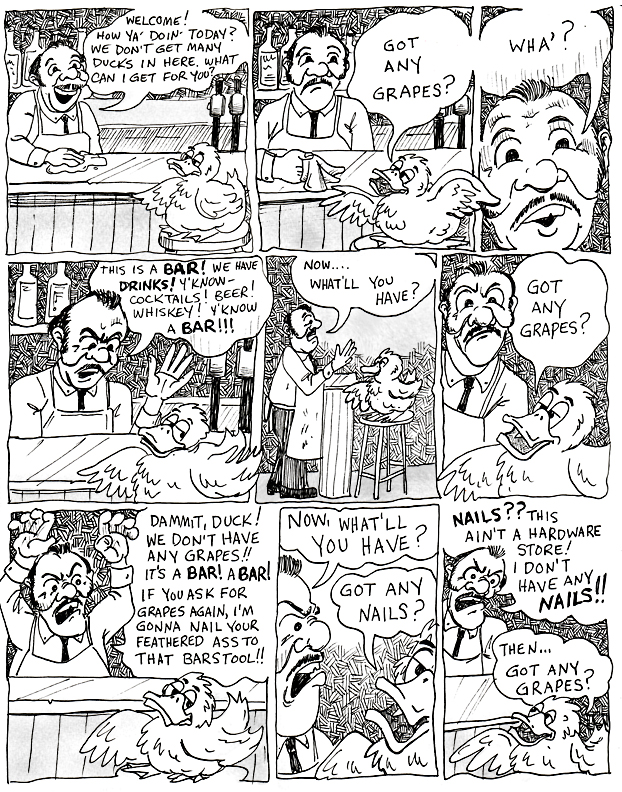
IF: clumsy 2
This week’s challenge word on the Illustration Friday website is “clumsy”.
This is the second illustration I’ve done for this topic. HERE is the first.
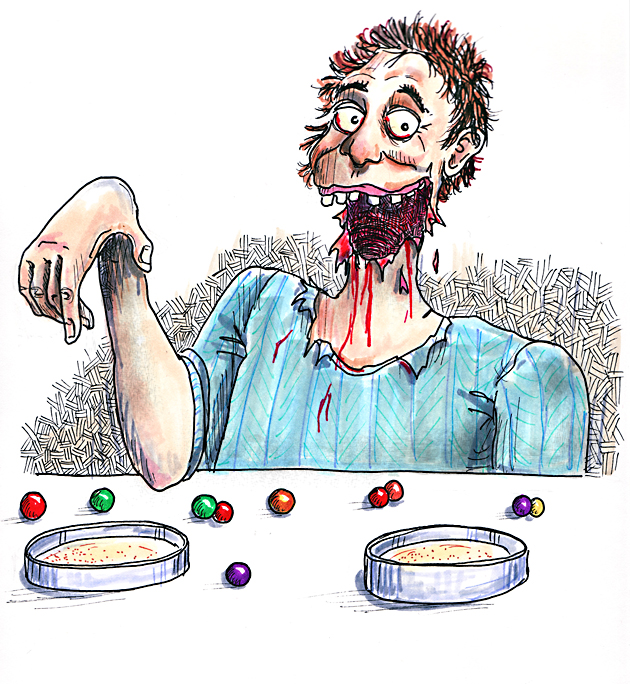
There is an unwritten rule among laboratory workers and those who carry out experiments. NO EATING IN THE LAB! Alexander Graham Bell’s famous words weren’t “Watson, come here! I need you! And bring me a sandwich!” Thomas Edison didn’t invent the incandescent light bulb so he could better see his barbecued brisket. If only Vladimir Likhonos, a young chemistry student from the Ukraine, had followed that simple rule.
25 year-old Vladimir was fond of chewing gum and had gotten into the habit of dipping his gum into citric acid to prolong the flavor. Vladimir was working with some volitile chemicals in a lab. He had two similar looking plates before him. One contained powdered citric acid and one contained a powdered form of an extremely powerful explosive. Vladimir dipped his gum into one of the plates and popped it into his mouth. The combination of his chewing and his saliva caused a reaction and BOOM! Vladimir had dipped his gum into the wrong plate.
Emergency workers found Vladimir dead, with his bottom jaw blown off and most of the lower part of his face gone.
Comments
IF: clumsy 1
This week’s challenge word on the Illustration Friday website is “clumsy”.
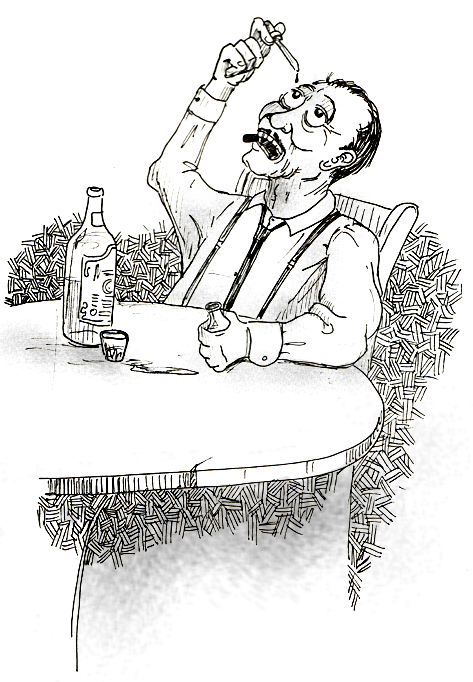
Tennessee Williams was one of the greatest American playwrights. He wrote The Glass Menagerie, A Streetcar Named Desire, The Rose Tattoo and Cat on a Hot Tin Roof, to name just a few.
Williams used eyedrops on a daily basis and had a ritual in which he applied them. He would sit down, unscrew the cap and place it in his mouth. He’d draw the precise amount of liquid into the eyedropper, lean his head back and, with a gentle squeeze of the rubber bulb, let the drops fall into his eye. On February 25, 1983, in his room at the Hotel Elysee in New York, Williams choked to death on an eyedropper bottle cap.
Comments
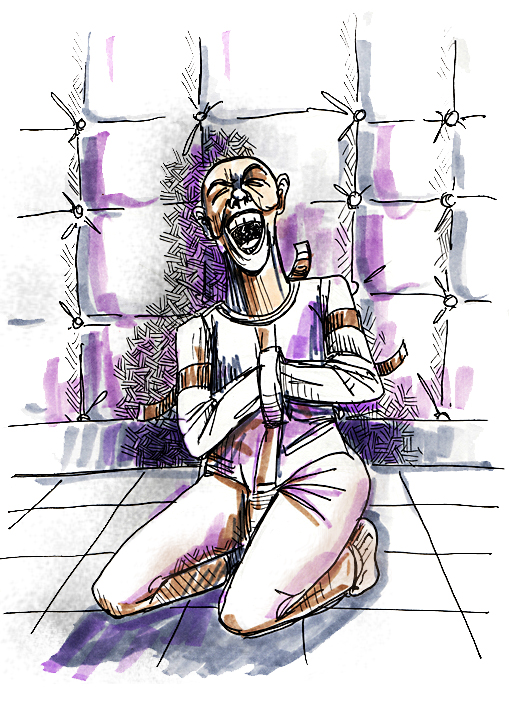
Monday Artday: insanity
A group of tigers danced with me
A poem of insanity
One time I ate the letter “G”
A poem of insanity
I fought alone in World War III
A poem of insanity
My arms are where my knees should be
A poem of insanity
I live next door to Brenda Lee
A poem of insanity
They’re watching me with ears that see
A poem of insanity
I built the Bridge at Tappan Zee
A poem of insanity
Above the purple manatee
A poem of insanity
I think about a killing spree
A poem of insanity
And eating crackers with baked brie
A poem of insanity
Once I wrestled big John Wayne
And then I flushed him down the drain
A school of fish I’d entertain
While serving them hot beef chow mein
I thought about a town in Spain
Until I was declared insane
The floor is covered with debris
I see my name on the marquee
I’m introduced by the emcee
But no one hears my constant plea
No one’s here, no one but me
And my poem of insanity
Comments
DCS: judith barsi

Judith Barsi began her career when she was discovered at a Los Angeles skating rink. She was cast in her first of over seventy commercials. Soon, she was doing guest spots on television series, appearing in over a dozen. Television led to films, including providing the voice for little Anne-Marie in the animated All Dogs Go To Heaven and Ducky in The Land Before Time. All by the time she was ten.
Any parent would have been proud of such accomplishments. Any parent but Judith’s father József. As Judith became more successful, József became more jealous. József, an alcoholic and unemployed plumber, was abusive, resentful, and paranoid. Before Judith went to the Bahamas to film Jaws: The Revenge, József held a knife up to his daughters throat and told her, “If you decide not to come back, I will cut your throat.” He was convinced that his wife, Maria, would take Judith to a photo shoot or movie shoot and never come back. Judith was taken to a child psychologist after breaking down in front of her agent. The psychologist identified severe physical and emotional abuse, and reported her findings to the authorities.
By the time Judith entered 4th grade, she was earning an estimated $100,000 a year which helped her buy the family a 3-bedroom house in the West Hills section of Los Angeles. József’s paranoia increased so much that he built a high-fence around the house, which could only be opened from inside. The constantly drunk József remained a recluse and threatened to kill his wife and daughter many times.
On July 25, 1988, József shot Judith in the head while she was asleep. Maria, hearing the gunshot, rushed down the hall to check on Judith. József met her in the hall and shot her as well. He left the bodies for three days, drenched them both in gasoline and set the house on fire. Then, he went into the garage and shot himself in the head.
Comments
IF: wilderness
This week’s challenge on Illustration Friday is “wilderness”.

After several days, Boffo decided that the wilderness was no place for a clown.
Comments
Monday Artday: invisible
This week’s challenge on the Monday Artday illustration website is “invisible”.
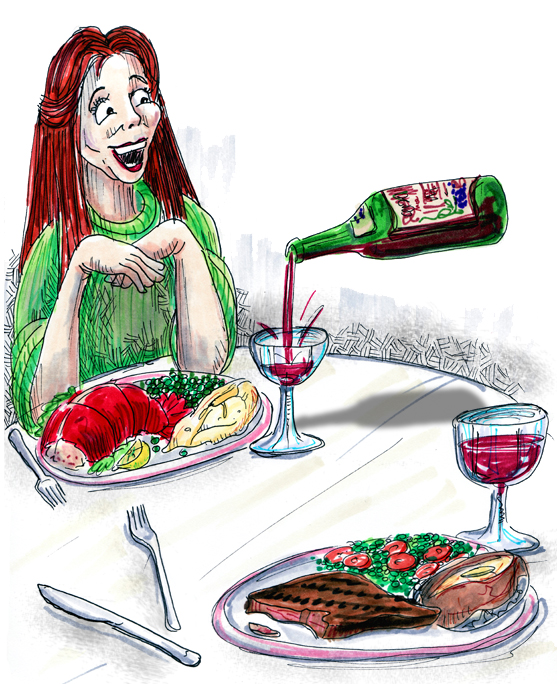
Marjorie’s date with Dr. Griffin was going very well.
Comments
from my sketchbook: dock ellis
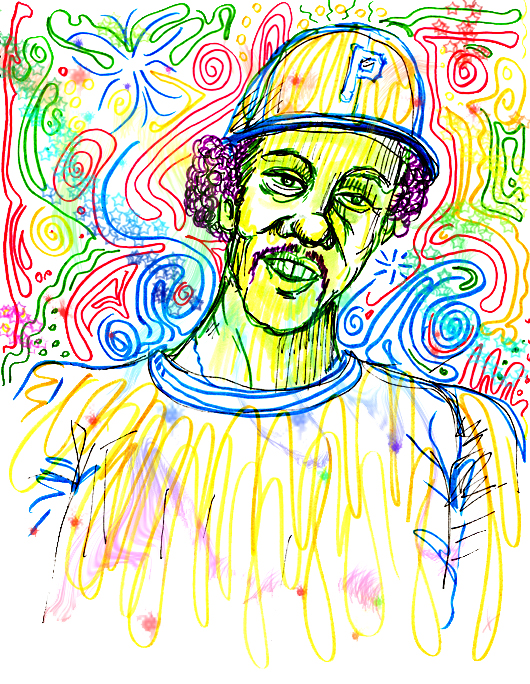
Pittsburgh Pirates pitcher Dock Ellis had, if anything, a colorful career with a lifetime win-loss record of 138-119 and a career earned-run average at a respectable 3.46.
His career was highlighted by events including famously beaning Reggie Jackson in retaliation for a home run in the 1971 All Star Game. In 1972, Dock was sprayed with mace by a security guard at Cinncinati’s Riverfront Stadium. The guard claimed that Dock had not properly identified himself and made threatening gestures with his fist. Dock said he was merely displaying his World Series ring to the guard. In May 1974, Dock decided to hit every player in the Cincinnati Reds’ lineup. Dock hit Pete Rose, Joe Morgan, and Dan Driessen in order in the top of the first inning. The fourth batter, Tony Perez, avoided Dock’s close pitches and drew a walk. The next batter was Reds’ catcher Johnny Bench. After two pitches aimed at Bench’s head, Dock was removed from the game by Pirates’ manager Danny Murtaugh.
But it was on June 12, 1970 that Dock achieved a record that still stands today. He became the only pitcher in professional baseball history to pitch a no-hitter while under the influence of LSD. Dock and the Pirates flew in to his hometown of Los Angeles for a road trip. He asked his manager if he could go home since he was not scheduled to pitch for two days. Granted permission for a day off, Dock took some LSD at the airport and went to visit some friends. Upon his arrival at his friend’s home, Dock began to experience a full-force acid trip and passed out. He woke up just long enough to take some more acid before he was awakened an hour later by his friend’s girlfriend, when she asked “Don’t you have to pitch today in San Diego?” Dock answered “No, I’m pitching tomorrow.” She informed him that he had been “out of it” for an entire day and it was tomorrow. She showed Dock that day’s newspaper as proof and Dock panicked. He rushed to the airport and arrived in San Diego two hours before game time. As Dock later related, he was as “high as a Georgia pine.”
Dock took the mound and in the course of nine innings where he claimed the ball was huge and then small; where he sometimes saw the catcher’s glove and sometimes not; where he dodged balls he perceived as line drives, but actually came nowhere near him he struck out six and walked eight. Aided by excellent fielding from second baseman Bill Mazeroski and center fielder Matty Alou, Dock pitched a no-hitter nonetheless. The Pirates beat San Diego 2-0.
Dock bounced around on four more teams in his later years, finally calling it a career back in Pittsburgh in 1979. After retirement, Dock, a long-time alcoholic, was diagnosed with cirrhosis of the liver. He passed away in 2008, while on the list for a transplant.
Comments
DCS: boris sagal

Boris Sagal, father of Married with Children star Katey Sagal, was a busy director from the middle 1950s until his death in 1981. He directed mostly episodic televison, including Mike Hammer, Peter Gunn, and several installments of anthology series like Twilight Zone and Alfred Hitchcock Presents.
Boris had a few forays into theatrical features, directing Elvis Presley in 1965’s Girl Happy and Richard Chamberlain in his first film Twilight of Honor. In the 70s, he helmed The Omega Man, a reworking of Richard Matheson’s novel I Am Legend, with Charlton Heston. But, he returned to televison to direct a long progression of made-for-TV movies and more episodic programs.
In 1981, while filming the TV movie World War III with Rock Hudson and Brian Keith, Boris had returned from setting up aerial location shots by helicopter. The helicopter landed in the parking lot of the Timberline Hotel (the hotel where exterior shot for Stanley Kubrick’s The Shining were filmed). Preoccupied with his work, Boris inadvertently turned the wrong way upon getting out of the helicopter and walked directly into the rear rotor blade. He was rushed to a hospital 60 miles away in Portland, Oregon. He died of severe head and shoulder injuries. Filming resumed the very next day with a new director.
Earlier in his career, Boris had directed the pilot episode of the World War II drama Combat! starring Vic Morrow. Ironically, Morrow would die in a similar helicopter accident less than one year later on the set of John Landis’ Twilight Zone – The Movie.
Comments
IF: confined
The current challenge on the Illustration Friday is “confined”.
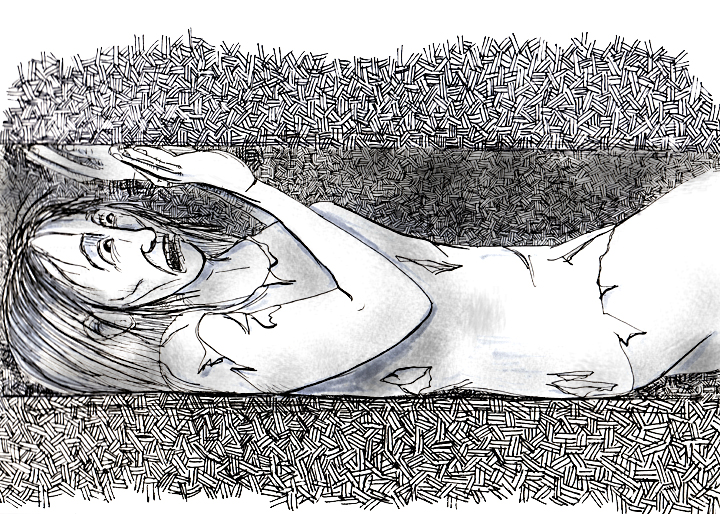
Colleen Stan’s seven year nightmare began when she was hitching a ride to a friend’s birthday party in May 1977.
Twenty-year old Colleen accepted a ride from a couple with a baby. While they drove, the man, Cameron Hooker, made idle conversation with Colleen as she sat in the back seat with his wife, Janice, and the baby. Soon, Hooker drove to a remote area and shut off the car’s engine. Janice took the baby and left the car. Colleen was confused, until Hooker put a knife to her throat and told her he would kill her if she didn’t do as he instructed. Hooker blindfolded and handcuffed Colleen. Janice returned to the car and they resumed driving. Unknown to Colleen, Hooker had made a deal with his wife. He would allow her to have a baby and, in exchange, he would be allowed have a fantasy slave.
They arrived at the Hooker home and Colleen was led to the basement where she was stripped naked and hung by her wrists several feet off the ground. Hooker and his wife had sex on the floor beneath Colleen. Sometime later, Hooker returned alone to beat and torture Colleen. He did this regularly, sometimes several times a day. When she wasn’t being tortured, Colleen was confined to a locked wooden box hidden beneath Hooker’s bed. After seven months of regular beatings and rapes, Colleen was forced by Hooker to sign a slavery contract that he had prepared. He convinced Colleen that their activity their every move was being watch by a powerful, all-seeing organization called “The Company”. He created an elaborate story about “The Company” finding her family and killing them if she tried to escape. Constant reinforcement of this idea eventually brainwashed Colleen. Her daily routine of torture, beatings and rape continued for years, as did her confinement to the wooden box.
After four years, Colleen was granted privileges including permission to work in the Hooker’s yard and care for the Hooker’s children. (Janice had delivered a second baby on the bed under which Colleen was held captive.) Colleen was even allowed to visit her family, while accompanied by Hooker posing as her boyfriend. She was so terrified by the idea of “The Company” that she did not dare reveal the truth about her situation to her parents. She appeared happy and smiling. Her parents were concerned at first, but they were so pleased to see her, they didn’t wish to pressure her, fearing they’d never see her again.
Hooker told Janice he wanted more slaves. Janice was fearful of her husband for years, but that suggestion was all she could take. After seven years, in August 1984, while Hooker was at work, Janice told Colleen “The Company” didn’t exist. She drove Colleen to the bus station and then went to the police. Janice told of Colleen’s abduction, the torture, the beatings and the brainwashing. She eventually testified in court against her husband. Hooker was sentenced to 104 years in prison. Janice and Colleen were relocated with new identities.