
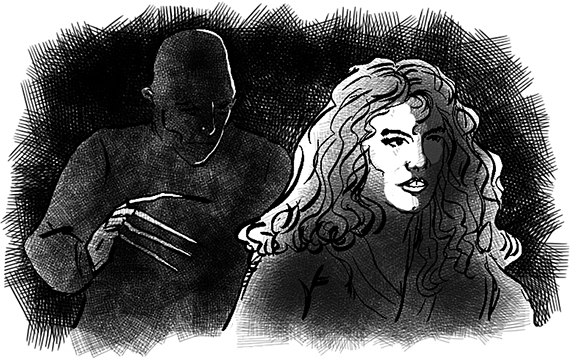
Inktober 2016 continues. Here is my entry for week number three.
Poor Nancy Thompson. Is she sleeping? Is Freddy Krueger the man of her dreams?

For fifteen minutes, every Friday night, US soldiers fighting in World War II were comforted by the songs and stories of “Phyllis Jeanne, your Canteen Girl.” Broadcast on the NBC network from 1942 until the end of the war, Phyllis Creore was a friendly voice for homesick troops. She used the name “Phyllis Jeanne” because she felt her actual surname was too difficult to pronounce. She was the unofficial opponent to the propaganda delivered by Tokyo Rose. Phyllis received hundreds and hundreds of letters from servicemen over the years. Some asked for photos and others offered “thanks” for performing, what they considered, a service and a morale booster.
She worked diligently at the New York Stage Door Canteen. founded by the American Theater Wing, and a precursor of today’s USO. In addition to singing and mingling with soldiers, she donated her government-issued ration coupons for sugar and eggs.
After the war, Phyllis became a renowned sculptor. Her art was displayed in numerous galleries.
Phyllis passed away this week at the age of 100. She had lived on her own in an apartment on Fifth Avenue, filled with scrapbooks of memorabilia from her days as the Canteen Girl.

Here’s another Inktober 2016 bonus…
“Just tell it to call you Billie, you bitch!”
– Henry Northrup’s parting words to his shrewish, overbearing wife Wilma in “Creepshow” (1982)
Here’s an account of my encounter with the aforementioned “Billie.”
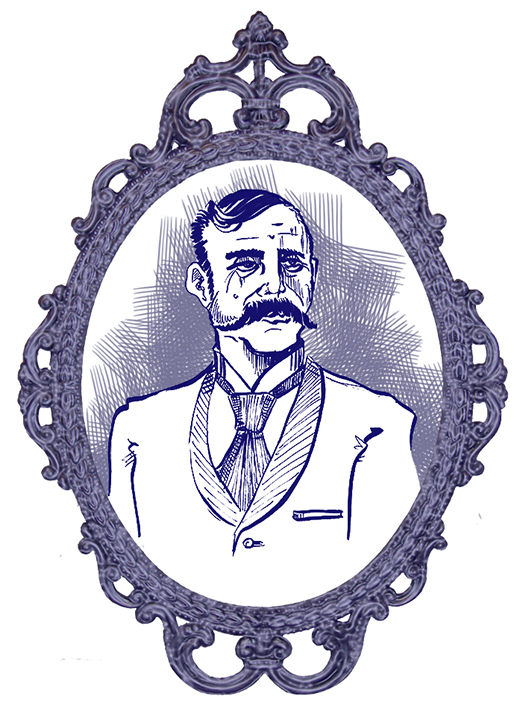
J. Abercrombie Glacier, the inventor of the ice cube.
When he passed away, scientists studied his extensive notes and journals, working diligently to duplicate his secret recipe.

Inktober rages on! Here is my entry for week number two. It’s Dr. Anton Phibes, as portrayed by the inimitable Vincent Price in the 1971 camp horror classic The Abominable Dr. Phibes and its sequel, Dr. Phibes Rises Again, released the following year.

Dennis Wilson was the self-proclaimed “black sheep” of the Wilson family. At his mother’s insistence, he was admitted to his brother Brian’s fledgling surf band, The Beach Boys, in 1961. Ironically, Dennis was the only member who actually surfed. Playing on the strength of a few school-sanctioned drum lessons, he recognized his own musical limitations and allowed brother Brian to supplement the band’s beat with more skilled studio musicians, most prominently Hal Blaine.
Dennis was as violent and aggressive as he was sensitive. He had a brief friendship with cult leader Charles Manson, who fancied himself a songwriter. The two collaborated on the B-side tune “Never Learn Not to Love,”but, upon its release, Dennis received sole writing credit. An incensed Manson threatened Dennis with murder. A fearless Dennis stood his ground, beating the shit out of Manson — reducing him to a blubbering, pleading mess in full view of many of his disciples. Manson and his “family,” who had taken up residence at the overly-generous Dennis’s home, were left with the house when a fed-up Dennis up and vacated the premises.
Dennis spiraled into alcohol and heroin abuse and was eventually kicked out of The Beach Boys by unanimous decision. He was preparing his first (and ultimately only) solo release and was indifferent to the band’s verdict. He had co-written (though was uncredited) Joe Cocker’s hit “You Are So Beautiful” with Billy Preston and was confident in his songwriting skills. However, he returned to the band within two weeks.
After years of hard work, Pacific Ocean Blue, Dennis’s solo effort was released to positive reviews but lukewarm reception. It sold poorly, although Dennis did perform some material from the album during Beach Boys concerts. Dennis later declared that, in his opinion, the album had no substance.
Despite his Beach Boys success, Dennis was homeless in 1983. He was also in and out of rehab. His violent temper erupted in an altercation at a hotel in Santa Monica. He admitted himself to a hospital to treat his sustained wounds and immediately began drinking upon his release. After drinking all day in late December 1983, a drunken Dennis dived into the harbor at Marina Del Rey to retrieve some items he tossed off of his yacht three years earlier. Dennis drowned. He had just turned 39. His estranged wife, Shawn Love, the daughter of his bandmate and first cousin Mike Love, insisted that Dennis be buried at sea. Although his brothers protested, Dennis was given an ocean burial under the auspices of the U.S. Coast Guard and special permission from President Ronald Reagan.
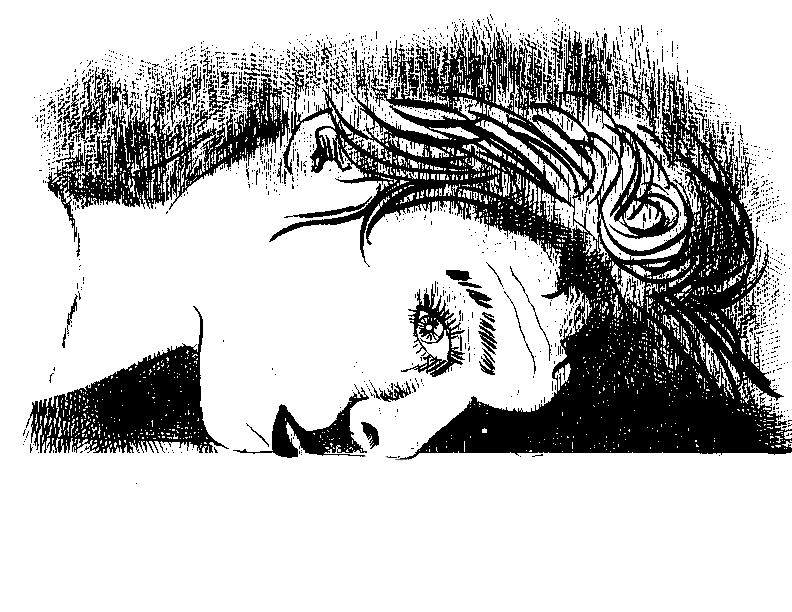
Here’s an Inktober 2016 bonus…
Poor Marion! As Norman Bates said, “She might have fooled me, but she didn’t fool my mother.”

I was a fan of Pat Benatar and I bought Crimes of Passion when it was released in 1980. Spawning three best-selling singles and several AOR station favorites, Crimes of Passion was the biggest selling album of Benatar’s career.
By the time Seven the Hard Way, her seventh album, came out, my musical tastes had moved on to bigger and better. Seven the Hard Way‘s lead-off track, “Sex as a Weapon” got some airplay, but despite a Grammy nomination and its provocative title, only reached number 28 on Billboard’s Top 100. The song, while it yearned to be a female empowerment anthem, suffered from unfortunate inane lyrics that were actually offensive to women.
Sorry Pat.

“…and He Who Walks Behind The Rows did say, ‘I will send outlanders amongst you: a man and a woman. And these outlanders will be unbelievers and profaners of the holy.'” — Isaac
Well, here we go again! Inktober is upon us. While other online artists are attempting the “one drawing per day” challenge, I, in my infinite and self-proclaimed laziness, will be doing one drawing per week. After all, I still participate in Illustration Friday (non-stop since 2007, I might add) and I do my weekly Dead Celebrity Spotlight, posted every Friday. So, you’ll just have to be satisfied with a weekly (or “weakly”) offering.
In keeping with the October/Hallowe’en theme I have done in years past, here is my Week One entry. It’s Isaac from the 1984 schlock horror film “Children of the Corn.”
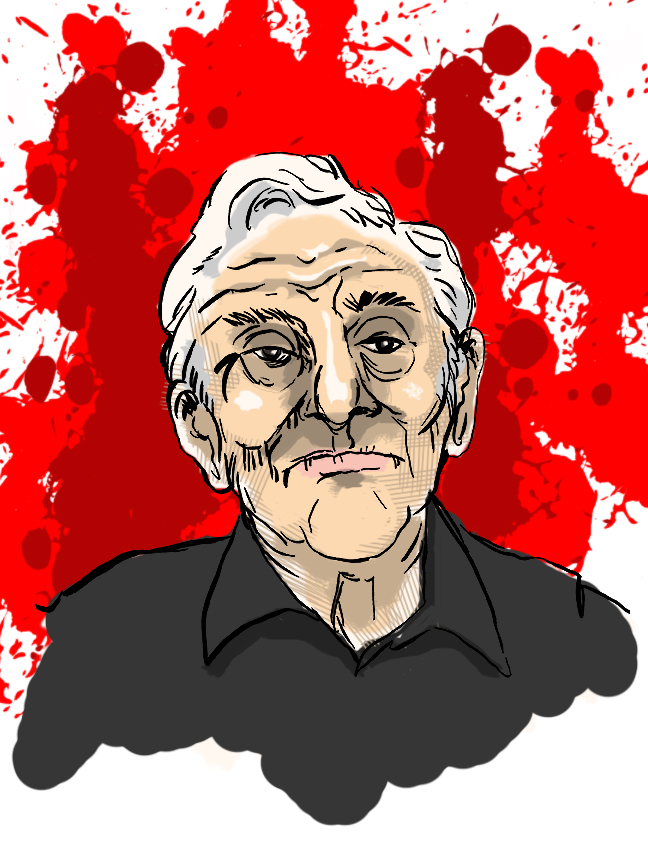
I have a friend named Sherry who is a writer. Although, she has written a novel, she spent a good portion of her career as a marketing copy writer. Once, in an online conversation, she mentioned a book on marketing techniques by Herschell Gordon Lewis. I questioned her about the author. She said he had written a number of books on the subject of advertising and marketing and was regarded, within the industry, as a true authority.
“Herschell Gordon Lewis?,” I asked, “Really?”
You see, I am more familiar with the name of Herschell Gordon Lewis from his other line of work.
Lewis was a filmmaker, entering into a long collaboration with notorious producer David F. Friedman in the early 1960s. The duo churned out a series of soft-core exploitation films, such as Living Venus, The Adventures of Lucky Pierre and Boin-n-g! The pair’s films were very successful because of a shoestring budget and their ability to skirt pornography laws. Their success allowed Lewis to explore a genre that he is credited with inventing — the “splatter” film. In 1963, Lewis and Friedman released Blood Feast, a gore-filled tale of a cannibalistic caterer who kills and feeds his prey to unsuspecting diners. The film’s 67 minute run time is amok with stabbings and hackings and general dismemberment, all served up in glorious, garish color. They followed the film up with two more, equally-sanguine entries Two Thousand Maniacs in 1964 and Color Me Blood Red in 1965. After the final release of the trilogy, Lewis and Friedman parted ways. Lewis however, continued to explore the genre, directing and writing such cult classics as A Taste of Blood and The Gore Gore Girls, earning himself the nickname “The Godfather of Gore.” Lewis supplemented his catalog with juvenile delinquent films and several children’s entries, as well.
Lewis taught college-level marketing classes and wrote marketing text books while simultaneously maintaining his film career. His students may or may not have been aware of his duality.
In the 70s, Lewis was convicted of fraud and served a brief prison sentence. He continued to write books on public relations, sales and promotion. He finally settled in Florida and founded Communicomp, a full-service direct marketing agency with clients throughout the world.
Lewis passed away earlier this week at the age of 90. A long career… make that two careers… as his legacy.