
The challenge at illustrationfriday.com this week is “leap”.
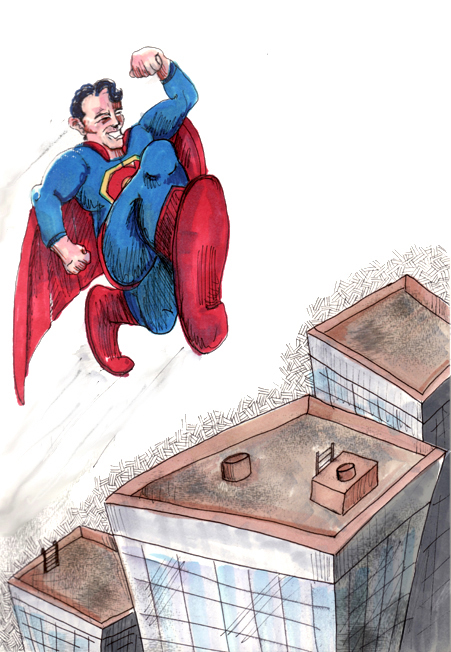
faster than a speeding bullet
more powerful than a locomotive
and able to blah blah blah…
SFG: mechanical
The weekly challenge word on sugarfrostedgoodness.com is “mechanical”.

It’s always tough finding a spot at the bar at the Piston My Brake Shoes Pub.
Comments
from my sketchbook: brimful of Asha

Asha Bhosle is an Indian singer, best known as a Bollywood playback singer. A playback singer is a singer whose singing is prerecorded for use in movies. Playback singers record songs on soundtracks, and actors or actresses lip-sync the songs for cameras.
Her career started in 1943 and has spanned over six decades. She has done playback singing for over 950 Bollywood movies. She is the sister of the equally accomplished Lata Mangeshkar.
Bhosle is considered one of the most versatile South Asian singers her range of songs includes film music, pop, ghazals, bhajans, traditional Indian Classical music, folk songs, qawwalis, Rabindra Sangeets and Nazrul Geetis. She has sung in over 14 languages including Hindi, Urdu, Telugu, Marathi, Bengali, Gujarati, Punjabi, Tamil, English, Russian, Czech, Nepali, Malay and Malayalam.
Asha Bhosle is believed to have sung over 12,000 songs. Though her sister, Lata Mangeshkar was featured in the Guinness Book of World Records during 1974-1991, for having sung the most songs in the world, reputed sources have introduced concerns to its veracity, claiming that the Guinness counts were exaggerated and Bhosle has recorded more songs than Mangeshkar.
CLICK HERE to hear the Cornershop song that was inspired by Asha Bhosle.
Comments
Monday Artday: underground
The challenge this week at Monday Artday is “underground”.
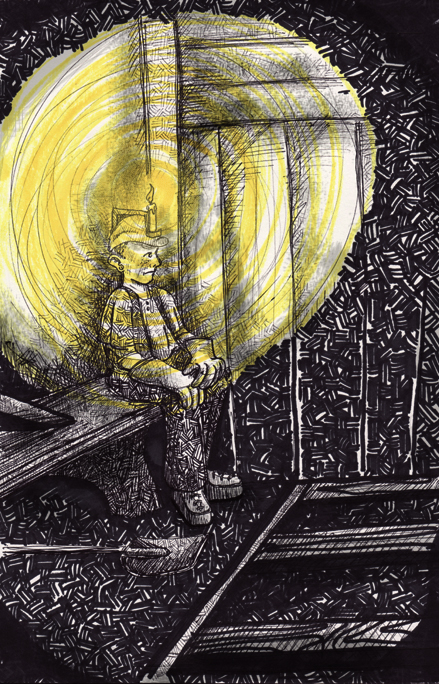
Vance Palmer was born September 16, 1893. In the early twentieth century, hundreds of boys like Vance worked as “door boys” or “nippers” in coal mines. Door boys were never over fourteen years of age and sometimes as young as ten. The work of the door boy was monotonous. He had to wake early, dress in clothes that were usually dirty with soot, and be in the mine when the first trip of coal cars entered in the morning. He would need to remain in the mine until the last car came out at night. The door boys’ duty was to open and shut the door as men and coal cars pass through the door, which controls and regulates the ventilation of the mine. That meant sitting alone in a dark mine passage hour after hour, with no human soul near; to see no living creature except the mules as they passed with their loads, or a rat or two seeking to share his meal. It meant standing in water or mud that covered the ankles, chilled to the bone by the cold drafts that rushed in when the trap door was opened for the mules to pass through. It meant working for fourteen hourswaitingopening and shutting a doorthen waiting again. Passing the time by reading was not an option for door boys, as the only light came from their helmet candle. Whittling and whistling were the boy’s chief recreations. Door boys would sometimes fall asleep at their post and fail to open their assigned door. In the darkness, a coal car would crash into the closed door, thus slowing down the mining process. And sometimes, a door boy would be killed by a speeding coal car, while attempting to cross the tracks in the darkness.
The door boy’s wages would vary from sixty five to seventy five cents a day, and from this he provided his own lamp, cotton and oil or candle.
Comments
IF: multiple
The illustrationfriday.com challenge this week is “multiple”.
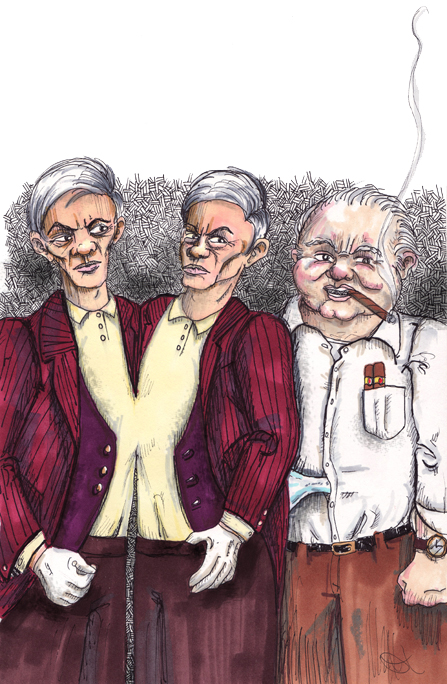
One of the most famous and interesting medical anomalies is the world’s only conjoined triplets, Chang and Eng and Archie Bunker. Conjoined twins are a rare phenomenon. It is estimated to occur from 1 in 50,000 births to 1 in 200,000 births. However, there is only one case of conjoined triplets on record.
Chang and Eng were born in May 1811 in the province of Samutsongkram in Siam (now Thailand). Archie, curiously, was born in the Queens borough of New York City in January 1971, nearly 160 years later. Chang and Eng were joined at the sternum by a small piece of cartilage. Their livers were fused but independently complete. Although 19th century medicine did not have the means to do so, modern surgical techniques would have easily allowed them to be separated today. Archie was attached to Eng by a cathode ray tube (CRT).
Chang and Eng and Archie lived productive lives. Chang and Eng, after touring the world with P.T. Barnum, retired and settled in White Plain, North Carolina, near Mount Airy. Chang and Eng married sisters Adelaide and Sarah Anne Yates. Chang and his wife had ten children; Eng and his wife had twelve. During the American Civil War Chang’s son Christopher and Eng’s son Stephen both fought for the Confederacy. Many of their descendants still live in the Mount Airy area.
Archie took a different course than his conjoined brothers. He grew up during the depression. He served with the United States Army Air Corp in Foggia, Italy in World War II (The Big One). He married the former Edith Baines and they had one child, Gloria, who much to Archie’s chagrin, married a meathead. Unlike his brothers, Archie held many jobs, including Loading Dock Foreman, Janitor, Taxi Driver and finally, Bar Owner.
Eng and Chang died in January 1874, at the age of 63. Chang preceded Eng in death by about two and a half hours. An autopsy indicated that Chang died of a blood clot in the brain; and at the time Eng’s demise was attributed, understandably, to shock.
In 1983, Archie didn’t die, so much as he was canceled.
Comments
SFG: bad idea

Monday Artday: getting ready
The challenge this week on Monday Artday is “getting ready”.

…for Opening Day!
I have mentioned before. I love baseball. I love watching baseball. I love going to baseball games. There are some things I don’t like about baseball (namely Brett Myers), but overall, I love it.
I have been a Phillies season ticket holder since 1996. That means I suffered through some pretty lousy years. I saw some seasons end with the Phillies so close to a championship, only to blow it in the final week. Last season, of course, was different. The Phils won the National League East pennant on the last day of the season. I was there. I was there among a deafening crowd. A crowd that screamed for nine straight innings. A crowd made up, mostly, of people who had never been to a baseball game in their lives and were merely jumping on the “post-season bandwagon”. Every one of them had loved the Phillies since…well….last week. As it played out, the Phillies post-season lasted three games and the temporary Phillies fans went back to follow the pathetic Philadelphia Eagles or American Idol.
I wouldn’t consider myself a “Phillies Fan”. It’s just that I love baseball and I live in Philadelphia so I have no choice if I want to see a baseball game. Sure, there are several minor leagues in the area. But, if I want to see minor league-caliber baseball, I’ll stick with the Phils.
I also worked as a soda vendor at Veterans Stadium when I was a kid. Veterans Stadium was home to the Phillies for 33 seasons. “The Vet” was, thankfully, imploded in March 2004. In April 2004, Citizens Bank Park opened. The new home of the Phillies is a beautiful, state-of-the-art facility that rivals many of the great parks in Major League Baseball. I’ve been to other parks in other cities. Citizens Bank Park is one of the best. Just hurry up and see it before the Phillies fans shit it up.
The Philadelphia sports fan. An unusual creature, that fan. They are nationally known for their aggressive and angry behavior. Everyone knows that we are the fans that booed Santa Claus. I’ve seen a player make a spectacular, multi-run saving catch in the top of an inning and come up to bat in the same inning, pop-up and get chided by the same crowd, like he just shot their dog.
And it’s THESE guys.
These guys show up every year. (If not them, then someone like them.) On Opening Day, they love the Phillies. They’ll scream, “The Phillies are going ALL THE WAY, BABY! ALL THE WAY TO THE FOOKIN’ WORL’ SERIES! DA METS FOOKIN’ SUCK! THE PHILS ARE DA BEST!”
Until the first time Pat Burrell stands at the plate with his bat on his shoulder, thinking about his fifty million dollar contract, while three balls sail unfettered through his strike zone.
Then, the screams become, “THEY SUCK! DA PHILLIES SUCK! Hey, where’s the beer guy?”
Comments
SFG: fire
The challenge this week on sugarfrostedgoodness.com is “fire“.
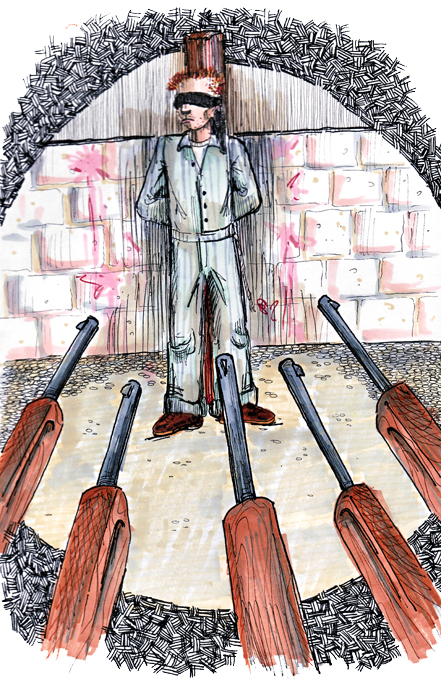
Edward Slovik was arrested and served jail time for several incidents of petty theft, breaking and entering and disturbing the peace, between 1937 and 1939. Slovik was classified as unfit for duty in the U.S. military because of his criminal record.
He met Antoinette Wisniewski while working at a plumbing company in Dearborn, Michigan, and the two were married in 1942. The intensity of World War II forced the military to lower their standards in order to meet demands for replacement troops. As a result, Slovik’s draft classification was changed and he was drafted into the infantry in January 1944.
During training, Slovik earned the reputation of being a good-natured buddy and learned to fire a rifle (which he hated) and other weapons. He was assigned to the 28th Infantry Division, stationed in France.
En route to the front, when his group of replacements was fired on, they stopped and dug in. Slovik and a friend became separated from the others. The two men soon came upon a camp of Canadian infantry and “joined” it, remaining with them for six weeks. Slovik finally rejoined his division, but he deserted almost immediately upon returning, ignoring the pleas of a friend not to leave. Slovik informed his company commander that he was “too scared” to serve in a rifle company and asked to be reassigned to a rear area unit. Slovik told the commander that he would run away if he were assigned to a rifle unit and asked him if that would constitute desertion. The commander confirmed that it would and refused his request for reassignment, assigning him to a rifle platoon.
A day later, Slovik voluntarily surrendered to an officer of the 28th Infantry Division, handing him a signed confession of desertion. However, he firmly stated he would run away again if forced to go into combat. The officer warned Slovik that his written confession was damaging evidence and advised him to destroy it. Slovik refused and he was confined in the division stockade.
Just prior to trial, the division judge offered Slovik a deal under which the court-martial action would be dropped if he would go back to his unit. Slovik refused. As a result, Slovik was tried and convicted of desertion, although he pleaded not guilty at the trial. The sentence of death was voted unanimously.
Slovik wrote a letter to General Dwight D. Eisenhower pleading for clemency, but no basis for clemency was found. On December 23, in the midst of the Battle of the Bulge, Eisenhower confirmed the death sentence. It was held that he “directly challenged the authority” of the United States and that “future discipline depends upon a resolute reply to this challenge.” Slovik was to pay for his defiant attitude and he was to be made an example.
Slovik was executed by firing squad in January 1945. None of the riflemen so much as flinched, believing Slovik had gotten what he deserved. Slovik’s last words were “They’re not shooting me for deserting the United Stated Army – thousands of guys have done that. They’re shooting me for bread I stole when I was 12 years old.”
Although over twenty-one thousand soldiers were given varying sentences for desertion during World War IIincluding forty-nine death sentencesonly Slovik’s death sentence was carried out. He remains the only American soldier to be executed for desertion since the Civil War.
The man didnt refuse to serve, he just refused to kill.
Comments
IF: theory
The illustrationfriday.com word this week is another abstract one. The word is “theory”.
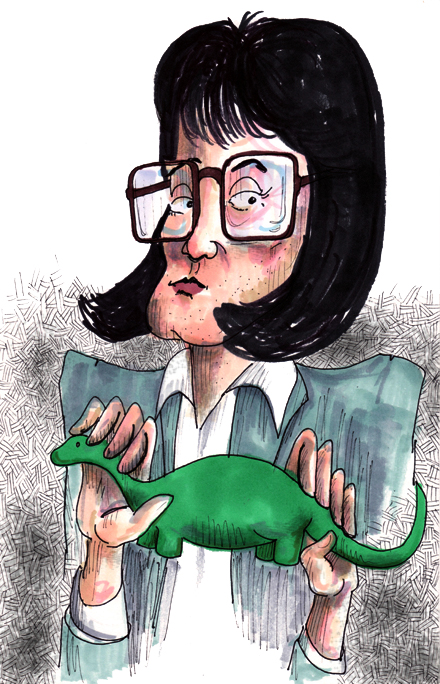
“Anne Elk’s Theory on Brontosauruses” is a sketch from an episode of Monty Python’s Flying Circus.
This skit features Graham Chapman as a television interviewer and John Cleese in preposterous drag as the palaeontologist, Anne Elk.
The plot of the skit is that the interviewee, Anne Elk, cannot bring herself to describe the actual basis of her supposed new palaeontological theory on brontosauruses. Ms. Elk spends most of the interview clearing her throat and making assertions like “My theory, which belongs to me, is mine.”
In the end, Miss Elk’s theory on brontosauruses is revealed as “All brontosauruses are thin at one end, much thicker in the middle and then thin again at the far end.” Her true concern is that she receive full credit for devising this new theory stating, “That is the theory that I have and which is mine and what it is, too.” The interviewer, is disbelief, answers, “Well, Anne, this theory of yours seems to have hit the nail right on the head.” To which Anne adds, ” … and it’s mine.”
The skit coined the concept of “Elk Theories” to describe scientific observations that are not theories but merely minimal accounts.
Comments
SFG: joy 2
The challenge word on sugarfrostedgoodness.com this week is “joy”.
This is the second of two illustrations for the topic.

With his calm, patient nature, Bob Ross came to prominence as the creator and host of The Joy of Painting, a long-running instructional program braodcast on public television. The show continues in reruns, even after Ross’s death in 1995.
Ross spent twelve years keeping medical records for the U.S. Air Force, which is where he first started painting. After leaving the Air Force, he studied with William Alexander before becoming famous worldwide with his own television program, The Magic of Oil Painting, also a public television staple.
During each half-hour segment of The Joy of Painting, Ross would instruct viewers in the art of oil painting using a quick-study technique that kept colors to a minimum and broke paintings down into simple steps that anyone could follow. Ross acknowledged that the appearances of the landscapes he painted were strongly influenced by his years living in Alaska, where he was stationed for the majority of his Air Force career.
He repeatedly stated on the show his belief that everyone had artistic talent and could become accomplished artists given time, practice, and encouragement, and to this end was often fond of saying, “We don’t make mistakes, we just have happy little accidents.” When asked about his laid-back approach to painting and eternally calm and contented demeanor, he once commented: “I got a letter from somebody a while back, and they said, ‘Bob, everything in your world seems to be happy.’ That’s for sure. That’s why I paint. It’s because I can create the kind of world that I want, and I can make this world as happy as I want it. Shoot, if you want bad stuff, watch the news.”
Ross utilized the wet-on-wet oil painting technique, in which the painter continues adding paint on top of still wet paint rather than waiting a lengthy amount of time to allow each layer of paint to dry. Combining this method with the use of giant house-painting brushes, large painting knives and fan brushes allowed Ross to paint trees, water, clouds and mountains in a matter of seconds.
In many episodes of The Joy of Painting, Ross noted that one of his favorite parts of painting was cleaning the brush, specifically the act of drying off a brush, which he had dipped in cleaner, by rapping it against the easel frame. He would often smile and even laugh out loud regularly during this practice as he, in his words, “Beat the devil out of it”.