 I write this at the risk of sounding like a cranky and bitter old man, but here goes. I love music. I especially love going to see live music. When I started to go to concerts, in those days of the early 1970s, the hierarchy of concert-going was as follows: the headlining band at the top, the opening band next, the audience, the people outside the venue who couldn’t get tickets and finally, your jealous friends who had to stay home and wait for your report the next day in school. Somewhere during the past 35 years, the hierarchy has changed and someone forgot to inform me.
In 1975, I scraped together $6.50 and bought a ticket to see Alice Cooper and Suzi Quatro at the Spectrum, Philadelphia’s premier venue to the top music acts of the day. In those days prior to the trampling deaths of eleven fans outside a Who concert at the Riverfront Coliseum in Cincinnati, concert facilities regularly offered “festival seating”, or as the Spectrum called it — a “dance concert”. The massive open floor, usually reserved for Flyers hockey or Sixers basketball, was cleared of all seats. Spectators filed in and staked out their space, a spot where they would stand for the duration of the show. The Alice Cooper show was a first come-first served dance concert. I arrived with my friends (via a begged ride from my mom) and, after getting frisked at the door, we entered the Spectrum for the first of many long and strange encounters with live music exhibitions. The concert crowd was buzzing. Suddenly, the house lights lowered and a pre-Leather Tuscadero Suzi Quatro hit the stage. Lights flashed as crowd screams filled the air. Suzi rocked for 45 minutes and I don’t remember a single song she did. When her set ended, we shook with anticipation, as Alice Cooper’s antics were just minutes away. Curiously, when Suzi Quatro’s set ended, the guy next to me left. Alice was promoting his Welcome to My Nightmare album. His show was mix of new material and classic Cooper tunes, all used as the soundtrack to a Broadway-like presentation involving six-foot black widow spiders, a chorus line of skeletons, a nine-foot tall cyclops and Alice getting beheaded on a guillotine. It was awesome! Alice had the crowd in the palm of his hand and they were mesmerized. Everyone — young and old, concert veterans and first-timers — had a great time, were happy that everyone else was having a good time and were respectful of personal space. My older brother, a veteran of many concerts himself, picked us up after the show. I think he even bought a t-shirt in the parking lot.
And so began my life-long love affair with concerts. I was bitten by the live music bug. A month later, I attended my second concert — America, with their opening act, former Raspberries lead singer, Eric Carmen. Needless to say, their straight-forward, mellow, acoustic guitar-driven folk-rock contrasted greatly with Alice Cooper’s heavy, horror-tinged anthems. Unfazed, I followed the America show with Elton John, Fleetwood Mac, Jethro Tull, three-hour Bruce Springsteen marathons and several Queen concerts — including one featuring Thin Lizzy as the opening act and one in which I attended despite being heavily medicated while battling a horrible case of walking pneumonia. The crowds remained cheerful, upbeat and respectful of one another. Later, I witnessed unusual crowds as I accompanied my Deadhead girlfriend (now my Deadhead wife) to many Grateful Dead events. At one Dead show in particular, the same stoned, dancing hippie fell on my lap four times. The fifth time, my brother-in-law grabbed him, cartoon style by the scruff of his dirty neck and the seat of his tie-dyed pants, and tossed him down an aisle. Although annoyed, I really never gave the incident another thought. Until recently.
As my musical tastes widened and evolved, I continued to go to more shows. Because my music interests skirted the mainstream, the bands I followed tended to play smaller venues. My wife and I saw The Clash at an ice skating rink on the University of Pennsylvania’s campus. We saw Warren Zevon six times at the now-defunct Chestnut Cabaret during his brief residence in Philadelphia. I was also rooked into going to the Chestnut Cabaret, by my ex-sister-in-law, to see what she promised would be a surprise mystery unannounced performance by The Rolling Stones. It wasn’t. The crowd, although disappointed, did not riot.
I saw indie nerds They Might Be Giants at Upper Darby’s Tower Theater. At thirty years of age, I cautiously entered my first mosh pit. That’s right — there was a guy onstage playing accordion and there was a mosh pit. Nevertheless, I got kicked in the head three times and had my glasses knocked off, but the crowd outside the mosh pit was well-behaved and enjoying the entertainment.
For the past five or so years, I’ve been going to concerts with my son. While I have an abundance of common interests with my wife, we part ways on most music. I am the first to admit that my musical leanings are skewed, for lack of a better word. My son, however, does share a love of unusual music and is happy to have me pay for a concert ticket. We saw many shows at the now-closed The Point, the successor to the legendary Main Point in Bryn Mawr, Pennsylvania. We enjoyed incredibly talented but lesser-known performers like DaVinci’s Notebook, Erin McKeown, Michael Penn, Dan Bern and the notorious Asylum Street Spankers. The Point was a wonderful intimate little club that always welcomed a respectful crowd of true music lovers.
My son had friends in a band. They were not the typical high school basement band. These kids were talented beyond their years and, unlike their noisy, out-of-tune contemporaries, they played jazz fusion. We saw them perform at a few tiny venues. They drew audiences comprised mostly of friends and relatives. It was at these shows that I began to notice something. And that something wasn’t right. During their performances, there was always a din of conversation. Loyal friends, there to show support for their pals, were engaging in non-stop conversation. They didn’t bother to lower the volume of their voices. It was as if the music was merely background for their dialogue. And, what’s worse, they weren’t even commenting on the music. They were having everyday conversation. With disregard for the confinements of the small setting, a few of the assembly walked directly in front of the band during the performance.
With each subsequent concert I attended, the respect level lowered. The concert hierarchy had changed. It was now topped at the highest level with each selfish individual and descended to….no one. That’s it. No one else. No one else matters. Concert goers now each perceive themselves as the most important person in the room. More important than the band and certainly more important than any one else in the audience. They exhibit an indignant air of entitlement. They are there to have a good time. Their own good time. And if that includes ruining a good time for someone else, well, fuck you. Several months ago, E. (my son) and I saw James, a British pop band boasting much of their success in the 90s. It was a standing-room general admission show. We arrived early and secured a spot in front of the stage. Almost at the end of the show, a young lady — no more than 17 — screamed something in my ear and then wedged herself into the three inches of space that separated me from my son. She began swaying and dancing and twirling and flailing her arms, knocking the hat off of the poor guy in front of her — a guy who had been really enjoying the show up until now. Then, she turned around and, with her back to the stage, waved her arms high over her head, trying to get the attention of the friends she left at the back of the venue. During the finale, the band invited fans onto the stage. This chick jumped up and kicked the poor guy whose hat she smacked, in an effort to scramble over him and the stage barricade. When the lights went on, she motioned to my son for help getting off the stage. He gave her the “yeah, right” look and abandoned her. Meanwhile, I spotted my friend RobotKasten and her boyfriend (RobotMichael?) and was talking with them. The young girl pushed herself into our conversation, demanding a pen. I handed her the pen from my pocket and said, “You may have this on the condition that you get the fuck away from me. As far away as possible. Your self-centered, unthinking behavior has ruined this show for many around you.” She called me a “bitch” and walked away. I’m pretty sure RobotMichael was entertained by my rant.
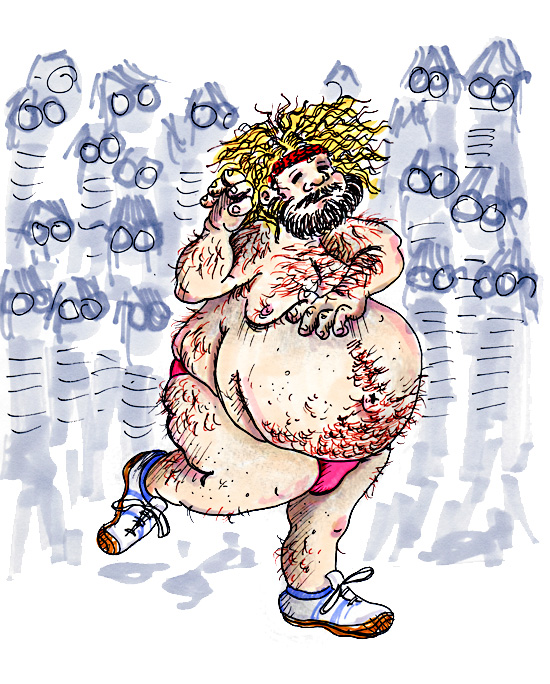
This past weekend, E. and I saw an interesting band called King Khan and The Shrines at The First Unitarian Church in center city Philadelphia, an actual working church that leases the building to a local promoter. I’ve been to shows at The Church before, including one where eels’ singer Mark Everett reprimanded audience members for trying to engage him in conversation during between-song banter. The King Khan show was in a small, poorly ventilated room in the basement of the church. The predominantly young crowd pushed and swayed at the stage front like a sweaty, slimy, beer-soaked cancer, stretching and infiltrating the group now retreating the rear of the room. An underage drunken girl was using me as a prop to keep herself from hitting the floor. Kids slammed full-speed into each other and lifted bodies above their heads like a perverse tribal offering. One noticeable gentleman, who had entered earlier dressed in a glitter sleeveless t-shirt, sweatpants and a red sequined elastic headband, now was stripped to the headband and pink bikini underpants and was headed for the stage. In the list of people I’d like to see wearing pink bikini underpants, he was none of them. I excused myself from my post at stage left and waited for E. in a safe position at a side wall. E. joined me several seconds later.
Friday night saw us at the beautiful World Cafe Live for a performance by Swedish indie rockers Peter, Bjorn and John. Once again, E. and I arrived early and found a spot at center stage. As the lights dimmed for the opening act, three women, in their 30s, moved into the crowd behind us. One of them (the one wearing WAAAAAAY too much perfume) showed evidence of a drinking binge that began that afternoon. She screamed and hooted and whistled. She talked non-stop, striving to get her voice above the level of the music, so everyone in the immediate area could hear her words of great wisdom. Her friends were obviously getting very embarrassed, as they were well aware of the sneers and dirty looks being shot in their direction. She, however, was oblivious to anyone and anything but herself. She leaned, full body, over E.’s back, in an effort to touch an imaginary something on the stage. When E. instinctively elbowed her, she screamed (and I quote): “If this faggot elbows me in the fucking tit again, I’m gonna punch him in the fucking face and call a cop.” Her calmer and more level-headed colleague tried to subdue her and looked at me for a little sympathy and understanding. She picked the wrong person in her search for compassion. I sternly stated my opinion. “Your friend needs to calm down.,” I said, “If she climbs across someone’s back, she has to expect to be elbowed. She has to realize that she is NOT the only person here. If she attempts to punch my son, I will get security and have her thrown out.” She understood. The drunk friend had moved further, now trying to climb a stage monitor. Cautioned by a stagehand, she lowered herself down. Her friend whispered to her and she screamed out at the top of her lungs, “I’m here to have a good time. I don’t give a shit about anyone else. Let them take care of themselves. I’m having a good time. That’s why I’m here!”
I think that sums it up as the voice of the new concert-going generation.