
The weekly challenge word on Monday Artday is “hygiene”
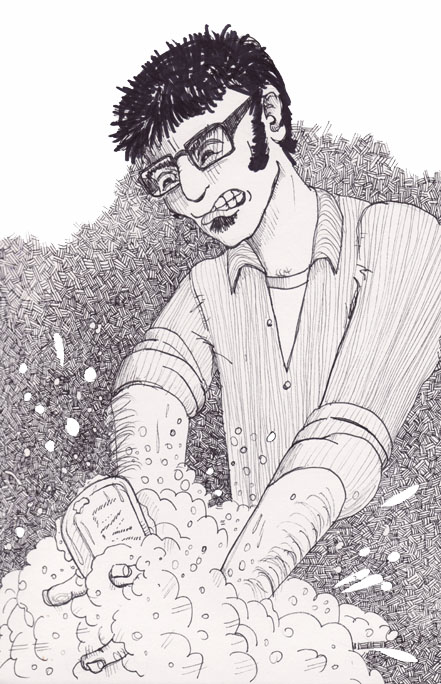
Mysophobia is a term used to describe a pathological fear of contact with dirt to avoid contamination and germs. Someone who has such a fear is often referred to as a “mysophobe”. The term was introduced by William A. Hammond in 1879, when describing a case of obsessive compulsive disorder exhibited in repeated washing one’s hands.
This phobia is sometimes referred to as germophobia (or germaphobia), a combination of germ and phobia to mean fear of germs, as well as bacillophobia and bacterophobia.
Mysophobia has long been related to OCD or washing one’s hands, however Harry Stack Sullivan, an American psychologist and psychoanalyst, notes that while fear of dirt underlies the compulsion of a person with this kind of OCD, their mental state is not about germs, it is about the hands must be washed.
IF: hats (part 2)
The challenge on illustrationfriday.com this week is “hats“. I really couldn’t decide on one idea, so I did two. This is the FIRST idea. Here is the second.
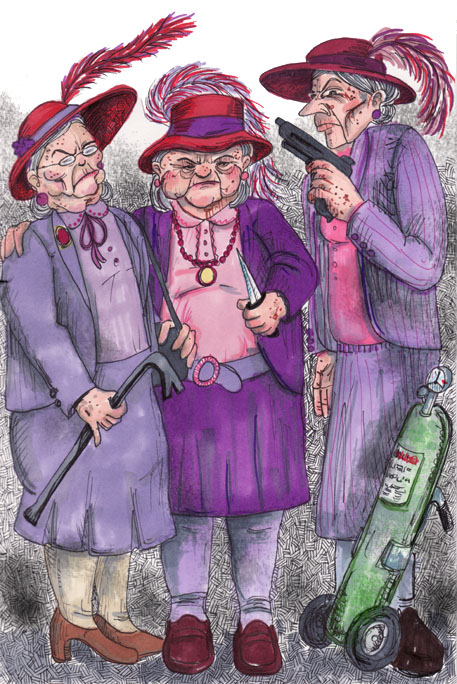
Over-50 communities and retirement homes across the country have seen vicious gangs appear. Gangs of desperate old ladies terrorizing shopping malls and Sunday brunches everywhere. They dress in gang colors of red and purple and they call themselves The Red Hat Society. Wherever they go, they strike fear in regular, upstanding citizens. These Red Hatters have been known to completely take over entire rooms in restaurants. They giggle and cackle and prance around in their decorated red hats and wild purple wardrobe. They commandeer buses and descend on malls and hotels and casinos. Sometimes, they even bring their own oxygen with them.
Their origins can be traced to a poem, written in 1961, by Jenny Joseph called Warning (a very ominous title, indeed). The first verse reads:
When I am an old woman I shall wear purple
With a red hat which doesnt go, and doesnt suit me.
And I shall spend my pension on guns and ammunition
And combat boots and flak jackets.
I shall push people who get in my way
And steal stuff from shops and totally ignore alarm bells
And fire my .45 into the air for no good reason
And make up for the sobriety of my youth.
I shall go out in my red hat and make people turn their heads
And I will kick their asses if they laugh and point
And I sure as hell wont take any shit from the man.
They are dangerous. Run for your lives!
Comments
IF: hats
The challenge word on illustration friday is “hats“.
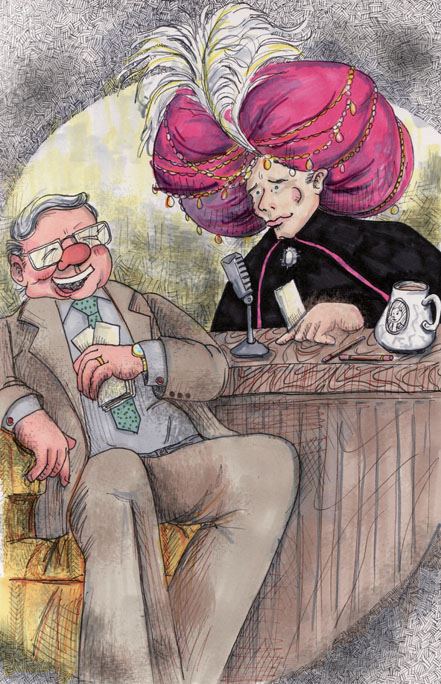
With the impending retirement of Jay Leno as host of the Tonight Show, it’s hard to believe that there is almost an entire generation who doesn’t know who Johnny Carson was. For many, Leno has always been the host of the Tonight Show. When Johnny stepped down on May 22, 1992, it most definitely was the end of an era. For 30 years, Ed McMahon‘s introduction of “Heeeeeeeeeeere’s Johnny” was the beginning of America’s bedtime ritual.
The Tonight Show featured many characters during its run. One of the most popular was Carnac the Magnificent. With the name taken from the stage name Johnny used as a magician, Carnac was “a seer, sage and soothsayer”. America’s excitement piqued when this “vistor from the East” was announced by Ed. The bit featured Johnny, decked out in an impossibly large turban and cape, as the psychic, who would divine the answers to the questions that were in envelopes “hermetically sealed” and had been kept in “a mayonnaise jar on Funk and Wagnalls’ porch since noon” that day. One at a time, Johnny would raise the envelopes to his forehead and announce an answer like “Dippity-do”. Then, he would tear open the envelope and read the question printed on a card: “What forms on your Dippity early in the morning?” The audience would laugh or groan (or both). And so it went.
A: Bible belt.
Q: What holds up Oral Roberts’ pants?
A: An unmarried woman.
Q: What was Elizabeth Taylor between 3 and 5 pm on June 1, 1952?
A: Clean air, a virgin and a gas station open on Sunday.
Q: Name three things you won’t find in Los Angeles.
If a particularly bad joke met with a large groan from the studio audience, Carnac would curse them with “May a crazy holy man set fire to your nose hair.” or “May a queasy camel freshen up your mother’s evening bath.”
I haven’t watched the Tonight Show since 1992. I think I know why. Who could possibly top Johnny Carson?
He was a tough act to follow.
Comments
SFG: black and white
The challenge this week at sugarfrostedgoodness.com is “black and white“.
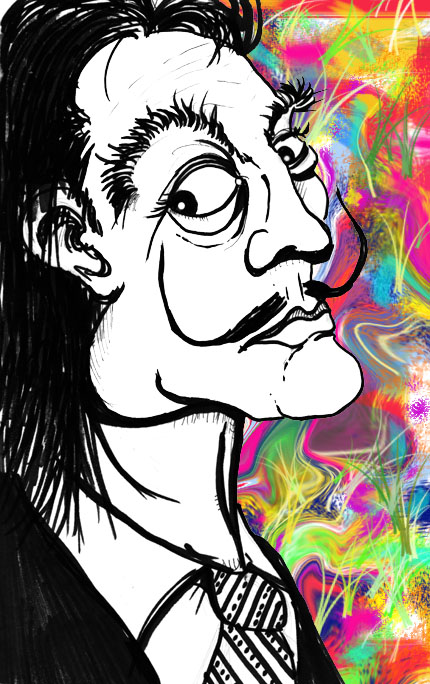
When presented with this challenge, the first image that came to mind was Salvador Dalí. I thought that the topic of “black and white” could give me the chance to experiment, as it is so non-specific. And what better experimental subject than Dalí.
Salvador Domingo Felipe Jacinto Dalí i Domènech, 1st Marquis of Púbol was born on May 11, 1904, in the town of Figueres, in the Empordà region close to the French border in Catalonia, Spain. Dalí’s older brother, also named Salvador, had died nine months earlier. His father, also named Salvador, was a middle-class lawyer and notary whose strict disciplinarian approach was tempered by his wife, (not named Salvador) who encouraged her son’s artistic endeavors. When he was five, Dalí was taken to his brother’s grave and told by his parents that he was his brother’s reincarnation, which he came to believe. Dalí had an affinity for doing unusual things to draw attention to himself. This sometimes irked those who loved his art as much as it annoyed his critics, since his eccentric manner sometimes drew more public attention than his artwork. He didn’t care what his critics thought of him and his actions. He relished the attention and enjoyed the feeling of pissing people off. When signing autographs for fans, Dalí would always keep their pens.
Dalí once said, “There is only one difference between a madman and me. I am not mad.”
I can relate to that.
Comments
Monday Artday: boo
The challenge on Monday Artday this week is “boo“.
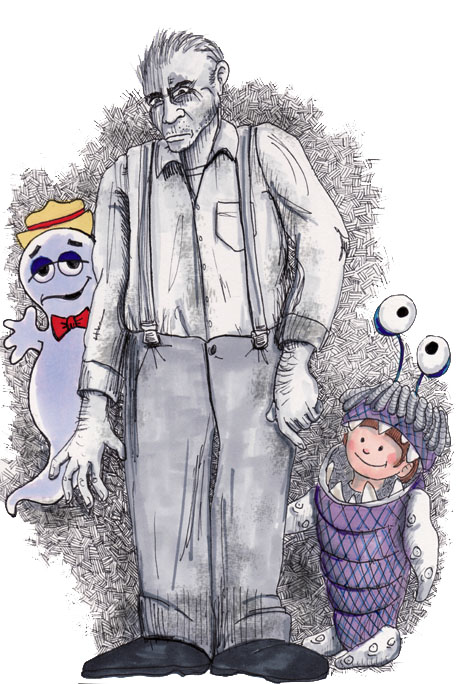
It’s the “phantom”, from Harper Lee’s To Kill a Mockingbird, Boo Radley protecting Scout and her brother Jem (played by Boo from Monsters Inc. and Boo Berry).
Comments
IF: trick or treat
The challenge on illustration friday is “trick or treat“, in honor of Halloween.
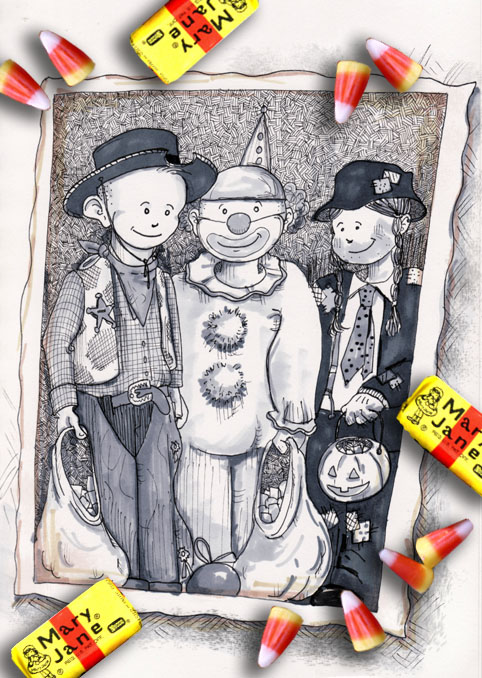
Ahh, the ancient tradition of “trick or treat”, with its origins steeped in European custom. Ancient? European?
The earliest appearance, in a national publication, of the phrase “trick or treat” was in 1939. In her 1919 history of the holiday, “The Book of Hallowe’en,” author Ruth Edna Kelley makes no mention of such a custom.
Trick or treating is a purely American custom, with no religious history or connotations. The earliest reference to ritual begging on Halloween in America occurs in 1915, with another isolated reference in Chicago in 1920. The thousands of Halloween postcards produced between the turn of the 20th century and the 1920s commonly show children but do not depict trick-or-treating.
Early national attention to trick-or-treating was given in October 1947 issues of the children’s magazines, such as Jack and Jill, and by Halloween episodes of the network radio programs The Baby Snooks Show in 1946 and The Jack Benny Show and The Adventures of Ozzie and Harriet in 1948. The custom had become firmly established in popular culture by 1952, when Walt Disney portrayed it in the cartoon Trick or Treat, Ozzie and Harriet were besieged by trick-or-treaters on an episode of their television show, and UNICEF first conducted a national campaign for children to raise funds for the charity while trick-or-treating.
Although some popular histories of Halloween have characterized trick-or-treating as an adult invention to rechannel Halloween activities away from vandalism, nothing in the historical record supports this theory. To the contrary, adults, as reported in newspapers from the mid-1930s to the mid-1950s, typically saw it as a form of extortion. Likewise, as portrayed on radio shows, children would have to explain what trick-or-treating was to puzzled adults, and not the other way around. Sometimes even the children protested: for Halloween 1948, members of the Madison Square Boys Club in New York City carried a parade banner that read “American Boys Don’t Beg.”
In Sweden, children dress up as witches and go door-to-door for sweet treats on Maundy Thursday (the Thursday before Easter) while Danish children dress up in various attires and go door-to-door on Fastelavn (or the next day, Shrove Monday).
In addition, there has never been an incident of random Halloween candy poisoning reported to any law-enforcement agency in any municipality in this country. Ever. The few that have been reported were later revealed to be targeted attacks that were covered up to look like a random act.
Happy Halloween. You are carrying on a tradition that is just a bit younger than my parents.
Comments
SFG: goblins, ghouls and ghosts
In honor of Hallowe’en, the sugarfrostedgoodness.com challenge this week is “goblins, ghouls and ghosts“.
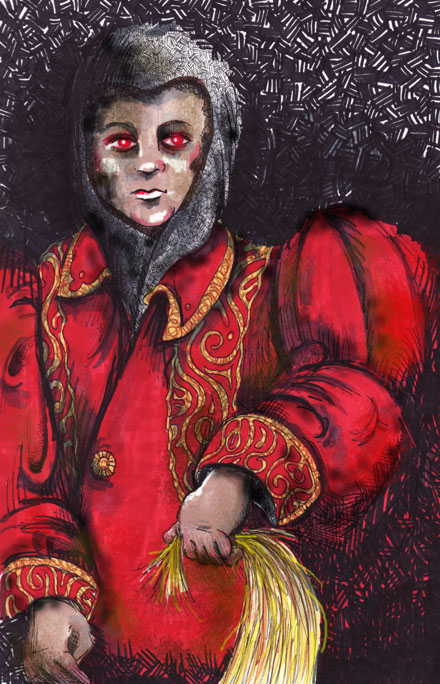
There have been headline-making serial killers over the years. Names like Ted Bundy, Ed Gein, Alferd Packer and Albert Fish…. all men. Very few women have entered the ranks of serial killers. The majority of women serial killers used subdued methods for their crimes, the most favored being poison. Enriqueta Martí had no time for poisons. She was a self-proclaimed witch in Barcelona, Spain in the early 20th century. She sold charms and love potions to earn a living, but had other activities to occupy her free time. Based on clues pieced together after her arrest, Enriqueta abducted several local children and held them captive until she killed them and boiled their bodies, using the bones in her potions and the flesh to consume. She had already murdered at least six children, when her last abductee, a young girl named Angelita, was rescued alive from Enriqueta’s lair. She described to police a tale of murder and cannibalism. According to the girl, she had been forced to partake of human flesh. Her “meal” had been the remains of another child, kidnapped by Enriqueta a short time earlier.
On the basis of Angelita’s story, police raided Enriqueta’s home. A search revealed bags of bloody children’s clothes, blood-caked knives, jars and vials of bones and human fat and several scalps of blond hair.
Enriqueta was arrested and convicted in 1912. Enriqueta was attacked and lynched in prison by fellow inmates. Although it was a lurid, front-page account, Enriqueta’s story was overshadowed by a bigger one… the sinking of the Titanic.
Happy Hallowe’en…. again.
Comments
pumpkins
It’s almost Halloween 2007, so I guess I am obliged to post a Halloween (or “Hallowe‘en“, for you sticklers) entry.
Several years ago, when I worked for a different company than I work for now, we had a Marketing Department Pumpkin Carving Contest. I really wanted to participate (you know, the whole “company morale” thing), but I had never carved a pumpkin in my life. Something about not being permitted to handle knives… but that’s a post for another time. So, in an effort to be amusing, I entered this creation…
On some of the ballots submitted to choose a winner of the contest, some voters noted mine as “angry” and “disturbingly violent”. I was going for funny.
The next year, I entered this guy…
After that year’s voting, I was one portable DVD player richer. And it turns out a co-worker submitted some photos of the contest to the Extreme Pumpkins website, where my entry was chosen as one of the winners of the 2006 contest.
The next year’s contest saw this submission from me…
I saw it as “a pumpkin with cancer”. Everyone else saw it as “disgusting”.
I got no votes.
I don’t work for that company any more.
Happy friggin’ Halloween.
Comments
Monday Artday: glamorous
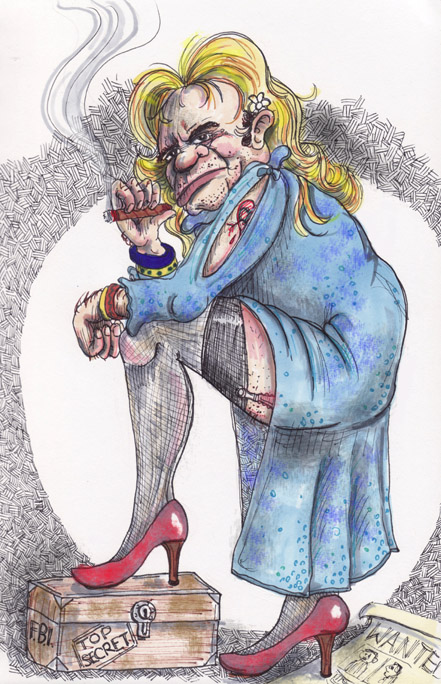
The US government has always been full of colorful characters. J. Edgar Hoover was no exception. Hoover was the founder of the present form of the Federal Bureau of Investigation and was its director for an unprecedented 48 years. Hoover’s leadership spanned eight presidential administrations, encompassed Prohibition, the Great Depression, World War II, the Korean War, the Cold War, and the Vietnam War. From the beginning of his career with the FBI, Hoover was accused of exceeding and abusing his authority. He is known to have investigated individuals and groups because of their political beliefs rather than their suspected criminal activity as well as using the FBI for other illegal activities such as burglaries and illegal wiretaps. Hoover frequently fired FBI agents by singling out those who he thought “looked stupid like truck drivers” or he considered to be “pinheads.” He also relocated agents who had displeased him to career-ending assignments and locations. A jealous J. Edgar Hoover maneuvered Melvin Purvis, the agent who captured John Dillinger, out of the FBI.
Hoover was a lifelong bachelor, and there has been speculation and rumors that Hoover was homosexual, but no concrete evidence of these claims has ever been presented. It has also been suggested that his long association with Clyde Tolson, an associate director of the FBI who was also Hoover’s heir, was that of a gay couple. The two men were almost constantly together, working, vacationing, and having lunch and dinner together almost every weekday. Upon Hoover’s death, Tolson was presented with the flag that draped Hoover’s casket.
The most famous rumor that attached itself to Hoover was he was a cross-dresser. This is most likely an urban legend. Alleged photos of Hoover in drag engaging in gay sex were the key to his reluctant pursuit of organized crime. As long as “the mob” possessed these alleged compromising pictures, Hoover backed off. These photos probably don’t exist, but it sure would be cool if they did.
Comments
IF: grow
The challenge word this week at illustrationfriday.com is “grow“.
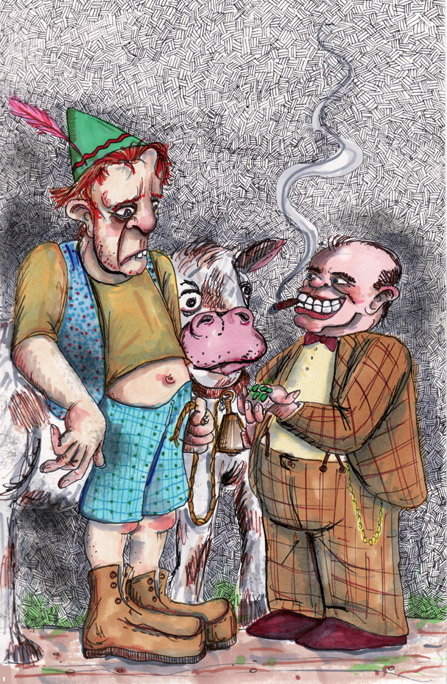
The story of “Jack and The Beanstalk” dates back to the oldest known version from 1807. But, the most popular version is the one told by noted historian and folklorist Joseph Jacobs. His story was published as part of English Fairy Tales in 1890.
If I remember the story correctly, Jack was a very poor boy who lived with his mother in the woods. They were so poor that one day his mother sent Jack into town to sell their only possession, their cow, for money to buy food. On his way, Jack came upon a slick businessman. The businessman offered Jack five “magic” beans in exchange for the cow. This deal made perfect sense to Jack and he traded the cow for the beans.
Jack was a dipshit.
And when he got home, his mother kicked the living crap out of his dumb ass.
…or something like that.