
The illustrationfriday.com challenge this week is “plain“.
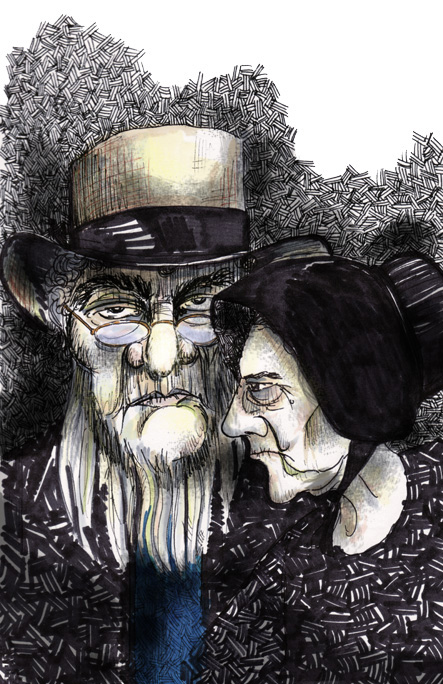
It is the practice of the Amish that men typically wear dark-colored trousers and a dark vest or coat, suspenders, broad-rimmed straw hats in the warmer months, and black felt hats in the colder months. Single Amish men are clean-shaven. If they are available to court women, they will put a dent in their hat. Married men grow a beard. Moustaches are not allowed, because they are associated with the military.
Women wear calf-length plain-cut dresses in a solid color, such as blue or black. Aprons are often worn at home, usually in white or black, and are always worn when attending church. A cape, which consists of a triangular piece of cloth, is usually worn, beginning around the teenage years, and pinned into the apron. In the colder months, a long woollen cloak is sported. Heavy bonnets are worn over the prayer coverings when Amish women are out in cold weather.
Some Amish groups prohibit buttons, allowing only hooks and eyes to keep clothing closed. The restriction on buttons is attributed in part to their potential for serving as opportunities for vain display. Straight-pins are often used to hold articles of clothing together. Clothing should not call attention to the wearer by cut, color, or any other feature. In all things, the concern is “plainness”.
The “plain” tradition carries on to funerals, which are conducted in the home without a eulogy, flower decorations, or other display. The casket is plain, without any adornment.
from my sketchbook: louis armstrong

Louis Armstrong was one of the most charismatic and innovative performers of the 20th century. His inspired and improvised soloing was the main influence for a fundamental change in jazz. Most famous as a cornet player, then as a trumpet player, toward the end of his career he was best known as a vocalist and became one of the most influential jazz singers.
Louis was born in 1901 in one of the poorest areas of New Orleans. His father abandoned the family when Louis was an infant and his mother left Louis and his sister to be raised my Louis’ grandmother. Louis moved back with his mother when he was five. He brought a little money into the home by delivering newspapers and selling discarded food to restaurants, but it wasn’t enough to keep his mother from prostitution. Louis hauled coal in New Orleans’ red-light district. There he experienced bands playing in brothels and dance halls. He formed a vocal quartet with three other boys and performed on street corners for tips. The Karnofskys, a family of Russian Jewish immigrants, hired Louis to work on their junk wagon. Louis purchased his first cornet with money loaned to him by the Karnofskys. To express gratitude towards the Karnofskys, who took him in as almost a family member, and fed and nurtured him, Armstrong wore a Star of David pendant for the rest of his life.
Louis’ 1926 performance of the song “Heebie Jeebies” was the turning point for “scat singing”. According to Louis, when he was recording the song with his band The Hot Five, his music fell to the ground. Not knowing the lyrics to the song, he invented a gibberish melody to fill time.
Louis continued to experiment and improve his playing for his entire career. He played with every major musical and vocal contemporary (Jimmie Rodgers, Bing Crosby, Duke Ellington, Fletcher Henderson, Bessie Smith, Ella Fitzgerald and many others) from the 1920s until his death in 1971. For thirty years, he played over 300 performances a year.
The nickname “Satchmo” is short for “Satchelmouth” (describing his embouchure). In 1932, Melody Maker magazine editor Percy Brooks greeted Armstrong in London with “Hello, Satchmo!” shortening “Satchelmouth“. Louis loved it and it stuck.
Louis Armstrong was a major financial supporter of civil rights activists, but preferred to work quietly behind the scenes, not mixing his politics with his work as an entertainer. However, he criticized President Eisenhower, calling him “two-faced” and “gutless” because of his inaction during the conflict over school desegregation in Little Rock, Arkansas in 1957. As a protest, Armstrong canceled a planned tour of the Soviet Union on behalf of the State Department saying “The way they’re treating my people in the South, the government can go to hell”.
In 1964, Louis knocked the Beatles off the top of the Billboard Top 100 chart with “Hello, Dolly”, which gave the 63-year-old performer a U.S. record as the oldest artist to have a #1 song.
Louis Armstrong died of a heart attack on July 6, 1971, at age 69, the night after playing a famous show at the Waldorf Astoria’s Empire Room. Shortly before his death he stated, “I think I had a beautiful life. I didn’t wish for anything that I couldn’t get and I got pretty near everything I wanted because I worked for it.”
Comments
IF: stitch
The illustrationfriday.com challenge this week is “stitch“.
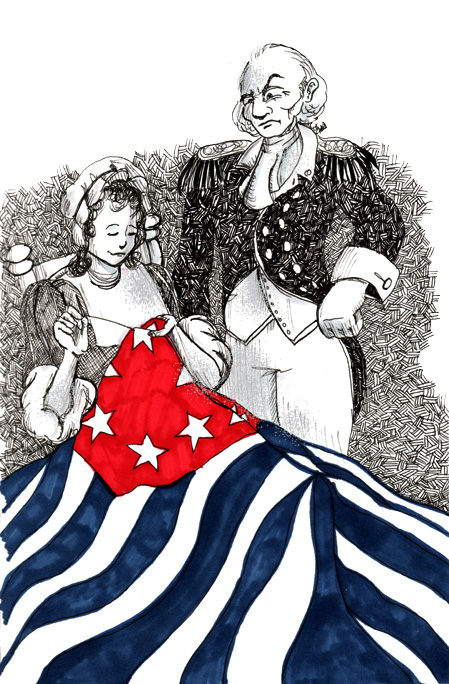
In a letter to the Board of Admiralty in 1780, Francis Hopkinson asserted that he had designed the flag of the United States of America. Hopkinson had received nothing for this work, and now he submitted a bill and asked “whether a Quarter Cask of the public wine” would not be a reasonable and proper reward for his labors. The Board forwarded the letter to Congress, which referred it to the Board of Treasury. Apparently acting on a request from Congress, Hopkinson sent a detailed bill to the auditor general, James Milligan. He sent it to the commissioners of the Chamber of Accounts, who replied six days later that they were of the opinion that the charges were reasonable and ought to be paid. The bill was then passed from government office to office, debated more and never paid. Though Hopkinson’s political adversaries blocked all attempts to have him paid for his services, they never denied that he made the designs. The journals of the Continental Congress clearly show that he designed the flag.
Elizabeth “Betsy” Griscom was the eighth of 17 children born into the Quaker family of Samuel and Rebecca Griscom. As an apprentice upholsterer, she fell in love with another apprentice, John Ross, the son of a Episcopal reverend. As Quakers, her mother and father disapproved of interdenominational marriages and disowned young Betsy. In 1773, the couple secretly traveled across the Delaware River to New Jersey, where they were married by William Franklin, Benjamin Franklin’s son. John opened up an upholstery shop and the young couple lived on the premises. John joined the military and while guarding munitions, he was killed by an accidental explosion of gunpowder. In 1777, Betsy married her second husband, Joseph Ashburn. Joseph was a mariner and was often at sea, leaving Betsy, a new mother, alone in Philadelphia. Ashburn was captured by the British and taken to Old Mill Prison in England. He died in prison before the British released the American prisoners in 1782. Betsy was visited by an old acquaintance named John Claypoole. He was a fellow prisoner and close friend of Joseph Ashburn. John was there to bring Betsy the news of her second husbands death. Betsy learned that she was once again a widow at the age of 30.
John Claypoole and Betsy rekindled their old friendship and were married in 1783. Betsy was finally able to enjoy a lengthy marriage to John Claypoole, but this 34-year relationship was not without its struggles. The couple had five more daughters together, but only four of them lived to maturity. John died in 1817, from a lengthy illness brought on by injuries he suffered in the war.
Betsy continued her upholstery business with the help of her daughter Clarissa. After over fifty years in her trade, she retired at the age of 76 and left the city to live on her daughter Susannas farm in the remote suburb of Abington. By 1833, Betsy was completely blind. She spent the last three years of her life living with her daughter Janes family on Cherry Street in Philadelphia. With family present, Betsy Ross died peacefully in her sleep in 1836. She was 84 years old.
Although Betsy Ross led an interesting life, there is no official documentation connecting her to the creation of the first American flag. The only claims to that distinction have been made by her descendants.
Oh, and I hate this guy.
Comments
SFG: science fiction
The sugarfrostedgoodness.com challenge this week is “science fiction”
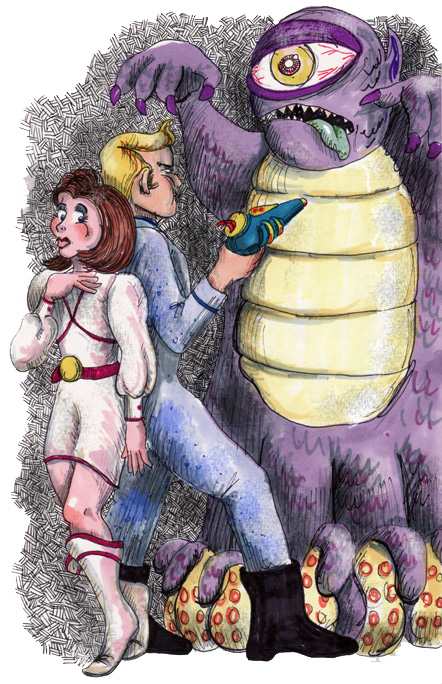
Michael Rennie was ill the day the earth stood still
But he told us where we stand
And Flash Gordon was there in silver underwear
Claude Rains was the invisible man
Then something went wrong for Fay Wray and King Kong
They got caught in a celluloid jam
Then at a deadly pace it came from outer space
And this is how the message ran:
Science Fiction – Double Feature
Dr. X will build a creature
See androids fighting Brad and Janet
Anne Francis stars in Forbidden Planet
Oh-oh at the late night, double feature, picture show.
I knew Leo G. Carroll was over a barrel
When Tarantula took to the hills
And I really got hot when I saw Janette Scott
Fight a Triffid that spits poison and kills
Dana Andrews said prunes gave him the runes
And passing them used lots of skills
But when worlds collide, said George Pal to his bride
I’m gonna give you some terrible thrills, like a:
Science Fiction – Double Feature
Dr. X will build a creature
See androids fighting Brad and Janet
Anne Francis stars in Forbidden Planet
Oh-oh at the late night, double feature, picture show.
I wanna go, oh-oh, to the late night double feature picture show.
By RKO, oh-oh, at the late night double feature picture show.
In the back row at the late night double feature picture show.
Comments
Monday Artday: most embarrassing moment
The Monday Artday challenge this week is “most embarrassing moment“.
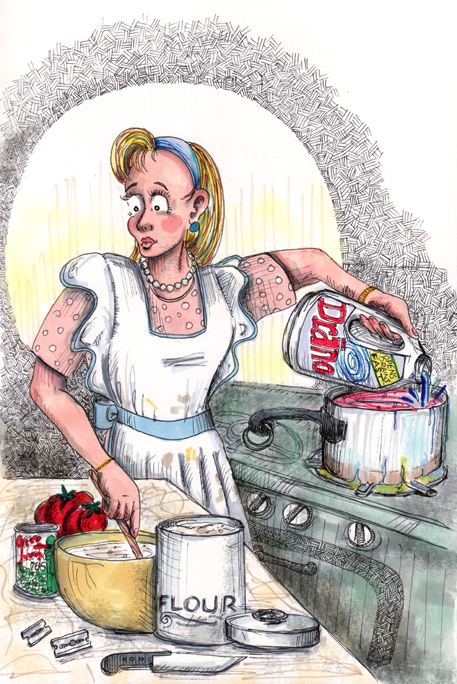
When I was a kid, a short time after my mom bumped off my dad by feeding him meatloaf stuffed with thumbtacks, I came home early from school and quietly walked into the kitchen. I caught my mom pouring Drano into the pot of tomato sauce she was cooking on the stove.
It was quite embarrassing.

This illustration won on Monday Artday for the week of January 20, 2008.
Comments
IF: 100%
The Illustration Friday challenge this week is “100%“.
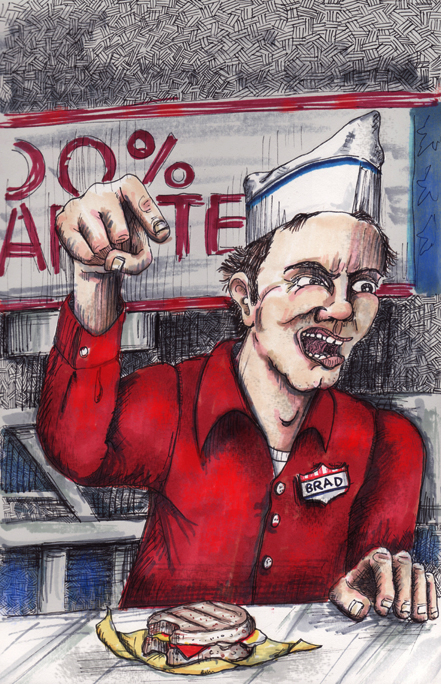
1982’s Fast Times at Ridgemont High was based on Cameron Crowe’s undercover exposé of high-school life. Crowe (who went on to write and direct Jerry Maguire and Almost Famous, for which he won an Oscar for Best Screenplay) went back to his alma mater, infiltrating the everyday life of the current student body. His character, although featured prominently in the book, was eliminated for the movie.
Fast Times was the starting point for many of Hollywood’s productive careers, including three Academy Award winners Sean Penn as stoned surfer Jeff Spicoli (2004 Best Actor for Mystic River), Nicolas Cage [billed under his real name Nicolas Coppola] in the tiny role as “Brad’s Bud” (1996 Best Actor for Leaving Las Vegas) and Forest Whitaker as football star Charles Jefferson (2007 Best Actor for The Last King of Scotland). The film also showcased early performances by Vic Morrow’s daughter and noted silver screen nutcase Jennifer Jason Leigh (Backdraft; Dolores Claiborne), Eric Stoltz (originally cast as Marty McFly in Back to the Future), Anthony Edwards (Revenge of the Nerds; eight seasons as Dr. Greene on ER), Amanda Wyss (Freddie Kreuger’s first victim in A Nightmare on Elm Street) and Pamela Springsteen (Bruce’s sister and Sean Penn’s former fiancé). Veteran actor Ray Walston turned in a terrific performance as the perpetually suspicious Mr. Hand, the geography teacher with a Hawaii fixation. It also featured a memorable scene with the future Mrs. Kevin Kline, Phoebe Cates, that became the making of fantasies for many a 1980s adolescent boy.
Beverly Hills Cop and The Santa Clause’s Judge Reinhold (the “close talker” from Seinfeld) gave one of Fast Times’ funniest performances as Brad Hamilton, the senior with big plans, if he could only get out of his minimum-wage job. Brad worked as fry cook par excellance at All American Burger. Brad prided himself on “selling no fry before its time”. While Brad usually worked in the kitchen, when the regular counter guy was in the bathroom, Brad had no choice but to face the customers. All American Burger offered a “100% Guaranteed Breakfast”, the best breakfast you ever ate or your money back!
This encounter occurred:
BRAD (nervously): May I help you?
BUSINESSMAN (returning his half-eaten breakfast): Yes. This is not the best breakfast I ever ate. And I want my money back.
Brad begins searching under the counter.
BRAD: Well, I believe you have to fill out a form. There’s a pad right around here.
BUSINESSMAN: No. I want my money back right now.
BRAD: Well, that’s not the way it works, really. And you ate most of your food already, too…
BUSINESSMAN: See that sign? It says 100% Money Back Guarantee. Do you know the meaning of the word ‘guarantee’? Do they teach you that here? Give me my money back.
BRAD: I can’t do that. But if you wait a minute…
BUSINESSMAN (as if talking to a kindergartener): Look. Just put your little hand back in the cash register and give me my $2.75 back. Okay? (He looks at Brad’s name tag.) Please, Brad?
BRAD: I’m sorry, sir. Just let me find the forms here.
BUSINESSMAN: I am so tired. I am so tired of dealing with morons. How hard is it to…
BRAD: Mister, if you don’t shut up, I’m gonna kick 100% of your ass.
Comments
SFG: superhero
The challenge on sugar frosted goodness this week is “superhero“.
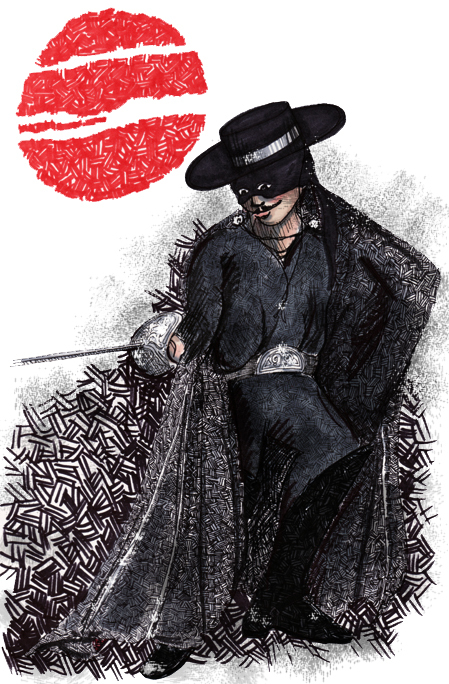
Don Diego de la Vega, the mild-mannered caballero who at night donned the black cape and hood and made his mark against evildoers as Zorro, first made his appearance in print in the All Story Weekly in Johnston McCulley’s five-part series entitled “The Curse of Capistrano,” on August 9, 1919. Douglas Fairbanks generated a sensation in 1920 with his silent film The Mark of Zorro, an adaptation of McCulleys first Zorro story, which remains one of the great classics of that era. Two decades later Tyrone Power and Basil Rathbone starred in the successful 1940 sound remake of The Mark of Zorro.
The most notable character whose creation was highly influenced by Zorro is Batman, created by Bob Kane and Bill Finger in 1939. In the origin, the Wayne family actually attend The Mark of Zorro at the cinema the night Bruce’s parents are murdered, and the future Batman takes some inspiration from the masked hero. Zorro keeps his horse in the basement of his house, and Batman keeps his Batmobile in a similar hideout, the Batcave.
Two superheroes for the price of one.
I realized I did an illustration for “superhero” in January 2007, before I had this blog. You can see it HERE.
Comments
Monday Artday: new year’s resolution
The first challenge for 2008 on Monday Artday is “new year’s resolution“. I don’t make new year’s resolutions for a few reasons. First, I know I will not keep them longer than three minutes. I am too set in my ways. Second, if I’m going to change something about myself, I don’t need a “new year” as an excuse. I’ll change because I want to and because I feel I have to. That said, I decided to do an illustration inspired by my New Year’s Eve experience.
My wife (check out her ebay store) and my son (listen to him Fridays 3PM – 7PM EST on Y-Rock on XPN) and I went to see Elvis Costello at the House of Blues in Atlantic City. My wife and I saw Elvis Costello in 1982 and I was less than impressed. It was during his “Punch The Clock” tour and since that album was not one of Elvis’ best, the show was not great. His performance on New Year’s Eve was very enjoyable, though. He came on stage precisely at 11:00 o’clock and plowed relentlessly through song after blistering song. His song selection ran the full spectrum of his thirty year career, even if his stage demeanor seemed distant. The audience was responsive, if not frenzied, and absolutely entertained.
As I watched this 53-year old punk perform songs from my youth, I remembered what a great and goofy figure Elvis was when he burst onto the scene in 1977. He was an angry British bloke in a Buddy Holly costume. I’m not sure when the transition occured, but sometime between then and now, he became this elder statesman of rock. Although he released a slew of mediocre albums, some jazz compositions and a symphony, he has not forgotten (and still acknowledges) the music that made him popular – the music that his fans still want to hear.
My son, a big Elvis Costello fan, went to see Elvis this past summer. Elvis was performing selections from Il Sogno, his attempt at classical music. Around the time the concert was beginning, I received a text message from my son. It said “These fucking rock stars only want to be classical composers!” On New Year’s Eve, my son got the Elvis show he wanted to see – even if it was four months late.
Oh, a new years resolution? I’ll go another year without heroin.
Here is Elvis Costello performing “Alison” at Atlantic City’s House of Blues on New Year’s Eve 2007.
This is my first post of 2008. I was the Monthly Winner for December 2007 on Monday Artday, based on submissions for the month.
Comments
IF: soar
The challenge word this week on Illustration Friday is “soar“.
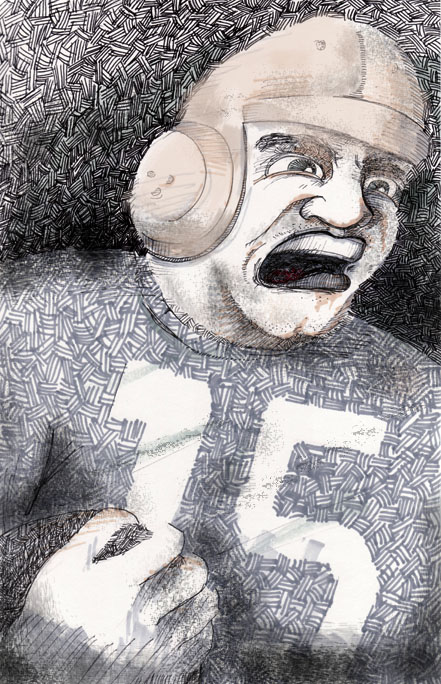
Hank Soar played nine seasons for the New York Giants and caught the game-winning touchdown pass in the 1938 NFL Championship Game against the Green Bay Packers at the Polo Grounds.
He coached the Providence Steamrollers in the Basketball Association of America (the forerunner to the NBA) in 1947.
His officiating in a baseball game during World War II drew the attention of Philadelphia Athletics manager Connie Mack, who recommended him for an umpiring career. He became an American League umpire in 1950. He was the first base umpire when Yankees’ Don Larsen pitched a perfect game in Game 5 of the 1956 World Series. He was again at first base on June 1, 1975 when Nolan Ryan of the California Angels pitched his fourth no-hitter. Soar also officiated in four All-Star Games, as well as the American League Championship Series in 1971. His on-field career ended in 1975, but was an assistant supervisor of umpires into the mid-1980s. He was greatly respected by players, a rarity among umpires, prompting Ted Williams to say “He’s absolutely consistent, that’s the most important thing in calling a pitch.”
Hank Soar died on Christmas Eve, 2001 at age 87.
Comments
Monday Artday: children’s book
The challenge on Monday Artday this week is an unusual one. It’s “children’s book“, with the actual challenge being “illustrate a page out of a childrens book you plan to make! If you do not plan to, just make an imaginary one!”
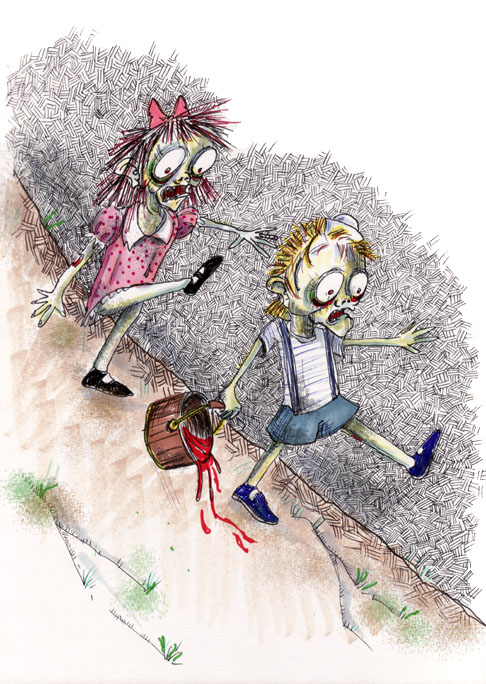
I chose “Zombie Jack and Jill”, a story I may write in the future (but unlikely that I will). I just thought the concept was funny.
Zombie Jack and Zombie Jill
Went up a hill
And came down with a bucket of blood.
They hungered for brains
And other remains
As they dragged themselves through the mud.