from my sketchbook: barbara lamarr

Ah, when the heroin is in my blood /And that blood is in my head /Then thank God that I'm as good as dead
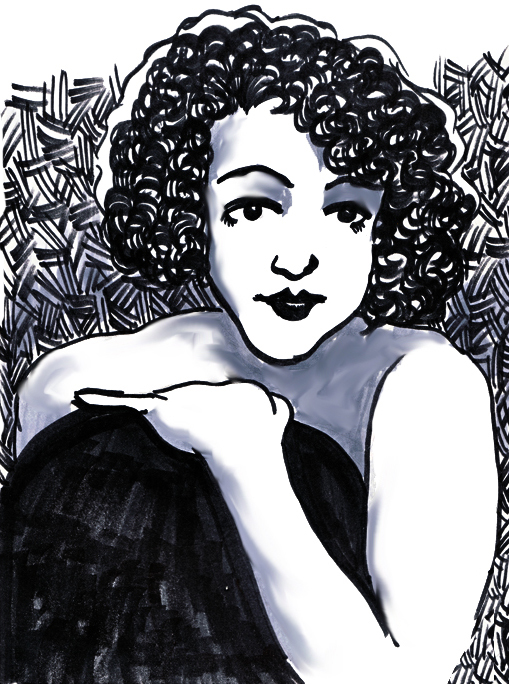
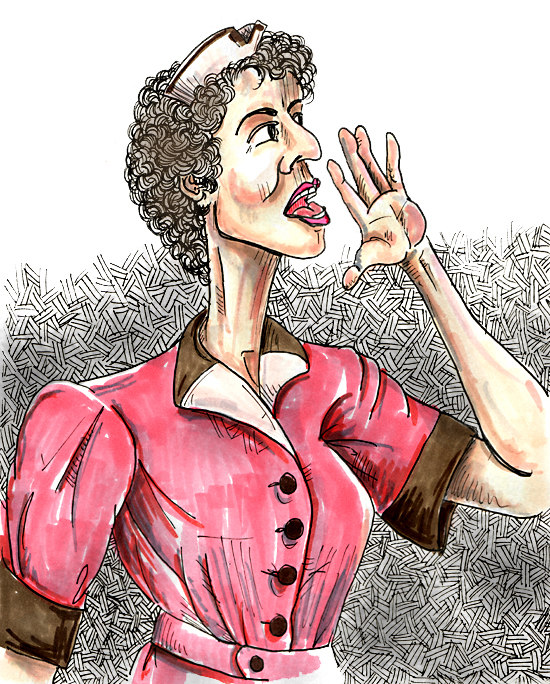
Barbara La Marr had a whirlwind, but brief, career. She began performing at an early age. She married at seventeen, the first of her five marriages. She became a screenwriter and then an actress appearing in over thirty films in six years. Barbara was given the nickname “The Most Beautiful Girl In The World”. She appeared on Broadway and filmed several dance short subjects with partners as diverse as Rudolph Valentino and Clifton Webb.

As her film career flourished in the early 1920s, she embraced the wild Hollywood lifestyle, boasting that she slept no more than two hours a night. She also developed an addiction to heroin. Barbara died of tuberculosis in 1926 at the age of 29.

In the 1930s, studio head Louis B. Mayer renamed up-and-coming actress Hedwig Kiesler “Hedy Lamarr” in honor of Barbara, one of his favorite actresses.

Comments

comments

DCS: gail russell

I had a few drinks. I had two. No four. Oh, I don't know how many I had. It's nobody's business anyway.
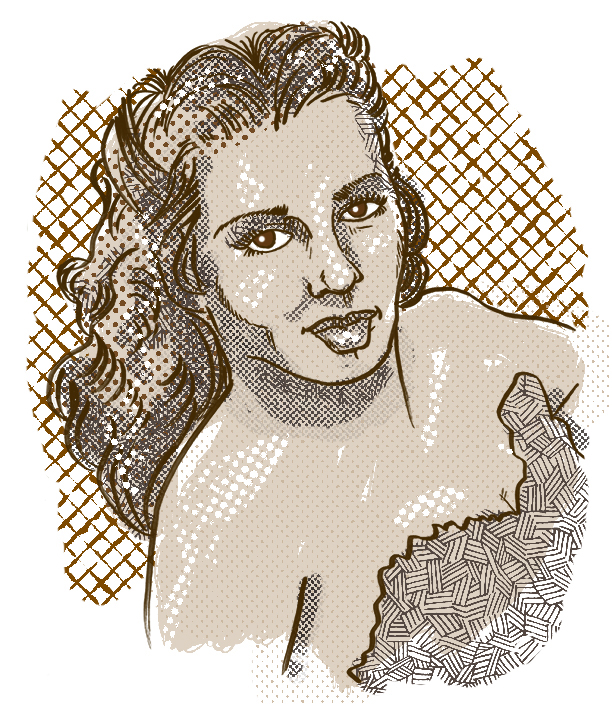
Gail Russell got an “introducing” credit in the 1944 supernatural thriller “The Uninvited” with Ray Milland, although she had made two earlier films. “The Univited”, one of the first Hollywood movies to present a ghost story in a serious manner (as opposed to comedies), made Gail an overnight star. She starred in a host of films opposite some of Hollywood’s biggest stars like Alan Ladd and John Wayne. Gail was rumored to be carrying on a secret affair with Wayne that allegedly led to his divorce. Wayne maintained that his relationship with Gail was nothing more than platonic.

Gail suffered from terrible stage fright and began drinking on the set of “The Univited”  to ease her nerves before appearing in front of the camera. As her career progressed, so did her alcohol consumption. She married actor Guy Madison, but that union ended in divorce due to her alcoholism. She was unable to get acting roles for five years, until her friend John Wayne cast her in the western “Seven Men from Now” with Randolph Scott in 1956.

In 1955, Gail left the scene of the crime after rear-ending another vehicle while intoxicated. In 1957, while driving under the influence of alcohol, Gail drove her convertible into the front of Jan’s Coffee Shop on Beverly Boulevard in Hollywood. When her hearing was scheduled, she failed to appear. Officers were sent to her home and found her drunk and unconscious. The hearing was held in the hospital where she was bedridden with severe effects from alcoholism. She joined Alcoholics Anonymous but it did no good.

In August 1961, she was found dead in her Brentwood, California apartment, a victim of liver damage and malnutrition. She was 35.

Comments

comments

from my sketchbook: elvia allman

SOMEONE'S asleep at the switch!
Elvia Allman had a long and productive career and, most likely, you never heard of her.

Elvia made her debut on Bob Hope’s radio show in the late 1930s, portraying the man-crazy character Cobina, a parody of Cobina Wright, a society debutante of the time. Wright sued over the portrayal. The case was settled out of court and she was awarded a reoccuring role on Hope’s show. Also on radio, Elvia was featured as Tootsie Sagwell, Gracie Allen’s best friend on The Burns and Allen Show and as Cora Dithers, the domineering wife of Dagwood Bumstead’s boss on the Blondie program.

Elvia voiced “Miss Cud”, the cow teacher in the 1935 Warner Brothers cartoon “I Haven’t Got A Hat” , featuring one of the earliest appearances of Technicolor at Warners, due to Walt Disney’s exclusive contact with the process. “I Haven’t Got A Hat” was also the debut of lovable stutterer Porky Pig. This performance obviously led to Elvia providing the voice for Disney’s Clarabelle Cow in 28 cartoons. Elvia soon lent her voice to the titular character in 1937’s Tex Avery animated short Little Red Walking Hood, in which she did a very convincing Katherine Hepburn imitation.

Elvia made her feature film debut in an uncredited role in Road to Singapore, the first of seven “road pictures” starring Bob Hope and Bing Crosby. She had unbilled guest apperances in multiple situation comedies like I Married Joan, December Bride, Love That Bob, and The Abbott and Costello Show, throughout the 1950s. Her most famous guest role was that of Lucy and Ethel’s stern assembly line supervisor at the candy factory, uttering the line “Speed it up a little”, on a classic episode of I Love Lucy.

In the 1960s, Elvia’s career was at a record pace with 14 appearances as busybody Selma Plout on Petticoat Junction and 13 appeareances as Elverna Bradshaw, essentially the same character, on The Beverly Hillbillies. These were just some of her 58 roles in various sitcoms, like The Munsters, Bewitched, The Addams Family and Hazel. She also had uncredited roles in two feature films, Breakfast at Tiffany’s and The Nutty Professor.

The 1970s saw Elvia’s career slow down considerably, with a stint as Oscar’s mother in one episode of The Odd Couple. Her roles revived briefly in the 80s with two guest shots on Murder She Wrote. In 1990, her career came full circle when she was asked to voice Clarabelle Cow in Disney’s animated take on The Prince and The Pauper. Clarabelle had not made a cartoon appearance in over 50 years.

Elvia died from pneumonia in 1992 at the age of 87, leaving behind a 55-year career of which to be proud.

Comments

comments

from my sketchbook: the wolfman

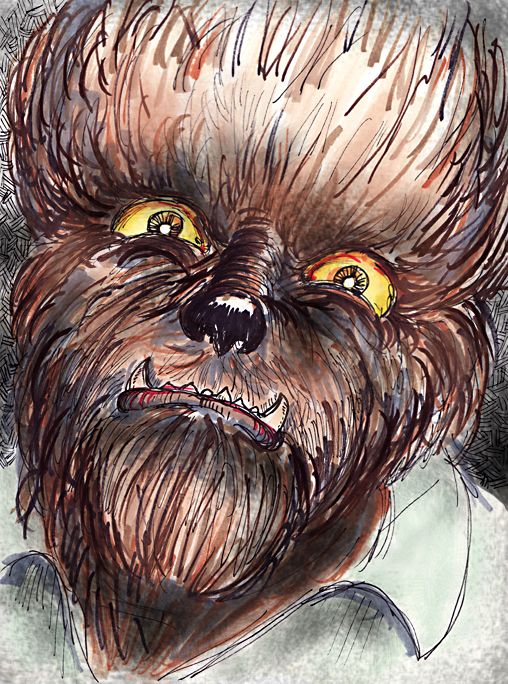
Earlier this week, I was alerted to a contest at the website Ain’t It Cool News, from my friend steeveedee. The contest is to promote the upcoming release of “The Wolfman”, a remake of the classic Universal horror movie starring Lon Chaney Jr.  The challenge is to submit an illustration of  The Wolfman in any form or situation. Interestingly, steeveedee knew where to turn, as I have done illustrations featuring variations on the Wolfman in the past. (They can be seen HERE and HERE and HERE, although THIS ONE is a stretch and probably doesn’t count.)

I decided to do a new illustration just for the occasion. Usually, when I start a new drawing, I gather reference photos to help with poses or with capturing the likeness of a famous person. This time, since I have seen the original film so many times (and it is my favorite of the Universal movie monsters), I did this portrait from memory. I will submit it today.
Mama said 'There's something strange about Billy'

Comments

comments

IF: muddy

This week Illustration Friday challenge word is “muddy”.
the mud and the guilt and the gun get heavy
Twenty-eight and a half inches of snow fell on Philadelphia today and it got me thinking about warmer times.

On the first Saturday of June 2008, my family and I attended The Appel Farm Arts and Music Festival, an annual outdoor all-day concert. This particular show was the twentieth anniversary of the event and included such diverse performers as nerd rockers They Might Be Giants, crossover folkie Suzanne Vega, singer-songwriter Marc Cohn, 80s retro-rockers Smithereens (see my post about Smithereens frontman Pat DiNizio elsewhere on this blog) and several other lesser-known performers.

We drove a little over an hour to Elmer, a sleepy South Jersey town with a population of just over 1300. Elmer is the home of Appel Farm, a facility that, in addition to the presenting the annual Arts and Music Festival, operates a day camp for 9 to 17 year-olds. On the day of the festival, the camp amenities were closed and off-limits to the concert-going faithful. This presented a potential problem because on this particular day, the temperature at the concert grounds was in excess of 100 degrees with 100 percent humidity. At 9 AM as we passed through the entrance gates, each of us laden with bottled water and other supplies, we were already perspiring like decathlon runners. We were greeted by a crystal-blue in-ground swimming pool surrounded by a fifteen foot high chain-link fence and a huge fluorescent yellow sign printed with a single word —”CLOSED” — in large angry capital black letters. We joined the crowd of attendees trudging off to secure a cool spot on the grassy audience area. As the masses plodded along the macadam walkway, heads turned and longingly eyed the forbidden pool.

We dropped our gear on the hot grass, unfurled our blanket and, each of us grabbing a bottle of water, readied ourselves for a full day of musical entertainment. The grounds boasted two stages, each nestled in a protective cover of trees and separated by a large flat field whose perimeter was lined with local artisans displaying their wares. Off to one side of the field were several food vendors offering selections of veggie-based hippie food along with the standard over-priced hot dogs and burgers.

The scheduled performers alternated from one stage to the other. If one wished to see all of the performances, a trek across the vendors’ field was required. As the day progressed, the temperature rose like the visible steam coming off the grass. It was hot, hotter than anyone could remember. People were dumping their water bottles over their own heads. Some clever patrons came with spray bottles filled with water and kept them stowed in their coolers along with their drinks and snacks. Everyone was visibly uncomfortable and many were obviously sizing up a plan to get to that pool.

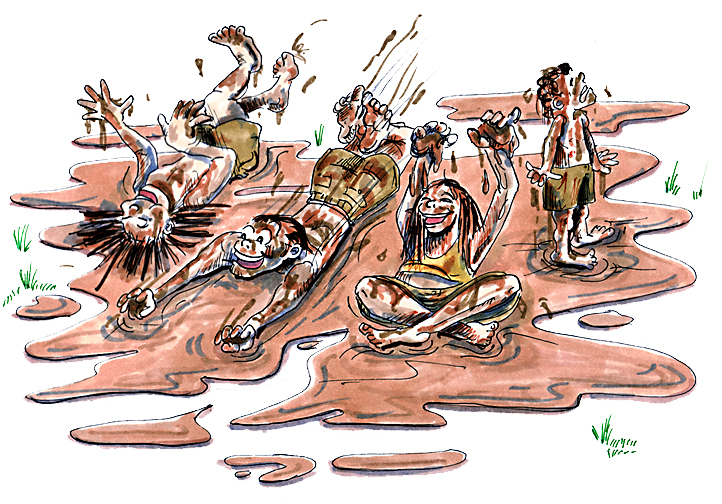
 Around four o’clock, my wife, my son and I were walking back to our plot at the big stage after an energetic performance from They Might Be Giants. As we crossed the field, we spotted a crowd gathered just to the right of the fenced-in pool. As is the policy at most public swimming pools, a shower is required before entering. Appel Farm’s was no different. A large, industrial-looking pipe rose six feet out of a small concrete block embedded in the grass. The pipe was topped with a curved showerhead and long chain for activation. This set-up was outside of the confining fence and was discovered by several of the concert-going youth. The shower was situated on a sloped area that I suppose assisted in drainage. In a scene reminiscent of Woodstock, the children were soaking themselves under the shower and then sliding in the muddy runoff that was now flooding the slope of grass. The more the shower ran, the muddier the grass became. The muddier the grass became, the more kids joined in. They rushed from all directions, stripping down to shorts (some to underwear) and diving head first into the murky turf and dousing the crowd with big sloppy spatters. Some rolled around in the sodden but cooling grass. Others dropped handfuls of drippy ooze on their heads and bodies. The whole scene brought to mind a primitive tribal ritual. We were mesmerized, though not enough to join in. We hurried off the catch Marc Cohn’s set, the final act of the day. Marc, we agreed, would have to be phenomenal in order to top the performance we just witnessed.

Comments

comments

from my sketchbook: the exorcist in six frames

There is a website based in the United Kingdom called Little White Lies. They are running a contest in conjunction with the release of a movie called “Kick-Ass” that is being released later this year. The contest is very simple. They’re asking to take any film and re-imagine it in the form of a comic, within a designated six-frame panel.

Here’s my second entry. It’s my version of  “The Exorcist” —
Why you do this to me, Dimmy?

Comments

comments

From my sketchbook: willy wonka in six frames

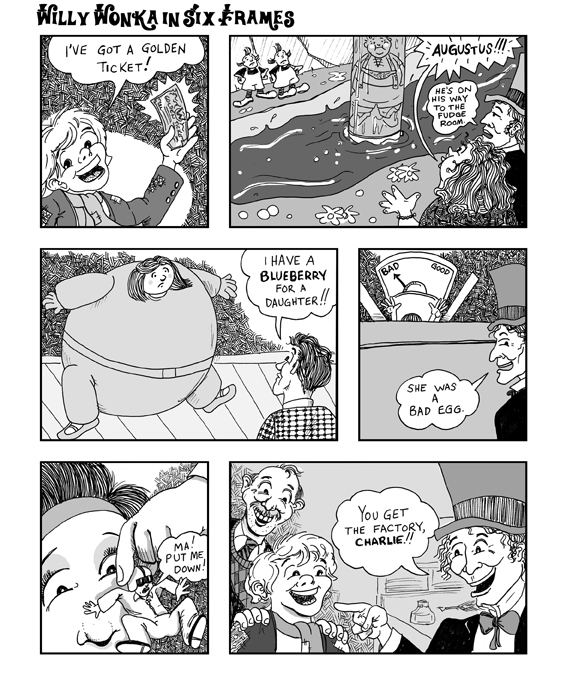
There is a website based in the United Kingdom called Little White Lies. They are running a contest in conjunction with the release of a movie called “Kick-Ass” that is being released later this year. The contest is very simple. They’re asking to take any film and re-imagine it in the form of a comic, within a designated six-frame panel.

Here’s my version of “Willy Wonka and the Chocolate Factory” —
How could you do something like this, build up a little boy's hopes and then smash all his dreams to pieces? You're an inhuman monster!

Comments

comments

IF: focused

The weekly challenge on the Illustration Friday website is “focused”.
My idea of a good picture is one that's in focus and of a famous person.
Andy Warhol fooled everyone. The iconic pioneer in pop art and experimental film was fully focused on one thing, and one thing only — making money. He took everyday objects — Campbell’s soup, flowers, knives, Coca-Cola, Brillo scouring pads — and forced the public to view them as art. He painted them as any artist would paint a portrait or a still life. He put them on display and said it was “art”, so it was. And he did it because he knew the public would buy what they were familiar with. Andy said this about his fascination with Coca-Cola:

“What’s great about this country is that America started the tradition where the richest consumers buy essentially the same things as the poorest. You can be watching TV and see Coca Cola, and you know that the President drinks Coca Cola, Liz Taylor drinks Coca Cola, and just think, you can drink Coca Cola, too. A coke is a coke and no amount of money can get you a better coke than the one the bum on the corner is drinking. All the cokes are the same and all the cokes are good. Liz Taylor knows it, the President knows it, the bum knows it, and you know it.”

In the 1970s, he painted commissioned portraits of rich celebrities, including Liza Minelli, Elizabeth Taylor, Michael Jackson and The Shah of Iran. Andy said of these portraits, “Making money is art, and working is art and good business is the best art.”

His controversial films — “Sleep” showing poet John Giorno sleeping for six hours and “Eat” consisting of a man (fellow artist Robert Indiana, creator of the famous LOVE statue)  eating a mushroom for 45 minutes — were early examples of “art films” and forerunners to performance artists. But, Andy’s goal was to stir up enough interest to entice people to view his films, and in turn, make more money.

Sure, Andy Warhol was a great innovator and forever changed the art world. But he also said, “An artist is somebody who produces things that people don’t need to have.”

Andy Warhol died in New York City on February 22, 1987. He had been making a good recovery from a routine gallbladder surgery when he died in his sleep from a sudden post-operative cardiac arrhythmia.

Comments

comments