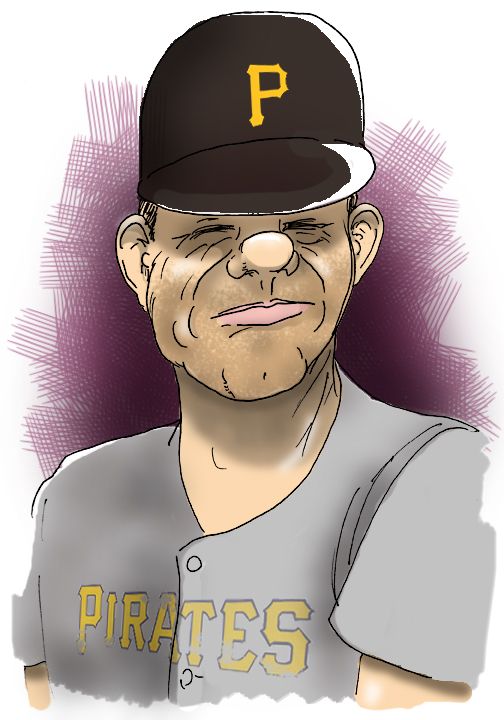
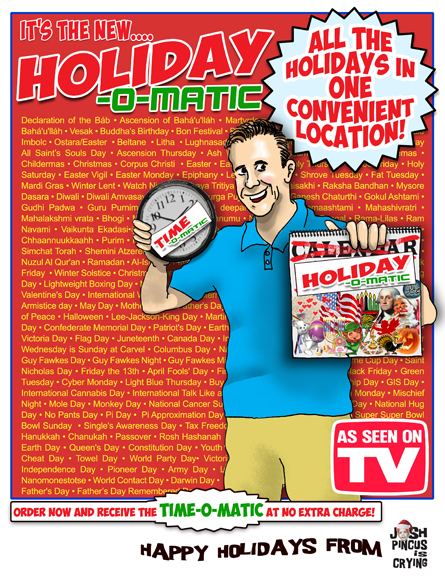
This week’s Illustration Friday challenge word is “new”.
New Years Eve 1986 was the most memorable New Year’s Eve for me — and nothing spectacular even happened. It was better than the New Year’s Eve when I got stupid drunk and discovered true meaning in Side Two of Pink Floyd’s Wish You Were Here. It was better than the New Year’s Eve that I dumped Linda Cohen just forty minutes after the ball dropped in Times Square. It was better than New Year’s Eve 1999, when I still maintained that it was not the turn of the century no matter what eleventy gazillion people said. No, I will never forget New Year’s Eve 1986 and even though I actually slept right through the clock striking midnight, I still remember it fondly it all these years later.
I have loved Walt Disney World since I set foot on those magical grounds in central Florida for the first time in 1981. I took two great summer trips there with friends, followed by a honeymoon with my new bride a few years later. Although, my wife and I love the Disney theme parks and the surrounding attractions (read: outlet malls), the heat and humidity in the Orlando area in July can be uncomfortable. So, we decided to give a December trip a try. The notion of seeing the Magic Kingdom decorated for Christmas heightened our excitement.
The decision to drive the 990 miles to Mickey’s Mecca was made without a discussion. Despite the fact that Mrs. P was just informed that she was six weeks pregnant, driving our car was still our preferred choice for transportation. We knew that with a family expansion, our next trip to anywhere would be way off in the unforeseeable future. So, my wife wanted one last long-distance hurrah behind the wheel before the responsibility of parenthood forces us to think rationally. Besides, she loves driving and I love passengering, so it’s a match made in heaven — by way of Triple A.
We were joined on this trip by Ricci, Mrs. P’s longtime closest friend, who was Maid of Honor at our wedding and our choice for godmother to our pending offspring. While I made the arrangements for admission tickets and plotting a route for our journey (in the days before the internet and the GPS), Ricci offered to take on the task of booking hotel accommodations near Disney World. A few days before our departure, Ricci cheerfully reported that she had secured a hotel.
We loaded up the hatchback of our tiny Nissan with enough essential gear for three adults and we left the day after Christmas, which — as the calendar would have it — was the first night of Chanukah. My ever-prepared spouse packed a small menorah and enough candles to take us through Day Eight of the observance. Judah Maccabee would have been proud. Mrs. P navigated the car south on I-95 and we talked and sang and marveled at the quirky sights along the way (A Cracker Barrel every fifteen feet qualifies as — quirky — in my book). After a long day of driving (and an obligatory stop at South of the Border for God knows what reason!), we pulled into a roadside motel just north of Savannah, Georgia. We just wanted to stretch our legs, eat and sleep so we could arrive fresh and relaxed in Orlando the next afternoon. Plus, we needed to light candles for Chanukah’s opening night. We grabbed a quick dinner at the restaurant next to our motel, returned to our room, kindled the holiday flames and hit the sack. We woke early the next morning and headed out to the same restaurant for breakfast. After our morning meal, we came back to find our room had been made up by the attentive housekeeping staff — beds made, fresh towels stacked by the small sink, carpets vacuumed, waste cans emptied. However, the remnants of the previous evening’s Chanukah candles were conspicuously untouched. The matchbook lay in the exact same position in which it was left. The melted candle wax, now hardened, stood undisturbed — its frozen drips never reaching the nearly circular, solid puddle of paraffin below. Several unused candles were untouched, still balanced precariously upon one another, just as they had slid from the box eight hours earlier. We figured the chambermaids were horrified and mistook this display for some primitive ritual of black magic, wanting no parts of it. Perhaps they left the room extra clean as a peace offering.
After a full morning on the road, we took the Kissimmee exit on I-4 and began the search for our hotel. Since it was holiday time, the hotels along that stretch of US Route 192 were adorned in Christmas finery. Hundreds of lights twinkled from in and around artificial greenery and from under piles of fake snow, giving the otherwise temperate clime a faux-wintry façade. The changeable signage below each lodging establishment’s illuminated logo declared some sort of sentiment of the season. We passed numerous “Happy Holidays,” “Seasons Greetings,” and the occasional holiday-specific “Merry Christmas,” all glowing softly with a welcoming radiance, regardless of the succession of angry “NO VACANCY” signs ablaze just a few inches below. Luckily, we had reservations. The procession of corporate resorts dwindled and we finally located our hotel. It was the last one on the strip before the multi-lane highway yielded to overgrown brush and heat-buckled macadam. The backlit sign proclaimed “Happy Birthday Jesus” in eight-inch high, right-to-the-point Helvetica Bold Caps. This was to be our home for the next five days.
I obtained the key and directions to our room from the office. I pointed to my wife and she pulled the car ahead in the direction of my outstretched finger. I turned the key in the lock (remember — this was 1986 in a technologically-deficient hotel) and the door swung open to reveal a plain room with two plain beds, a plain lamp and plain dresser and, as we soon discovered, a sink without running water. A quick call to the office (on the age-yellowed desk phone) told me that some work was being performed on the pipes and the water should be on in “a little bit.” I was not familiar with the Southern chronological time-frame of “a little bit,” so we had no choice but to stick it out and wait. After settling in and a casual dinner, we decided to turn in and get an early start tomorrow at the Magic Kingdom. I noticed that instead of a deadbolt and chain, our hotel room door sported a length of rubber hose nailed to the door jamb adjacent to the knob. (I shit you not!) Proper security was achieved by looping the hose around the door knob, followed by praying to the Lord Birthday Boy. I followed the procedure with the hose, but instead of prayer, I opted to slide a chair in front of the door. I put my faith in a heavy object rather than a magical Lamb of God.
The next morning we were jarred awake by a sound. Not a phone ring or an alarm clock or even the sound of wrenches tightening pipes. This was a human sound; a human voice — or two. Through the paper-thin walls, we could hear the unmistakable tones of an argument, and a heated one, at that! It was coming from the adjoining room. While there was no denying that a bitter disagreement was unfolding on the other side of a few inches of plaster and wood, we couldn’t make out a single recognizable word. Actually, we could make out four words. Four distinct words. Four words that were used repeatedly and they came through clear as crystal as though the speaker were at a lecture hall podium. “SHUT THE FUCK UP!” burst forth in staccato rhythm. Then, some muffled dialogue. Then, some more muffled dialogue, until the fervent crescendo of “shut the fuck up! Shut The Fuck Up! SHUT THE FUCK UP!” pierced the suppressed fracas again, cutting like a machete through softened butter. We were glued to the unseen action, momentarily stopping our preparations for rushing out to a theme park. Suddenly, the explicit (but subdued) sound of a slamming door signified the ruckus had ended. We laughed as we resumed getting ready to start our day. Making our way across the parking lot to our car, we wondered about the “SHUT THE FUCK UP!” family, surmising that if they were here, then they are on vacation and if they are on vacation, then — Dear Lord! — how did they behave at home?
It was odd being in Walt Disney World wrapped in a heavy jacket for warmth, especially after so many previous visits in shorts and T-shirts. Disney World draws tourists from so many areas and so many various climates, the mish-mash of clothing we saw was intriguing. While in a queue line for It’s a Small World, we were flanked by a family in parkas (from Florida) and a family in Hawaiian shirts and clam diggers (from Minnesota). The weather was indeed brisk. While waiting for the next performance of The Country Bear Jamboree (re-programmed for the season as The Country Bears’ Christmas Vacation), the three of us chatted and planned out our day. In front of us was a harried mother with a baby in the crook of her arm. A small boy, about 6-years old, ran around her like a blur, screaming, flailing his arms, swinging on the ropes that delineated the queue area. The poor woman was exasperated, trying unsuccessfully to keep the child in check. In front of them were an older couple dressed in Christmas-y sweaters and knit gloves and a single woman roughly the same age. They were quietly talking, perhaps about finally being able to do all the things they hoped to, now that they had reached retirement age. As she talked, the single woman kept craning her neck over the crowds, obviously gauging the arrival of the missing member of their foursome. Soon, a smiling white-haired man, all sweatered and gloved and looking like a missing piece to this retired crew puzzle, approached. He held before him a cardboard tray with four neatly-arranged foam cups, wispy curls of steam escaping from their vented plastic lids. Balancing the tray, he slipped under the ropes, joined his party and began distributing the beverages. Suddenly, the gyrating 6-year old flung himself forward, his outstretched arms knocking the man off-balance for a second. He regained his footing without spilling a drop, but was noticeably shaken by the unexpected shove. The boys mother, now mortified, grabbed the youngster’s arm with enough force to yank it from its socket and, with baby parked on her hip, pulled him out of line for a overdue lesson in “How to Behave in Public,” complete with some hands-on reinforcement. The two couples looked bewildered, as though they had entered a play in the middle of the second act. With pleading eyes, they silently sought an explanation from us, since we were close enough to bear witness. “Well,” I offered, “maybe he was mad that you didn’t bring hot cocoa for him.”
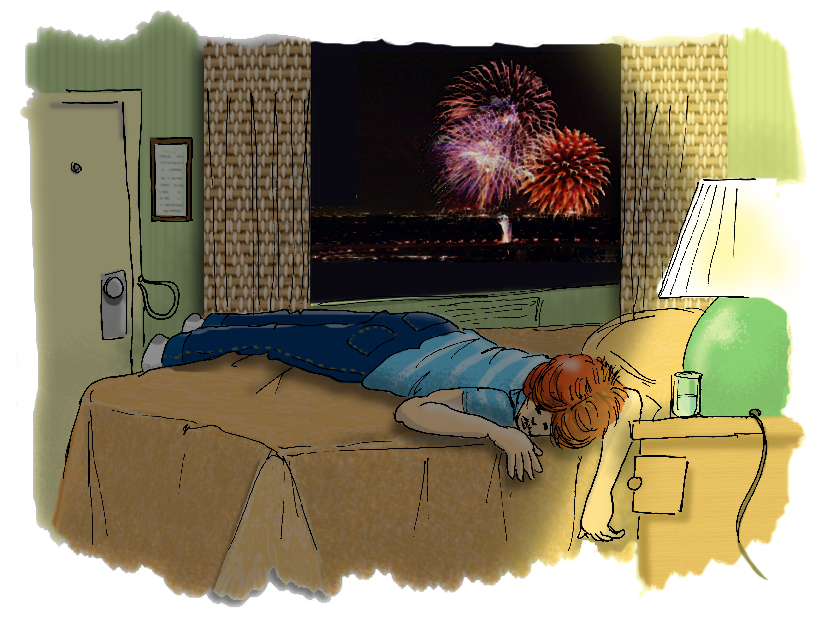
To celebrate New Year’s Eve, Walt Disney World had a veritable smorgasbord of festive events lined up. There would be fireworks and parades and marching bands and a giant mess to clean up the next day and, of course, thousands of people. We crammed as many rides as we could into that afternoon. Our plan was to leave the park, get a fast dinner, grab a nap and come back refreshed and ready for a long night of partying. I followed the “leaving the park” and the “fast dinner” part as per our arrangement, but when it came time for the “nap” portion, I got a little tripped up. Actually, I never woke up. Come to think of it, I dont think I ate dinner. Mrs. P and Ricci did, or so they told me when they came back to our hotel room after midnight to find me fully-clothed and zonked out cross-ways on the bed. The television was blaring with the harrowing story of a deadly casino fire in Puerto Rico and I still slept through the shouting reporters and the wail of sirens. Even the exploding fireworks (that I was missing) from the nearby Disney Resort weren’t enough to stir my slumber.
I missed welcoming the New Year for the first time in ages. So, why was New Year’s Eve 1986 so memorable? It was the gateway to 1987; the year life changed for Mr. and Mrs. Pincus. In eight months, we welcomed something much better than a new year.
We welcomed a son.
Comments
comments