DCS: irene morgan

The best thing for me to do was to go to the Supreme Court.

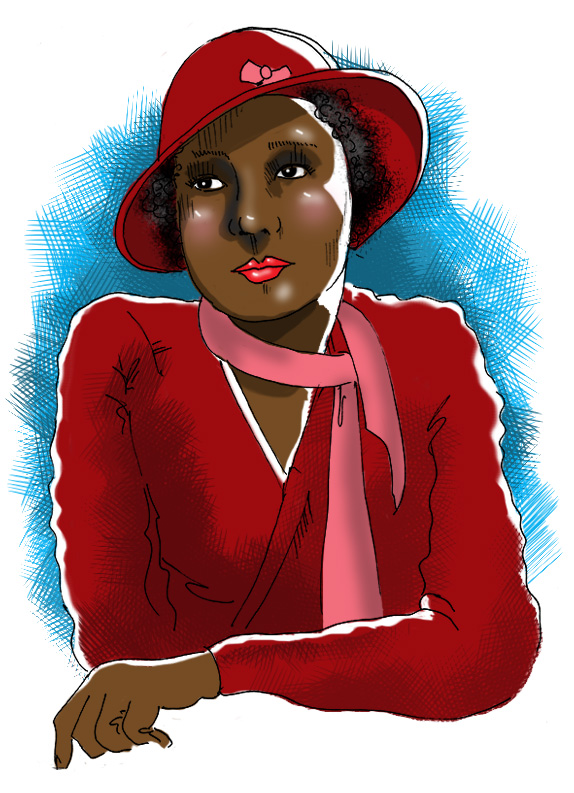
On July 16, 1944 — eleven years before Rosa Parks was asked to relinquish her bus seat in Montgomery, Alabama — 27 year-old Irene Morgan boarded a Greyhound bus in southeastern Virginia to head home to Baltimore, Maryland. Irene was returning home from a visit with her mother. Irene had suffered a miscarriage and her mother was helping her to cope both physically and mentally. Like many women on the home front of World War II, Irene worked on the production line for the B-26 Marauder, a twin-engine bomber manufactured by the Glenn L. Martin Company. Irene was a regular “Rosie the Riveter.”

Irene selected a seat next to another African-American woman who was holding an infant. Current laws dictated that an African-American passenger could not sit across from or next to a Caucasian passenger, although there were no formal signs posted on vehicles. At a stop in Middlesex County, Virginia, a white couple got on the bus and the driver ordered Irene and her seatmate to give up their seats. The woman with the baby retreated dutifully to the rear of the bus, but Irene did not budge. The driver grew angry but Irene refused to move. The driver hopped off the bus and returned within minutes with a local sheriff. The law officer handed Irene an arrest warrant, which Irene took… and ripped up in front of the shocked faces of the sheriff, the driver and the other passengers. She then tossed the pieces out the window. The sheriff laid his hand on Irene’s shoulder to physically remove her from the seat. Irene reacted by kicking the sheriff in the groin. The sheriff buckled in pain. Once he regained his composure, he left and another sheriff boarded the bus to make an attempt at removing Irene from her seat. The second lawman threatened to use his nightstick, but the unfettered Irene ripped his shirt when he grabbed her arm. Soon, a deputy came to lend assistance and Irene was eventually arrested.

Charged with violation of Virginia’s “Jim Crow” transit law and resisting arrest, Irene conceded to pay only the hundred dollar fine for resisting arrest. She refused to plead guilty to the segregation charge, as her native Maryland did not enforce segregation for interstate travel. With the help of the NAACP, Irene took her case to the Virginia Supreme Court. When the Virginia Supreme Court ruled against her, Irene took the case to the U.S Supreme Court.

With representation by former governor of the U.S. Virgin Islands William H. Hastie  and future Supreme Court Justice Thurgood Marshall, the U.S. Supreme Court ruled that Virginia’s law enforcing segregation on interstate buses was unconstitutional.

“If something happens to you which is wrong, the best thing to do is have it corrected in the best way you can,” said Irene. “The best thing for me to do was to go to the Supreme Court.

Irene lived out her life in Gloucester County, Virginia, She passed away in 2007 at the age of 90.

Comments

comments

IF: electronic

...and through the wire...

Forced by his parents to take piano lessons, Robert Moog preferred tinkering around in his father’s workshop. Robert’s father was an engineer at Consolidated Edison and Robert became fascinated by the wires and tubes and other electronic accessories. Around this time, Robert discovered the theremin, an unusual musical instrument that makes otherworldly sounds created merely by the wave of the hand. At the age of 14, Robert built his first theremin from plans in a magazine.

Robert pursued and achieved several degrees in electrical engineering, including a Ph.D from Cornell University.  Using technology he learned at school, Robert began building and selling theremins from his home. One of his customers, the celebrated experimental musician Raymond Scott, rewired Robert’s theremin to be controled by keyboard and, thus, invented the Clavivox, an early sound synthesizer.

While at Cornell, Robert worked diligently on sound modules for a synthesizer he was developing. Robert experimented, hoping to the reduce the size of current synthesizers, making them more portable and user-friendly. With the help and suggestions from experimental musicians like Wendy Carlos and Herb Deutsch, he premiered the Moog Synthesizer in the early 1960s. Robert explained that  “I don’t design stuff for myself. I’m a toolmaker. I design things that other people want to use.” Never satisfied to rest on his laurels, Robert continued to work on and refine his invention. His instrument soon became a staple of such noted musical acts as Emerson, Lake and Palmer, The Rolling Stones, Yes and The Grateful Dead.

Unfortunately, Robert was a poor businessman. He sold his company, Moog Music, to Norlin Musical Instruments (now part of Gibson Guitars), but remained with the company as a designer. However, had his contract not required him to stay for four years, he said he would have left sooner. Moog faced fierce completion from Roland and Arp, who built cheaper synthesizers.

In 1978, Robert moved to Asheville, North Carolina and opened Big Briar Music, eventually renaming the company Moog Music, after buying back the rights to the name. He became a research professor at the University of North Carolina while working on a synthesizer operated by touchscreen.

Robert passed away in 2005 at the age of 71. Without Robert Moog’s contributions, there would be no “electronic music” genre.

Comments

comments

DCS: matthew henson

adventure is out there

Born to sharecroppers in 1866, Matthew Henson fled persecution by the Ku Klux Klan and headed to Georgetown with his family. While attending an event honoring President Abraham Lincoln, young Matthew was inspired by a speech delivered by Frederick Douglass. Douglass called upon blacks to vigorously pursue educational opportunities and battle racial prejudice.

Matthew began working as a cabin boy aboard a merchant ship. The ship’s captain taught Matthew how to read and write. At 21, Matthew was working in a Washington, DC department store when he met Commander Robert E. Peary. When Peary learned of Matthew’s sailing experience, he recruited the young man to join his upcoming expedition to Nicaragua. Matthew accompanied Peary on explorations for the next twenty years – exclusively in the Arctic. Matthew became fluent in the Inuit language. He was an expert craftsman and dog sled driver and his resourcefulness was beneficial to his colleagues in the harsh Arctic conditions.

In 1909, Peary and his crew of over 40 men and women started out to reach the North Pole. As they came closer to the North Pole, Peary selected Matthew as part of a team of six to make the final run. An exhausted Peary could no longer continue on foot. He made the rest of the journey seated in a dog sled while Matthew was sent ahead as a scout. It was Matthew Henson who planted the American flag at the designated spot. However, in the years following, Robert Peary was lauded for the accomplishment, with Matthew largely forgotten. He spent the next thirty years on the staff of the U.S. Customs House in New York. It wasn’t until 1944 that Matthew (and other members of the Peary expedition) received proper acknowledgement with medals from Congress. Presidents Truman and Eisenhower both honored Matthew just prior to his death in 1955.

Comments

comments

DCS: wilma rudolph

La Gazzella Nera

Wilma Rudolph was born prematurely with a birth weight of 4-and-a-half pounds. She suffered from several early childhood illnesses, including pneumonia and scarlet fever. At the age of five, she contracted infantile paralysis, caused by the polio virus. Although she recovered from polio, Wilma lost strength in her left leg and foot. Physically disabled for much of her early life, Wilma wore a leg brace until she was twelve years old.

She never let any of those setbacks stop her.

At the 1956 Summer Olympics in Melbourne, Australia, Wilma won a bronze medal in the 4 x 100-meter relay. Four years later, at the Olympic games in Rome, she won three gold medals in the 100 and 200-meter individual events and the 4 x 100-meter relay. She became the first American woman to win three gold medals in a single Olympics. She was also touted as “The Fastest Woman in the World.”

When Wilma returned home to Clarksville, Tennessee, her success was celebrated with “Welcome Wilma Day” on October 4, 1960. It was a day filled with festivities, including a huge banquet in her honor. On Wilma’s insistence, the parade and banquet became the first, fully-integrated city-sponsored event in the history of Clarksville.

In later years, using her fame, Wilma campaigned for civil rights and, in 1963, the mayor of Clarksville announced that all of the city’s public facilities, including restaurants, would become fully integrated.

At 54, Wilma was diagnosed with cancer, which spread rapidly. She passed away in 1994. Thousands of mourners attended her memorial. In 1984, the Women’s Sports Foundation selected Wilma as one of the five greatest women athletes in the United States. Two years after her death, the foundation presented its first Wilma Rudolph Courage Award to another Olympic gold medalist, Jackie Joyner-Kersee.


Comments

comments

DCS: adelaide hall

Creole Love Call

20 year-old Adelaide Hall performed with numerous all-African-American cast productions in the early 20th Century, including shows by Eubie Blake and W.C. Handy.

In 1927, Adelaide was appearing in Dance Mania with Duke Ellington. At a stop at the Standard Theater in Philadelphia, Ellington introduced a new composition, an instrumental he called “Creole Love Call.” Adelaide stood in the wings, humming along to the tune as she waited for her time to perform. Ellington stopped playing, got up from the piano and asked, “Can you do that again? That’s just what I was looking for!” Adelaide was startled and she confessed, ” I don’t know. I don’t even know what I was doing.” She gathered her thoughts and again, hummed the counter melody as Ellington played the piano. A few days later, the pair recorded the haunting tune. In 1928, the song entered the Billboard charts at Number 19.

Adelaide was wildly popular throughout the 30s, playing to a world wide audience and headlining prestigious venues like The Cotton Club, The Apollo and the Harlem Opera House. Despite her popularity and acclaim, she faced racism. She and her husband were harassed and antagonized after buying  an estate in the predominantly-white suburb of Westchester, New York.

In the late 30s, Adelaide moved to England and continued entertaining enthusiastic crowds. She became the first African-American to sign a long-term contract with the BBC. She released over 70 records for the British label Decca. She was a regular on British stage and even showed up in a cameo role in the 1940 Oscar-winning film The Thief of Bagdad.

Adelaide performed well into the 80s and 90s including a one-woman show at Carnegie Hall. She was the subject of a 1990 documentary called Sophisticated Lady. At a 1992 ceremony where she was honored by the British Academy of Songwriters, Composers and Authors, Adelaide was told by attendees that she appeared to be fifty — despite having recently celebrated her 90th birthday.

Adelaide passed away in November 1993. At a memorial service,  British journalist broadcaster Michael Parkinson remarked, “Adelaide lived to be 92 and never grew old.”

Comments

comments

DCS: patricia “boots” mallory

boots

While working as an usherette at the Lyric Theater in Mobile, Alabama, Patricia “Boots” Mallory was offered a spot in the travelling show by Florenz Ziegfeld. She accepted and soon traveled with the troupe to New York where she was featured in the 1931 Ziegfeld Follies.

Moving to Hollywood, “Boots” joined Fox Films and made her screen debut in “Walking Down Broadway,” the first sound film by director Erich von Stroheim. Fox executives strongly objected to some of the films themes, including sexual escapades and an implied lesbian relationship between “Boots” and a character played by ZaSu Pitts. Another director was brought in to re-cut the film and re-shoot some scenes. It was re-released under another title and the original version is considered lost.

“Boots” was regarded for her striking looks and was photographed by famed Hollywood promotional photographer George Hurrell. She also posed for risque lingerie photographs and was painted nude by noted pin-up artist Rolf Armstrong.

In 1933, “Boots” married producer William Cagney, brother of actor James. She made mostly “B” pictures including a role with Rin-Tin-Tin. She also was cast opposite her brother-in-law in a few “Lux Radio Theater” broadcasts. She made her final screen appearance in 1938 in an uncredited role along side Laurel and Hardy.

“Boots” passed away from a throat ailment in 1958 at the age of 45. She was married to her second husband, actor Herbert Marshall.

Comments

comments