DCS: slim galliard

Vout-o-Reenee

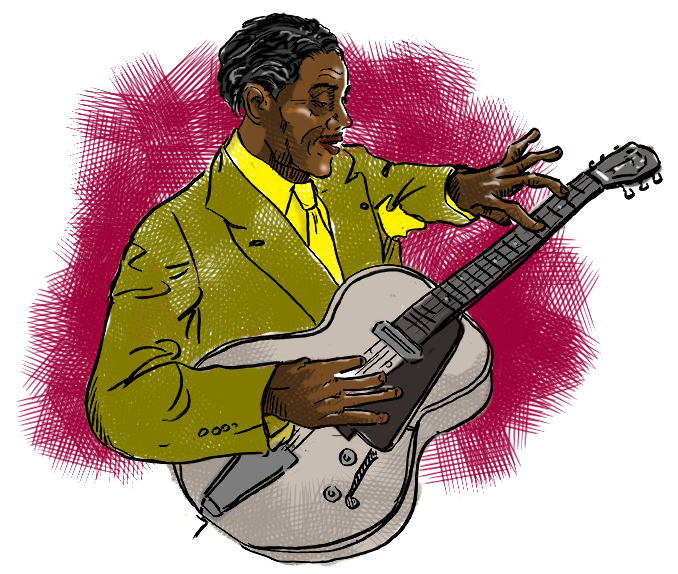
Slim Galliard’s early life is sketchy, as he offered different origin stories to different people. He did, however, serve in World War II as a bomber pilot, briefly interrupting his successful music career. He insisted that he worked as a hat maker in Greece and a hearse driver turned rum-runner in Detroit, but these are part of the colorful early life that Slim most likely made up.

Slim spoke five languages to varying degrees, in additional to inventing his own language which he dubbed “Vout-o-Reenee.” He even wrote a dictionary detailing word usage. Slim composed several songs based on “Vout-o-Reenee,” including “Flat Foot Floogee (with a Floy Floy)” and “Cement Mixer (Put-Ti Put-Ti).” He often mixed words and phrases from other languages into his composition. He was particularly fond of Yiddish phrases, as highlighted in “Dunkin’ Bagel” and “Matzo Ball.” He claimed that his father was Ashkenazi Jewish, but that claim is unconfirmed.

He released a number of albums and appeared in films and television, including Roots: The Next Generation and the David Bowie film Absolute Beginners. He played with jazz greats Charlie Parker, Dizzy Gillespie and Coleman Hawkins. Slim often played guitar with his hand pointed down on the guitar neck. He’d play the piano with his palms up. Fellow musicians found his playing erratic and difficult to follow.

He performed for many years, touring Europe extensively, until he passed away in 1991 at the age of 80.

Comments

comments

DCS: pearl bailey

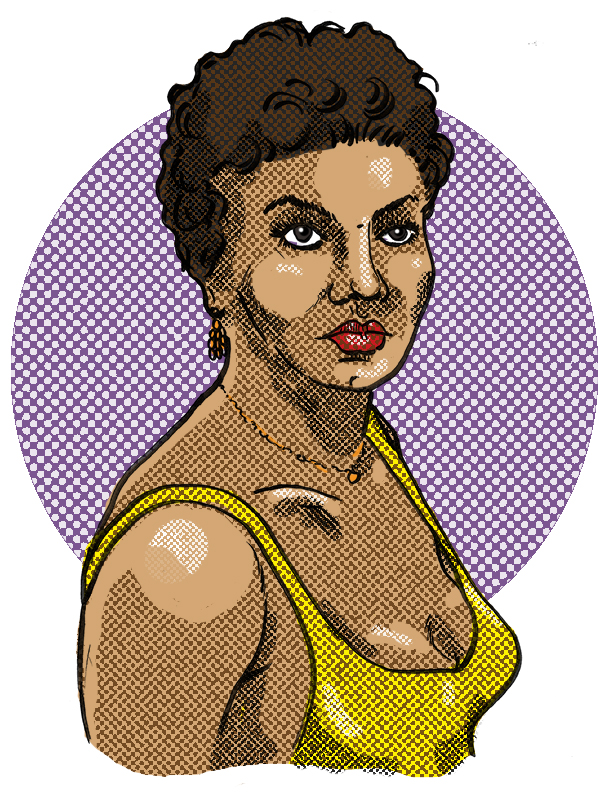
Oh boy! Did I love Pearl Bailey! She was a terrific singer and actress with a delightful personality. Pearl was deservedly honored with a number of awards during her lifetime, including a special Tony Award, a Daytime Emmy, the Screen Actors Guild Life Achievement Award in 1976 and the Presidential Medal of Freedom, which she received two years before her passing.

Pearl, or “Pearlie Mae” as she was affectionately known, was the embodiment of the word “entertainer.” Recently, I have been watching re-broadcasts of the old Ed Sullivan Show. Pearl was a favorite guest performer of Ed’s, appearing on the program an impressive 23 times. Each one of those appearance were a joy to watch. Reaction shots of the audience show everyone with a broad smile on their collective faces, though Pearl appears to be having the best time of anyone.

I was lucky enough to have seen Pearl Bailey in-person at a benefit performance held at Philadelphia’s famed Academy of Music. Pearl was captivating. Her voice and her cheerful, engaging stage presence were a wonderful combination. The audience that night were treated to several hours of memorable entertainment, but — once again — Pearl Bailey was having the best time of all.

Pearl passed away in August 1990 at the age of 72. She is buried just outside of her “adopted” hometown of Philadelphia.

Comments

comments

DCS: peter tosh

Abandoned by his parents and shuffled around from family member to family member, Winston McIntosh never lost his sense of determination. Living in the Trenchtown section of Kingston, Jamaica, teenage Winston was fascinated by a street musician. He watched the man play his guitar for endless hours every day. Winston concentrated on the man’s intricate finger movements. Soon, he asked the man for his guitar and played the song back to him. The street musician was impressed and asked Winston who taught him to play. Winston replied that he taught himself.

Winston met Joe Higgs, a local reggae musician who offered free music lessons to young people. Winston was introduced to two other students — Robert Marley and Neville Livingston. Higgs taught the trio to harmonize and they developed their talents on the street corners of Trenchtown.

In 1964, 20-year old Winston, now going by the name “Peter Tosh,” formed The Wailing Wailers with Marley and Livingston. Tosh, the only member of the group who could play an instrument, taught Marley and Livingston how to play guitar and drums respectively. Marley, who spent time in the United States with family, returned to Jamaica in 1967, anxious to reignite his interest in music. Tosh and Livingston, now known as “Bunny Wailer,” had embraced the Rastafarian religion. Marley became interested and joined, his newfound spirituality becoming a major influence on his music.

After a successful run with Bob Marley and the Wailers, Peter Tosh began a solo career. He signed with Rolling Stones Records in 1977. His music offered a decidedly political message and Peter was known as a vocal advocate for the legalization of marijuana. At a 1978 concert, he lit a joint onstage and lectured negatively about government officials. A month later, he was apprehended by police while exiting a Kingston dance club and severely beaten while in custody. Unfettered, he continued to release politically-charged music, embracing additional causes like nuclear arms and apartheid. He was honored with a Grammy in 1987.

In September 1987, Peter was at his home in Kingston, when three men broke in and threatened the singer. They demanded money. Peter claimed he had none, but the gang were doubtful. For hours, they tortured the Peter. Several unsuspecting visitors to the house were also taken and held captive. After hours of frustration, the gang opened fire on the occupants of the house. Peter was shot twice in the head and died instantly. Two other guests were killed as well. Andrea Brown, Peter’s common law wife, was wounded. Dennis “Leppo” Lobban, identified as the gang’s leader, was arrested. A jury found him guilty, but his death sentence was commuted to life in prison — where he remains today. A few years earlier, Peter had worked with Lobban to find him employment after a previous jail sentence. Peter was 42 at the time of his death.

In 2016, the Peter Tosh Museum opened in Kingston on what would have been Peter Tosh’s 76th birthday.

Comments

comments

DCS: fayette pinkney

In 1963, music impresario Richie Barrett was looking for the next “big thing.” He was responsible for discovering and promoting such popular and, more importantly, top-selling musical acts like Frankie Lymon & The Teenagers and Little Anthony & The Imperials. Barrett assembled a trio of Philadelphia teenagers and dubbed his new group The Three Degrees. The group changed members over the years, always keeping its pretty lead singer Fayette Pinkney at the forefront.

In 1974, The Three Degrees were the featured vocalists on the R&B hit “TSOP (The Sound of Philadelphia)” by MFSB, a group of seasoned studio musicians formed by the legendary Kenny Gamble and Leon Huff at the famed Philadelphia Sigma Studios. Later the same year, The Three Degrees scored a Top Ten hit with “When Will I See You Again.” In all, Fayette and her band mates enjoyed success with seven Top 40 hits in the United Kingdom. They also performed on the NBC sitcom Sanford and Son.

Fayette began dating singer Lou Rawls and Barrett didn’t like it one bit. He ordered her to end the relationship, threatening to fire her. Fayette stood her ground and stayed with Rawls. Barrett — true to his word — dismissed Fayette, replacing her with original group member Helen Scott. After being let go from The Three Degrees, Fayette flew to England to record her one and only solo album, entitled One Degree. The album was well received by both fans and critics, but Fayette was finished with the music industry.

Fayette returned to school and earned a earned a Bachelor’s degree in psychology from Temple University and a Master’s degree in human services from Lincoln University. She worked as a psychologist, as well as a vocal coach. She also sang with her church’s choir.

In 1994, Fayette’s daughter passed away from sudden infant death syndrome just two days after birth. In 2009, Fayette passed away unexpectedly from acute respiratory failure. She was 61 years old.

Comments

comments

DCS: sidney poitier

I saw Lilies of the Field when I was a kid. I watched it with my mom, who ignited my love of movies. She was also a big fan of Sidney Poitier’s. I remember loving the film and being just riveted — captivated — every moment that Sidney Poitier was on the screen. He was a commanding presence. Not in the manner of a Charlton Heston, whose hammy portrayals belied his propensity to devour and digest every piece of scenery within reach. Sidney Poitier’s acting style was subtle and real. He was mostly soft spoken, even when he was enraged (as in In The Heat of the Night), he expressed a natural restraint that made his characters believable and instantly relatable. Sidney Poitier’s Homer Smith in Lilies of the Field was an everyman who refused to be taken advantage of, yet displayed compassion for those in need and the performance was one of the best ever put to film.

I recently watched Lilies of the Field after not seeing it for a long, long time. Sidney Poitier’s performance — once again — captivated me like it did the first time I saw this wonderful movie.

Sidney Poitier passed away in January 2022 at the age of 94. He was great in everything he was in — even if the movie itself wasn’t that good. There will never be another actor like him.

Comments

comments