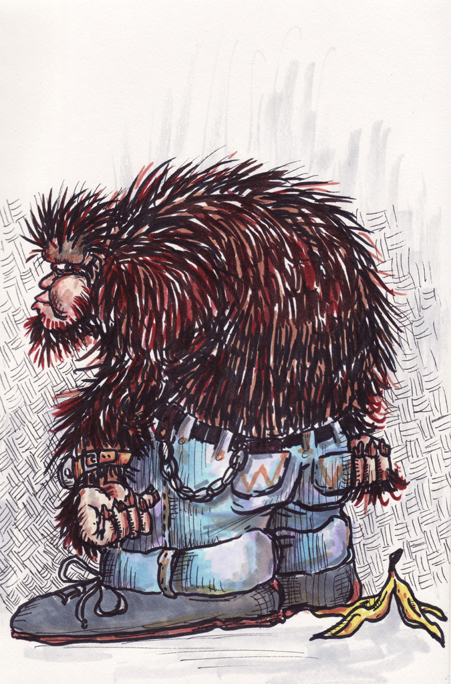
The word this week at sugarfrostedgoodness.com is “flash” (as in the DC Comics superhero)
What more can be said? Speed kills……
Thanks to this guy for the concept.
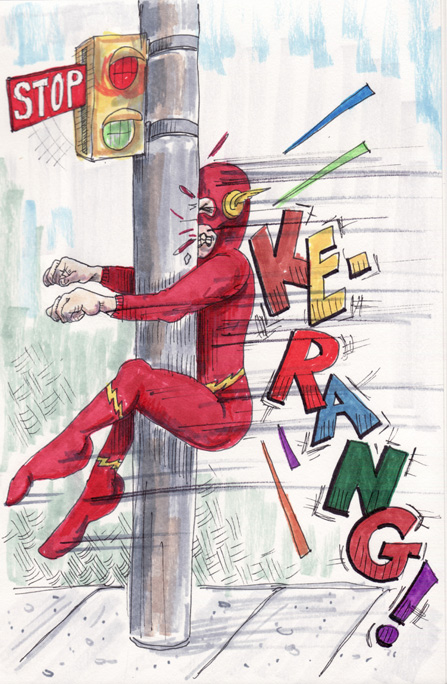
The word this week at sugarfrostedgoodness.com is “flash” (as in the DC Comics superhero)
What more can be said? Speed kills……
Thanks to this guy for the concept.
The challenge word(s) this week on Monday Artday is “no pants”
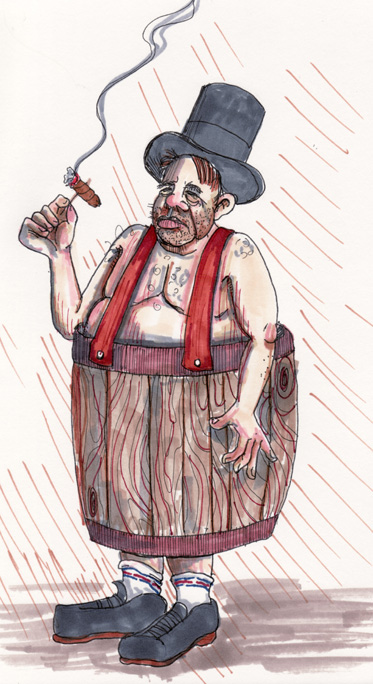
Poor people only wear barrels in comic strips and political cartoons. If I was poor, I’d wear a barrel. Hell, I might wear a barrel to work tomorrow!
This illustration won the weekly challenge at Monday Artday (week ending August 12, 2007)
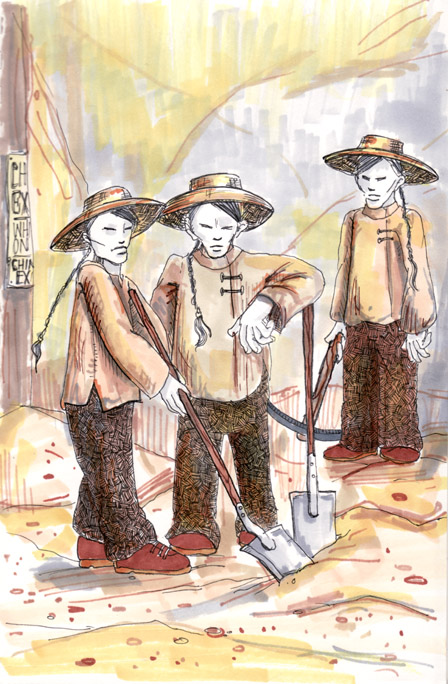
This week’s word(s) at sugarfrostedgoodness.com is “old west“. The heyday of the American “Old West” was roughly the time between the years 1865 to 1890. These times bring to mind romantic stories of cowboys and gunfights, of John Wayne and Roy Rogers, of saloon dancers and wagon trains. But this is a Hollywood version of the “Old West”. There is another “Old West” that this country would rather forget.
The Transcontinental Railroad was completed in 1869. It was the beginning of a nation-wide linking of railways. It was a major factor in the building and strengthening of the United States. Because it was such a massive undertaking, laborers were scarce. Thousands of Chinese immigrants, who came to the US during the Gold Rush in 1849 and had a reputation as hard workers, were recruited by the railroad companies to build the railroads. The Chinese were hired to keep labor costs down, as they were paid about one-third of white laborers’ salary. Plus, they had to provide their own food and pay for their own living expenses, benefits that were covered for the white workers by the railroad companies.
Thirteen thousand Chinese workers dug tunnels and laid track for half of the Transcontinental Railroad. In photos and illustrations depicting the “Golden Spike” ceremony at Promontory Point, Utah, the site of the joining of the East and West railroad, the Chinese are conspicuously absent.
As a reward and thanks for Chinese efforts, the United States passed the Chinese Exclusion Act of 1882. This act outlawed all Chinese immigration to the United States and denied citizenship to those already settled in the country. Official discrimination extended to the highest levels of the U.S. government: in 1888, U.S. President Grover Cleveland, who supported the Chinese Exclusion Act, proclaimed the Chinese “an element ignorant of our constitution and laws, impossible of assimilation with our people and dangerous to our peace and welfare.”
Sing it, Lee Greenwood.
This week’s word at Monday Artday was a difficult one…. “envision“. I really thought about this one for a long time. Envision is a pretty abstract word. It brings forth thoughts of visionaries like Thomas Edison or Walt Disney. It envokes thinkers like DaVinci and Plato. Great men. Men with ideas and concepts far beyond their times.
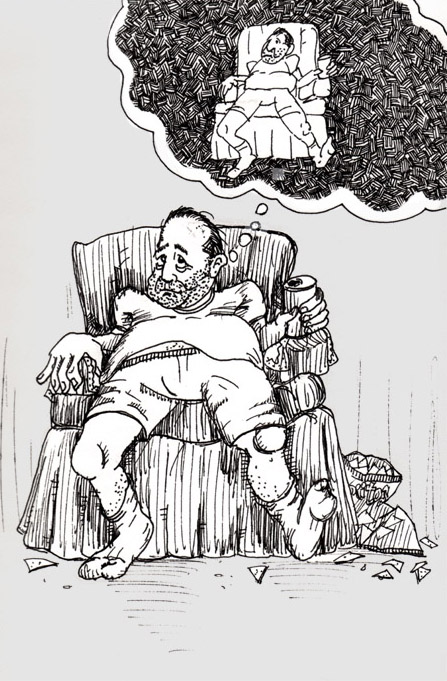
Then I thought, “What do lazy people envision?”
A “tip of the hat” for style inspiration to R. Crumb and jimmyjanesays.
Two illustrators whose penwork I admire.
This week’s word over at illustrationfriday.com is “moon”
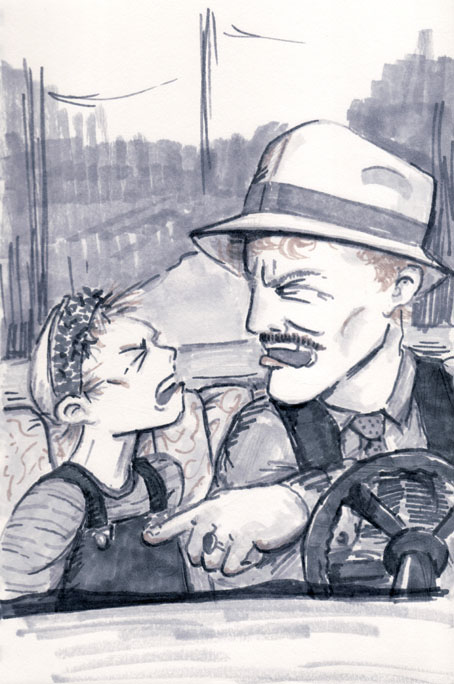
Paper Moon is a classic, if not underrated, American movie, It was directed by Peter Bogdonovich, fresh off the acclaim of The Last Picture Show. The film starred the hottest actor of the time, Ryan O’Neal as con-man/bible salesman Moses Pray and his then 9-year old daughter, Tatum as wayward Addie Loggins, a waif put into the charge of Moses, who may or may not be her father. The story takes place in a Depression-era midwest United States (changed from the novel’s setting of the deep south). Bogdonovich was searching for a better title for the film. He didn’t like the novel’s title “Addie Pray”. After going through music he had chosen for the soundtrack, he came across the song “Paper Moon”. He asked his mentor, Orson Welles, his feelings on using that as a title. Welles replied that it was so perfect, he should not bother making the movie and just release the title. Welles also suggested that the film be shot in black and white through a red filter to give it a high-contrast, period look.
Paul Newman and his daughter, Nell Potts, were originally cast when the project was slated to be directed by John Huston. When Huston bowed out, so did Newman. Bogdonovich was signed on and the O’Neals were brought in. This was supposed to be a one-shot deal for little Tatum, as her dad wanted to keep her out of the motion picture business. Obviously Hollywood and Tatum had different plans. Tatum went on to win the 1974 Oscar for Best Supporting Actress (beating co-star Madeline Kahn) and becoming the youngest Oscar winner in a competitive category (Shirley Temple was given an honorary award at age 6). Despite her father’s original wishes, Tatum went on to make a dozen more movies.
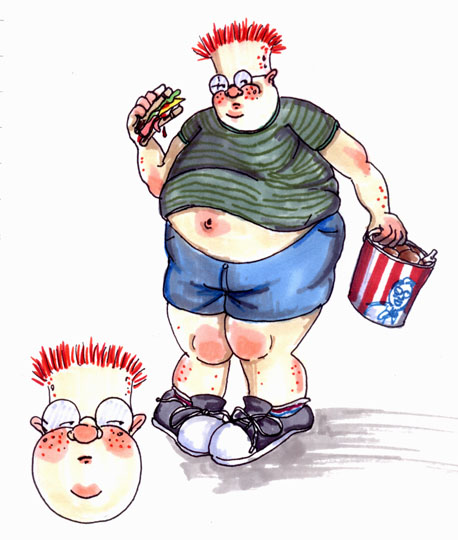
This is my secret…..
Actually, it’s Steve’s secret.
This week’s challenge word(s) at Monday Artday is “my secret“.
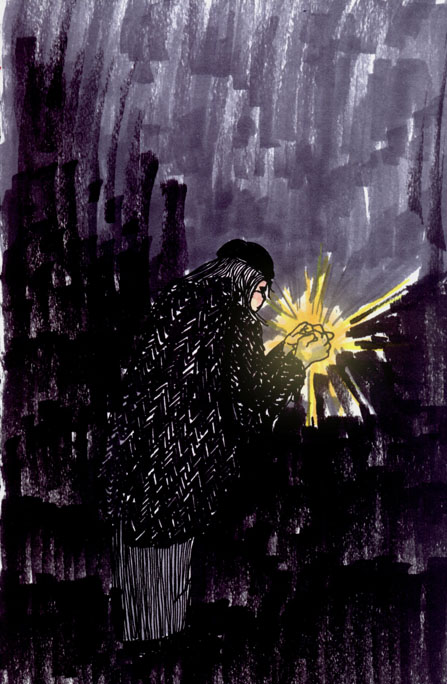
What is that?
What is that mysterious figure holding in his hands?
That’s my secret…
open to your comments.
Illustrationfriday.com poses the challenge word of “poem” this week.
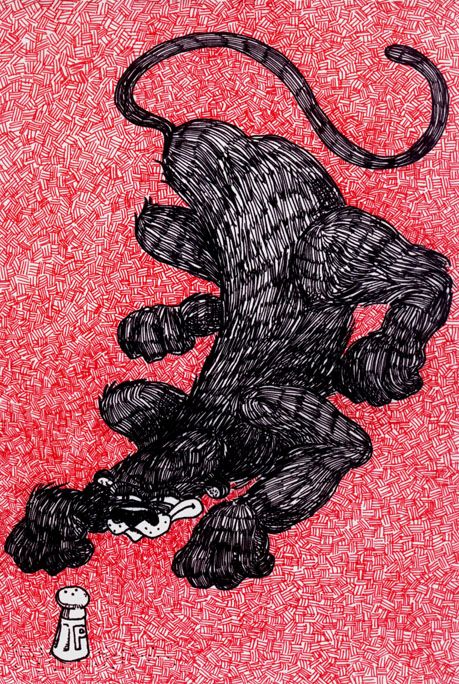
When I was very young, I had a huge book of poetry. It contained famous poems like Paul Revere’s Ride and Hiawatha and Casey at the Bat. It also had many poems by Ogden Nash, a great American poet. Nash wrote humorous poems filled with puns. He is probably most famous for “Reflections On Ice-Breaking“. But my favorite Ogden Nash poem is “The Panther”
The panther is like a leopard
Except it hasn’t been peppered
Should you behold a panther’s crouch
Prepare to say ouch
Better yet, if called by a panther
Don’t anther.
Comments? I know you have them…
This week’s challenge on Sugar Frosted Goodness is “dead presidents“.
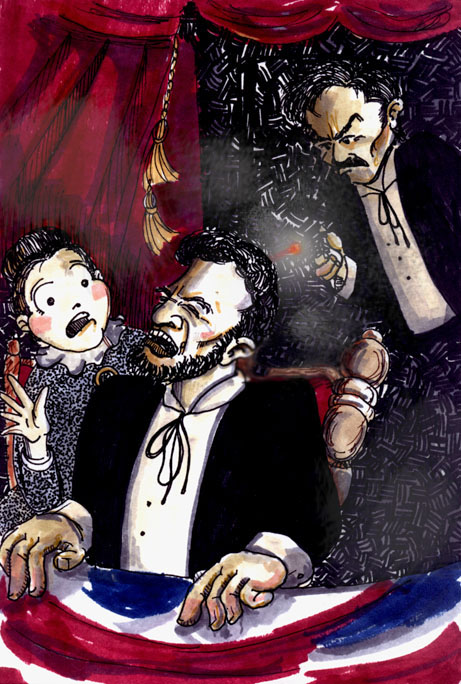
Although my favorite dead president is William Henry Harrison, depicting Abraham Lincoln’s assassination was, visually, much more exciting. It was a giant, ill-conceived conspiracy that eventually ended with John Wilkes Booth being tracked down and shot by Union soldiers…and Lincoln appearing on the five-dollar bill.
At a tavern on the night of the assassination, a patron allegedly heckled Booth that he’d never be the actor his father was. Booth replied, “After my appearance on stage tonight, I’ll be the most famous man in America.” This incident is most likely not true.
READ ABOUT THE CONTROVERSY THAT THIS DRAWING CAUSED HERE!