DCS: hugh masekela

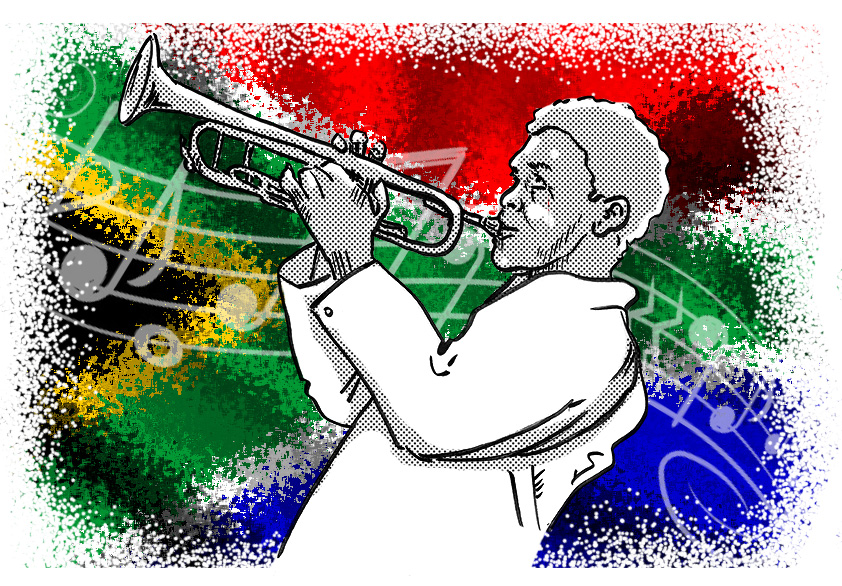
14 year-old Hugh Masekela was inspired to pick up a trumpet after seeing Kirk Douglas in the 1950 film Young Man with a Horn. He sought out someone to teach him to play with the help and guidance of his friend, Johannesburg Archbishop Trevor Huddleston. Soon, Hugh was writing music that was reflective of his turbulent surroundings.

At 20, he formed an ensemble called Jazz Epistles and they recorded the first album by an African jazz band. The Jazz Epistles toured for a year, until the 1960 Sharpeville massacre — where nearly 70 protestors were shot to death. The South African government banned gatherings of ten or more people, prompting Hugh to flee the country. He headed to England and then the United States, where he was befriended by singer/actor Harry Belafonte. Hugh took classes at the prestigious Manhattan School of Music, honing his already-superior trumpet skills.

In 1967, Hugh released a jazz-inflected take on “Up Up and Away” and followed it up with his version of “Grazing in the Grass.” He scored a major hit with “Grazing in the Grass” — selling over four million copies — and was invited to perform at the 1967 Monterey Pop Festival. Later, Hugh was instrumental in organizing “Zaire 74,” a music festival centered around the “Rumble in the Jungle” boxing match between George Foreman and Muhammad Ali. Hugh lent his inimitable sound to The Byrds on “So You Want to Be a Rock ‘n’ Roll Star,” as well as Paul Simon’s “Further to Fly.” Hugh was asked to open shows for Simon on his Graceland worldwide tour.

Hugh continued to explore different types of African music, experimenting and mixing it all together to form his own unique sound that was constantly evolving. In his 70s, Hugh played with The Dave Matthews Band during a concert in Johannesburg. In 2016, Hugh reunited with his Jazz Epistles bandmate Abdullah Ibrahim, performing together for the first time in 60 years.

Hugh was diagnosed with prostate cancer and succumbed to the illness in January 2018 at the age of 78.
Comments

comments

DCS: dusty hill

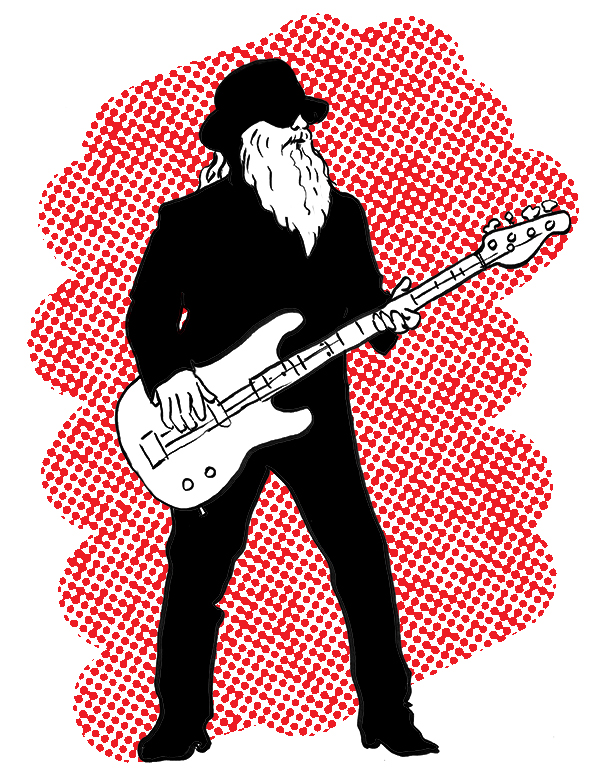
ZZ Top is one of the few bands in rock & roll history to feature the same personnel lineup for its 52 years of existence. Founded in 1969 by Frank Beard, Dusty Hill and Billy Gibbons, ZZ Top, the “Little Ol’ Band from Texas” as they are affectionately known, enjoyed a lengthy career, filled with hit records, acclaimed videos and raucous live performances — plus a legion of dedicated fans.

On July 23, 2021, Dusty Hill did not make the stage for a show in New Lenox, Illinois. Prior to showtime, it was announced that the venerable bassist was headed home to deal with a “hip ailment.” He was expected to make a speedy recovery and rejoin his bandmates as soon as he could. The band’s longtime guitar tech Elwood Francis filled in on bass for the performance.

On July 28, 2021 — just five days later — Dusty Hill passed away in his sleep. He was 72.

Comments

comments

DCS: cass daley

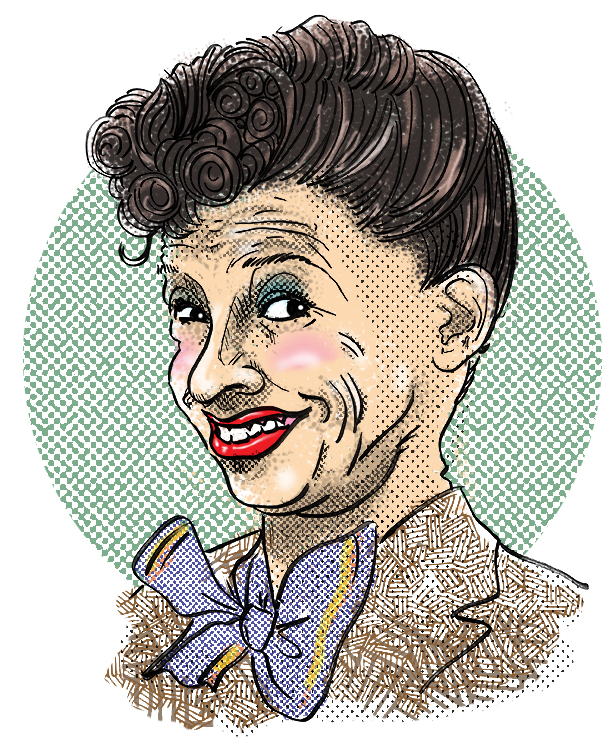
Cass Daley was a born entertainer. She sang on street corners as a child. Later, while working as a hat-check girl in a local club, Cass was given the opportunity to sing between shifts. She performed in vaudeville in the 1930s, eventually taking a featured role in the Ziegfeld Follies as a singer and comedienne. She became well-known for her wild, physical stage antics and her trademark protruding front teeth.

In the early 1940s, Cass embarked on a film career, co-starring in wartime features like The Fleet’s In and Riding High. She was a popular act among troops stationed overseas during World War II and performed for them often. She was a regular singer on Armed Forces Radio and was a featured performer on Mail Call and The Fitch Bandwagon, as well as her own short-lived show. A brief foray into recording yielded a couple of top singles, including a version of “Aba Daba Honeymoon” in 1951.

With radio on the decline, Cass retired from show business to raise her son. However, she was coaxed back onto the stage to appear in a 1972 nostalgia revue called Big Show of 1928, which toured the country and played New York’s Madison Square Garden.

Alone in her Hollywood apartment in March 1975, Cass accidentally tripped and fell on a glass-top coffee table. A jagged shard of broken glass pierced her throat and she bled to death by the time her husband arrived home. Cass was 59 years old.

Comments

comments

DCS: bob welch

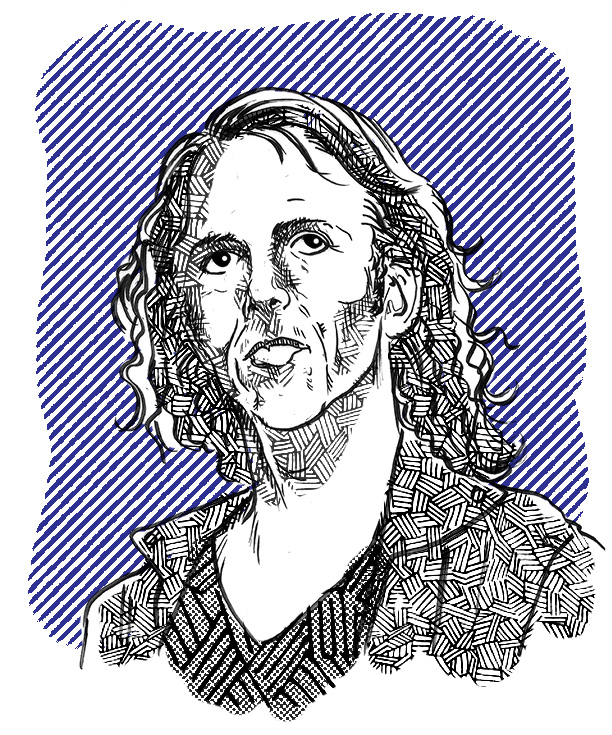
The son of two Hollywood show business personalities — father Robert Sr, who produced films for Bob Hope and Bing Crosby and mother Templeton Fox, a singer and actress — Bob Welch had performing in his blood.

Bob took up the clarinet as a youngster, switching to the guitar in his teens. He expressed and interest in jazz and rhythm & blues. He pursued his musical study with a move to France, intending to enroll at the prestigious Sorbonne. Instead he opted to spend his days smoking hashish with a group of local hippies he befriended. Bob returned to the US without a degree.

In 1964, Bob joined a Los Angeles band called The Seven Souls. The band got some local gigs and competed in a “Battle of the Bands” competition, losing to another LA band called “Sly and the Family Stone.” When The Seven Souls split, he formed a heavy-metal band called Paris. Paris released two albums before breaking up in 1971.

Blues-rock band Fleetwood Mac had just lost their lead guitarist Jeremy Spencer to a religious cult. Bob auditioned for the band and was signed as rhythm guitarist, backing lead guitarist Danny Kirwan. Although they respected each other musically, Bob and Kirwan butted heads regularly. Kirwan was also a heavy drinker, making him very belligerent and aggressive during their many disagreements. The first Fleetwood Mac album with Bob as a member was Future Games, on which Bob supplied the title song. He contributed “Sentimental Lady” to their next release Bare Trees. The band took on a new and different sound with the addition of Bob — and Danny Kirwan didn’t like it. He called Bob’s compositions “weird” and “too jazzy.” Before a 1972 concert, Kirwan and Bob got into a heated argument. Kirwan smashed his guitar and refused to take the stage. Bob was forced to cover the guitar parts, despite being totally unprepared. Kirwan was fired from the band the next day.

Changing line-ups, internal stress and the demise of the marriage of John and Christine McVie weighed heavy on Fleetwood Mac. Not wanting to cancel a planned tour, manager Clifford Davis assembled a group of musicians — including Bob — to tour as “Fleetwood Mac,” without the actual band member’s consent. Lawsuits aborted the tour and Fleetwood Mac remained conspicuously missing from the music scene for over a year.

Exhaustion, alienation and a dispute over royalties forced Bob to leave Fleetwood Mac in 1974. He released his first solo effort in 1977 — the same year as Fleetwood Mac’s career-defining album Rumours. Bob’s debut went platinum and yielded three hit singles including a cover of his Fleetwood Mac composition “Sentimental Lady.” Whule his subsequent follow-up albums were successful, they did not live up to his first solo record.

Bob was not invited to the 1998 induction ceremony when Fleetwood Mac entered the Rock & Roll Hall of Fame. Original and early members of the band were included, but not Bob.

In early 2012, Bob underwent spinal surgery. While recovering, doctors gave Bob a grim prognosis. He was told that his condition would worsen and he would eventually lose the ability to walk. He continued to take prescribed pain medication and still experienced great pain. On June 7, 2012, after composing a nine-page letter to his wife, Bob took his own life with a self-inflicted gunshot. He was 66 years years old.

Comments

comments